


Every company that buys materials or ships products has transport emissions in its value chain. In the GHG Protocol, most of them sit in Scope 3 Category 4, called upstream transportation and distribution. For manufacturers and distributors in Romania, trucks between suppliers, plants, warehouses and customers are often a visible part of the footprint. This guide explains what belongs in Category 4, how to calculate it and which new standards apply in 2026.
In short
- Scope 3 Category 4 covers transport and storage of purchased goods by third parties, plus every transport service your company pays for, including outbound deliveries.
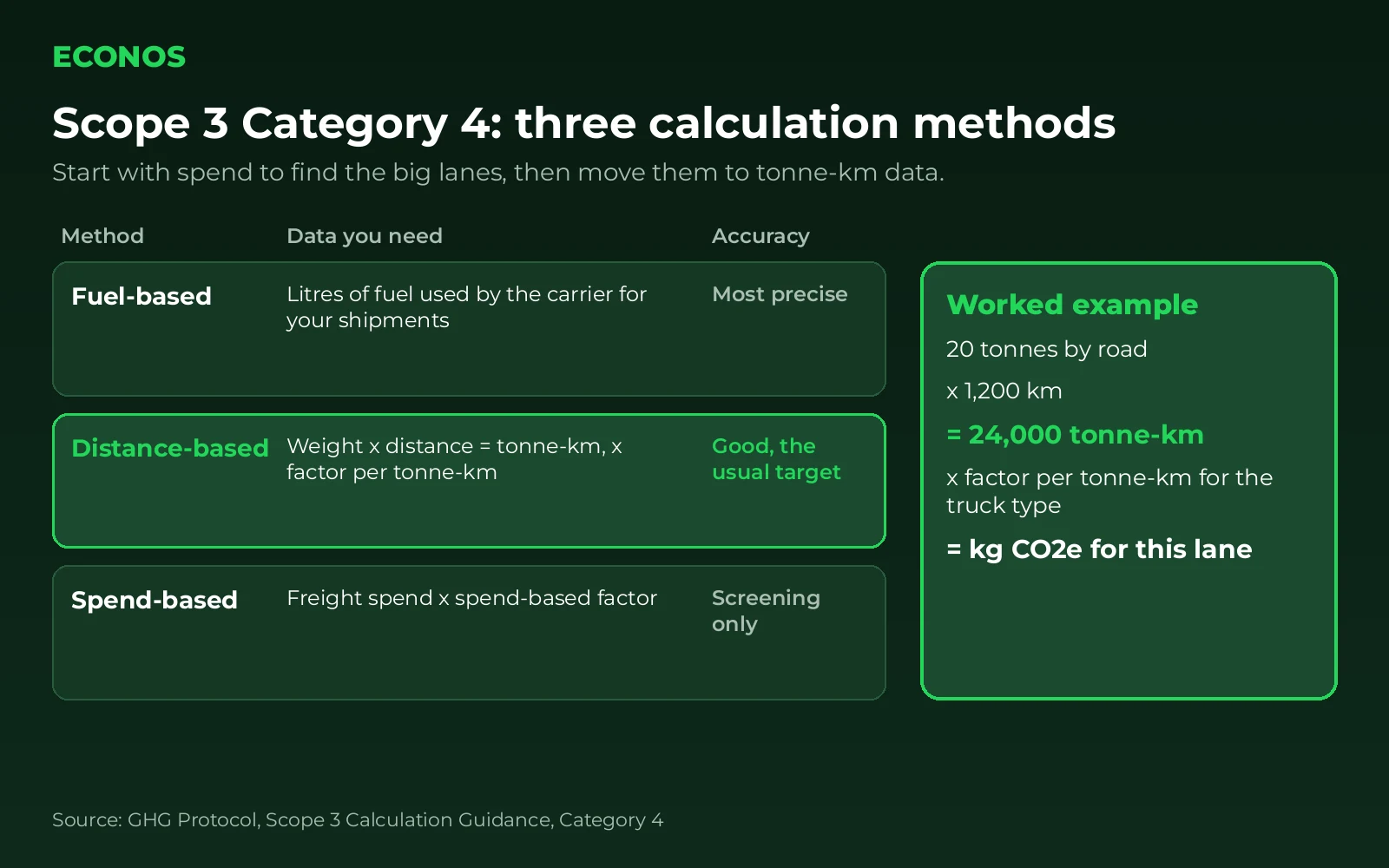
- The GHG Protocol allows a fuel-based, a distance-based (tonne-km) and a spend-based method. Most companies start with spend and move to distance data.
- ISO 14083 is the reference standard for freight emissions, and Regulation (EU) 2026/1030 makes it the common EU method for disclosed transport emission figures.
What Scope 3 Category 4 covers
According to the GHG Protocol Scope 3 Calculation Guidance for Category 4, this category includes three types of activity:
- transport of products bought in the reporting year, from tier 1 suppliers to your own sites, in vehicles you do not own or operate;
- third-party transportation and distribution services you buy, for inbound logistics, outbound logistics and transport between your own sites;
- storage of purchased products in third-party warehouses and distribution centres.
Road, rail, sea and air all count. Category 4 is the logistics side of your purchases, so it sits next to Scope 3 Category 1 for purchased goods and services, which covers the production of what you buy.
What does not go in Category 4
Transport in vehicles you own or control is not Scope 3. Diesel for your own trucks is Scope 1, as explained in our guide on how to calculate Scope 1 emissions, and electricity for your own electric vans is Scope 2. Fuel and energy products themselves are also excluded, and business travel of employees goes to Category 6.
Scope 3 Category 4 or Category 9: who pays the transport?
The split between upstream and downstream transport confuses many teams. The GHG Protocol states that outbound logistics services purchased by the reporting company are upstream. So if you pay the carrier that delivers to your customer, those emissions go to Category 4. If the customer organises and pays the transport, the emissions go to Category 9, downstream transportation.
In practice, the Incoterms in your sales contracts tell you who pays the main freight. A typical case we see at ECONOS is a Romanian manufacturer that sells to German customers on delivered terms and buys raw materials on ex works terms. Both flows are paid by the manufacturer, so both are Category 4, even though one is inbound and one is outbound.

How to calculate Scope 3 Category 4: three methods
1. Fuel-based method
You multiply the fuel used by the carrier for your shipments by the emission factor of that fuel. This is the most precise option, and the GHG Protocol recommends it when carriers can provide fuel data. In reality, few carriers report fuel per customer.
2. Distance-based method (tonne-km)
The distance-based method multiplies the weight of each shipment by the distance travelled and by an emission factor per tonne-km for the mode and vehicle type. For example, 20 tonnes moved 1,200 km by road equals 24,000 tonne-km. You then multiply 24,000 by the factor for that truck type from a recognised database, such as the UK government GHG conversion factors. Our article on GHG emission factors explains how to choose and document the factor.
3. Spend-based method
You multiply freight spend by a spend-based factor per unit of currency. It is fast, but the GHG Protocol calls it a screening approach with high uncertainty, because prices do not reflect distance or load.
Warehousing and distribution centres
For storage, the guidance uses the energy and refrigerant emissions of each third-party site, allocated by your share of the stored volume, or an average factor per pallet or cubic metre per day.
ISO 14083, GLEC and the new EU rules
ISO 14083, published in March 2023, is the international standard for quantifying greenhouse gas emissions from transport chains, including hubs. It works on a well-to-wheel basis, so it covers fuel production as well as fuel use. The GLEC Framework of Smart Freight Centre is the practical method aligned with it, and version 3.2 was released in October 2025 with updated default values.
The EU has now adopted Regulation (EU) 2026/1030 on the greenhouse gas emissions accounting of transport services, known as CountEmissionsEU. It does not oblige every company to calculate transport emissions. However, when transport emission figures are calculated and disclosed within its scope, they must follow EN ISO 14083. According to the ALICE logistics platform, most provisions apply from December 2030. Verify the final dates in the text before you plan.
For buyers, the message is simple: ask carriers and forwarders for ISO 14083 or GLEC aligned data now. It will become the standard format in tenders and customer questionnaires, including EcoVadis assessments.
Scope 3 Category 4 in practice: a 5-step workflow
- Export all freight, courier and warehousing invoices for the year, and list your carriers and forwarders.
- Tag each flow: inbound, outbound paid by you, outbound paid by the customer (Category 9), own fleet (Scope 1).
- Run a spend-based screening to find the largest flows.
- For those flows, collect weight, origin, destination and mode from transport documents such as CMR consignment notes, and calculate tonne-km.
- Ask your main carriers for ISO 14083 data, and document every assumption.
In our projects with Romanian manufacturers, the hardest part is data, not the formula. Freight invoices often show only a price, while weight and distance sit in the transport documents. Our AI carbon accounting assistant AVA helps map freight lines to the right category and emission factor, so your team can focus on collecting weights and distances. Once you see your largest lanes, our guide to reducing supply chain emissions covers options such as fuller loads, rail and route planning. Reusable pallets and crates also change your logistics, see our article on PPWR reuse targets for transport packaging.
Conclusion
Scope 3 Category 4 is one of the easier Scope 3 categories to improve, because the data already exists in your transport documents. Start with a spend screening, move your largest lanes to tonne-km, and ask carriers for ISO 14083 data. If you are not sure whether you need a full inventory, read who still needs a carbon footprint after Omnibus.
Frequently asked questions
What is Scope 3 Category 4?
Scope 3 Category 4 covers emissions from transporting and storing the goods a company buys, in vehicles and warehouses it does not own or operate. It also includes the transport and distribution services the company pays for, including outbound deliveries to customers.
What is the difference between Category 4 and Category 9?
Category 4 covers inbound transport from tier 1 suppliers and any transport service your company pays for. Category 9 covers the transport of sold products that you do not pay for, for example when the customer organises the pick-up.
Does my own truck fleet belong in Category 4?
No. Fuel burned in vehicles your company owns or controls is Scope 1, and electricity for your own electric vehicles is Scope 2. Category 4 only covers vehicles and warehouses operated by third parties.
What is a tonne-kilometre?
A tonne-kilometre (tkm) is one tonne of goods moved over one kilometre. In the distance-based method you multiply the weight of each shipment by the distance, then by an emission factor per tonne-km for the transport mode.
Do I have to use ISO 14083?
Not for a voluntary GHG inventory, but it is the reference method for transport emissions. Under Regulation (EU) 2026/1030, transport emission figures calculated and disclosed within its scope must follow EN ISO 14083, with most provisions applying from December 2030.
Sources and recommended reading
- GHG Protocol, Scope 3 Calculation Guidance, Category 4: Upstream transportation and distribution (PDF)
- GHG Protocol, Corporate Value Chain (Scope 3) Standard
- Regulation (EU) 2026/1030 on GHG emissions accounting of transport services, EUR-Lex
- ALICE, CountEmissionsEU: implications of Regulation (EU) 2026/1030
- Smart Freight Centre, GLEC Framework and Global Logistics Emissions Council
- UK government, GHG conversion factors for company reporting
Recommended on ECONOS
- Scope 3 Category 1: purchased goods and services
- Scope 2 in Romania: location-based or market-based
- Scope 3 emissions: the key to real ESG success
- Reduce your carbon footprint with ECONOS
How ECONOS can help
ECONOS calculates Scope 1, 2 and 3 inventories in line with the GHG Protocol, including a full Scope 3 Category 4 analysis of your freight, courier and warehousing flows. Our carbon footprint assessment starts with a spend screening and moves your main lanes to tonne-km data, and the ECONOS Academy trains your logistics and purchasing teams to update the calculation on their own.