

For many companies, Scope 3 Category 1 is the largest block of their carbon footprint. It covers the emissions created upstream, before the goods and services you buy reach your door. This guide explains what belongs in purchased goods and services, the four calculation methods of the GHG Protocol, and the practical workflow we use with companies in Romania.
In short
- Scope 3 Category 1 covers the cradle-to-gate emissions of the goods and services a company buys in the reporting year, unless they belong to another Scope 3 category.
- The GHG Protocol allows four methods: supplier-specific, hybrid, average-data and spend-based. You can mix them across purchases.
- Start with a spend-based screening to find hotspots, then replace estimates with supplier data for the purchases that matter most.
What Scope 3 Category 1 covers
Category 1 is the first of the 15 categories in the GHG Protocol Corporate Value Chain (Scope 3) Standard. The GHG Protocol Scope 3 Calculation Guidance defines it as all upstream, cradle-to-gate emissions from the production of products purchased or acquired by the company. Products means both goods (raw materials, components, packaging, office supplies) and services (IT, cleaning, consulting, marketing).
Cradle-to-gate means everything that happens from raw material extraction until the product leaves the supplier: extraction, processing, manufacturing and the transport between those stages. What you do with the product after you receive it is not part of Category 1.
If you are new to the three scopes, start with our guide on how to calculate Scope 1 emissions and our article on Scope 2 location-based and market-based methods in Romania.
What does not go in Category 1
- Capital goods such as machines, vehicles and buildings go in Category 2.
- The upstream emissions of fuels and electricity that you already count in Scope 1 and 2 go in Category 3.
- Transport from a tier 1 supplier to your company goes in Category 4.
- Business travel goes in Category 6.
The split matters because one invoice can hide two categories. In ECONOS projects with Romanian manufacturers, we often see supplier invoices that bundle the material and the delivery on one line. Separate them where you can, or write down the assumption you used.
Why purchased goods and services matter
A report by CDP and BCG published in June 2024 found that companies' Scope 3 supply chain emissions were on average 26 times higher than their operational emissions, based on 2023 disclosures (CDP press release). For manufacturers, retailers and distributors, purchased goods and services is often one of the largest parts of that supply chain impact.
It is also where customers look. Buyers with climate targets ask their suppliers for product footprints and emission data. Our article on why Scope 3 emissions are key to ESG success explains the wider context, and our supplier assessment guide for procurement teams shows how buyers evaluate suppliers.
The 4 GHG Protocol methods for Scope 3 Category 1
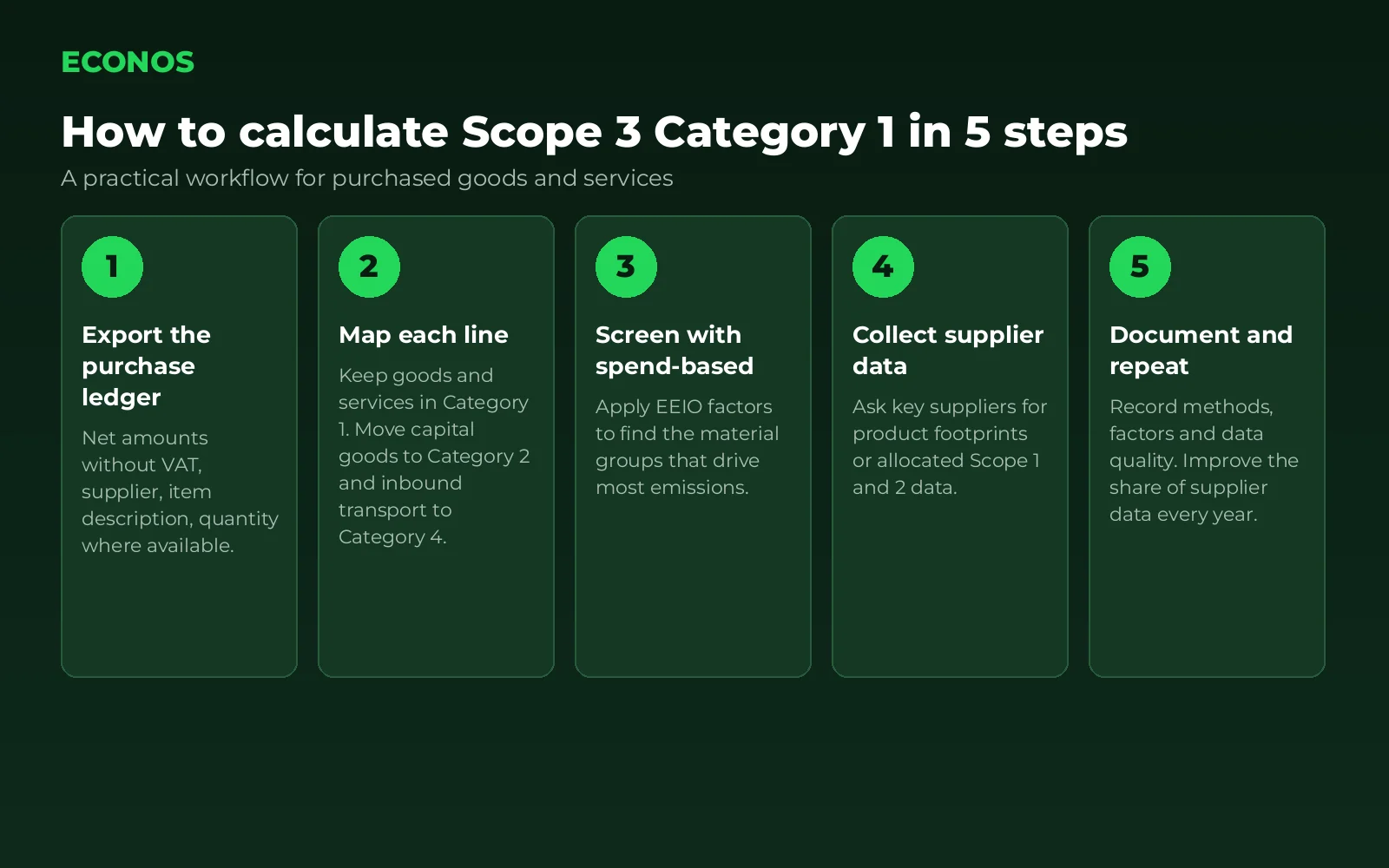
The GHG Protocol lists four methods, from the most specific to the least specific. You do not need one method for everything. You can use different methods for different purchases.
1. Supplier-specific method
Quantity purchased multiplied by a supplier-specific cradle-to-gate emission factor for that product. Suppliers usually get this figure from a product carbon footprint or a life cycle assessment (LCA). It is the most precise option when the data quality is good.
2. Hybrid method
The hybrid method combines the supplier's allocated Scope 1 and 2 emissions with the emissions of the materials it buys, the transport of those inputs and its waste. Secondary emission factors fill the gaps.
3. Average-data method
Mass or number of units purchased multiplied by an industry-average cradle-to-gate factor from a process-based life cycle database. The average-data method needs quantities, for example from purchase records or bills of materials.
4. Spend-based method
Net spend multiplied by an EEIO emission factor (kg CO2e per unit of currency). Environmentally extended input-output databases such as EXIOBASE provide these factors by economic sector. The spend-based method is fast and covers all purchases, but it follows prices, not physical reality. The guidance notes that inflation data may be used when the factor year and the data year differ.
Our guide on GHG emission factors for sustainability managers explains how to choose and document factors.
One warning from the guidance: specific does not always mean accurate. Data collected from a supplier may be less accurate than industry-average data for a given product. Always check the method and boundary behind a number a supplier sends you.
How to calculate Scope 3 Category 1 in 5 steps
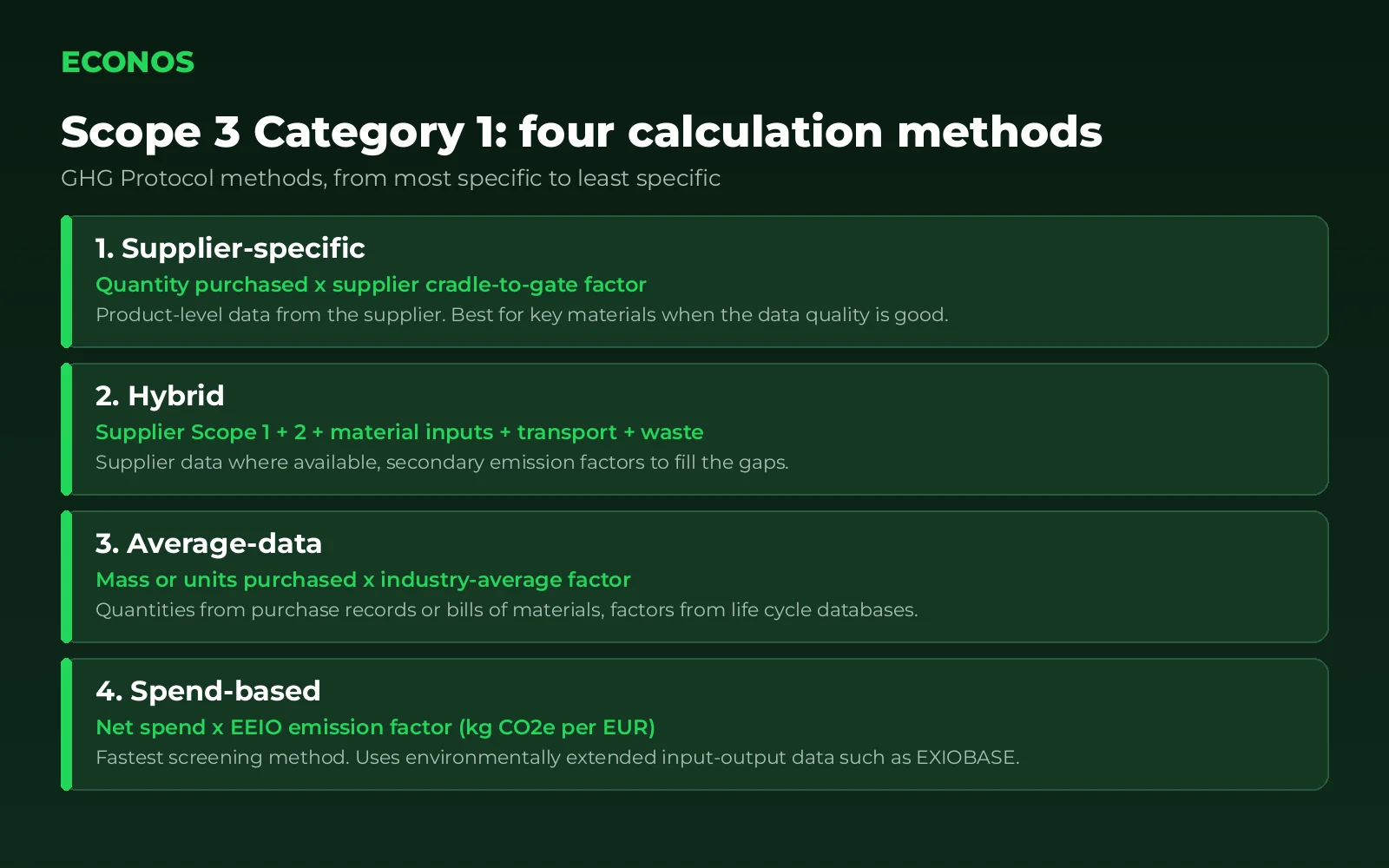
- Export the purchase ledger for the reporting year from your accounting or ERP system. Use net amounts without VAT, plus supplier, description and quantity where available. Convert RON to the currency of your factors.
- Map each line to Category 1, Category 2, Category 4 or another category, and exclude items that are not purchases, such as taxes and salaries.
- Run a spend-based screening to see which material groups and suppliers drive the emissions.
- Ask your key suppliers for product footprints or allocated Scope 1 and 2 data, and move those purchases to a more specific method.
- Document methods, factors and data quality, then repeat every year with a higher share of supplier data.
In our work with Romanian companies, the first screening usually shows that a few material groups, such as metals, plastics or packaging, drive most of Category 1. That tells you which suppliers to contact first, instead of sending a questionnaire to hundreds of them. Our AI carbon accounting assistant AVA maps purchase lines to categories and emission factors to speed up this step.
Once you know your hotspots, our guide on how to optimize supply chain emissions covers the reduction options.
Common mistakes in Scope 3 Category 1 calculations
- Including VAT in the spend data.
- Counting the same purchase twice, for example a machine in Category 1 and Category 2, or fuel in Scope 1 and Category 1.
- Using factors from one year with spend from another year without inflation adjustment.
- Leaving out services such as IT, cleaning or consulting.
- Accepting supplier figures without checking their method and boundary.
- Not writing down the assumptions, which makes the next year impossible to compare.
Frequently asked questions
What is Scope 3 Category 1?
Scope 3 Category 1 covers the cradle-to-gate emissions of all goods and services a company buys in the reporting year, unless they are reported in another category. It includes raw materials, components, packaging and services such as IT or consulting.
What is the difference between Category 1 and Category 2 in Scope 3?
Category 1 covers goods and services used in operations, while Category 2 covers capital goods such as machines, vehicles and buildings. A purchase goes in only one of the two, so define the split, for example in line with your fixed asset register.
Is the spend-based method accepted by the GHG Protocol?
Yes. The spend-based method is one of the four methods in the GHG Protocol Scope 3 Calculation Guidance. It is useful for screening, but you should move to supplier-specific, hybrid or average-data methods for your largest purchases.
Where do I find emission factors for purchased goods and services?
Spend-based factors come from environmentally extended input-output databases such as EXIOBASE. Average-data factors come from life cycle databases, and supplier-specific factors come from your suppliers' product footprints.
Do Romanian SMEs need to calculate Scope 3 Category 1?
It depends on who asks. Many SMEs are not directly obliged, but large customers and banks increasingly request supply chain data. Check the current reporting rules in our article on who still needs a carbon footprint after Omnibus.
Sources and recommended reading
- GHG Protocol, Scope 3 Calculation Guidance, Category 1: Purchased goods and services (PDF)
- GHG Protocol, Technical Guidance for Calculating Scope 3 Emissions
- GHG Protocol, Corporate Value Chain (Scope 3) Standard
- CDP, Corporates' supply chain Scope 3 emissions are 26 times higher than their operational emissions (2024)
- CDP and BCG, Scope 3 Upstream: Big Challenges, Simple Remedies (PDF)
- EXIOBASE, multi-regional environmentally extended input-output database
Recommended on ECONOS
- How to calculate Scope 1 emissions
- Scope 2 in Romania: location-based or market-based
- GHG emission factors explained
- Carbon footprint assessment, Scope 1, 2 and 3
- Reduce your carbon footprint
How ECONOS can help
ECONOS calculates Scope 1, 2 and 3 inventories in line with the GHG Protocol, including a full Scope 3 Category 1 analysis of your purchase ledger. Our carbon footprint assessment service starts with a spend-based screening and then builds supplier engagement for your hotspots. Through the ECONOS Academy we train your team to run the calculation on its own the following year.
Want to know how large your purchased goods and services emissions are? Contact ECONOS and we will review your purchase data with you.