
.png)

TL;DR:
- Most corporate climate ambitions often fail because Scope 3 emissions from supply chains constitute 70 to 90% of the total footprint. Building a reliable emissions baseline, embedding sustainability into procurement governance, and implementing logistics and circular economy strategies are essential for meaningful reductions. Continuous monitoring, supplier engagement, and operational integration are key to maintaining compliance and achieving visible, impactful progress.
Scope 3 emissions are where most corporate climate ambitions quietly collapse. If you are a supply chain professional or sustainability manager, you already know that the bulk of your organization’s carbon footprint does not come from your own facilities or electricity bills. It lives inside your supplier network, your logistics operations, and your product lifecycle. Learning how to optimize supply chain emissions is not a theoretical exercise. It is one of the most concrete and compliance-relevant challenges your organization faces right now, and this guide walks you through every stage: measurement, governance, logistics, circularity, and reporting.
Table of Contents
- Key takeaways
- How to optimize supply chain emissions: starting with a baseline
- Aligning procurement and governance
- Practical strategies to reduce logistics emissions
- Circular economy principles in your supply chain
- Monitoring, reporting, and continuous improvement
- My take: why ambition without operations always fails
- Ready to map and reduce your supply chain emissions?
- FAQ
Key takeaways
| Point | Details |
|---|---|
| Scope 3 dominates your footprint | 70 to 90% of emissions sit in the supply chain, making procurement your highest-impact lever. |
| Start with a solid baseline | Mapping supplier emissions with consistent data standards is the prerequisite for any credible reduction strategy. |
| Governance unlocks procurement change | Embedding sustainability criteria and internal carbon pricing into sourcing decisions turns ambition into accountability. |
| Logistics optimization delivers fast wins | Network redesign, shipment consolidation, and route planning reduce emissions without requiring supplier buy-in. |
| Reporting is now a legal obligation | CSRD, California SB-253, and other frameworks require detailed Scope 3 disclosures, making data traceability non-negotiable. |
How to optimize supply chain emissions: starting with a baseline
You cannot reduce what you have not measured. This sounds obvious, but the real challenge is that measuring supply chain emissions requires data from entities outside your control. Suppliers, logistics partners, and raw material producers often report emissions inconsistently, or not at all.
The first step is building an emissions baseline that maps every significant Scope 3 category. For most manufacturers and retailers, the priority categories are purchased goods and services (Category 1), upstream transportation (Category 4), and use of sold products (Category 11). A useful starting point is the GHG Protocol’s Scope 3 standard, which gives you a defensible structure for categorization.
How to approach data collection:
- Start with spend-based estimates using emission factors from databases like Ecoinvent or the EPA’s EEIO model. These are imprecise but fast, and they help you identify hotspots.
- Progress to supplier-specific data for your top 20 to 30 suppliers by spend or emissions intensity. Platforms like CDP Supply Chain or SEDEX make this structured and auditable.
- Document your data lineage at every step. Who provided the data, when, and under what methodology. This is not bureaucracy. It is what makes your numbers defensible under audit.
Pro Tip: When engaging suppliers for emissions data for the first time, lead with a simple, three-question survey: What is your total energy consumption? What share is renewable? Do you have a carbon footprint report? You will get far higher response rates than sending a full GHG questionnaire cold.
One of the most persistent obstacles is that suppliers often lack tools and expertise to quantify their own emissions, particularly smaller ones in emerging markets. Your role is not just to collect data but to help build supplier capacity over time. Establishing clear KPIs, for example, carbon intensity per unit of product or percentage of suppliers with verified emissions data, gives you a measurable path forward.
| Data quality tier | Method | Use case |
|---|---|---|
| Tier 1 (spend-based) | EEIO or economic emission factors | Initial hotspot screening |
| Tier 2 (activity-based) | Fuel, energy, and distance data from logistics | Transportation and upstream freight |
| Tier 3 (supplier-specific) | Primary data from supplier GHG reports | Strategic suppliers and high-impact categories |
Aligning procurement and governance
Measuring emissions is one problem. Getting your organization to act on that data is a different one entirely. Procurement teams often fail because they lack a clear mandate to resolve sustainability-cost trade-offs combined with effective governance and measurement systems.
The fix is structural, not motivational. Here is how to build the organizational backbone that makes green procurement work:
- Establish a cross-functional mandate. Sustainability decisions in procurement must not sit with one team alone. Finance, operations, legal, and sustainability need shared ownership over supplier criteria and trade-off decisions.
- Embed sustainability into supplier scorecards. Weight environmental performance alongside cost, quality, and delivery. If it does not appear in the scorecard, it will not influence sourcing decisions in practice.
- Introduce internal carbon pricing. Assigning a shadow price to carbon, often between $50 and $150 per tonne depending on your sector, makes emissions visible in financial terms that procurement managers and CFOs can act on.
- Write sustainability clauses into contracts. Require suppliers to share emissions data, set improvement targets, and participate in joint reduction initiatives. Contract sustainability clauses are increasingly standard practice among companies serious about Scope 3 compliance.
- Tie incentives to results. Whether through preferred supplier status, longer contract terms, or co-investment in efficiency projects, suppliers need a reason to prioritize your sustainability requirements over their other customers.
Pro Tip: The most effective internal carbon pricing programs in supply chain are not used to penalize procurement teams. They are used to make the cost of inaction visible to leadership. Frame it as a risk pricing tool, not a tax.
The common organizational blind spot here is treating procurement sustainability as a reporting task rather than an operational one. Real change happens when your buyer in Bucharest or Paris has sustainability criteria on their screen at the moment of sourcing decision, not six months later during an ESG report review.
Practical strategies to reduce logistics emissions
Once governance is in place, logistics offers some of the most tangible and fastest-return opportunities to reduce supply chain carbon footprint. The good news is that many logistics emissions reductions also reduce costs.
Network redesign and shipment consolidation can significantly lower logistics-related emissions by reducing total miles traveled and improving load efficiency. Here is what that looks like in practice:
- Centralize distribution infrastructure. Consolidating regional distribution centers reduces the number of last-mile legs and optimizes freight routes. One well-placed distribution hub can eliminate dozens of partial truckload movements per week.
- Maximize full truckloads. Running at 60% capacity is not just wasteful financially. It means you are emitting carbon for air. Carrier consolidation programs and shipment batching are straightforward fixes.
- Adopt route optimization software. Tools that factor in real-time traffic, load weight, and fuel efficiency cut both miles and idling time. The emissions impact compounds over a fleet of hundreds of vehicles.
- Transition to low-emission transportation. Electric vehicles for urban last-mile delivery are now cost-competitive in most European markets. For long-haul, LNG or hydrogen options are advancing faster than most logistics teams realize.
- Engage your 3PL providers. Your third-party logistics partners carry your emissions in their operations. Require them to report emissions per shipment and include this in contract negotiations.
| Strategy | Emissions impact | Cost impact | Implementation time |
|---|---|---|---|
| Shipment consolidation | High | Cost reduction | Short (1 to 3 months) |
| Route optimization software | Medium to high | Cost reduction | Short to medium |
| Distribution network redesign | Very high | Variable | Long (12+ months) |
| Fleet electrification (urban) | High | Cost neutral to positive | Medium to long |
| 3PL emissions reporting | Indirect | Minimal | Short |
Circular economy principles in your supply chain
Circularity is not just an environmental philosophy. It is a practical mechanism for cutting emissions at the source. Implementing circularity across a product lifecycle reduces both emissions and improves economic efficiency, because waste and emissions are often the same problem wearing different labels.
Here is how to bring circularity into your supply chain sustainability practices:
- Prioritize recycled and renewable inputs. For packaging and raw materials, shifting to recycled content directly cuts upstream extraction emissions. Even partial substitution at scale makes a measurable difference.
- Design for disassembly. Products designed to be repaired, remanufactured, or recycled at end of life reduce the need for virgin material in future production cycles. This has the biggest emissions impact in electronics, automotive, and industrial equipment.
- Work with suppliers on waste valorization. One company’s manufacturing offcut is another’s input material. Supplier collaboration programs that facilitate material exchanges reduce waste disposal emissions and lower procurement costs simultaneously.
- Rethink packaging. Returnable packaging programs and right-sized packaging reduce both material use and transportation weight, cutting emissions on two fronts at once.
Waste reduction as a strategic pathway to emissions reduction makes the economic case for circularity far stronger than the environmental one alone. When you frame it to your CFO as reducing input costs and material waste, the sustainability case follows naturally.
Pro Tip: Before launching a circular sourcing initiative, audit your top 10 suppliers for existing waste streams. You will almost always find opportunities for material recovery or exchange that neither party had previously formalized. These are fast wins that cost almost nothing to implement.

Monitoring, reporting, and continuous improvement
Getting your emissions baseline and strategy in place is the beginning, not the destination. The regulatory environment in 2026 makes ongoing monitoring and transparent reporting a legal requirement for many organizations. California SB-253, NY SB 9072A, and EU CSRD all enforce extended reporting requirements for Scope 3 emissions, and the bar for data quality is rising every year.
Here is a practical framework for maintaining emissions performance over time:
- Build traceability into your data systems. Treat carbon data as an operational system with data lineage, not as a spreadsheet you update once a year. Traceability and governance are essential for credible emissions measurement under CSRD and similar frameworks.
- Define standard KPIs and track them quarterly. Useful metrics include carbon intensity per revenue unit, percentage of suppliers with verified emissions data, and absolute Scope 3 emissions year over year.
- Invest in supplier capacity-building. Companies that actively engage suppliers are nine times more likely to achieve their Scope 3 targets. Training, co-funded tools, and simplified reporting templates remove the barriers that stop suppliers from participating.
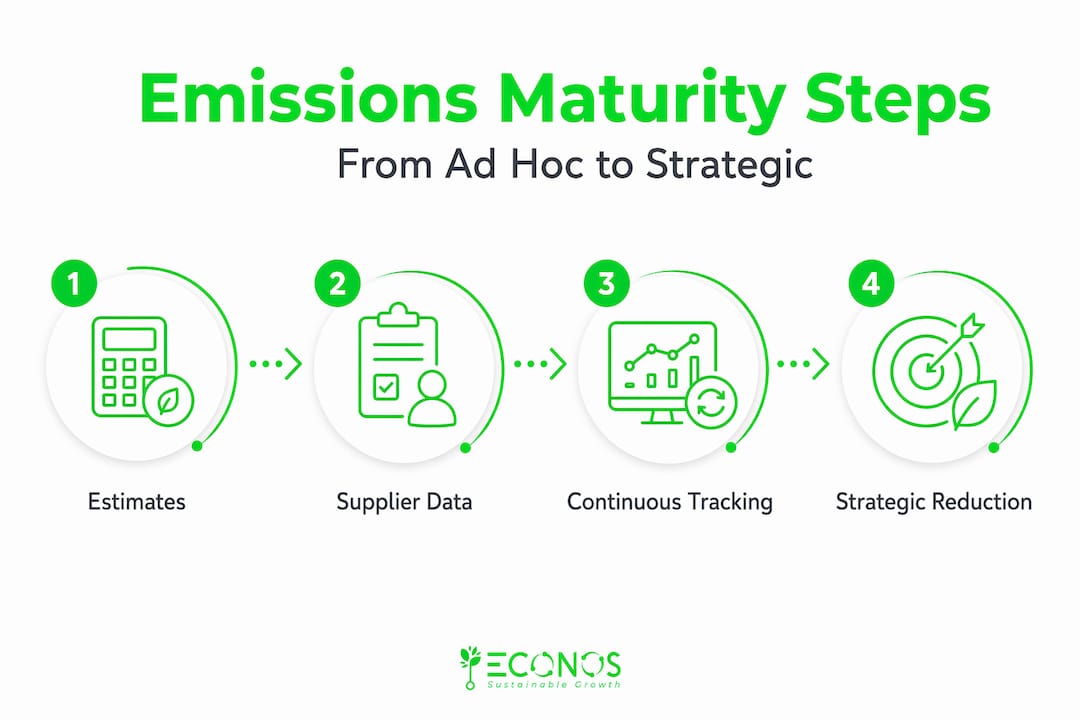
- Use maturity models to prioritize next steps. Not every improvement has the same impact. A maturity assessment helps you identify whether your biggest gap is data quality, governance, logistics, or sourcing, and where to invest next.
| Maturity level | Characteristics | Next action |
|---|---|---|
| Level 1: Ad hoc | Spend-based estimates, no supplier engagement | Build baseline and identify hotspots |
| Level 2: Developing | Activity data for key categories, partial supplier data | Strengthen governance and contract clauses |
| Level 3: Managed | Verified supplier data, defined KPIs | Implement reduction programs and circularity |
| Level 4: Leading | Full traceability, continuous improvement, disclosed publicly | Align with science-based targets |
For effective carbon emissions reduction, the organizations that succeed are the ones that stop treating emissions reporting as an annual compliance task and start treating it as a monthly operational discipline.
My take: why ambition without operations always fails
I have worked with supply chain and sustainability teams across manufacturing, retail, and financial services, and the pattern I see most consistently is this: organizations invest heavily in setting net-zero targets and building sustainability reports, and almost nothing in the operational plumbing that would actually get them there.
The honest truth is that emissions targets without data governance are just aspiration. I have seen companies present impressive Scope 3 numbers in ESG reports that were built entirely on spend-based estimates from three years ago. That is not transparency. That is greenwashing with a spreadsheet.
What actually works is treating carbon data the same way you treat financial data. You would not accept unaudited revenue figures in a board report. The same standard needs to apply to emissions. That means data lineage, version control, supplier verification protocols, and someone accountable for data quality by name.
The other lesson I keep relearning is that supplier collaboration is simultaneously the hardest and most impactful thing you can do. Suppliers push back. They have competing priorities. Smaller ones genuinely lack capacity. But the organizations that invest in supplier enablement, not just supplier requests, are the ones making real progress. It takes patience and humility to admit that your decarbonization depends partly on other people’s capabilities. That is exactly why it is worth building.
Progress here is not linear. It is iterative, messy, and worth every bit of effort.
— Mathieu
Ready to map and reduce your supply chain emissions?
If you have recognized your organization in any part of this guide, whether you are struggling to build a defensible baseline, align procurement governance, or meet CSRD disclosure requirements, Econos-esg can help you move from intention to execution.
Econos-esg’s carbon footprint assessment is built specifically for organizations that need to map Scope 1, 2, and 3 emissions with the rigor that regulators and rating agencies now demand. The team also supports ESG reporting compliance under CSRD and ESRS, so your disclosures are accurate and defensible. What sets Econos-esg apart is its training-first model. You do not just receive a report. You build the internal capacity to manage emissions data on your own terms, supported by AVA, the AI-powered carbon accounting assistant. Contact Econos-esg to discuss a tailored emissions reduction roadmap for your supply chain.
FAQ
What percentage of emissions come from the supply chain?
Scope 3 emissions represent 70 to 90% of most companies’ total carbon footprint, making the supply chain the single largest source of corporate emissions and the highest-priority area for climate action.
How do you start mapping supply chain emissions?
Begin with spend-based estimates using EEIO emission factors to identify hotspot categories, then progressively collect activity-based and supplier-specific data for your highest-impact suppliers using frameworks like the GHG Protocol Scope 3 standard.
What regulations require Scope 3 supply chain reporting?
California SB-253, New York SB 9072A, and the EU’s CSRD all require detailed Scope 3 emissions disclosure from qualifying companies, making supply chain emissions reporting a legal obligation rather than a voluntary practice in many jurisdictions.
Why do supplier engagement programs matter for emissions?
Companies that actively engage their suppliers are nine times more likely to hit their Scope 3 targets, because the majority of emissions reductions depend on actions taken by suppliers, not just internal operations.
How does circularity help cut supply chain pollution?
Circular economy practices reduce the need for virgin material extraction and minimize waste across the value chain, lowering upstream and downstream emissions simultaneously while often generating cost savings through better resource efficiency.