

Scope 2 emissions look like the easiest part of a carbon footprint. You take the electricity invoices, multiply the kWh by an emission factor, and you are done. Then a customer questionnaire asks for two Scope 2 figures, your auditor asks which supplier mix you used, and the green tariff you pay for does not change your result. This guide explains the two methods, what they mean for a company in Romania in 2026, and what is changing in the GHG Protocol.
What Scope 2 covers
Scope 2 covers the indirect emissions from the electricity, heat, steam and cooling that your company buys and consumes. The emissions happen at the power plant or the heating plant, but your consumption causes them. For most companies in Romania, Scope 2 means grid electricity for offices, warehouses and production sites, plus district heating in some cities.
If you are new to the topic, start with our introduction to carbon footprint and the article Carbon footprint in 2026: who still needs one after Omnibus.
Two methods, two different questions
Since 2015, the GHG Protocol Scope 2 Guidance asks companies that operate in markets with contractual instruments, such as guarantees of origin, to report Scope 2 in two ways. This is called dual reporting. Romania is one of these markets.
- Location-based method. It uses the average emission intensity of the grid where you consume the electricity. It answers the question: what emissions does my consumption cause on the grid I am connected to? For Romania, a common reference is the national production mix. The Association of Issuing Bodies (AIB) gives 220 g CO2/kWh for 2025.
- Market-based method. It uses the emissions of the electricity you chose to buy through contracts: a supplier specific mix, guarantees of origin (GOs) or a power purchase agreement (PPA). If you have no such instrument, you must use the residual mix. This is what remains after the renewable attributes already claimed by others are removed. For Romania, the AIB residual mix for 2025 is 245 g CO2/kWh, higher than the production mix.
The residual mix is higher because the clean electricity that others claimed with certificates is taken out of the pool. If you do not hold certificates, you get what is left.
A worked example: 1,000 MWh, four results
Take a company that consumes 1,000 MWh of electricity per year in Romania.
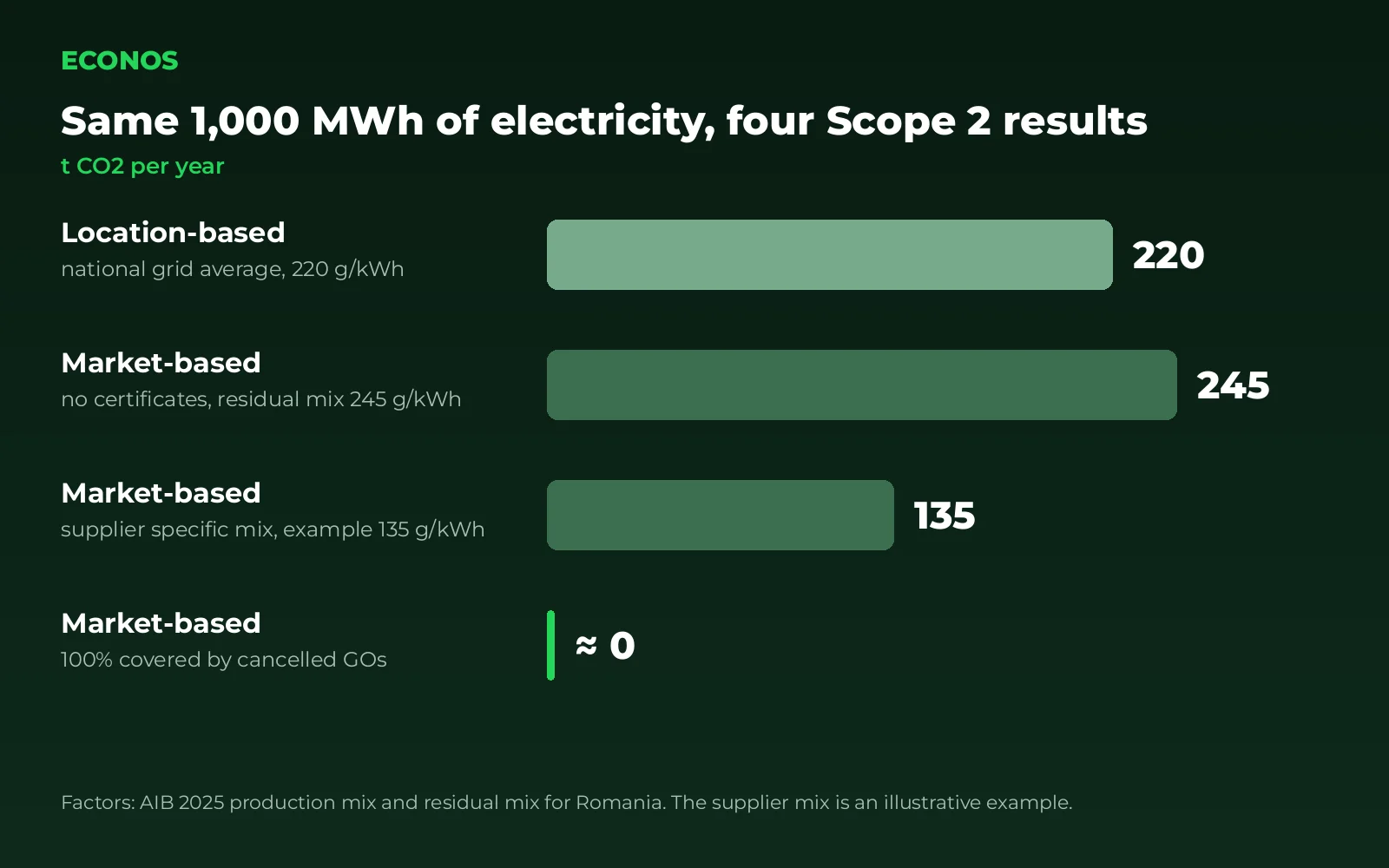
- Location-based, with the national production mix of 220 g CO2/kWh: about 220 t CO2.
- Market-based, with no certificates, using the residual mix of 245 g CO2/kWh: about 245 t CO2.
- Market-based, with a supplier specific mix of, for example, 135 g CO2/kWh: about 135 t CO2. This is valid only if the supplier mix is backed by guarantees of origin and is not counted twice.
- Market-based, with 100% of the consumption covered by guarantees of origin cancelled in your name: close to zero.
Same electricity, same meters, four different numbers. The difference is not physics. It is documentation.
What is specific to Romania
Guarantees of origin. In Romania, guarantees of origin are issued by ANRE. At the start of 2026, Romanian GOs were transferred free of charge and could not be traded across borders. Emergency Ordinance 59/2025 changes this framework and prepares a real market. ANRE became an observer in the AIB in November 2025 and is working towards full membership and connection to the AIB Hub. Check the status for your reporting year before you rely on any certificate.
The energy label on your invoice. Every supplier publishes the mix of the electricity it sold. You can use it as a supplier specific factor only if it meets the GHG Protocol quality criteria. Ask your supplier in writing how the label is calculated and whether the renewable part is covered by cancelled GOs.
District heating. There is no certificate market for heat in practice. Use a supplier specific factor if the heat provider gives one, otherwise a documented average factor. Note the source and the year.
When does a certificate really count?
For the market-based method, a contractual instrument counts only if it meets a set of quality criteria. In simple terms:
- It carries the emission rate of the electricity it represents.
- It is the only claim on that electricity. It is tracked in a registry and cancelled for you.
- It covers the same period as your consumption.
- It comes from the same market where you consume the electricity.
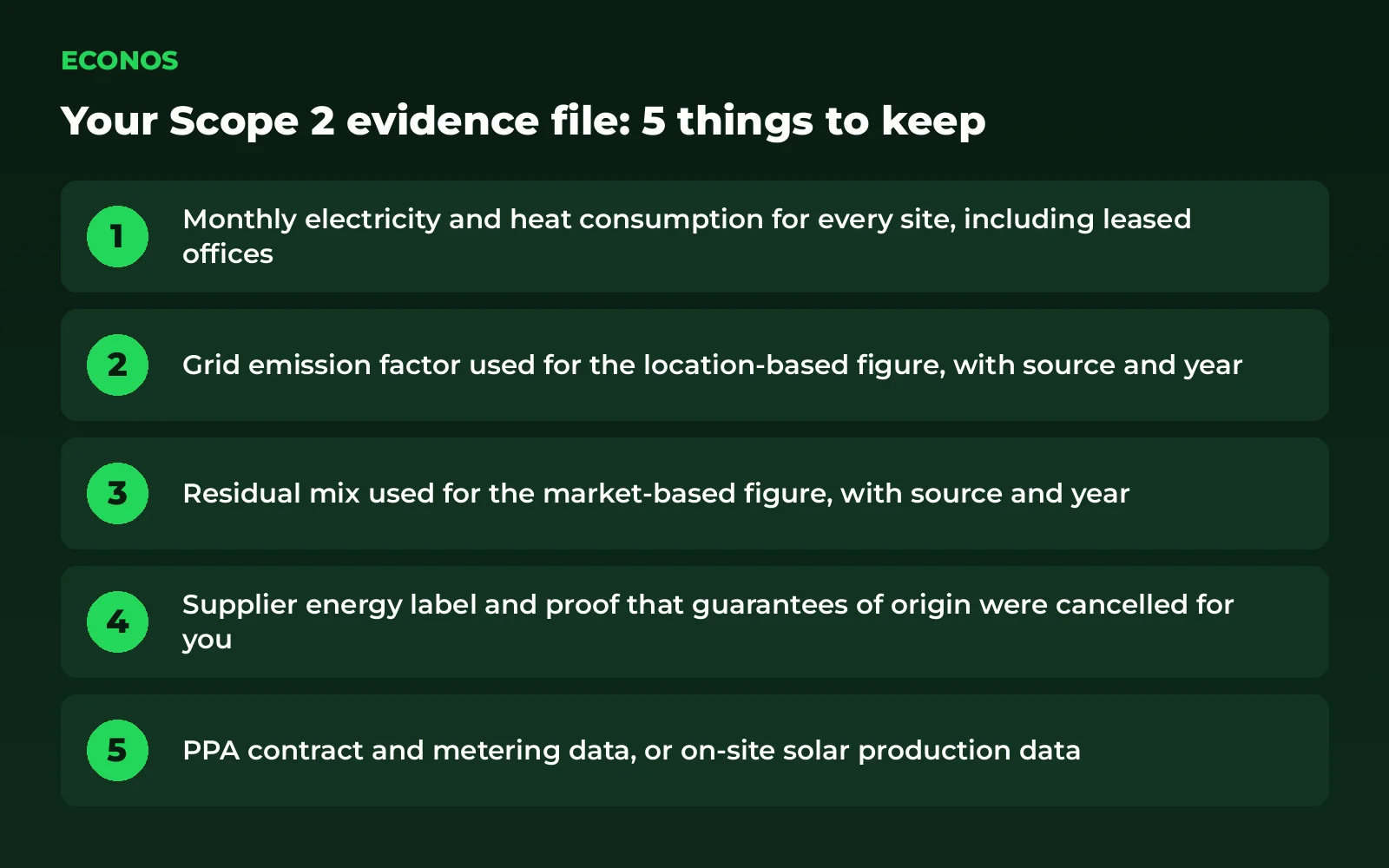
Keep the proof: certificate numbers, cancellation statement, volume in MWh, production period, technology and country. Without this file, an auditor or a rating platform will ask you to fall back on the residual mix.
What is changing in the GHG Protocol
The GHG Protocol is revising its Scope 2 rules. A public consultation ran from October 2025 to the end of January 2026. It proposed two new conditions for certificates in the market-based method: hourly matching, where certificates must match consumption hour by hour, and deliverability, where the electricity must come from a grid that can physically deliver it to you.
The feedback was mixed. The summary published in July 2026 showed low support among companies for hourly matching. In October 2026, the GHG Protocol described two market-based approaches under discussion. Method 1 would add hourly matching, deliverability and incrementality. Method 2 would keep the 2015 rules until a transition date that is not yet set. The final standard is not adopted.
What this means for you today:
- Keep reporting with the 2015 rules for your current reports.
- Collect monthly consumption data per site now, and hourly data where your meters allow it.
- If you negotiate a new PPA, ask whether hourly production and consumption data will be available.
Which number to show
Report both, side by side, and always name the method and the factor source. Use the location-based figure to track efficiency, because it only moves when your consumption moves. Use the market-based figure to show your purchasing choices. Do not present a market-based result close to zero as carbon neutral. Your Scope 1 and Scope 3 emissions remain, and the location-based figure is still there.
Customer supplier platforms and rating questionnaires such as EcoVadis increasingly ask for both figures separately. Prepare them once, correctly, and you reuse them everywhere.
Five common mistakes
- Claiming a green tariff without proof that GOs were cancelled for your consumption.
- Putting the production mix in the market-based column instead of the residual mix.
- Mixing factors from different years without saying so.
- Forgetting electricity and heat in leased offices where the landlord pays the bills.
- Not writing down the factor source, the year and the version.
For a deeper look at factors, read our guide Emission factors explained for compliance professionals.
Frequently asked questions
Do I need to report both methods? Under the GHG Protocol, yes, if you operate in a market with contractual instruments. Romania is such a market.
Do guarantees of origin reduce my real emissions? They reduce your market-based figure. Your location-based figure stays the same. Real reductions on the grid come from lower consumption and new renewable capacity.
What about solar panels on my roof? Electricity you produce and consume yourself has no Scope 2 emissions, so it lowers both figures. If GOs are issued for that production and sold to someone else, you can no longer claim it as renewable in your market-based figure.
Where do I find the Romanian residual mix? The AIB publishes the European residual mixes every year, usually around May or June for the previous year.
Sources and recommended reading
- GHG Protocol, Scope 2 Guidance (2015)
- GHG Protocol, Scope 2 market-based method update (October 2026)
- AIB, European Residual Mixes 2025
- EY Romania, Guarantees of origin in Romania: what OUG 59/2025 brings
- Economica.net, ANRE becomes an observer in the AIB
Recommended on ECONOS
- Carbon footprint assessment, Scope 1, 2 and 3
- Reduce my carbon footprint
- How to implement effective carbon emissions reduction methods
- ECONOS Academy
How ECONOS can help
ECONOS calculates your Scope 1, 2 and 3 emissions under the GHG Protocol, with both Scope 2 methods documented and ready for customers, auditors and EcoVadis. We check your supplier labels and guarantees of origin, choose and document the right factors, and train your team so you can repeat the exercise every year with AVA, our AI carbon accounting assistant.
Contact us for a discussion about your carbon footprint. An ECONOS expert will reply as soon as possible.