
.png)

TL;DR:
- An emission factor is a coefficient that quantifies greenhouse gas emissions per unit of activity data, enabling organizations to estimate their emissions without direct measurement at every source. Accurate carbon accounting relies on using current, geographically relevant emission factors sourced from EPA, IPCC, and IEA, with regular updates and thorough documentation. The most common errors stem from unit mismatches and outdated data, emphasizing the need for disciplined validation, annual reviews, and proper source citation in emission factor application.
An emission factor is a coefficient that quantifies greenhouse gas emissions per unit of activity data, translating operational inputs like fuel burned or electricity consumed into measurable CO2-equivalent outputs. Organizations including the EPA, IPCC, and IEA publish and maintain these coefficients so that companies can calculate emissions without direct measurement at every source. For environmental professionals and compliance officers, understanding how to source, apply, and validate emission factors is not optional. It is the technical foundation of every credible carbon footprint assessment, CSRD disclosure, and regulatory filing.
What is an emission factor and how is it defined?
An emission factor is derived from scientific measurement, engineering calculations, or statistical analysis, and it expresses the mass of a pollutant or greenhouse gas released per unit of activity. The standard formula is: Emissions = Activity Data × Emission Factor × (1 - Efficiency/100). A typical unit looks like kg CO2e per kWh of electricity consumed, or kg CO2e per liter of diesel burned.
This coefficient serves a critical function: direct measurement of emissions at every source is impractical and cost-prohibitive for most organizations. Emission factors provide the estimation bridge that makes large-scale carbon accounting possible. The EPA, IPCC, and IEA each publish databases covering hundreds of fuel types, sectors, and geographies, giving practitioners a structured starting point for any calculation.
The term “emission factor” is the recognized industry standard in GHG accounting, used consistently across the GHG Protocol Corporate Standard, ISO 14064, and CSRD/ESRS frameworks. You will sometimes see it called an “emissions coefficient” in older literature, but the terminology is interchangeable in practice.
Where do emission factors come from?
The three primary institutional sources are the EPA, the IPCC, and the IEA, each serving different geographic and sectoral needs.
- EPA (U.S. Environmental Protection Agency): The AP-42 compilation covers stationary combustion, industrial processes, and fugitive emissions for U.S. operations. It is the reference standard for U.S. regulatory filings and air permit applications.
- IPCC (Intergovernmental Panel on Climate Change): The IPCC Emission Factor Database provides default factors organized by fuel type and sector, designed for national greenhouse gas inventories. These are the fallback values when country-specific data is unavailable.
- IEA (International Energy Agency): The IEA Emissions Factors Package covers CO2, CH4, and N2O for electricity and heat generation across countries from 1990 to 2025, updated quarterly and annually. This is the go-to source for Scope 2 electricity emission factors in international reporting.
Beyond these three, national environmental agencies publish country-specific factors. The UK’s DEFRA, France’s ADEME Base Empreinte, and Romania’s national inventory reports all provide localized values that outperform generic international defaults in accuracy.
Geographic and temporal relevance is not a preference. It is a requirement. Using a 2020 factor for 2026 reporting can materially undermine footprint accuracy, particularly for electricity grids undergoing rapid decarbonization. A grid factor that was accurate four years ago may now overstate emissions by a meaningful margin, which creates both credibility and compliance risk.
Pro Tip: When reporting under CSRD or GHG Protocol, always document the source, version, and publication year of every emission factor you use. Auditors and verifiers will ask, and a clear data trail protects you from challenge.
How to calculate emissions using emission factors
Applying emission factors correctly requires three aligned inputs: activity data, the matching emission factor, and consistent units. Here is the standard workflow used in Scope 1, 2, and 3 calculations:
- Identify the activity data source. This could be fuel consumption in liters, electricity use in kWh, travel distance in km, or refrigerant top-up in kg. The unit of the activity data must match the denominator of the emission factor.
- Select the appropriate emission factor. Match the factor to the fuel type, technology, geography, and reporting year. For Scope 2, choose between location-based (grid average) and market-based (supplier-specific) factors as required by your reporting framework.
- Apply the formula. Multiply activity data by the emission factor. If a combustion efficiency adjustment is relevant, apply the (1 - Efficiency/100) term. The result is expressed in kg CO2e or tonnes CO2e.
- Verify unit alignment. Unit mismatches between activity data and emission factors are a leading cause of calculation errors. Confirm that the numerator (pollutant mass) and denominator (activity unit) are consistent before finalizing any figure.
- Document and disclose. Record the emission factor value, its source, and the calculation date. This is required under CSRD/ESRS, GHG Protocol, and most national regulatory frameworks.
For Scope 3 categories, the same logic applies but the activity data becomes more complex. Category 6 (business travel) uses distance-based factors from sources like DEFRA. Category 11 (use of sold products) requires product-specific factors. Aligning Scope 3 emissions calculations with the right emission factors is where most organizations struggle most.
Pro Tip: For electricity-intensive operations, recalculate your Scope 2 emission factor every reporting year. Grid decarbonization in markets like Romania, France, and Vietnam means last year’s factor is already outdated.

What are the limitations of emission factors?
Emission factors are population averages, not precision instruments. The EPA is explicit: emission factors represent long-term averages across many facilities, and roughly half of individual sources will have actual emission rates above or below the published value due to natural operational variability.
“Emission factors are not suitable for use as permit limits or for precise site-specific compliance determinations. They reflect average emission rates for source categories and can produce incorrect compliance results when misapplied.” — U.S. EPA
This has direct implications for how you use them:
- Permit compliance: EPA’s AP-42 factors are averages and are not recommended as permit limits. Regulatory permit applications require stack testing or source-specific measurement, not generic coefficients.
- Grid electricity: Emission factors for electricity generation must be updated frequently. A factor from 2021 for a grid that has since added significant renewable capacity will overstate your Scope 2 emissions and misrepresent your actual impact.
- Uncertainty ranges: The confidence level of an emission factor depends on how many test measurements it was derived from and how consistent those measurements were. IPCC default factors carry explicit uncertainty ranges. Ignoring those ranges in a corporate inventory is a methodological gap that auditors will flag.
- Technology specificity: A generic “natural gas combustion” factor may not reflect the actual efficiency of your specific boiler model. Where site-specific data is available, it always takes precedence over a published average.
Accuracy in emission factors is necessarily relative. Professionals must minimize uncertainty by choosing factors aligned closely with their operational location and time frame. The goal is not perfection. It is defensible, documented, and directionally correct.
Comparing common emission factor datasets
Choosing the right dataset depends on your sector, geography, and reporting framework. The table below compares the three most widely used sources.
| Dataset | Coverage | Update frequency | Best use case |
|---|---|---|---|
| EPA AP-42 | U.S. stationary sources, industrial processes | Periodic (varies by chapter) | U.S. Scope 1 regulatory reporting and air permits |
| IPCC EF Database | Global, by fuel type and sector | Updated per assessment cycle | National inventories, fallback defaults for Scope 1 |
| IEA Emissions Factors Package | Electricity and heat, 150+ countries, 1990 to 2025 | Quarterly and annual | Scope 2 location-based calculations, international reporting |
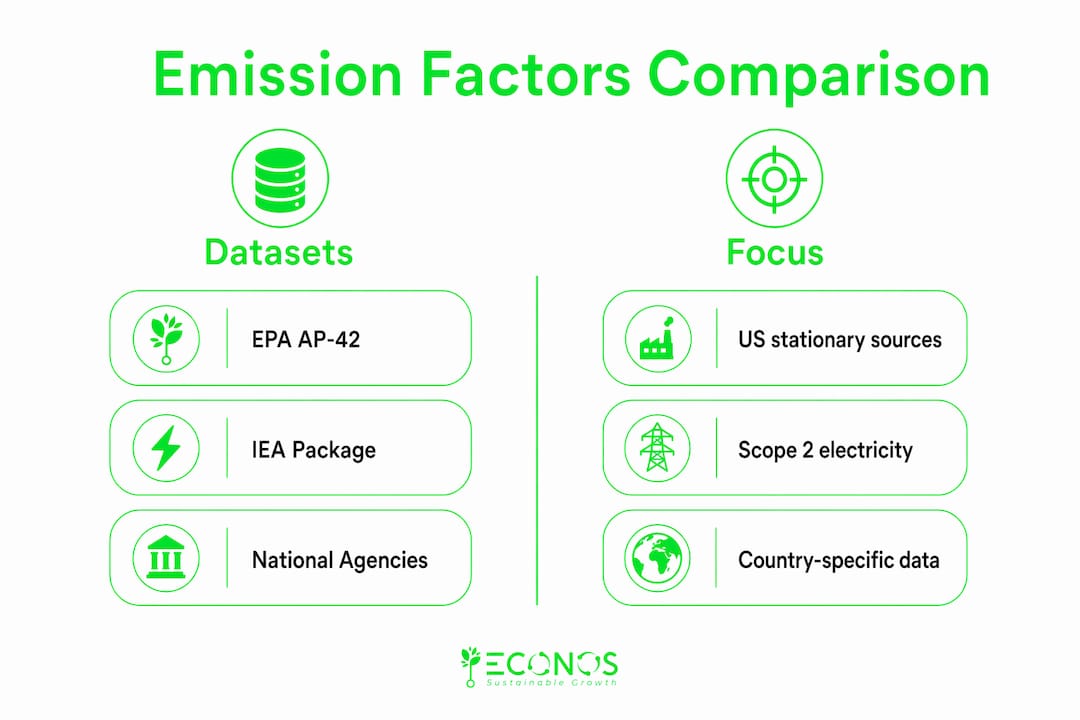
The IEA Emission Factors Package is the strongest option for Scope 2 electricity calculations across multiple geographies, covering CO2, CH4, and N2O by country and fuel type. For Scope 1 combustion in the U.S., EPA AP-42 remains the regulatory standard. For organizations reporting under CSRD with operations across Europe and Asia, combining IEA electricity factors with IPCC combustion defaults and local national inventory data produces the most defensible inventory.
No single dataset covers every need. Most organizations working across multiple countries and emission scopes will draw from at least two of these sources within a single reporting cycle.
Best practices for selecting and applying emission factors
Getting emission factors right is less about finding the perfect number and more about building a disciplined, documented process. These practices reduce error and strengthen auditability:
- Validate units first, always. Before any calculation, confirm that the activity data unit and the emission factor denominator match exactly. Mixing liters with cubic meters, or MJ with kWh, produces errors that compound across an entire inventory.
- Prioritize recency and geography. A current, country-specific factor outperforms an older global average in every reporting context. For electricity, use the most recent year available from IEA or your national grid operator.
- Triangulate where uncertainty is high. When a single source gives you low confidence, cross-reference two or three databases. If they converge, you have a defensible value. If they diverge significantly, investigate why before proceeding.
- Document every assumption. Record the factor value, the source URL or publication, the version or year, and the rationale for selection. This documentation is required under CSRD/ESRS and protects you during third-party verification.
- Review annually. Emission factors change. Grid mixes shift. Fuel compositions update. Build an annual review of your factor library into your carbon accounting calendar, not as a one-time task.
Pro Tip: Use your carbon footprint reduction checklist as an audit trigger. Each time you identify a new reduction measure, verify that the emission factor supporting that calculation is still current.
Key takeaways
Accurate carbon accounting depends on selecting emission factors that are geographically relevant, temporally current, and methodologically matched to your activity data and reporting framework.
| Point | Details |
|---|---|
| Core definition | An emission factor converts activity data into GHG emissions using the formula: Emissions = Activity × EF × (1 - Efficiency/100). |
| Primary sources | EPA AP-42, IPCC EF Database, and IEA Emissions Factors Package each serve different sectors and geographies. |
| Temporal accuracy | Using outdated factors, especially for electricity grids, materially reduces inventory accuracy and creates compliance risk. |
| Known limitations | Emission factors are population averages. They are not suitable for site-specific permit compliance determinations. |
| Best practice | Validate units, document sources, and review your factor library every reporting year without exception. |
Why emission factors are harder to get right than they look
I have worked with dozens of companies across Romania, France, and Vietnam on carbon footprint assessments, and the same pattern appears repeatedly. Teams spend significant effort collecting activity data, then apply whatever emission factor appears first in a Google search. That is where the inventory falls apart.
The honest reality is that emission factor selection is where most carbon accounting errors originate. Not in the data collection. Not in the formula. In the factor itself. A company using a 2019 Romanian grid factor for a 2025 CSRD disclosure is not just imprecise. It is producing a number that no verifier will accept without challenge.
What I find most underappreciated is the pace of change. Grid decarbonization in markets like Romania and France is moving faster than most internal sustainability teams update their factor libraries. The IEA now publishes quarterly updates for good reason. The energy transition is not a slow background process anymore. It is a variable that changes your Scope 2 number year over year, sometimes by more than your actual efficiency improvements.
My recommendation to every compliance officer I work with: treat your emission factor library as a living document, not a one-time setup. Assign ownership, set an annual review date, and build version control into your carbon accounting system. The companies that get this right are the ones whose ESG disclosures hold up under scrutiny, not just the first year, but every year after.
— Mathieu
How Econos-esg helps you get emission factors right

Getting emission factors right across Scope 1, 2, and 3 requires more than a spreadsheet and a database subscription. It requires a structured methodology, current data sources, and a team that understands both the technical requirements and the regulatory context. Econos-esg builds that capacity directly inside your organization. Through our carbon footprint assessment service, we integrate up-to-date emission factors from EPA, IEA, and national sources into a calculation framework tailored to your sector, geography, and reporting obligations. We also offer ESG reporting support that covers CSRD/ESRS compliance, EcoVadis preparation, and third-party verification readiness. You leave with a defensible inventory and the internal knowledge to maintain it.
FAQ
What is an emission factor in simple terms?
An emission factor is a number that converts an activity, like burning fuel or using electricity, into an equivalent amount of greenhouse gas emissions. It is expressed as a mass of CO2e per unit of activity, such as kg CO2e per kWh.
Which emission factor database should I use for Scope 2 reporting?
The IEA Emissions Factors Package is the standard reference for Scope 2 location-based calculations, covering electricity and heat generation across 150+ countries with data updated quarterly through 2025.
Can emission factors be used for regulatory permit compliance?
No. The EPA states explicitly that AP-42 emission factors are population averages and are not suitable for use as permit limits or site-specific compliance determinations. Stack testing or source-specific measurement is required for permit applications.
How often should emission factors be updated in a carbon inventory?
Emission factors should be reviewed and updated at least annually. Electricity grid factors in particular change year over year due to decarbonization trends, and using outdated values can materially misrepresent your Scope 2 emissions.
What causes the most errors in emission factor calculations?
Unit mismatches between activity data and emission factor denominators are the most common technical error. Verifying that units align before running any calculation is the single most effective quality control step in carbon accounting.