
.png)

TL;DR:
- Supplier assessment involves evaluating suppliers against specific criteria to determine compliance, risk, and sustainability. Effective programs focus on 6-8 core categories, use evidence-based scoring, and require corrective action plans to manage risks actively. Regular, tiered evaluations incorporating verified ESG data ensure a trustworthy and actionable supply chain risk management process.
Supplier assessment is the structured evaluation of suppliers against predefined criteria to measure compliance, risk, and sustainability performance across your supply network. Done well, it gives procurement teams the evidence they need to make defensible sourcing decisions rather than gut-call ones. Frameworks like Carter’s 10 C’s and third-party rating platforms like EcoVadis have made this process more systematic, but the fundamentals remain the same: define what good looks like, gather evidence, score it honestly, and act on what you find.
What criteria should a supplier assessment cover?
The most effective vendor assessment strategies focus on six to eight core categories rather than sprawling checklists. Selecting 6–8 core categories with three to five factors each reduces noise and drives focused improvement. More categories do not produce better decisions. They produce more paperwork and less clarity.
The five standard risk domains that procurement teams rely on are:
- Compliance: Regulatory adherence, certifications, labor standards, and anti-corruption policies
- Financial stability: Liquidity ratios, credit ratings, and ownership structure
- Operational performance: Delivery reliability, quality metrics, and capacity utilization
- Cybersecurity: Data handling practices, breach history, and IT infrastructure controls
- Sustainability and ESG: Carbon footprint, social practices, governance transparency, and EcoVadis scores
Carter’s 10 C’s framework extends this further by adding competency, commitment, culture, communication, and CSR as evaluation dimensions. It gives procurement teams a repeatable scoring system that goes well beyond price and delivery. That breadth matters when you are assessing a strategic supplier who touches multiple parts of your operation.
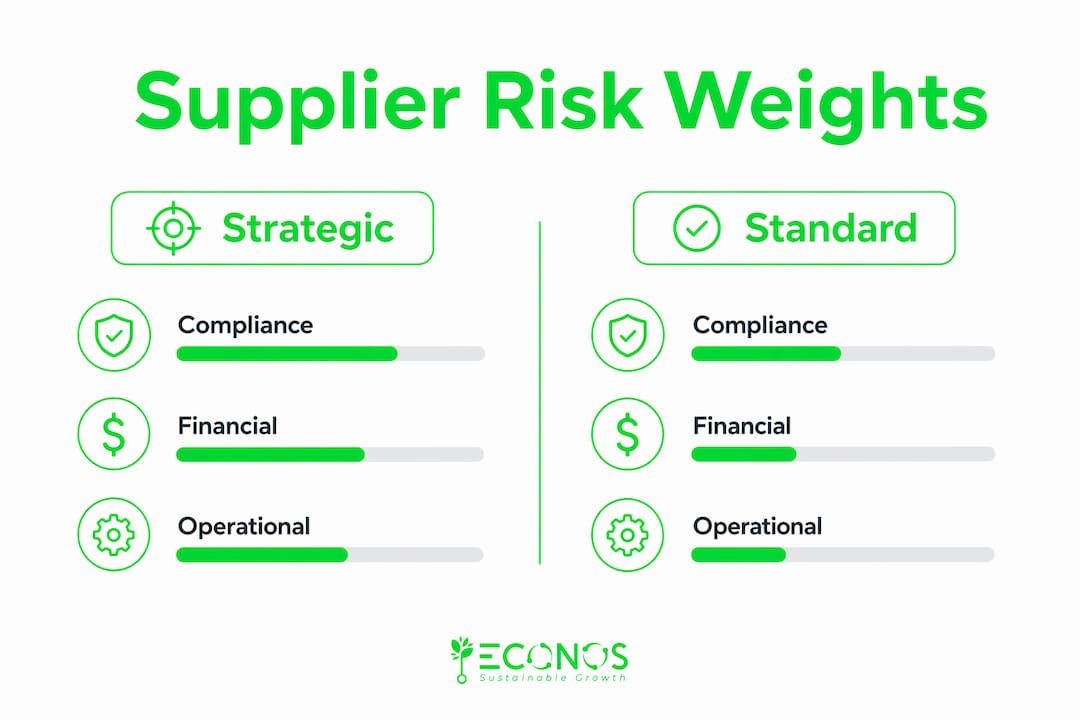
Once you have your categories, scoring them consistently is the next challenge. The standard formula is Risk Score = Likelihood × Impact, with each variable rated on a 1–5 scale. Weights shift by supplier tier and engagement type. A cloud infrastructure provider warrants heavier weighting on cybersecurity. A raw materials supplier warrants heavier weighting on environmental compliance.

| Risk Domain | Weight for Strategic Supplier | Weight for Standard Supplier |
|---|---|---|
| Compliance | High | High |
| Financial Stability | High | Medium |
| Operational Performance | High | High |
| Cybersecurity | Medium to High | Low to Medium |
| Sustainability / ESG | High | Medium |
Pro Tip: Avoid 10-point scoring scales. A simple 3-point scale using Low, Medium, and High with concise written justifications for high-risk ratings produces more defensible results and stronger stakeholder buy-in than false precision ever will.
How do you design an effective supplier evaluation process?
A supplier evaluation process that actually reduces risk follows a clear lifecycle. Skipping steps, especially the back end of the process, is where most programs fall apart.
-
Scope and tier your supply base. Classify suppliers as critical, high, medium, or low risk based on spend, strategic importance, and geographic exposure. This step determines how deep your assessment goes and how often you repeat it.
-
Define criteria and weighting. Agree on your six to eight categories before you send a single questionnaire. Criteria defined after data collection are not criteria. They are rationalizations.
-
Gather evidence. Use a combination of supplier self-assessment questionnaires, third-party audits, financial databases, and sustainability certifications. Self-assessments require verification through independent data sources like audits and certifications to be credible. Questionnaires alone create blind spots.
-
Score and profile each supplier. Apply your Likelihood × Impact formula. Document the justification for every high-risk score. A score without a rationale is not defensible in a procurement review or a regulatory audit.
-
Make a decision. Every supplier profile should end with one of three outcomes: accept, mitigate, or reject. Accept means the risk is within tolerance. Mitigate means you require a corrective action plan. Reject means the supplier does not meet minimum thresholds.
-
Document and monitor. A defensible vendor risk assessment includes defined scope, scored profiles with justifications, clear decisions, and documented ongoing monitoring. Monitoring is not optional. It is where the real risk management happens.
The most common failure point is step five. Teams complete thorough assessments and then file the results without issuing corrective action plans. Without corrective action plans with timelines and KPIs, assessments become audits rather than active risk management. That distinction matters enormously when a supply disruption or compliance failure surfaces.
Pro Tip: Build reassessment triggers into your monitoring program. A supplier’s credit rating downgrade, a cybersecurity incident, or a new regulatory requirement in their operating country should automatically flag them for an out-of-cycle review. Continuous monitoring using automated alerts catches emerging risks between formal assessments.
How often should you assess suppliers, and how do you tier them?
Assessment frequency is a resource allocation decision, not just a compliance one. Treating every supplier as a top priority is the fastest way to burn out your procurement team and dilute the quality of every assessment you run.
Failing to tier your supply base leads to resource dilution. Effective tiering based on objective criteria is the foundation of a sustainable assessment program. The 2026 industry standard is clear: strategic suppliers require formal evaluations every six months, while the broader supply base should be assessed at least annually.
| Supplier Tier | Risk Level | Assessment Frequency | Assessment Depth |
|---|---|---|---|
| Critical | Very High | Semi-annual | Full audit with third-party verification |
| High | High | Annual | Detailed questionnaire plus financial review |
| Medium | Medium | Annual | Standard questionnaire |
| Low | Low | Biennial or event-triggered | Lightweight self-assessment |
The tiering criteria should be objective and documented. Spend threshold, revenue dependency, sole-source status, regulatory exposure, and geographic risk all belong in the tiering model. Subjective judgments about “important relationships” do not.
One practical approach is to map your supply base on a two-axis grid: strategic importance on one axis, inherent risk on the other. Suppliers in the high-importance, high-risk quadrant are your critical tier. Suppliers in the low-importance, low-risk quadrant are your standard tier. The grid makes tiering decisions transparent and repeatable across procurement cycles.
How to integrate ESG compliance into supplier assessments
ESG integration in supplier assessments is no longer optional for companies operating under CSRD, the EU Corporate Sustainability Due Diligence Directive, or customer-driven sustainability requirements. It is a compliance obligation with direct commercial consequences.
The most credible approach to assessing vendor reliability on ESG criteria combines self-reported data with third-party verified scores. EcoVadis scores, ISO 14001 certifications, and SA8000 social accountability certifications all serve as independent corroboration. Self-assessments require cross-verification against external indicators to produce accurate supplier risk profiles. A supplier who claims strong environmental practices but holds no certifications and has no third-party audit history warrants skepticism.
Key ESG metrics to include in your supplier audit checklist:
- Environmental: Scope 1, 2, and 3 greenhouse gas emissions, energy consumption, water use, and waste management practices
- Social: Labor standards, health and safety incident rates, living wage compliance, and diversity policies
- Governance: Anti-corruption policies, board oversight of ESG, and transparency of sustainability disclosures
Linking ESG scores to corrective action plans is where most programs fall short. A supplier with a low EcoVadis score should not simply receive a lower overall rating. They should receive a specific improvement target, a timeline, and a KPI tied to their next assessment. That structure transforms ESG assessment from a reporting exercise into a supply chain improvement program. For a practical framework on how ESG compliance in supply chains connects to efficiency gains, the evidence is compelling.
Continuous monitoring of ESG performance should cross-verify supplier disclosures against external indicators. Cross-verification against cybersecurity events, financial reports, and sanction lists catches discrepancies that self-reported data will never surface. For teams building out their compliance workflows, the ESG due diligence guide for 2026 from Econos-esg offers a structured starting point.
Key takeaways
Effective supplier assessment requires tiered evaluation, evidence-based scoring, and corrective action plans that turn findings into measurable risk reduction.
| Point | Details |
|---|---|
| Use 6–8 core categories | Focused criteria reduce noise and drive clearer improvement actions than broad checklists. |
| Score with Likelihood × Impact | Apply a 1–5 scale per risk domain and adjust weights by supplier tier and engagement type. |
| Tier your supply base | Assess critical suppliers semi-annually and standard suppliers annually to avoid resource dilution. |
| Verify ESG claims independently | Combine self-assessments with EcoVadis scores, ISO certifications, and third-party audits for credibility. |
| Require corrective action plans | Every high-risk finding needs a timeline, KPI, and mutual accountability to drive real change. |
What most supplier assessment programs get wrong
I have reviewed supplier assessment programs across manufacturing, retail, and financial services, and the same failure pattern shows up repeatedly. Teams invest heavily in the front end of the process: building questionnaires, defining criteria, and scoring suppliers. Then they file the results and move on. No corrective action plans. No reassessment triggers. No accountability on either side.
The honest admission is that a completed assessment with no follow-through is worse than no assessment at all. It creates a false sense of security. You believe you know your supplier risk profile. You do not. You know what your suppliers told you six months ago.
The fix is not more complexity. Complex 10-point scales and 80-question questionnaires do not produce better decisions. They produce more data that no one acts on. A simple, defensible scoring rubric with clear accept, mitigate, or reject outcomes forces the decision that most programs avoid.
The other thing I would push back on is the over-reliance on self-reported questionnaires. Suppliers fill them out to pass, not to disclose. Cross-verifying responses against financial databases, sanction lists, and third-party sustainability ratings is not optional due diligence. It is the baseline. If your program does not include independent verification, you are not assessing suppliers. You are collecting their self-promotion.
Build the corrective action plan into the process from the start. Make it a standard output of every assessment, not an exception triggered only by catastrophic findings. That shift alone moves supplier assessment from a compliance checkbox to a genuine risk management function.
— Mathieu
How Econos-esg supports your supplier assessment program
Supplier assessment programs are only as strong as the ESG data behind them. Econos-esg works with procurement and sustainability teams to build the evidence base that makes assessments credible and defensible.
From carbon footprint assessment covering Scope 1, 2, and 3 emissions to full ESG reporting under CSRD and ESRS, Econos-esg provides the data infrastructure that supplier assessments depend on. As an accredited EcoVadis Core partner with a Gold EcoVadis rating, Econos-esg also supports EcoVadis certification preparation for both buyers and suppliers. If your program needs to move from questionnaire collection to verified, audit-ready sustainability data, that is exactly where Econos-esg operates.
FAQ
What is supplier assessment in procurement?
Supplier assessment is a structured process for evaluating suppliers against predefined criteria covering compliance, risk, financial stability, and sustainability performance. It produces scored profiles that support accept, mitigate, or reject sourcing decisions.
What framework is best for supplier selection criteria?
Carter’s 10 C’s framework covers competency, capacity, commitment, control, cash, cost, consistency, culture, communication, and CSR, giving procurement teams a repeatable multi-dimensional supplier evaluation process beyond price and delivery alone.
How often should supplier risk assessments be conducted?
Strategic suppliers should receive formal assessments every six months. The broader supply base requires at least an annual review, with out-of-cycle assessments triggered by material changes like credit downgrades or regulatory incidents.
How do you incorporate ESG into a supplier audit checklist?
Include Scope 1, 2, and 3 emissions, labor standards, health and safety rates, and governance transparency as scored criteria. Verify supplier disclosures against third-party ratings like EcoVadis scores and ISO certifications rather than relying on self-reported data alone.
What makes a supplier assessment defensible?
A defensible assessment includes a defined scope and tier, evidence collected across major risk domains, scored profiles with written justifications, clear accept or mitigate or reject decisions, and documented corrective action plans with timelines and KPIs.