

To calculate Scope 1 emissions, you need three things: the quantities of fuel and gases your company used, the right emission factors, and a clear list of what you own or control. It sounds simple. In practice, most first carbon footprints we review in Romania miss at least one Scope 1 source, usually refrigerant leaks. This guide shows the method step by step, with a worked example you can repeat with your own invoices.
In short
- Scope 1 emissions are direct emissions from sources your company owns or controls: boilers, vehicles, process equipment and refrigerant leaks.
- The formula is activity data multiplied by an emission factor, or by a global warming potential (GWP) for refrigerants.
- Collect gas invoices, fuel card reports and refrigerant service records, then document every factor, its source and its year.
What are Scope 1 emissions?
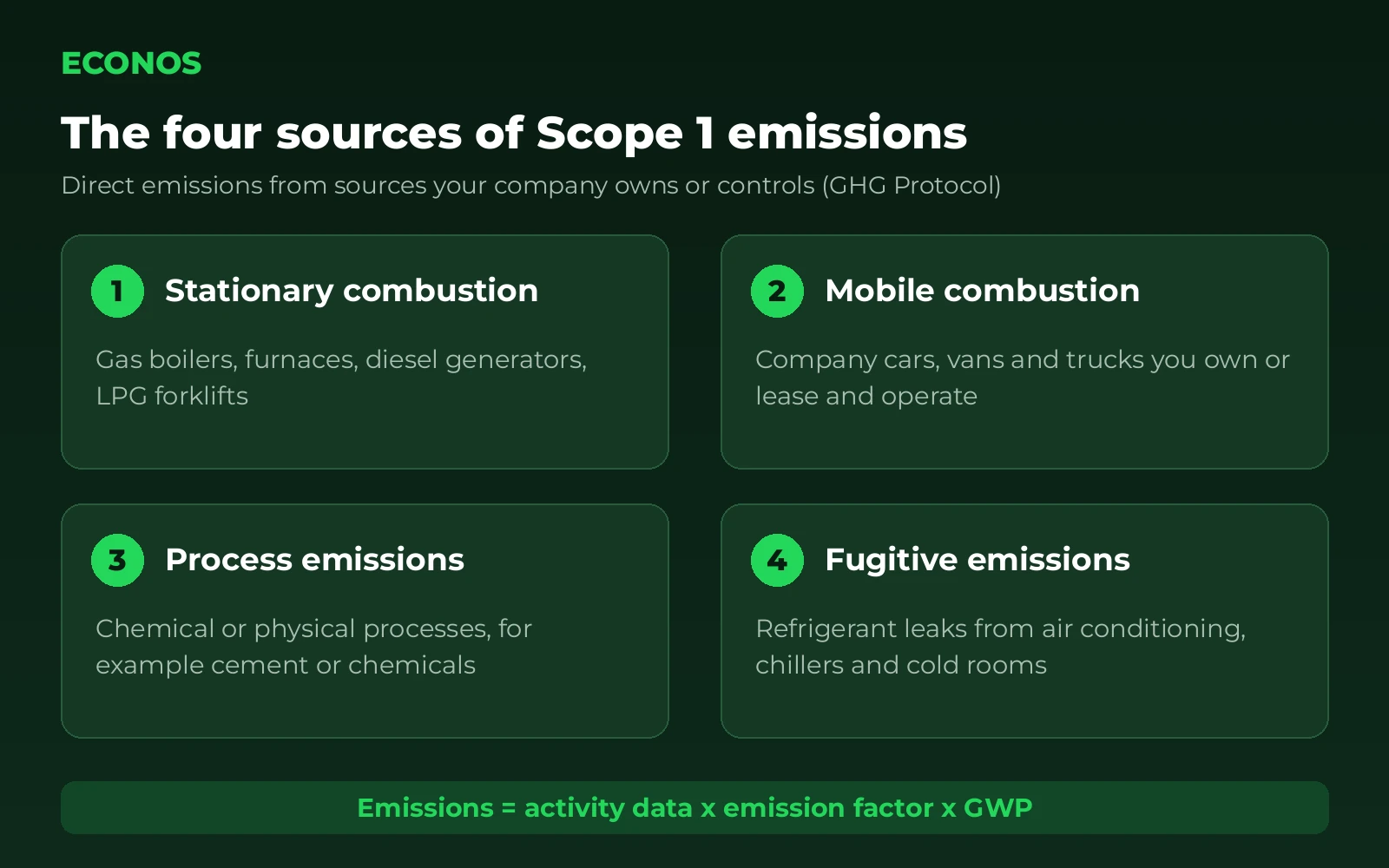
The GHG Protocol Corporate Standard defines direct GHG emissions as emissions from sources that are owned or controlled by the company. It groups them in four families: combustion in stationary equipment, combustion in vehicles, physical or chemical processes, and fugitive emissions such as equipment leaks.
If you are new to the topic, read our introduction to carbon footprint first. To check whether your company really needs a full inventory this year, see Carbon footprint in 2026: who still needs one after Omnibus.
The four sources to check before you calculate Scope 1 emissions
1. Stationary combustion
Natural gas boilers, industrial furnaces, dryers, diesel emergency generators and LPG or diesel forklifts. In Romania, gas invoices are expressed in kWh, which makes the data easy to collect.
2. Mobile combustion
Cars, vans and trucks owned by the company, and vehicles you lease and operate when you use the operational control approach. Fuel card reports in litres are the most reliable source. Electricity used to charge electric cars is not Scope 1, it belongs to Scope 2, explained in our article Scope 2 in Romania: location-based or market-based.
3. Process emissions
Emissions released by chemical or physical reactions, not by burning fuel. Cement, lime, glass, chemicals and some metal processes are the typical cases. Most offices, distributors and light manufacturers have none.
4. Fugitive emissions from refrigerants
Fugitive emissions are mainly HFC refrigerants that leak from air conditioning units, chillers, cold rooms and refrigerated trucks. The small quantities hide large effects, because these gases have a very high GWP.
How to calculate Scope 1 emissions, step by step
- Set your boundary. List every site, vehicle and piece of equipment you own or control. Choose a consolidation approach and keep it every year.
- Collect activity data. Gas in kWh from invoices, fuel in litres from fuel cards, refrigerant in kg from service reports.
- Choose emission factors. Use a recognised source, for example the default factors of the IPCC 2006 Guidelines, stationary combustion chapter, or a national database. Write down the version and year.
- Apply GWP values to convert refrigerants and other gases into CO2 equivalent.
- Add, check and document. Compare with last year and explain large changes.
Factors are where most errors happen. Our guide emission factors explained for compliance professionals covers how to choose them and how to document them.
A worked example with real factors
Take a Romanian company with one production site and a small fleet.
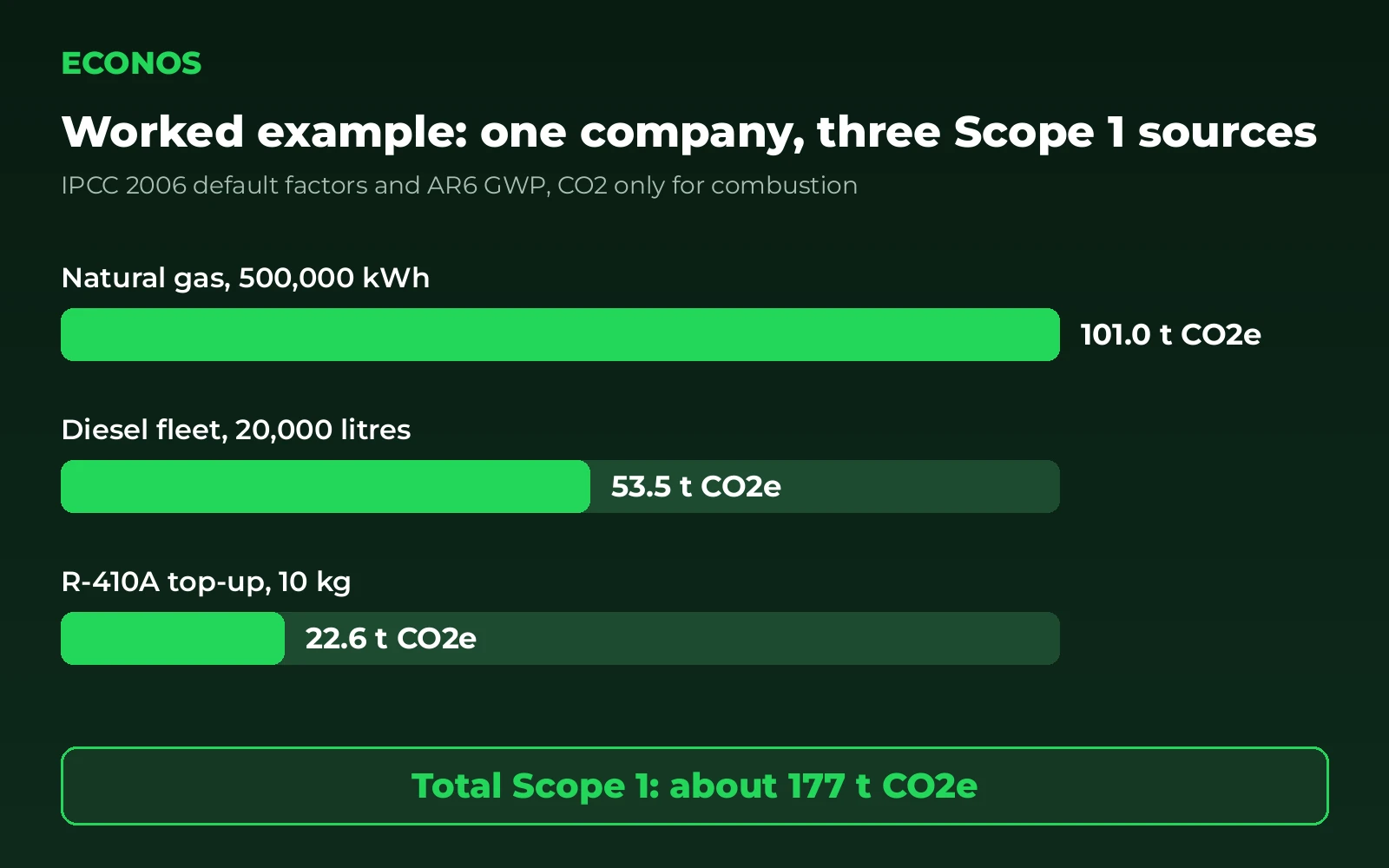
- Natural gas: 500,000 kWh per year. The IPCC default factor is 56,100 kg CO2 per TJ on a net calorific basis, which is about 0.202 kg CO2 per kWh. Result: about 101 t CO2.
- Diesel fleet: 20,000 litres. With the IPCC default of 74,100 kg CO2 per TJ, the default net calorific value of 43.0 TJ per thousand tonnes and a typical density of 0.84 kg per litre, this gives about 2.68 kg CO2 per litre. Result: about 53.5 t CO2.
- Refrigerant: 10 kg of R-410A refilled after a leak. R-410A is a 50/50 blend of HFC-32 and HFC-125. With the AR6 values published by the GHG Protocol GWP table, 771 and 3,740, its GWP is about 2,256. Result: about 22.6 t CO2e.
Total Scope 1: about 177 t CO2e. Ten kilograms of gas weigh almost half as much as 20,000 litres of diesel in this inventory.
Two technical points. First, the example counts CO2 only for combustion. Complete factor sets also include small amounts of methane and nitrous oxide. Second, energy on gas invoices is usually expressed on a gross calorific basis, while IPCC factors use the net basis. For natural gas the difference is about 10 percent, so always check which basis your factor uses. For refrigerants, the GHG Protocol recommends the latest IPCC values, AR6, as listed in its Global Warming Potential values table.
Where to find Scope 1 data in a Romanian company
In our carbon footprint projects in Romania, the finance team usually has the gas invoices and the fuel card reports ready in a few days. The refrigerant data is the gap. Air conditioning refills sit in a maintenance contract that nobody connects to the carbon footprint, and the LPG forklifts and the emergency generator are often forgotten.
The EU F-gas Regulation (EU) 2024/573 helps here. It requires leak checks on many types of equipment and records of the quantities added. Ask your service company for the intervention sheets for the whole year and add up the kilograms refilled per gas type.
Common mistakes when you calculate Scope 1 emissions
- Leaving out refrigerants because the quantities look small.
- Counting electric car charging in Scope 1 instead of Scope 2.
- Mixing gross and net calorific values without noticing.
- Reporting CO2 from biomass, such as wood pellets, inside Scope 1. The GHG Protocol asks you to report it separately.
- Changing factor sources from one year to the next without explaining the change.
A clean Scope 1 is also the base for a credible reduction plan. Our carbon footprint reduction checklist for companies shows where to act first, and our article on Scope 3 emissions explains what comes after Scopes 1 and 2.
Why getting Scope 1 right matters for customers and EcoVadis
Scope 1 is the part of your footprint that you control directly, so customers and rating platforms expect it to be complete and reliable. In an EcoVadis assessment, a documented Scope 1 and 2 inventory is a basic piece of evidence in the environment theme. If you need help with the full inventory, see our carbon footprint assessment for Scope 1, 2 and 3.
Frequently asked questions
What are Scope 1 emissions?
Scope 1 emissions are the direct greenhouse gas emissions from sources your company owns or controls. Typical examples are gas boilers, company vehicles, diesel generators and refrigerant leaks from air conditioning.
How do you calculate Scope 1 emissions?
Multiply each activity figure, such as kWh of gas, litres of diesel or kg of refrigerant, by an emission factor or a global warming potential. Then add the results and convert them to tonnes of CO2 equivalent.
Are refrigerant leaks part of Scope 1?
Yes. Under the GHG Protocol, leaks of HFC refrigerants from equipment you own or control are fugitive Scope 1 emissions. The quantity refilled during maintenance is usually the best estimate of what leaked.
Are leased company cars Scope 1 or Scope 3?
It depends on your consolidation approach. Under operational control, which most companies use, fuel burned in cars you lease and operate is reported in Scope 1.
Which GWP values should I use in 2026?
The GHG Protocol recommends the latest IPCC values, currently AR6. If a customer or programme asks for AR5, use it consistently and state the choice in your report.
Conclusion
To calculate Scope 1 emissions correctly, start with a clear boundary, collect gas, fuel and refrigerant data, apply documented factors and AR6 GWP values, and explain every choice. Once the method is written down, repeating it every year takes a fraction of the first effort.
Sources and recommended reading
- GHG Protocol, A Corporate Accounting and Reporting Standard, revised edition
- IPCC 2006 Guidelines, Volume 2, Chapter 2: Stationary Combustion
- GHG Protocol, Global Warming Potential Values (August 2024)
- Regulation (EU) 2024/573 on fluorinated greenhouse gases, EUR-Lex
- GHG Protocol, Calculation tool for direct emissions from stationary combustion
- GHG Protocol, Scope 1 and 2 GHG Inventory Guidance handbook
Recommended on ECONOS
- Carbon footprint assessment, Scope 1, 2 and 3
- Reduce my carbon footprint
- How to implement effective carbon emissions reduction methods
- ECONOS Academy training
How ECONOS can help
ECONOS calculates your Scope 1, 2 and 3 emissions under the GHG Protocol. We map your sites, vehicles and cooling equipment, collect the data with your team, choose and document the factors, and deliver results ready for customers, auditors and EcoVadis. With AVA, our AI carbon accounting assistant, you can repeat the calculation every year without starting from zero.
Contact ECONOS to discuss your carbon footprint. An ECONOS expert will reply as soon as possible.