
.png)

TL;DR:
- Emission factors convert activity data into estimated greenhouse gas emissions and are essential for accurate GHG inventories. They vary by scope, geography, and energy source, requiring careful selection, consistent GWP basis, and regular updates to reflect changing energy mixes. Misusing or combining outdated, inconsistent, or regionally inappropriate factors can lead to significant errors and audit challenges.
A GHG emission factor is a coefficient that quantifies the average amount of greenhouse gas emitted per unit of activity, such as liters of fuel burned or kilowatt-hours of electricity consumed. In carbon accounting, it is the single most critical input for translating raw operational data into a measurable emissions figure. Without a reliable emission factor, every number in your GHG inventory is an educated guess. This guide covers the types, calculation methods, geographic nuances, and practical pitfalls of emission factors, written specifically for environmental professionals managing Scope 1, 2, and 3 reporting under frameworks like CSRD, GHG Protocol, and EcoVadis.
What are the main types and sources of GHG emission factors?
Emission factors are not a monolithic category. They differ by emission source, geographic context, and the scope of emissions they represent. Understanding these distinctions is the foundation of any credible GHG footprint analysis.
The most common classification follows the GHG Protocol’s Scope structure:
- Scope 1 factors cover direct combustion sources, including natural gas boilers, diesel generators, and company-owned vehicles. These are often sourced from US EPA AP-42, DEFRA UK, or IPCC guidelines, and are typically expressed in kg CO2e per unit of fuel (liter, cubic meter, or GJ).
- Scope 2 factors apply to purchased electricity and heat. Grid electricity factors vary by country and reflect the national energy mix. They are published by the IEA, EPA eGRID, and DEFRA, among others.
- Scope 3 factors cover upstream and downstream activities, including purchased goods, business travel, and waste. These often come from databases like Ecoinvent or DEFRA’s supply chain factors.
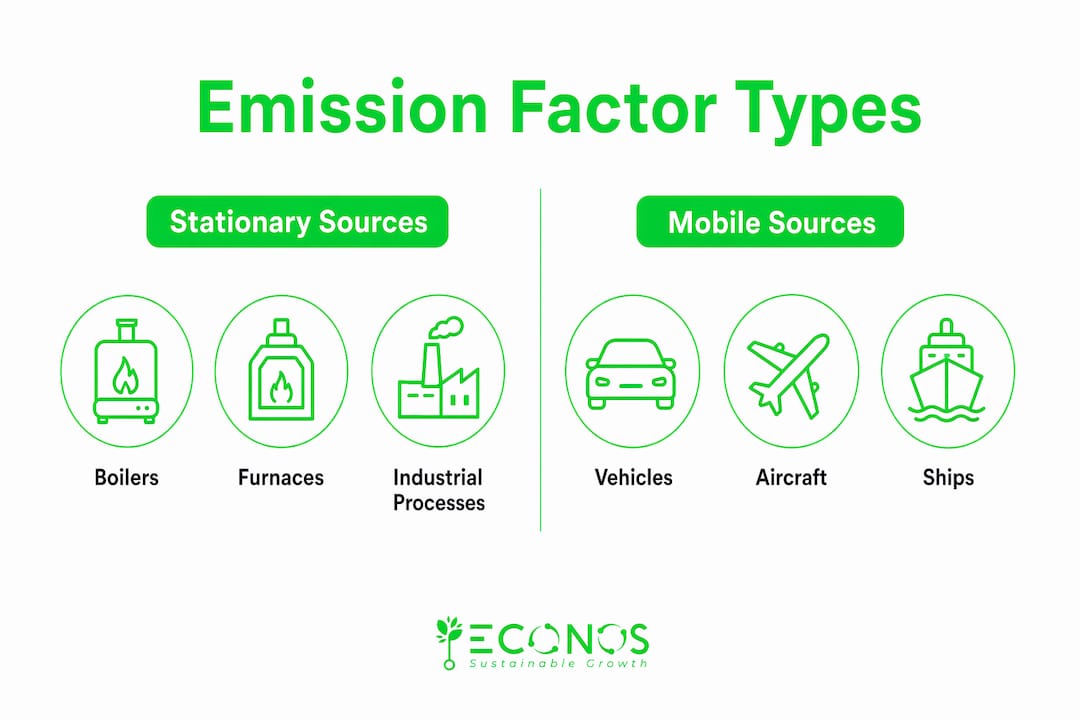
Beyond scope, emission factors also split between stationary sources (boilers, furnaces, industrial processes) and mobile sources (fleet vehicles, aircraft). Stationary combustion factors are usually more stable and well-documented. Mobile source factors depend heavily on vehicle type, fuel standard, and load conditions.
Multiple authoritative sources publish emission factors, including government agencies like the US EPA and UK DEFRA, international bodies like the IPCC and IEA, and specialized lifecycle databases like Ecoinvent. Geographic and temporal relevance matters enormously. A 2015 grid factor for Germany will significantly understate current emissions reductions from renewable expansion. Always use the most recent dataset available for the reporting year in question.
How are GHG emission factors calculated and applied?
The standard formula for calculating emissions using an emission factor is E = A × EF × (1 - ER/100), where E is total emissions, A is the activity data, EF is the emission factor, and ER is the emission reduction efficiency as a percentage. This formula, published by the US EPA, is the backbone of most emissions inventory methods.
Here is how it works in practice, step by step:
- Collect activity data. Gather metered or invoiced consumption figures. For fuel combustion, this means liters or cubic meters. For electricity, it means kWh from utility bills.
- Select the correct emission factor. Match the factor to the fuel type, geographic region, and reporting year. A natural gas boiler in France requires a different factor than the same boiler in Romania.
- Apply unit conversions. Scope 1 combustion factors from DEFRA are often expressed on a gross calorific value (GCV) basis. If your fuel meter records volume, you need a density and calorific value conversion before applying the factor.
- Calculate raw emissions. Multiply activity data by the emission factor. The result is typically in kg CO2, kg CH4, and kg N2O separately.
- Apply GWP to convert to CO2e. Use the GWP values embedded in your chosen dataset. DEFRA 2025 factors already embed IPCC AR5 GWP-100 values (CH4 = 28, N2O = 265), so no additional GWP multiplier is needed. Applying one anyway causes double counting.
A concrete example: a facility consumes 10,000 liters of diesel. Using a DEFRA 2025 Scope 1 factor of approximately 2.68 kg CO2e per liter, total emissions equal 26,800 kg CO2e, or 26.8 tonnes CO2e. That figure feeds directly into your Scope 1 total for CSRD or EcoVadis reporting.
Pro Tip: Always document which emission factor dataset and version you used, including the publication year. Auditors under CSRD and EcoVadis will ask. A clear assumption log is not bureaucracy. It is your defense against challenge.

What are the common limitations and misconceptions about emission factors?
Emission factors are statistical averages derived from measurements across many sources. They are not precise constants for any individual facility. This distinction matters more than most practitioners admit.
The US EPA is explicit on this point. Errors of 50% or more are possible when applying population-average factors to a specific source. A well-maintained, modern boiler will emit less than an aging unit running on the same fuel, yet both receive the same emission factor in a standard inventory. This does not make emission factors useless. It means you must treat your GHG inventory as an estimate, not a measurement.
A second critical misconception involves regulatory compliance. The EPA advises explicitly that emission factors are not emission limits and must not be used as permit ceilings. Using AP-42 factors as compliance benchmarks could incorrectly flag roughly half of all sources as noncompliant, because the average factor sits in the middle of a wide distribution.
Common pitfalls to watch for in practice:
- Mixing GWP versions. Applying AR6 GWP values to a dataset that already embeds AR5 values inflates your inventory. DEFRA 2025 uses AR5. The IPCC AR6 report uses updated values. Confirm which version your dataset uses before any manual adjustment.
- Using outdated factors. Grid electricity factors change annually as energy mixes shift. A 2020 factor for the UK grid overstates current emissions given the growth of offshore wind.
- Applying national averages to regional operations. The US national average grid factor from EPA eGRID is 0.350 kg CO2e/kWh, but regional grids like WECC (western US) differ substantially from SERC (southeastern US).
“Emission factors represent the best available estimate for a population of sources. They are a tool for inventory, not a verdict on any individual facility.” — US EPA guidance
How do geographic and energy mix differences affect grid electricity factors?
Grid electricity emission factors are among the most variable inputs in any corporate GHG inventory. The range spans from 0.028 kg CO2e/kWh in Norway to 0.699 kg CO2e/kWh in South Africa, a 25-fold difference driven entirely by national energy mix. This variance is not academic. It directly determines whether your Scope 2 emissions look like a rounding error or a material risk.
The table below shows selected country grid factors for reference:
| Country | Grid emission factor (kg CO2e/kWh) | Primary energy driver |
|---|---|---|
| Norway | 0.028 | Hydropower |
| France | ~0.052 | Nuclear |
| United Kingdom | 0.177 | Gas + renewables mix |
| Germany | 0.330 | Gas + coal + renewables |
| United States | 0.350 | Gas + coal + renewables |
| South Africa | 0.699 | Coal-dominant |
The US national average of 0.350 kg CO2e/kWh comes from EPA eGRID 2023. The UK figure of 0.177 reflects DEFRA 2025 data. Germany’s figure reflects a grid still transitioning away from coal. These numbers shift year over year, which is why annual updates to your emission factor dataset are not optional under frameworks like CSRD.
The GHG Protocol Scope 2 Guidance distinguishes between location-based and market-based methods. The location-based method uses the average grid factor for the country or region where electricity is consumed. The market-based method uses supplier-specific factors or residual mix factors, which apply when a company purchases renewable energy certificates (RECs) or power purchase agreements (PPAs). Both methods are valid, but they must be reported separately and cannot be mixed within a single Scope 2 total.
Pro Tip: In multi-country corporate inventories, mixing grid factors from different sources such as Ember, DEFRA, and EPA eGRID is methodologically defensible, provided you disclose the sources transparently and explain the rationale. Consistency within each country is what matters most.
How to select and use emission factors effectively for reporting
Selecting the right emission factor is a judgment call, not a lookup exercise. The criteria that matter most are geography, data vintage, scope alignment, and the GWP basis embedded in the dataset. Getting these right before you build your inventory saves significant rework during assurance or audit.
Practical guidance for sustainability managers:
- Prioritize national or regional factors over global averages. For a Romanian manufacturing facility, DEFRA or IPCC factors are acceptable for Scope 1 combustion, but a Romania-specific grid factor from the IEA or national regulator is more accurate for Scope 2.
- Resolve conflicting values by documenting your rationale. When two credible sources give different factors for the same activity, choose the more recent one and note the discrepancy. Transparency is more defensible than false precision.
- Align GWP basis across all factors in the inventory. Mixing AR5 and AR6 GWP values in the same inventory creates inconsistencies that auditors will flag. Pick one version and apply it consistently.
- Update factors annually. Grid electricity factors in particular change meaningfully year over year. A static factor from 2022 applied to 2025 data is a methodological error, not a conservative assumption.
- Use emission factors to feed ESG reporting metrics. Emission factors are not just for carbon footprints. They feed intensity ratios, reduction targets, and Scope 3 category calculations that appear in CSRD disclosures and EcoVadis scorecards.
For Scope 3 emissions, spend-based or activity-based emission factors from Ecoinvent or DEFRA supply chain tables are the standard starting point. The choice between them depends on data availability and the materiality of the category. A spend-based factor for purchased goods is a reasonable proxy when supplier-specific data is unavailable, but it carries higher uncertainty than a physical activity factor.
Key takeaways
Accurate GHG accounting requires selecting emission factors that are geographically specific, temporally current, and aligned to a consistent GWP basis, because errors in any one of these dimensions compound across the entire inventory.
| Point | Details |
|---|---|
| Emission factor definition | A coefficient linking activity data to GHG emissions, expressed in kg CO2e per unit of activity. |
| Geographic variance is material | Grid factors range from 0.028 to 0.699 kg CO2e/kWh globally, making country selection critical for Scope 2. |
| Factors are averages, not limits | Facility-level errors of 50% or more are possible; never use emission factors as regulatory compliance ceilings. |
| GWP consistency is non-negotiable | Mixing AR5 and AR6 GWP values, or applying multipliers to pre-converted datasets like DEFRA 2025, inflates inventories. |
| Annual updates are required | Grid and supply chain factors shift year over year; static datasets create methodological errors in multi-year reporting. |
What I have learned from working with emission factors in practice
By Mathieu
After working through GHG inventories across more than a dozen industries at Econos-esg, the pattern I see most often is not a lack of data. It is overconfidence in the data that exists. Companies spend weeks collecting activity data with precision, then apply a single national average emission factor and treat the result as authoritative. The factor is doing most of the work, and it is an average.
My honest observation is that the most useful thing a sustainability manager can do is build a sensitivity table. Run your inventory with three different emission factors for your highest-emission activities. If the result changes by less than 5%, your choice of factor is not your biggest problem. If it changes by 30%, you need a better factor before you publish anything.
The second thing I would push back on is the instinct to use the most recent dataset for everything. Consistency across reporting years matters as much as currency. If you switch from DEFRA 2024 to DEFRA 2025 mid-inventory, you need to restate prior years or clearly disclose the change. Auditors under CSRD are not just checking your math. They are checking whether your methodology is stable enough to support trend analysis.
The third point is one I confess we learned the hard way with early clients: document your assumptions before the audit, not during it. An assumption log written under pressure looks like it was written under pressure. One built into your workflow from the start looks like a mature system. That distinction matters enormously when a third-party verifier is reviewing your CSRD disclosure.
— Mathieu
How Econos-esg supports precise carbon accounting

Selecting the right emission factors and applying them correctly across Scope 1, 2, and 3 is exactly the kind of work where a methodology error early in the process creates compliance risk later. Econos-esg has completed over 158 projects across 17 industries, helping companies like Michelin, eMAG, and Raiffeisen Bank build GHG inventories that hold up under EcoVadis and CSRD scrutiny. Our carbon footprint assessment service integrates industry-standard emission factor databases with your specific operational data, and our AVA platform helps your team run calculations autonomously without creating consultant dependency. If your ESG reporting needs a more defensible emissions methodology, we are ready to help.
FAQ
What is an emission factor in GHG accounting?
An emission factor is a coefficient that converts activity data, such as fuel consumption or electricity use, into an estimated quantity of greenhouse gas emissions, expressed in kg CO2e per unit of activity. It is the primary calculation input in any GHG inventory.
Which databases provide the most reliable emission factors?
The US EPA AP-42 and eGRID, UK DEFRA annual factors, IPCC Emission Factor Database (EFDB), and IEA grid factors are the most widely accepted sources for corporate GHG inventories. Ecoinvent is the standard for Scope 3 lifecycle-based factors.
Can emission factors be used as regulatory compliance limits?
No. The US EPA explicitly states that emission factors are population averages and must not be used as permit ceilings, because doing so could misclassify roughly half of all sources as noncompliant.
Why do grid electricity emission factors vary so much by country?
Grid factors reflect the national energy mix. Norway’s hydropower-dominant grid produces 0.028 kg CO2e/kWh, while South Africa’s coal-reliant grid produces 0.699 kg CO2e/kWh. The difference is entirely structural, not operational.
What is the risk of mixing AR5 and AR6 GWP values in one inventory?
Mixing GWP versions inflates or deflates your total CO2e figure and creates inconsistencies that auditors will flag. DEFRA 2025 already embeds AR5 GWP values, so applying an additional AR6 multiplier to those factors results in double counting.