

Most PPWR discussions focus on sales packaging, labels and recyclability. The PPWR reuse targets in Article 29 of Regulation (EU) 2025/40 go after something else: the pallets, crates, drums and boxes that move goods between companies. From 2030, a large part of this transport packaging must be reusable, and for some flows it must be 100% reusable. This guide explains the rules, the exemptions and what Romanian manufacturers and distributors should plan now.
In short
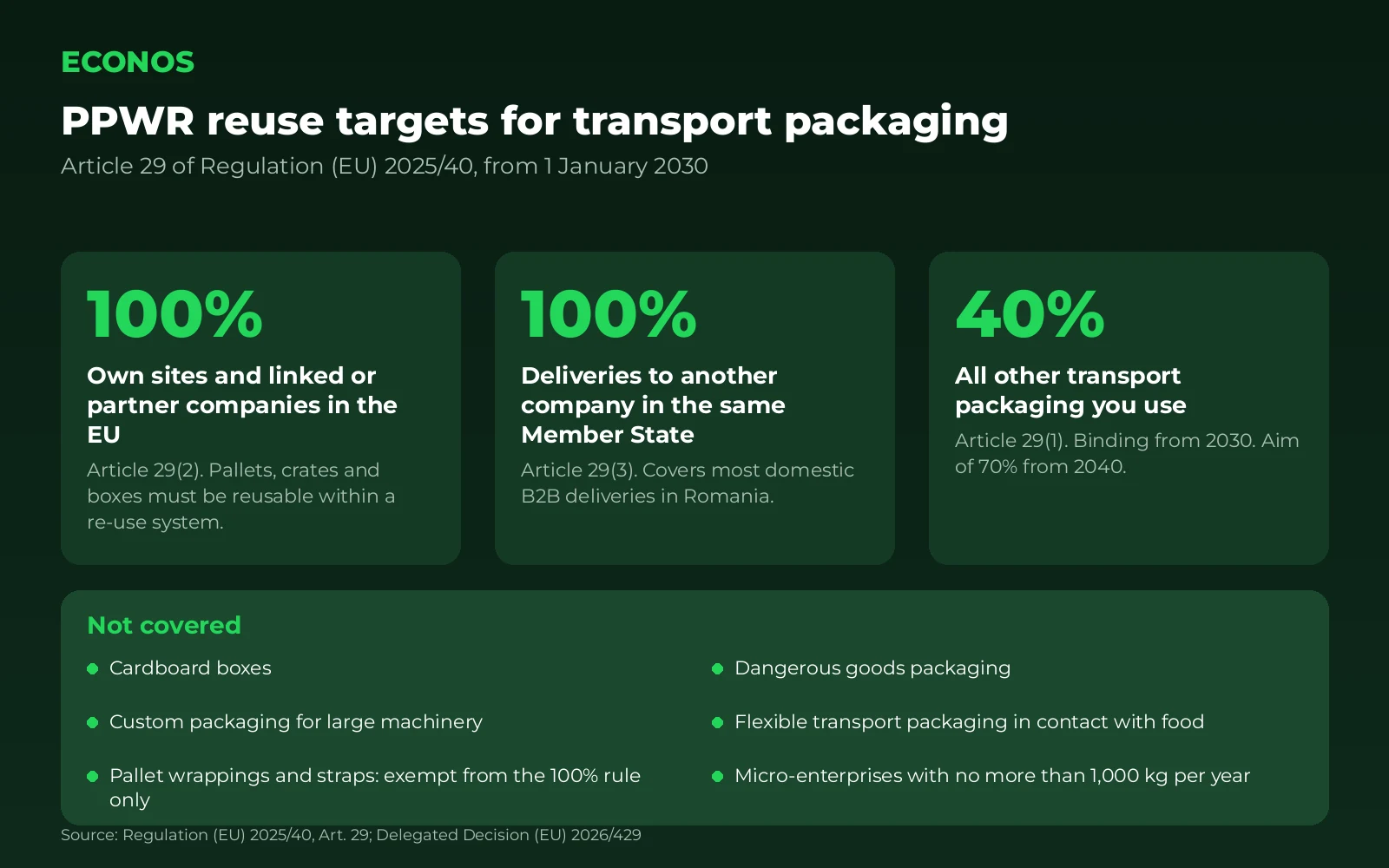
- From 1 January 2030, at least 40% of the transport packaging you use must be reusable within a re-use system, with an aim of 70% by 2040.
- Transport between your own sites, or deliveries to another company in the same Member State, must use 100% reusable packaging.
- Cardboard boxes, dangerous goods packaging and a few other formats are excluded, and pallet wrappings and straps are exempt from the 100% rule.
What the PPWR reuse targets say
Article 29(1) applies to economic operators using transport packaging, or sales packaging used for transport, within the EU by road, rail, ship or air. The list is wide: pallets, foldable plastic boxes, boxes, trays, plastic crates, intermediate bulk containers, pails, drums and canisters, of any size or material, including flexible formats. From 1 January 2030, at least 40% of this packaging must be reusable packaging within a re-use system. For 2040, the text says operators "shall endeavour" to reach 70%, which is an aim, not a binding target.
The obligation sits with the company that uses the packaging, which is not always the company that made it. If you are unsure how your role is defined, read our guide on manufacturer and producer roles under the PPWR.
The 100% rule for domestic and intra-group flows
Two flows go further than 40%. Under Article 29(2), packaging used to move products between your own sites, or between your sites and linked or partner enterprises anywhere in the EU, must be reusable within a re-use system. Under Article 29(3), the same applies when you deliver products to another economic operator within the same Member State. For a Romanian company, this means most domestic B2B deliveries.
Grouped packaging and beverages
Article 29 also sets a 10% target from 2030 for grouped packaging in the form of boxes, excluding cardboard, and a 10% target for final distributors selling certain beverages. Beverage reuse connects with deposit systems, covered in our article on the PPWR deposit return system in Romania.
Exemptions from the PPWR reuse targets
Article 29(4) excludes four types of packaging from paragraphs 1 to 3:
- packaging for the transport of dangerous goods under Directive 2008/68/EC;
- custom-designed packaging for large-scale machinery and equipment;
- flexible transport packaging in direct contact with food and feed;
- cardboard boxes.
The Commission FAQ on the PPWR states that this list is limitative and read strictly, and that it does not cover interlayers. If your choice is between cardboard and plastic, our guide on choosing cardboard or plastic packaging under the PPWR covers the other rules that apply.
Pallet wrappings and straps
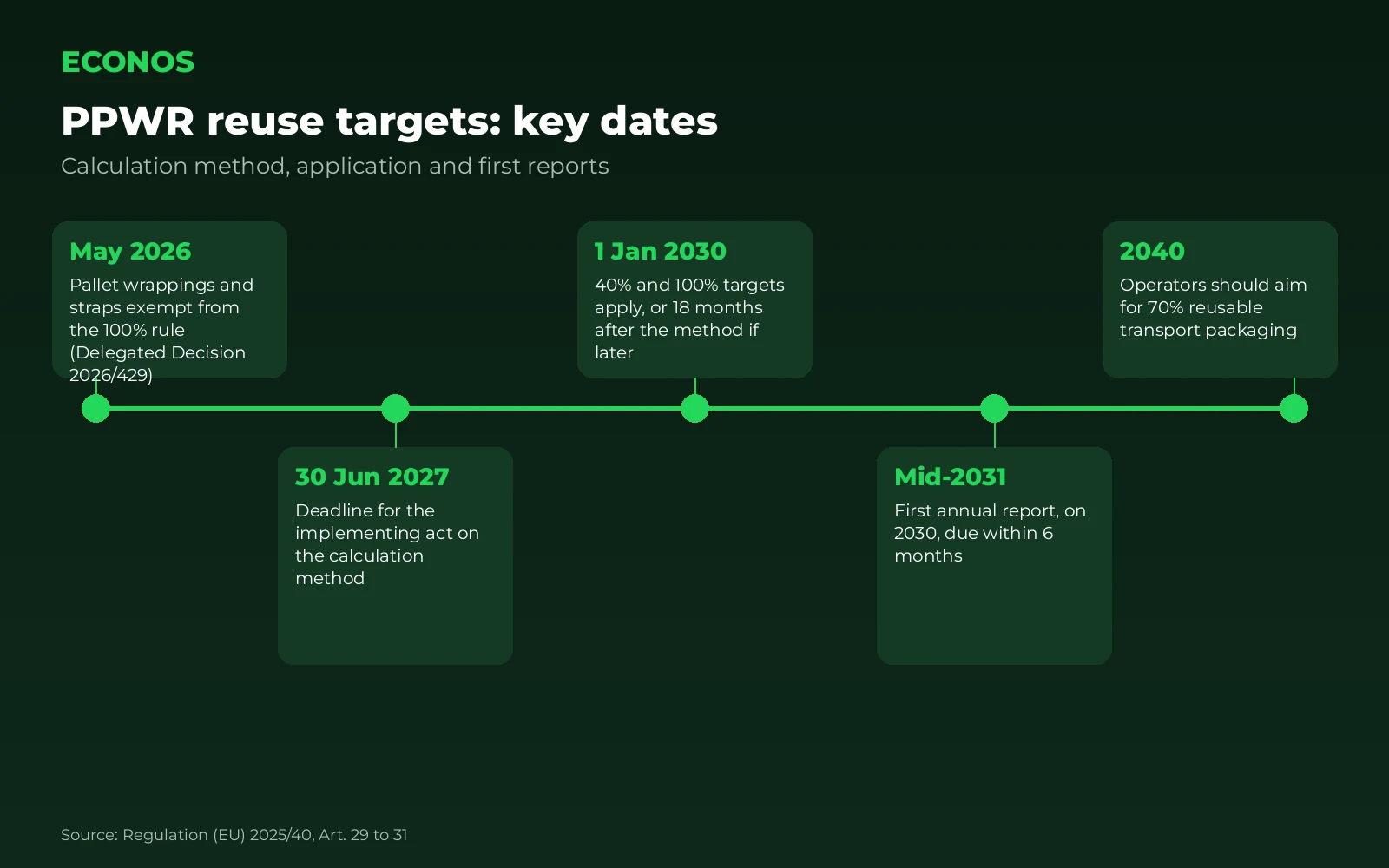
Commission Delegated Decision (EU) 2026/429 exempts pallet wrappings and straps from the 100% rule in Article 29(2) and (3). It has applied since May 2026. Stretch film and straps still count under the general 40% target, as AGRINFO summarises.
Micro-enterprises and national derogations
Under Article 29(13), an operator is exempt for a calendar year if it is a micro-enterprise and made available no more than 1,000 kg of packaging in a Member State. Article 29(14) also lets a Member State exempt operators for 5 years if strict national recycling and waste prevention conditions are met. Romania has not announced such a derogation, so verify before relying on it.
How the PPWR reuse targets will be measured
The calculation method is not final. Article 30(3) asks the Commission to adopt an implementing act by 30 June 2027. Operators must show compliance from 1 January 2030, or 18 months after that act enters into force, whichever is later.
Reusable packaging must also complete a minimum number of rotations, to be set in a delegated act, and you must take part in a re-use system that meets Annex VI. The Commission FAQ gives the exchangeable Euro pallet as an example of an open-loop system, and you can also use a pooling provider or set up a closed loop with your customers. Under Article 31, you report your results every year, the first reporting year is 2030, and reports are due within 6 months after the year ends.
What we see in Romanian companies
A typical case we see at ECONOS is a Romanian food or building materials producer that delivers to retail distribution centres and wholesalers in Romania. Goods leave on one-way wooden pallets, plastic crates are bought new and not taken back, and every pallet is wrapped in film. Under Article 29(3), those domestic deliveries fall under the 100% rule from 2030, so the pallets and crates need to move into a re-use system with return logistics.
The cost is not only packaging. Pooling fees, return transport, cleaning and tracking all change. Fewer one-way pallets and crates also change the packaging quantities you declare for EPR each year, see packaging EPR in Romania and EPR fee eco-modulation after 2030. For examples of formats that already work, see our article on reusable packaging solutions for businesses.
How to prepare for the PPWR reuse targets in 6 steps
- Map your transport packaging by flow: own sites, linked companies, domestic customers, other EU customers, exports.
- Mark the exempt items: cardboard boxes, dangerous goods packaging, flexible food-contact formats, film and straps.
- Count units and weight per flow to estimate your gap to 40% and 100%.
- Talk to pallet and crate pooling providers and to key customers about return loops.
- Compare one-way and reusable options on cost and carbon, for example with a life cycle assessment (LCA).
- Set up data collection now, so you can report on 2030 from day one.
Shipping box sizes matter too, because the 50% cap in our guide on the PPWR empty space ratio also targets transport and e-commerce packaging. Reusable packaging must also be documented in your PPWR technical file and declaration of conformity.
Conclusion
The PPWR reuse targets turn pallets and crates into a compliance topic. For Romanian companies, the 100% rule for domestic deliveries is the part that will change logistics the most. Starting the mapping in 2027 gives you time to build return loops before 2030.
Frequently asked questions
What are the PPWR reuse targets for transport packaging?
From 1 January 2030, at least 40% of the transport packaging an economic operator uses must be reusable within a re-use system, with an aim of 70% by 2040. For transport between your own sites or linked enterprises in the EU, and for deliveries to another operator in the same Member State, the rule is 100%.
Are cardboard boxes covered by the reuse targets?
No. Article 29(4) of Regulation (EU) 2025/40 excludes cardboard boxes, packaging for dangerous goods, custom packaging for large machinery and flexible transport packaging in direct contact with food. The Commission FAQ says this list is read strictly.
Does stretch film have to be reusable under the PPWR?
Not under the 100% rule. Delegated Decision (EU) 2026/429 exempts pallet wrappings and straps from Article 29(2) and (3). They are still part of the general 40% target.
Who is responsible for meeting the PPWR reuse targets?
The economic operator that uses the transport packaging, typically the company that ships the goods. It must take part in a re-use system that meets Annex VI of the regulation and report its results each year.
When is the first PPWR reuse report due?
The first reporting year is 2030, and reports are due within 6 months after the end of the year, so by mid-2031. The calculation method will be set by an implementing act due by 30 June 2027.
Sources and recommended reading
- Regulation (EU) 2025/40 on packaging and packaging waste, EUR-Lex
- Commission Delegated Decision (EU) 2026/429 on pallet wrappings and straps, EUR-Lex
- Commission Notice C/2026/3084, guidance document for the PPWR
- European Commission, PPWR frequently asked questions
- European Commission, packaging waste policy page
- AGRINFO, transport packaging reuse of pallet wrappings and straps
Recommended on ECONOS
- PPWR packaging minimisation: Article 10 guide
- PPWR banned packaging formats from 2030
- PPWR for exporters and importers
- PPWR authorised representative
How ECONOS can help
ECONOS helps Romanian and EU companies map their transport packaging flows, estimate their gap to the PPWR reuse targets, compare one-way and reusable options and prepare the data for annual reporting. Our EU packaging law compliance service covers PPWR and EPR end to end, and ECONOS Academy trains logistics, purchasing and quality teams to manage the topic on their own.
Contact ECONOS to review your transport packaging before 2030.