
.png)

TL;DR:
- Businesses face increasing pressure to adopt scalable, compliant reusable packaging solutions that align with regulations like the EU’s PPWR. Successful implementation requires careful evaluation of durability, logistics, traceability, and interoperability, emphasizing system design over material choice alone. Leveraging technology and standards-driven formats enables companies to reduce environmental impact and meet evolving sustainability demands.
Businesses in every sector are under mounting pressure to rethink their packaging. Regulatory deadlines are tightening, customers are watching, and investors are asking hard questions about supply chain sustainability. The challenge is not whether to adopt reusable packaging. It is knowing which examples of reusable packaging solutions are actually practical, scalable, and compliant with current frameworks like the EU’s Packaging and Packaging Waste Regulation. This article breaks down what to evaluate before you commit, then walks through real-world cases with enough operational detail to help you make informed decisions.
Table of Contents
- Key takeaways
- 1. Evaluation criteria for reusable packaging solutions
- 2. Refillable consumer containers: the Ocado Retail model
- 3. Reusable transport packaging for B2B supply chains
- 4. Smart reusable packaging for e-commerce and retail shipping
- 5. Comparison of reusable packaging types by business suitability
- 6. Hygiene standards and interoperability as scaling enablers
- My honest perspective on scaling reusable packaging
- How Econos-esg can help you move from examples to execution
- FAQ
Key takeaways
| Point | Details |
|---|---|
| Start with design criteria | Evaluate durability, hygiene, foldability, and traceability before choosing a reusable format. |
| Consumer refillables scale fast | Ocado reached 90% of its customer base with a simple hand-back refill system using food-grade containers. |
| Foldable transport packaging pays off | BMW Group saved approximately 3,000 tonnes of CO2 annually by switching to foldable large containers. |
| IoT tracking protects your investment | Smart asset management eliminated 100,000 cardboard cartons and saved £6,000 in waste costs for Whitecroft Lighting. |
| Compliance is non-negotiable by 2026 | PPWR mandates reusability targets, traceability, and eco-design standards for all packaging placed on the EU market. |
1. Evaluation criteria for reusable packaging solutions
Before selecting a format, you need a framework. The examples of reusable packaging solutions that succeed in real deployments share a common set of design and operational traits. Skipping this step is how businesses end up with a pilot that never scales.
Here are the criteria that matter most:
- Durability and hygiene: The packaging must withstand repeated cleaning cycles without degrading. Published washing and inspection standards from the PR3 and CSA Group provide a benchmark for maintaining product safety and regulatory defensibility across reuse cycles.
- Regulatory compliance: The EU PPWR regulation mandates eco-design, reusability targets, and label traceability for all packaging placed on the EU market. Your chosen solution must be built to meet these requirements, not retrofitted later.
- Return logistics design: Foldability and nesting capability directly affect the cost and carbon footprint of reverse logistics. This is often the deciding factor between a system that is financially sustainable and one that is not. A full sustainable packaging workflow helps you model these tradeoffs before committing.
- Traceability and asset management: Without tracking, reusable packaging becomes a cost center. IoT integration, barcoding, or RFID tagging are now standard expectations, not premium add-ons.
- Ergonomics and user experience: Adoption rates drop when the format is awkward to handle. This applies to both consumer-facing products and warehouse staff managing transport containers.
- Material and circularity: Recycled content, recyclability at end of life, and material compatibility with cleaning agents all affect the lifecycle sustainability of the system.
Pro Tip: Before shortlisting formats, run a simple life cycle assessment on your current packaging. This gives you a baseline to measure actual improvement, not just assumed benefit. Econos-esg offers LCA consulting specifically for packaging decisions.
2. Refillable consumer containers: the Ocado Retail model
One of the most cited sustainable packaging examples in consumer goods right now is Ocado Retail’s refill program, developed in partnership with Amcor. The program uses food-grade 2 kg and 3 kg containers designed for multiple reuse cycles, with customers returning them through Ocado’s existing delivery network.
What makes this model operationally significant is the hand-back system. Drivers collect used containers during scheduled deliveries, eliminating the need for customers to make separate returns. This reduces friction dramatically. The result: Ocado scaled the program to 90% of its customer base, expanding the product range included in the refill system through 2024.
Key features of this format worth noting:
- Food-grade materials that meet hygiene and food contact standards
- Container design that holds up through multiple collection and cleaning cycles
- Integration with an existing logistics network, removing the need for separate reverse logistics infrastructure
- Scalable onboarding, since the system uses established delivery touchpoints
For businesses in food retail, grocery delivery, or any consumer subscription model, the Ocado case demonstrates that refillable containers do not require a separate logistics system. They require thoughtful integration with what you already operate.
3. Reusable transport packaging for B2B supply chains
Business-to-business logistics has the most mature ecosystem of reusable transport packaging, and also the highest volume opportunity for carbon reduction. The types of reusable containers in this category include pooled returnable plastic crates (RPCs), sleeve pack containers, pallet collars, and foldable large load carriers.
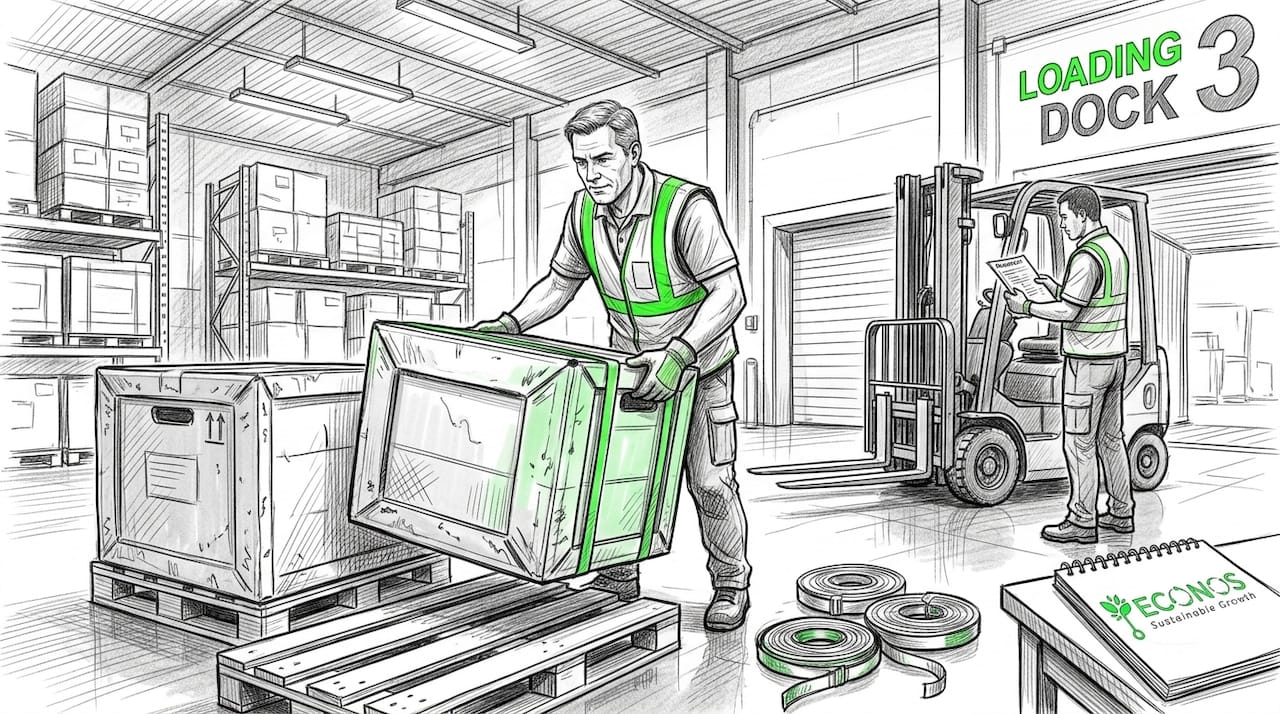
The most notable recent product in this space is the FalConic® Sleeve Pack Container, developed by Cabka and CHEP and launched at FachPack 2024. It is designed for light and medium dry goods, built from recycled materials, and specifically engineered to reduce reverse logistics volume. The FalConic SPC reduces empty-return volume by up to 75%, which is not a marginal gain. It changes the economics of reusable transport packaging entirely.
| Container type | Foldability | Best use case | PPWR-readiness |
|---|---|---|---|
| FalConic® Sleeve Pack Container | Yes, 75% volume reduction | Light/medium dry goods | Yes, traceable and recycled |
| Smartbox 1309.C2 pallet box | Yes, 50%+ reduction | Heavy goods, pallet shipping | Partial |
| Pooled RPCs (standard) | No | Fresh produce, food logistics | Depends on operator |
| BMW CabFold Hybrid container | Yes, 70% smaller when folded | Automotive parts | Yes |
The BMW Group case adds a different dimension. BMW deployed foldable large containers that fold 70% smaller for returns, fitting 288 units into a single return truck. The annual carbon saving reached approximately 3,000 tonnes of CO2. That figure came not from material choices alone, but from dramatically reducing the number of return trips required.
Pro Tip: When evaluating reusable transport packaging, calculate the return trip volume before anything else. A container that folds to one-quarter of its full size may generate more carbon and cost savings than one made from a more sustainable material but shipped back at full volume.
4. Smart reusable packaging for e-commerce and retail shipping
E-commerce creates a particular challenge for reusable packaging because there is no reliable point of return built into the transaction. The workarounds are becoming more sophisticated, and some are already generating measurable results.
Whitecroft Lighting’s case is the clearest example of what data-driven asset management can accomplish. The company deployed Geopak™ reusable containers fitted with GPS tracking via Sensolus technology, managed through Peak Technologies’ IoT platform. The outcome: eliminating 100,000 cardboard cartons and saving £6,000 in waste disposal costs. Those are hard financial numbers, not projected sustainability benefits.
Royal Mail’s deployment offers another scale point. The organization tagged 850,000 wheeled containers with IoT Pixels for real-time location and temperature monitoring, reducing container loss across a network of that size.
“Data-driven asset management transforms reuse programs into cost-saving, waste-reducing operations.” The businesses that treat reusable packaging as a tracked asset, rather than a consumable, are the ones that generate positive ROI fastest.
For e-commerce specifically, the practical reusable packaging ideas gaining traction include:
- Reusable shipping bags with embedded QR codes and collection points at retail locations or lockers
- Closed-loop mailer programs where the shipper manages collection and cleaning
- GPS-tracked rigid containers for B2B shipments within fixed trade lanes
The common thread is visibility. Without knowing where your containers are, you cannot recover them, clean them, or reuse them. Technology is not optional in this category. It is the difference between a reuse program and a loss program.
5. Comparison of reusable packaging types by business suitability
Not every format fits every operation. Here is a direct comparison of the main sustainable packaging examples covered in this article, mapped to the criteria that matter for business decision-making.
| Format | Durability | Reverse logistics | IoT-ready | Carbon impact | Best fit |
|---|---|---|---|---|---|
| Refillable consumer containers (Ocado model) | High | Integrated with delivery | Optional | High | Food retail, grocery delivery |
| Foldable sleeve pack containers (FalConic) | Very high | 75% volume reduction | Yes | Very high | FMCG, dry goods logistics |
| Foldable large containers (BMW model) | Very high | 70% smaller return | Traceable | Very high | Automotive, heavy industry |
| Smart reusable e-commerce containers (Geopak) | High | Managed via platform | Yes (GPS) | High | B2B e-commerce, retail |
| Pooled RPCs | Medium-high | Pooled return system | Varies | Medium | Fresh produce, cold chain |
The decision factors shift depending on your sector. Consumer-facing businesses should prioritize customer experience and integration with existing touchpoints, as Ocado demonstrated. B2B logistics operations should focus on foldability and asset tracking from day one.
For EU-based businesses, PPWR compliance should be treated as a minimum threshold, not a stretch goal. Understanding how extended producer responsibility frameworks interact with your packaging choices is part of getting this right. The best practices for reusable packaging all point to the same conclusion: design for the return trip as carefully as you design for the outbound one.
6. Hygiene standards and interoperability as scaling enablers
One of the least discussed but most critical factors in the benefits of reusable packaging is what happens between uses. Cleaning, inspection, and repacking processes are where many pilots stall. Without a defined protocol, reuse becomes a liability rather than an asset.
The RES-002:25/CSA R303:25 standard, published by PR3 and CSA Group with ANSI recognition, addresses exactly this. It establishes standardized washing processes that maintain product safety and support regulatory defensibility across markets. This is part of a six-standard series designed to create interoperability across reuse systems, which matters enormously when you are operating across multiple facilities or geographies.
Interoperability is the foundation for scaling beyond pilots. A reusable packaging system that only works within a single facility or supply chain partner network has limited value. The companies that will lead on packaging reuse initiatives are the ones investing now in formats and systems that can plug into emerging shared infrastructure.
If you are designing a reusable packaging program from scratch, choosing formats aligned with published interoperability standards reduces the risk of obsolescence as the regulatory and infrastructure landscape matures. You can also review our packaging recyclability guide for practical design decisions that support both reusability and end-of-life compliance.
My honest perspective on scaling reusable packaging
I have spent enough time with businesses working through packaging transitions to recognize a pattern. The companies that struggle are almost always the ones that started with the material decision. They picked a container, ran a small pilot, and then discovered that the return logistics, the cleaning process, and the asset tracking were not figured out. The pilot stalls, costs mount, and leadership loses confidence.
The companies that succeed start with the operational question: how does this come back, how does it get cleaned, and how do we know where it is? That framing changes every decision downstream.
What I find genuinely encouraging about the examples covered here, from BMW to Ocado to Whitecroft Lighting, is that none of them achieved results through heroic effort. They achieved results through deliberate system design. The foldability that saves BMW 3,000 tonnes of CO2 annually was an engineering specification, not an accident.
My honest admission is that regulatory compliance tends to get treated as a constraint. It is actually clarifying. When PPWR tells you that your packaging must be traceable, reusable, and designed to defined standards, it removes ambiguity. You know what the system has to do. The harder work is building the internal capacity to manage it, which is where most businesses need support they are not yet asking for.
— Mathieu
How Econos-esg can help you move from examples to execution
Knowing what good reusable packaging looks like is a start. Knowing whether your current packaging strategy is actually reducing your carbon footprint, meeting PPWR requirements, and holding up under ESG scrutiny is a different challenge entirely. Econos-esg works with mid-size and large companies to provide carbon footprint assessment and ESG reporting services that ground packaging decisions in real data. We also offer LCA consulting to evaluate the environmental impact of packaging systems before you commit. If you are working toward PPWR compliance or preparing for an EcoVadis evaluation, we can help you build the internal capability to do this work with confidence, not just outsource it.
FAQ
What are the main types of reusable packaging for businesses?
The primary types include refillable consumer containers, reusable transport packaging such as foldable crates and sleeve pack containers, and smart reusable e-commerce shipping formats with asset tracking. Each serves different supply chain contexts and regulatory requirements.
How does PPWR affect reusable packaging decisions in 2026?
The EU Packaging and Packaging Waste Regulation mandates eco-design, reusability targets, and traceability for packaging placed on the EU market. Businesses must select formats that meet these standards, not formats that can be adapted later.
What is the ROI on reusable transport packaging?
ROI depends heavily on return logistics efficiency and asset tracking. BMW Group achieved approximately 3,000 tonnes of CO2 savings annually through foldable containers, while Whitecroft Lighting saved £6,000 in waste costs by eliminating 100,000 cardboard cartons with GPS-tracked reusable containers.
Do reusable packaging systems require IoT technology?
Not always, but tracking significantly improves recovery rates and asset utilization. Royal Mail deployed IoT Pixels across 850,000 containers to reduce loss, and Whitecroft Lighting’s results were directly tied to real-time GPS visibility of their reusable packaging fleet.
How do I know which reusable packaging format fits my business?
Start with your return logistics model, your regulatory obligations under PPWR, and your current packaging volume. Map these against the durability, foldability, and traceability requirements of each format. A life cycle assessment of your current packaging provides the baseline comparison you need to make a defensible choice.