

The PPWR deposit return system rules in Article 50 of Regulation (EU) 2025/40 decide how every single-use plastic bottle and drinks can in the EU will be collected from 2029. Romania is one of the few Member States that already runs a full deposit scheme, the SGR managed by RetuRO. That gives local drinks producers a head start, but it does not mean nothing will change. This guide explains what the PPWR requires, how the Romanian system compares, and what producers and importers should check now.
In short
- By 1 January 2029, every Member State must separately collect at least 90% by weight of single-use plastic drinks bottles and metal drinks containers up to 3 litres, mainly through a deposit return system.
- Romania already meets the core of the PPWR deposit return system through the SGR, with a collection rate of 85% for January to September 2026, so the main gap is reaching 90% over a full year.
- Producers should keep their SGR registration and product data clean, prepare for harmonised labelling, and link deposit data to their EPR and recycled content reporting.
What the PPWR deposit return system rule says
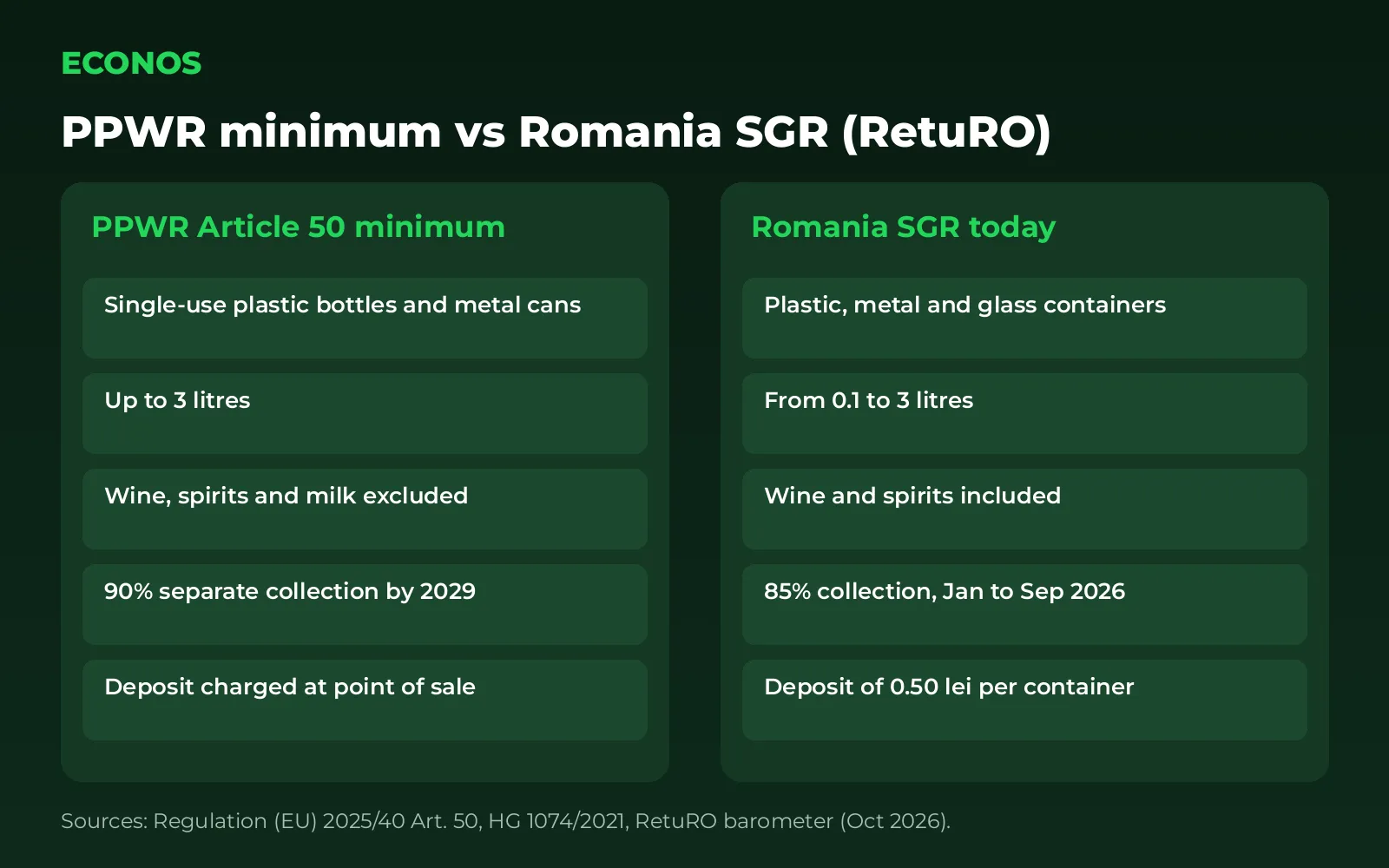
Article 50 of the Packaging and Packaging Waste Regulation (EU) 2025/40 sets a clear target. By 1 January 2029, Member States must ensure the separate collection of at least 90% by weight per year of single-use plastic drinks bottles and single-use metal drinks containers with a capacity of up to 3 litres. To reach it, they must set up a deposit and return system and make sure a deposit is charged at the point of sale.
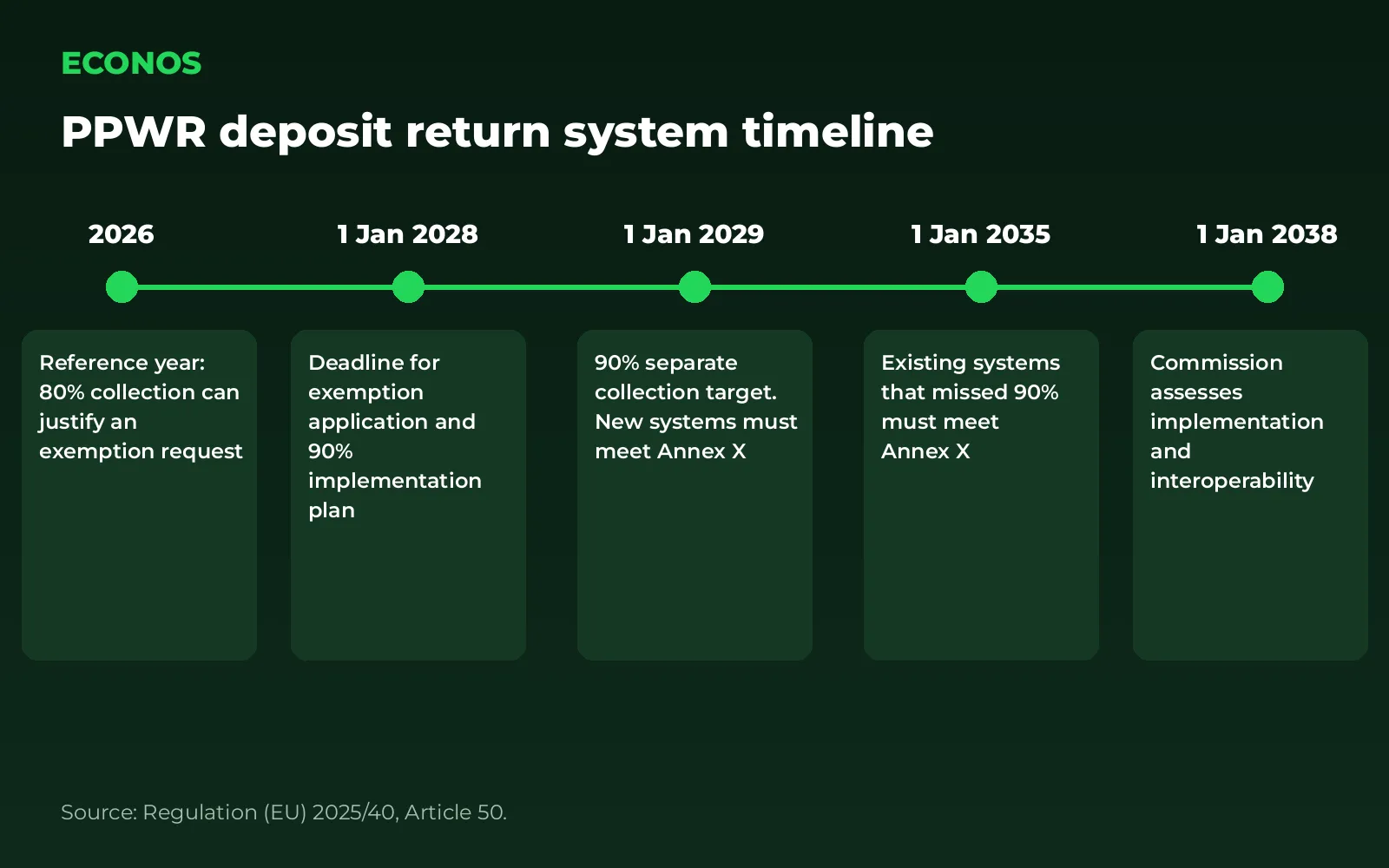
The regulation also sets minimum design requirements for these systems in Annex X. New systems must meet them by 1 January 2029. Existing systems that already reach the 90% target by that date are not required to meet Annex X immediately, but those that miss it must comply by 1 January 2035.
If you are new to the wider regulation, start with our overview of what already applies under the PPWR after 12 August 2026, then come back to the deposit rules.
Scope and exclusions
The EU minimum covers plastic bottles and metal cans only. Article 50(4) excludes packaging for wine and aromatised wine products, other fermented drinks under CN code 2206 00, spirit drinks under CN heading 2208, and milk and dairy products. Member States may also exempt containers below 0.1 litres when participation is technically impossible.
Member States can go further. Article 50(9) allows national rules that include excluded products, and Article 50(8) asks them to work towards deposit systems for glass bottles and beverage cartons. Hospitality operators can be exempted from charging the deposit when drinks are opened, consumed and returned on the premises.
The 80% exemption route
A Member State without a deposit scheme can ask for an exemption if its separate collection rate for a format reached 80% or more for packaging placed on the market in 2026. The request and an implementation plan to reach 90% must be submitted by 1 January 2028. If the rate then stays below 90% for three consecutive years, the exemption ends and a deposit return scheme must follow.
Romania's SGR and the PPWR deposit return system
Romania launched its SGR (Sistemul de Garanție-Returnare) on 30 November 2023 under Government Decision HG 1074/2021. It is run by the administrator RetuRO. Consumers pay a deposit of 0.50 lei on single-use beverage containers made of plastic, metal or glass between 0.1 and 3 litres, and get it back when they return the empty container.
The Romanian scope is wider than the EU minimum. It includes glass, and it covers wine and spirits, which Article 50 lets countries add. Producers and importers must register, sign a contract with RetuRO and meet return targets, while retailers must charge the deposit and accept returns.
Performance is close to the EU target. According to the RetuRO barometer published in October 2026, more than 4.1 billion containers were returned between January and September 2026, with a collection rate of 85%, compared with 82% in the same period of 2025. The monthly rate reached 93% in August and 97% in September. The question for 2029 is whether Romania can hold 90% over a whole year.
What drinks producers and importers should do now
For most companies in Romania, the PPWR deposit return system is less about new registration and more about data quality and consistency across obligations. These steps cover the essentials.
- Map every beverage SKU by material, volume and market, and confirm which ones fall under the SGR, the EU minimum, or both.
- Check that each SKU is registered correctly with RetuRO, including barcodes and the deposit marking, before any packaging change goes to print.
- Confirm your legal role for each product. Our guide on manufacturer or producer under the PPWR helps you decide who carries the obligation.
- Align deposit data with your packaging EPR reporting in Romania, so quantities placed on the market match across systems.
- Plan packaging design for the future PPWR recyclability grades and recycled content requirements, not only for the deposit label.
In our work with beverage companies in Romania, a common issue is the export SKU. A producer selling the same bottle in Romania and in another Member State often finds that the SGR marking and barcode registered with RetuRO do not fit the other market's scheme. Each country can have its own deposit label, so one design rarely works everywhere until harmonised labelling applies. We usually advise building a SKU matrix early, before the next packaging redesign.
How deposit links to EPR, labelling and recycled content
A deposit return scheme does not stand alone. Plastic drinks bottles also face recycled content targets from 2030 under Article 7 of the PPWR, and high-quality PET from a deposit system is one of the main sources of food-grade recyclate. Clean deposit streams therefore matter for your own supply of recycled material.
Labelling is the second link. The PPWR moves towards harmonised labels under Article 12, applying from 12 August 2028 at the earliest, once the Commission's implementing acts are in place. Check the final dates in the Official Journal before you redesign artwork.
Finally, deposit packaging still sits inside your extended producer responsibility picture. Our article on EPR fee eco-modulation after 2030 explains how design choices will affect what you pay. For a structured compliance review, see our EU packaging law compliance service, and for material comparisons, our life cycle assessment (LCA) work.
Frequently asked questions
What is the PPWR deposit return system requirement?
Article 50 of Regulation (EU) 2025/40 requires Member States to collect at least 90% of single-use plastic drinks bottles and metal drinks containers up to 3 litres by 1 January 2029. To do this, they must run a deposit and return system with a deposit charged at the point of sale.
Does Romania need a new deposit system because of the PPWR?
No. Romania already operates the SGR, run by RetuRO since November 2023. The main challenge is to reach the 90% collection rate over a full year, and to meet the Annex X minimum requirements if that target is missed by 2029.
Which drinks are excluded from the PPWR deposit rules?
The EU minimum excludes packaging for wine, aromatised wine, other fermented drinks, spirits and milk and dairy products. Romania still includes wine and spirits in its SGR, which the PPWR allows as a stricter national rule.
Are glass bottles covered by the PPWR deposit return system?
Glass is not part of the mandatory EU minimum, but Member States are asked to work towards deposit systems for glass bottles and beverage cartons. In Romania, single-use glass beverage containers are already part of the SGR.
What should drinks producers in Romania do now?
Keep RetuRO registrations and SKU data accurate, align deposit and EPR quantities, and plan packaging changes around recycled content and harmonised labelling. Exporters should check deposit marking rules in each target market.
Sources and recommended reading
- Regulation (EU) 2025/40 on packaging and packaging waste, EUR-Lex
- European Commission, packaging waste policy page
- RetuRO, administrator of Romania's deposit return system
- RetuRO barometer, January to September 2026 (Retail FMCG)
- Romanian Ministry of Environment, Waters and Forests
Recommended on ECONOS
- PPWR producer registration: the obligation that decides whether you can legally sell
- PPWR for food and beverage: the rules that change your production line
- Packaging EPR in Romania: how it works and costs
- ECONOS Academy training on packaging compliance
How ECONOS can help
ECONOS helps beverage producers, importers and retailers in Romania align their PPWR deposit return system obligations with EPR, recyclability and recycled content requirements. We map your SKUs, check your SGR and EPR data, and build a packaging roadmap to 2030. Our AI assistant on the ECONOS platform also helps you keep packaging data in one place.
Want to know where your drinks portfolio stands before 2029? Contact ECONOS for a short review of your packaging compliance.