

A parcel with a small product, a large box and a pile of air cushions is about to become a compliance problem. The EU Packaging and Packaging Waste Regulation sets a maximum PPWR empty space ratio of 50% for grouped, transport and e-commerce packaging, and it adds a general duty to minimise packaging weight and volume. Here is what the rule says, who it applies to and how to calculate it.
In short
- Article 24 of Regulation (EU) 2025/40 caps the empty space ratio of grouped, transport and e-commerce packaging at 50%, and void fill counts as empty space.
- The cap applies from 1 January 2030, or 3 years after the calculation method is adopted, whichever is later. The method is due by 12 February 2028.
- The obligation sits with whoever fills the box, usually the shop or its fulfilment provider, and reusable packaging in a re-use system is exempt.
What the PPWR empty space ratio rule says
Article 24 of the Packaging and Packaging Waste Regulation (EU) 2025/40 requires economic operators who fill grouped packaging, transport packaging or e-commerce packaging to ensure that the maximum empty space ratio is 50%. The regulation defines e-commerce packaging as transport packaging used to deliver products sold online or through other distance sales to the end user.
Empty space is the difference between the total volume of the outer packaging and the volume of the sales packaging inside it. The empty space ratio is that empty space divided by the total volume of the outer packaging. Space filled by paper cuttings, air cushions, bubble wrap, foam or polystyrene chips counts as empty space, so void fill does not help you pass.
It sits next to the general packaging minimisation duty in Article 10, which requires manufacturers and importers to reduce weight and volume to the minimum necessary for functionality. If you are not sure whether you are the manufacturer, the filler or both, our guide on manufacturer and producer roles under the PPWR walks through the definitions.
When the 50% empty space rule applies
The dates are often misquoted. Some sources still claim a 40% cap from August 2026, which is not what the final text says. As we explained in our overview of what already applies after 12 August 2026, the 50% cap has a later start. The Commission guidance document on the PPWR confirms the timeline below.
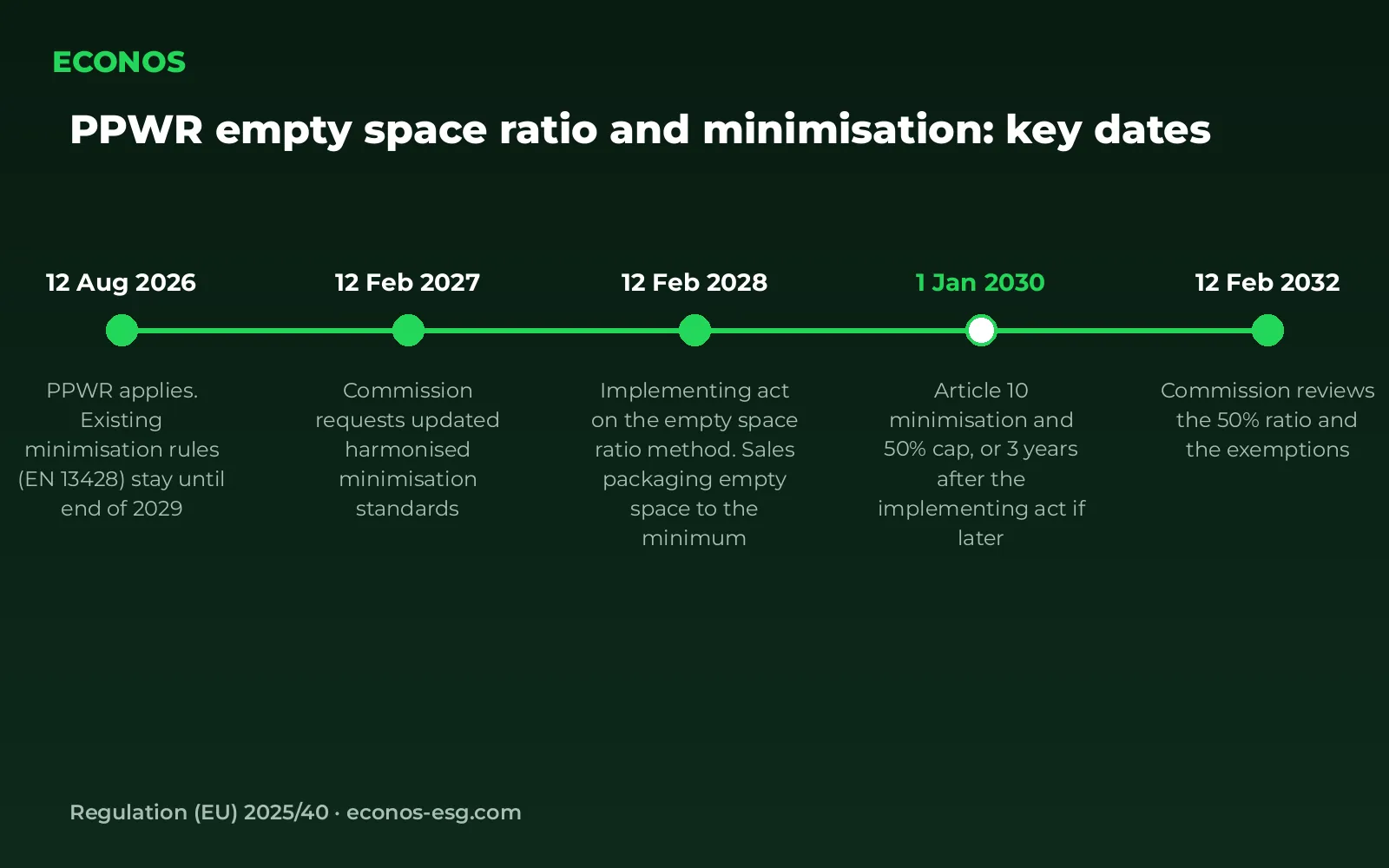
- 12 August 2026: the PPWR applies. The existing minimisation requirements of the Packaging Directive 94/62/EC and the standard EN 13428:2004 stay in effect until the end of 2029.
- 12 February 2027: the Commission must request updated harmonised standards on minimisation.
- 12 February 2028: deadline for the implementing act on the calculation method. Fillers of sales packaging must also reduce empty space to the minimum necessary.
- 1 January 2030: Article 10 minimisation and the 50% cap apply, or 3 years after the implementing act enters into force if that is later.
- 12 February 2032: the Commission reviews the 50% ratio and the exemptions.
How to calculate the PPWR empty space ratio
The final calculation method will come from an implementing act of the European Commission, which must take into account irregular product shapes, liquids, fragile items, several products in one box and space for shipping labels. Until then, the definitions in Article 24(3) give you a solid way to screen your packaging.
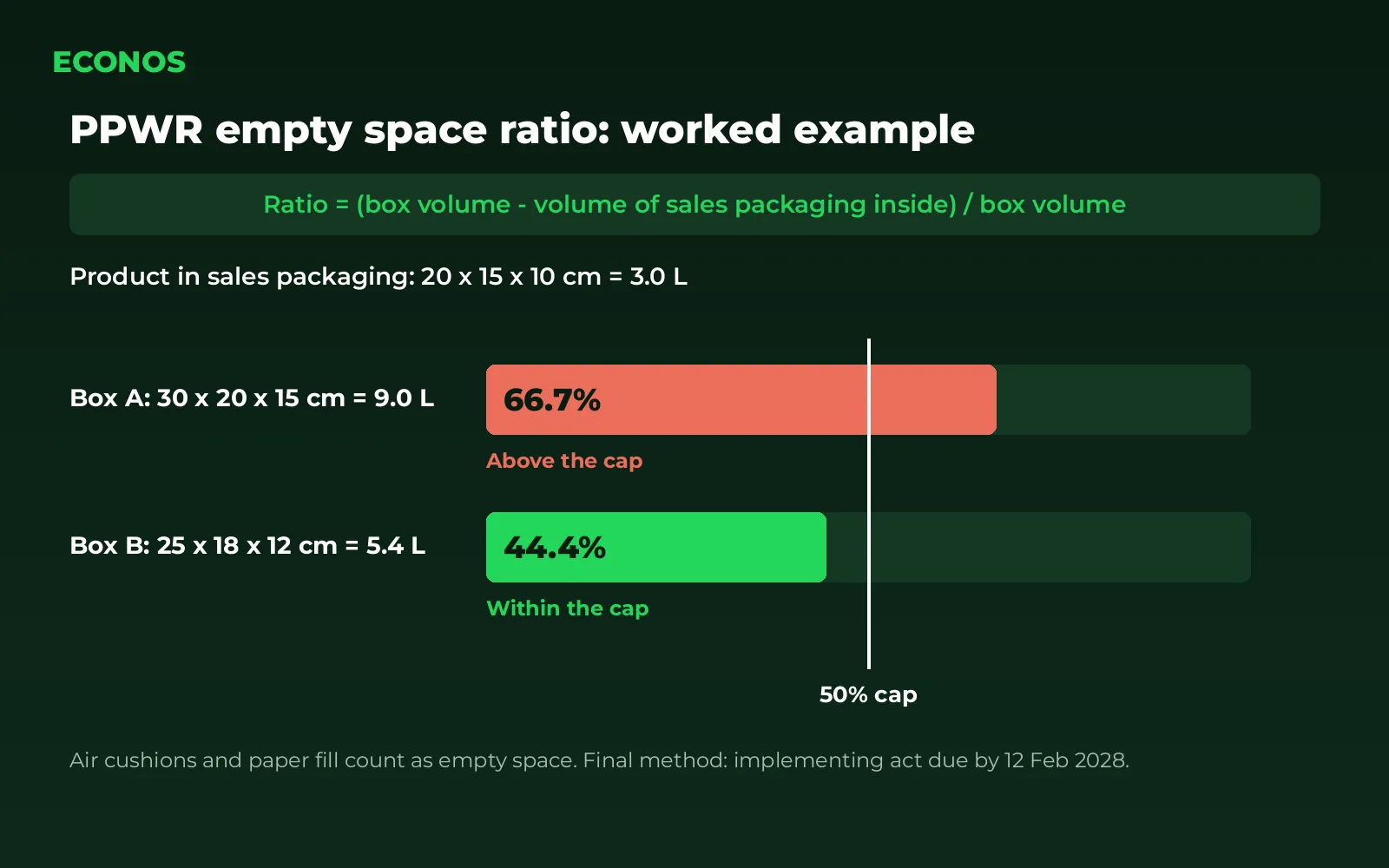
Take a product in its sales packaging measuring 20 x 15 x 10 cm, which is 3.0 litres. Shipped in a 30 x 20 x 15 cm box (9.0 litres), the empty space is 6.0 litres and the ratio is 66.7%, above the cap. Moving to a 25 x 18 x 12 cm box (5.4 litres) brings the ratio down to 44.4%, within the cap.
What counts as empty space
Everything in the outer box that is not sales packaging counts: air, paper fill, bubble wrap and foam. A smaller box with less filling is therefore the main lever, not a different type of void fill. Material choice still matters for recyclability, and our article on choosing cardboard or plastic packaging under the PPWR covers that side.
Who is responsible, and the exemptions
The 50% cap targets the operator who fills the outer packaging. For an online shop that packs its own orders, that is the shop. When a fulfilment provider packs the orders, the obligation follows the packing, so contracts should say who measures and documents the ratio. For a wider view of online sales duties, see our guide to packaging EPR for e-commerce.
Article 24(5) exempts two cases from the 50% cap: sales packaging used as e-commerce packaging, for example a product shipped in its own branded box, and reusable packaging within a system of re-use. Both must still meet the Article 10 minimisation requirements.
Packaging minimisation under Article 10
From 2030, Article 10 bans packaging that does not meet the Annex IV performance criteria and packaging designed only to increase perceived volume, such as double walls, false bottoms and unnecessary layers. Annex IV of the regulation lists eight criteria, including product protection, logistics, information requirements, hygiene and safety, and recyclability. Marketing and consumer acceptance are no longer accepted as reasons for extra weight or volume.
Compliance is demonstrated in the technical documentation, which feeds the EU declaration of conformity. Our guide on the PPWR declaration of conformity and technical file explains how the file is built. Narrow exemptions exist for designs or trademarks protected before 11 February 2025 and for products with a protected geographical indication.
What we see in Romanian companies
In packaging reviews we run for Romanian online retailers and distributors, the pattern is very similar. Orders are packed in three or four standard box sizes chosen years ago, small items travel in boxes sized for the largest product, and air cushions fill the gap.
The fix is rarely expensive. A sample of real orders, a simple volume check and one or two extra box sizes usually solve most cases. Lighter, smaller boxes also cut the packaging weight you declare for EPR, which matters as fees move towards eco-modulated EPR fees after 2030. If you want support across all PPWR obligations, our EU packaging law compliance service covers the full assessment.
A five step action plan
- List your outer packaging: grouped, transport and e-commerce formats, with dimensions.
- Measure a sample of real shipments and calculate the empty space ratio with the Article 24(3) definitions.
- Flag the formats above 50% and the products that drive them.
- Test right sized boxes or on demand box making, and document product protection results.
- Prepare the minimisation evidence for your technical file, and track the implementing act due by February 2028.
Frequently asked questions
What is the PPWR empty space ratio?
It is the share of a grouped, transport or e-commerce package that is not taken up by the sales packaging inside. Article 24 of Regulation (EU) 2025/40 caps it at 50%, and space filled with air cushions, bubble wrap or paper fill counts as empty.
When does the 50% empty space rule apply?
From 1 January 2030, or 3 years after the Commission implementing act on the calculation method enters into force, whichever is later. The implementing act is due by 12 February 2028, so the cap may in practice apply later than 2030.
Who is responsible for the empty space ratio?
The economic operator who fills the grouped, transport or e-commerce packaging. For online sales this is usually the shop or the fulfilment provider that packs the order, not the box supplier.
Does the 50% cap apply to sales packaging?
No. Sales packaging has no fixed threshold, but from 12 February 2028 its empty space must be reduced to the minimum necessary for functionality, and from 2030 the Article 10 minimisation rules apply. Sales packaging shipped as e-commerce packaging is exempt from the 50% cap.
How do I prove packaging minimisation?
Through the technical documentation in Annex VII. For each Annex IV performance criterion you explain which design requirement prevents a further reduction of weight or volume, supported by tests, studies or simulations. Until 2030, EN 13428:2004 remains the reference standard.
Sources and recommended reading
- Regulation (EU) 2025/40 on packaging and packaging waste, EUR-Lex
- Commission Notice C/2026/3084, guidance document for the PPWR
- European Commission, packaging waste policy page
- Directive 94/62/EC on packaging and packaging waste, EUR-Lex
Recommended on ECONOS
- PPWR recyclability: grades A, B and C
- PPWR labelling requirements 2026
- PPWR declaration of conformity and technical file
How ECONOS can help
The PPWR empty space ratio is one of the easier rules to get ahead of, because the data sits in your warehouse. ECONOS measures your shipments, identifies the formats above the cap, prepares the minimisation evidence for your technical documentation and trains your team through ECONOS Academy. Contact ECONOS to plan your PPWR packaging review.