

Most packaging teams in Romania are asking the same question this autumn: what exactly must be printed on our packs, and when? The PPWR labelling requirements in Article 12 of Regulation (EU) 2025/40 answer it in stages. Some rules already apply since 12 August 2026, while the new harmonised sorting label is still waiting for an EU implementing act. This guide explains what applies now, what comes in 2028 and 2029, and how to prepare your artwork without printing the wrong symbols.
In short
- Since 12 August 2026, misleading packaging labels are banned and manufacturers must show their identification details. The harmonised material label is not mandatory yet.
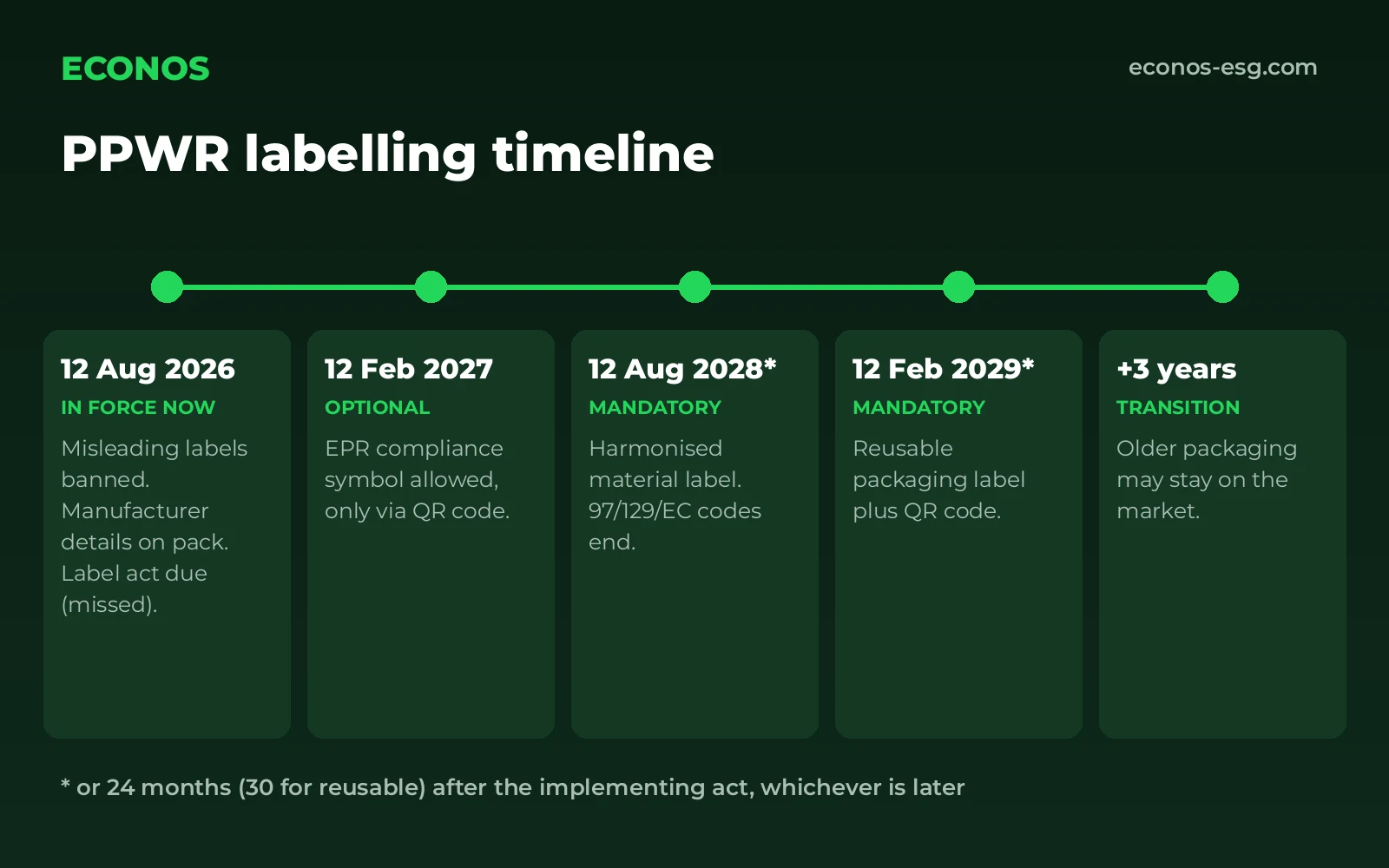
- The EU material composition label applies from 12 August 2028, or 24 months after the implementing act enters into force, whichever is later. The Commission missed its August 2026 deadline for that act.
- The best move now is to collect material data per SKU, clean up green claims and reserve space on artwork for a pictogram and a QR code.
What the PPWR labelling requirements cover
Article 12 is not one rule but a set of labels with different dates. It covers a material composition label to help consumers sort waste, a reusable packaging label with a QR code, optional labels on recycled and bio-based content, deposit-return labels and a ban on misleading claims. It sits next to the other obligations explained in our overview of what already applies under PPWR after 12 August 2026.
Labelling also links to your PPWR declaration of conformity file. The information you print must match the data in your PPWR declaration of conformity and technical file, so the same material data serves both.
What applies now, since 12 August 2026
Two of the PPWR labelling requirements need no implementing act. First, Article 12(8) prohibits labels and marks that could mislead consumers about sustainability, packaging features or disposal options. Second, manufacturers must identify themselves with their name, registered trade name or trademark, postal address and electronic contact details, on the packaging or, where that is not possible, in an accompanying document.
The ban on misleading labels overlaps with the EU rules on environmental claims on packaging introduced by Directive (EU) 2024/825, which applies from 27 September 2026. Vague wording such as "eco-friendly" without proof is now a real legal risk. Our guide on how to avoid greenwashing explains how to check each claim before it goes to print.
In Romania, the national packaging marking rules also remain in place for now. Article 9 and Annex 3 of Law 249/2015 use the material codes of Decision 97/129/EC, such as PET 1, PP 5 or ALU 41, and the marking must be visible, legible and durable.
The harmonised sorting label: 2028 or later
Under Article 12(1), packaging placed on the EU market must carry a pictogram-based label showing its material composition. This is the core of the PPWR labelling requirements for most consumer packs. It applies from 12 August 2028, or 24 months after the implementing act enters into force, whichever is later. Transport packaging is generally excluded, except e-commerce packaging, and packaging in a deposit-return system follows its own labelling rules.
The Commission was due to adopt the implementing act by 12 August 2026 and missed that deadline, as reported by Packaging Europe. So 12 August 2028 is now a minimum date, not a fixed one. Each month of delay pushes the obligation later. Designs circulated during preparation are not law, so do not print them yet.
When the harmonised label applies, the Commission's draft PPWR guidance indicates that national sorting labels and the 97/129/EC abbreviations can no longer be used alongside it. For Romanian companies, that means the current Law 249/2015 codes will eventually be replaced on pack.
Reusable packaging label and QR code
Reusable packaging
From 12 February 2029, or 30 months after the implementing act, reusable packaging must carry a label telling users it is reusable. Details on the reuse system and collection points must be available through a QR code on packaging or a similar data carrier. If you are designing a reuse model, our article on the PPWR deposit return system in Romania shows how deposit and reuse rules connect.
EPR symbol and recycled content labels
From 12 February 2027, packaging covered by an EPR scheme may carry a symbol showing the producer meets its obligations, but only through a QR code or similar digital technology, never as a printed logo. Labels on recycled or bio-based content are voluntary, but if you use them from 2028 they must follow the harmonised specifications. Compostable packaging under Article 9 has extra wording rules, covered in our guide on compostable packaging and PPWR Article 9.
How to prepare for the PPWR labelling requirements
Among the PPWR labelling requirements, Article 12(12) gives a transition: packaging made or imported before the labelling dates may stay on the market for up to three years after the requirements apply. That helps, but only if you plan your artwork cycles. A situation we see often at ECONOS with Romanian food and cosmetics producers is that material data for caps, sleeves and trays sits with suppliers, not in the company. When the label becomes mandatory, that gap blocks the artwork update.
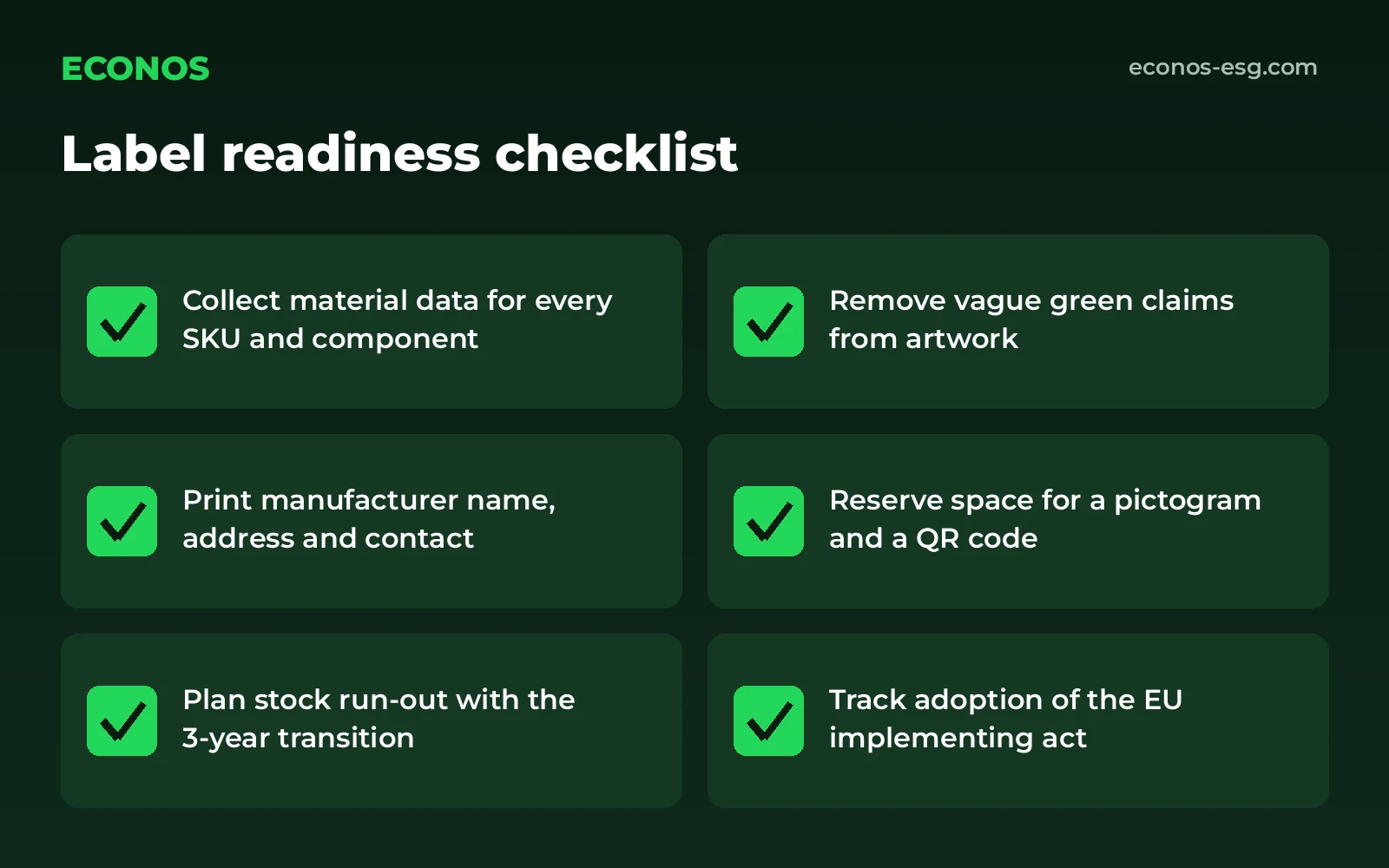
- Build a material list per SKU and per component, with the material, colour and any coating.
- Remove vague green claims and keep only claims you can prove.
- Check that manufacturer identification is complete on every pack.
- Reserve space on dielines for a pictogram and a QR code.
- Align print runs with the three-year transition to avoid write-offs.
- Assign one person to track the EU implementing act.
Material data also feeds your material composition label and your PPWR recyclability grade, so the work pays off twice. If you are unsure whether you act as manufacturer or producer, read your role under the PPWR first, because that decides who signs off the label.
Frequently asked questions
When does the PPWR harmonised label become mandatory?
From 12 August 2028, or 24 months after the EU implementing act enters into force, whichever is later. Because the act was not adopted by August 2026, the real date will likely move beyond August 2028.
What labelling rules apply right now?
Misleading labels are banned and manufacturers must show their identification details on the packaging. In Romania, the material marking under Law 249/2015 and Decision 97/129/EC still applies.
Is a QR code mandatory on packaging?
Not for every pack. A QR code or similar data carrier is required for reusable packaging information from 2029, and the EPR compliance symbol may only be shown digitally. For other packaging it is optional.
Can I keep selling packaging printed with the old symbols?
Yes, for a limited time. Packaging made or imported before the new labels apply may stay on the market for up to three years after the requirements take effect.
Does transport packaging need the sorting label?
Transport packaging is generally exempt from the material composition label, except e-commerce packaging. Check each packaging format against Article 12 before you decide.
Sources and recommended reading
- Regulation (EU) 2025/40 on packaging and packaging waste, EUR-Lex
- European Commission, draft notice interpreting the PPWR, C(2026) 2151
- European Commission, packaging waste page
- Commission Decision 97/129/EC, packaging material identification system
- Romanian Law 249/2015 on packaging, Ministry of Environment
- Packaging Europe, Commission misses PPWR labelling deadline
Recommended on ECONOS
- PPWR declaration of conformity and technical file
- PPWR recyclability: grades A, B and C
- Packaging EPR in Romania: how it works and costs
- PPWR deposit return system in Romania
How ECONOS can help
ECONOS helps Romanian and EU companies turn the PPWR labelling requirements into a clear artwork plan: material data per SKU, claim review, label mapping and links to your conformity file. Our EU law compliance service covers PPWR and EPR end to end, and ECONOS Academy trains packaging and marketing teams. Contact ECONOS to review your packaging labels before your next print run.