


Many companies in Romania have already looked at labels, recycled content and the empty space rule. Fewer have looked at PPWR packaging minimisation, the obligation in Article 10 of Regulation (EU) 2025/40 that asks you to prove your packaging is no heavier and no bigger than it needs to be. This guide explains what Article 10 requires, the deadlines, and how to build the evidence file.
In short:
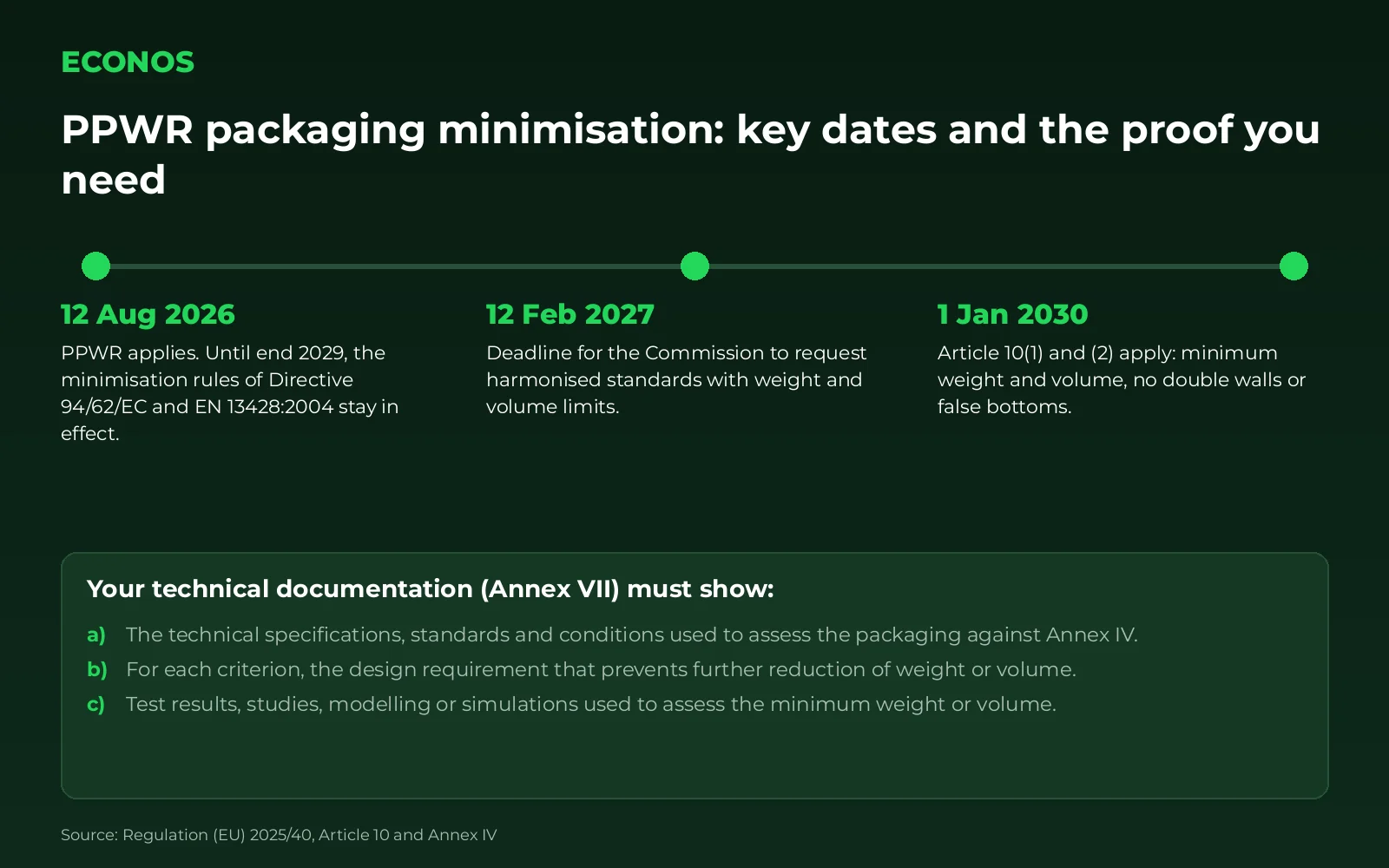
- From 1 January 2030, packaging weight and volume must be reduced to the minimum necessary for its function (Article 10(1)).
- From the same date, packaging that only increases perceived volume, such as double walls, false bottoms and unnecessary layers, may not be placed on the market (Article 10(2)).
- You prove compliance in the technical documentation, by assessing each design against the 8 performance criteria of Annex IV.
What is PPWR packaging minimisation?
Under Article 10 of the Packaging and Packaging Waste Regulation, the manufacturer or importer must ensure that packaging is designed so that its weight and volume are reduced to the minimum necessary to ensure its functionality, taking into account its shape and material. If you are not sure whether you are the manufacturer, read our guide on manufacturer or producer roles under the PPWR first, because the duty follows the role.
The idea is not new: the old Packaging Directive already required packaging volume and weight to be limited to the minimum adequate amount, in its Annex II essential requirements. What changes with the PPWR is that the rule becomes directly applicable in every Member State, with a structured method and a documentation duty that market surveillance authorities can check.
Article 10 PPWR: what the law says, paragraph by paragraph
Paragraph 1: minimum weight and volume by 2030
By 1 January 2030, every packaging format you place on the market must be designed with the minimum packaging weight and volume needed for its function. This is a design obligation for product development, procurement and suppliers, not only for compliance.
Paragraph 2: no double walls, false bottoms or unnecessary layers
Paragraph 2 bans packaging that does not meet the Annex IV performance criteria and packaging with features that aim only to increase the perceived volume of the product, including double walls, false bottoms and unnecessary layers. The Commission guidance on the PPWR confirms that paragraphs 1 and 2 both apply from 1 January 2030. Until the end of 2029, the minimisation rules of Directive 94/62/EC and the standard EN 13428:2004 stay in effect, so oversized or deceptive packs are already a risk today.
Two exemptions exist: packaging designs protected by design rights or shape trademarks registered before 11 February 2025, where minimisation would alter their novelty or distinctiveness, and products covered by a protected geographical indication or an EU quality scheme. For deceptive formats more broadly, see our article on PPWR banned packaging formats.
Paragraph 3: harmonised standards are coming
By 12 February 2027, the Commission must request European standardisation organisations to prepare harmonised standards for measuring compliance. For the most common packaging types, these standards should set maximum weight and volume limits and, where appropriate, wall thickness and maximum empty space. Until they exist, your documented reasoning is the method. Follow the status of this request on the European Commission packaging page before you finalise your files.
The 8 Annex IV performance criteria
Annex IV is the core of PPWR packaging minimisation. For each criterion, you must explain which design requirement prevents a further reduction of weight or volume. The Annex IV performance criteria are:
- Product protection, against damage, moisture, light or oxygen.
- Manufacturing processes, such as filling lines, tooling and line speed.
- Logistics, including pallet patterns, handling and warehousing.
- Packaging functionality, including sales for gifts or seasonal events.
- Information requirements, such as labels, barcodes and dates.
- Hygiene and safety, such as child resistance, anti-tamper features and safe opening.
- Legal requirements under other applicable law.
- Recycled content, recyclability and re-use, which can justify extra weight, for example a reusable crate or a move to mono-material.
Criterion 8 links minimisation to your other PPWR work. A heavier mono-material tray can be the right answer if it improves the recyclability grade of your packaging, or if it is needed to reach your PPWR recycled content targets.

Technical documentation: how to prove PPWR packaging minimisation
Article 10(4) says compliance must be shown in the technical documentation referred to in Annex VII. It must contain at least:
- the technical specifications, standards and conditions used to assess the packaging against Annex IV;
- for each performance criterion, the design requirement that prevents further reduction of weight or volume;
- test results, studies, modelling or simulations used to assess the minimum necessary weight or volume.
Annex IV Part B adds two practical rules. You must investigate all reduction options within a given material, such as removing a superfluous layer, and simply switching from one material to another is not considered sufficient. You must also document variations between production batches. This file then supports your declaration, as explained in our guide to the PPWR declaration of conformity and technical file.
Minimisation vs the empty space ratio
Article 10 applies to all packaging and looks at the design of the pack itself. The empty space rule in Article 24 targets grouped, transport and e-commerce packaging and sets a maximum ratio of empty space. Both rules push in the same direction, but they need separate evidence. Read our article on the PPWR empty space ratio if you ship to consumers or use secondary packaging.
How to prepare a minimisation assessment in 5 steps
- List your packaging formats by SKU, with weight, dimensions, material and supplier.
- Rank them by volume placed on the market and by visible risk, such as large outer cartons or decorative layers.
- For each format, write one short justification per Annex IV criterion, with a named design requirement.
- Collect evidence: drop and compression tests, line trials, pallet simulations, supplier specifications.
- Decide the redesign actions, plan them with suppliers, and store the file with your technical documentation.
In our PPWR projects in Romania, a typical finding is a secondary carton sized years ago for an older product or pallet pattern. The assessment makes this visible, and the fix often lowers material cost and future EPR fees, since EPR fee eco-modulation after 2030 rewards lighter and better designed packaging.
Frequently asked questions
When does PPWR packaging minimisation apply?
Both paragraphs of Article 10 apply from 1 January 2030, as confirmed by the Commission guidance. Until the end of 2029, the minimisation rules of the old Packaging Directive and the standard EN 13428:2004 remain in effect.
Who is responsible for packaging minimisation under the PPWR?
The manufacturer or importer of the packaging or packaged product is responsible. In practice, brand owners need their packaging suppliers, because the evidence comes from design and testing.
What are the Annex IV performance criteria?
There are 8: product protection, manufacturing processes, logistics, functionality, information requirements, hygiene and safety, legal requirements, and recycled content, recyclability and re-use. For each one you document the design requirement that blocks further reduction.
Is switching from plastic to cardboard enough to comply?
No. Annex IV Part B states that substituting one packaging material with another is not considered sufficient. You must investigate reduction options within the material you use.
Are there official weight and volume limits?
Not yet. The Commission must request harmonised standards by 12 February 2027, and these should set maximum weight and volume limits for common formats. Until then, your documented assessment is the method.
Sources and recommended reading
- Regulation (EU) 2025/40 on packaging and packaging waste, EUR-Lex
- European Commission, packaging waste policy page
- Commission Notice C/2026/3084, guidance document for the PPWR
- Directive 94/62/EC on packaging and packaging waste, EUR-Lex
- ECOS recommendations on the PPWR packaging minimisation standardisation request
- Romanian Ministry of Environment, Waters and Forests
Recommended on ECONOS
- PPWR empty space ratio explained
- PPWR banned packaging formats
- PPWR declaration of conformity and technical file
- ECONOS Academy training
How ECONOS can help
ECONOS helps manufacturers, importers and brand owners prepare their PPWR packaging minimisation assessment: packaging inventory, Annex IV justifications per format, evidence collection with suppliers, and a technical file ready for inspection. Our EU law compliance services cover the full PPWR, and our ECONOS Academy trains your team to keep the file up to date on its own.
Want to know where your packaging stands before 2030? Contact ECONOS and we will review your highest risk formats with you.