

From 2030, the plastic in your packaging will have to contain a minimum share of recycled material, and not just any recycled material. PPWR recycled content rules in Article 7 of Regulation (EU) 2025/40 set targets of 10% to 35% of post-consumer recycled plastic per packaging type, rising to 25% to 65% in 2040. This guide explains the targets, who must prove them and what Romanian companies should check in their supply contracts now.
In short
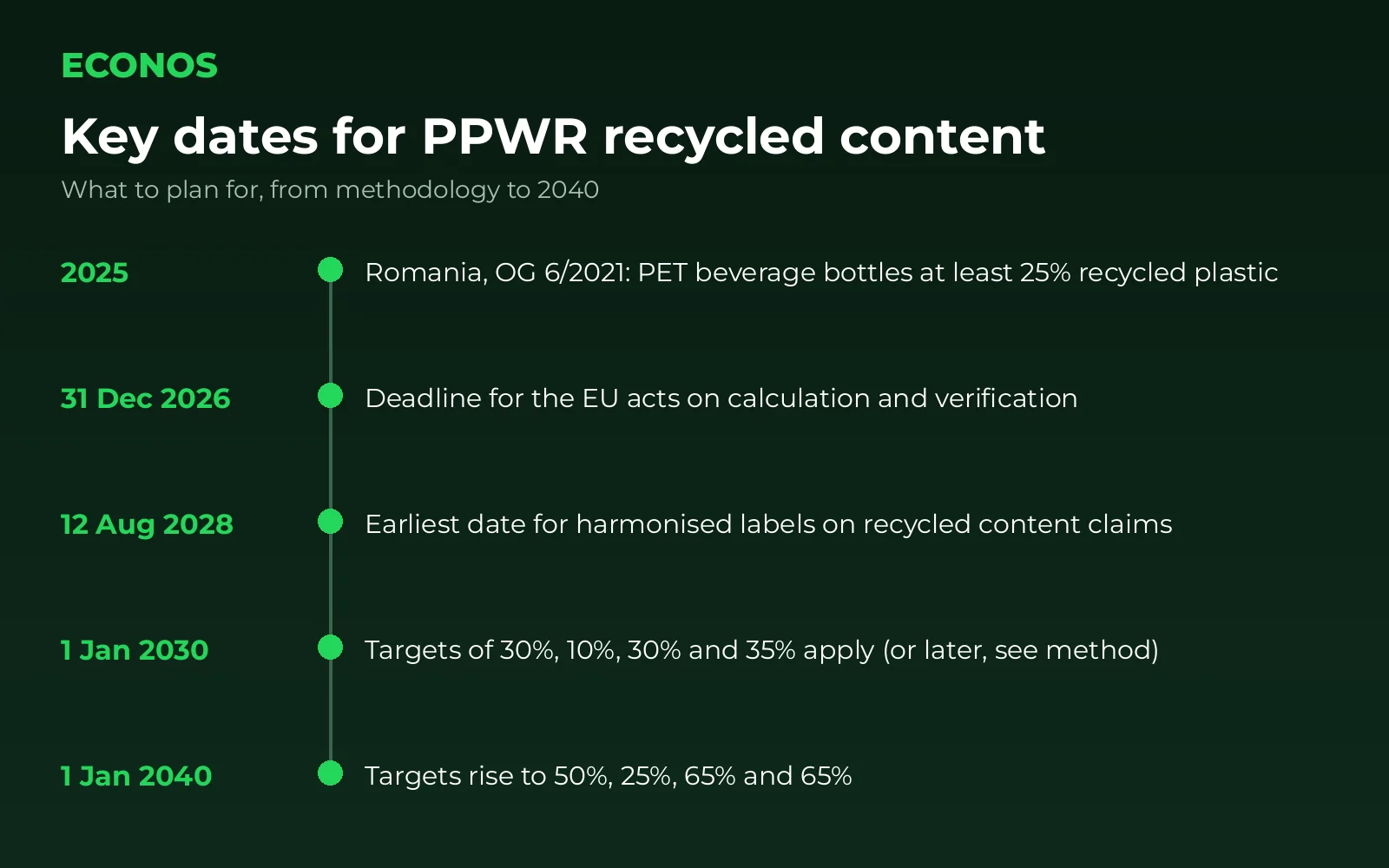
- From 1 January 2030, or 3 years after the EU calculation method enters into force if later, plastic packaging must contain 30%, 10%, 30% or 35% recycled content depending on its type.
- Only plastic recovered from post-consumer waste counts. Factory scrap and production regrind do not.
- The manufacturer or importer proves compliance in the technical documentation, as an average per manufacturing plant and year.
What the PPWR recycled content rule says
Article 7 of the Packaging and Packaging Waste Regulation (EU) 2025/40 requires any plastic part of packaging placed on the EU market to contain a minimum percentage of recycled content recovered from post-consumer plastic waste. The share is calculated per packaging type and format, as an average per manufacturing plant and per year, not item by item.
The rule only covers the plastic parts. Paper, glass and metal packaging have no recycled content target under Article 7, although recycled content can still influence your EPR fees. If you are still deciding between materials, our comparison of cardboard or plastic packaging under the PPWR is a good starting point.
PPWR recycled content targets for 2030 and 2040
The recycled content targets depend on whether the packaging is contact-sensitive, meaning it is used for food, feed, cosmetics, medicines, medical devices and similar sensitive products, and on the polymer.
- Contact-sensitive packaging made mainly of PET (except single-use beverage bottles): 30% from 2030, 50% from 2040.
- Contact-sensitive packaging made of other plastics (except single-use beverage bottles): 10% from 2030, 25% from 2040.
- Single-use plastic beverage bottles: 30% from 2030, 65% from 2040.
- All other plastic packaging, for example stretch film, crates or detergent bottles: 35% from 2030, 65% from 2040.
The 2030 date can move. The targets apply from 1 January 2030 or 3 years after the entry into force of the implementing act on the calculation method, whichever is later. That act was due by 31 December 2026, and the Commission consulted stakeholders on the draft rules in 2026, according to this summary of the call for evidence. Verify the final adoption date before you plan your timeline.

What counts as post-consumer recycled plastic
This is where most supplier declarations fail. The regulation counts only plastic recovered from post-consumer plastic waste, meaning waste generated from products that were already placed on the market. Edge trims, rejected parts and regrind from your own production line are useful, but they do not count toward the target.
The waste must also have been collected in the EU under EU waste rules, or in a third country under equivalent standards, and recycled in installations that meet equivalent environmental rules. The Commission will set the methodology for calculation and verification, which may include third-party audits of recyclers and packaging manufacturers.
A typical situation we see at ECONOS in Romania: a food producer buys PET trays from an importer whose supplier declares "50% recycled". When we ask for the evidence, the recycled share turns out to be mostly post-industrial regrind. On paper the tray looks compliant. Under Article 7 it would not be.
Exemptions from the recycled content targets
Article 7 does not apply to several categories, including:
- immediate packaging of medicinal products and contact-sensitive packaging of medical devices and in vitro diagnostics;
- compostable plastic packaging, covered in our guide to compostable packaging and PPWR Article 9;
- packaging for the transport of dangerous goods;
- contact-sensitive packaging for infant food and food for special medical purposes;
- any plastic part below 5% of the total weight of the packaging unit;
- food contact packaging where the recycled content would threaten human health and breach Regulation (EC) No 1935/2004.
The Commission must also assess, by 1 January 2028, whether derogations are needed for the 10% and 35% categories where suitable recycling technologies are not available.
Who must prove PPWR recycled content
Compliance is demonstrated by the manufacturer or importer in the technical documentation listed in Annex VII. That file supports the EU declaration of conformity, explained in our article on the PPWR declaration of conformity and technical file. If you are unsure whether you are the manufacturer, read our guide on manufacturer and producer roles under the PPWR.
Recycled content also connects to other PPWR rules. Your EPR fees may be modulated based on the recycled share, as described in our article on EPR fee eco-modulation after 2030. And if you print a recycled content claim on pack, Article 12 requires that label to follow the harmonised EU specifications from 12 August 2028, or 24 months after the relevant implementing act, whichever is later. Our guide to PPWR labelling requirements covers the details.
What already applies in Romania
Romanian beverage producers already know a version of this rule. The Single-Use Plastics Directive (EU) 2019/904 was transposed by Government Ordinance 6/2021, which requires PET beverage bottles to contain at least 25% recycled plastic from 2025 and 30% from 2030, as an average across bottles placed on the national market, with annual reporting to AFM, as summarised by PwC Romania. The PPWR extends the logic to all plastic packaging and moves the average to each manufacturing plant.
The RetuRO deposit system collects beverage bottles separately, which is the kind of clean stream recyclers need for bottle-to-bottle PET. See our article on the PPWR deposit return system in Romania for how that system evolves.
How to prepare in five steps
- Map every plastic packaging component by type: contact-sensitive PET, other contact-sensitive plastic, beverage bottle or other.
- Ask suppliers for the recycled share and the type of recycled material (post-consumer or post-industrial), with certificates.
- Calculate your gap to the 2030 target per format and identify where recycled grades are scarce or expensive, especially food-grade polyolefins.
- Add recycled content clauses and evidence obligations to your purchasing contracts.
- Check the effect on recyclability and carbon, for example with a life cycle assessment of the alternatives.
Conclusion
PPWR recycled content targets look far away, but recycled food-grade plastic is already in short supply and contracts for 2030 are being negotiated now. Companies that map their formats and clean up supplier evidence early will avoid both non-compliance and last-minute price shocks. Our team supports this work as part of our EU law compliance services.
Frequently asked questions
What are the PPWR recycled content targets for 2030?
Plastic packaging must contain 30% post-consumer recycled plastic for contact-sensitive PET, 10% for other contact-sensitive plastics, 30% for single-use beverage bottles and 35% for all other plastic packaging. The targets apply from 1 January 2030 or 3 years after the EU calculation method enters into force, whichever is later.
Does post-industrial recycled plastic count toward the PPWR targets?
No. Article 7 only counts recycled content recovered from post-consumer plastic waste, meaning waste from products already placed on the market. Production scrap and regrind can still be used, but they do not count toward the minimum percentage.
Who must prove recycled content under the PPWR?
The manufacturer or importer of the packaging demonstrates compliance in the technical documentation required by Annex VII. The percentage is calculated as an average per manufacturing plant and year, per packaging type and format.
Which packaging is exempt from the recycled content rules?
Exemptions include compostable plastic packaging, immediate packaging of medicines, contact-sensitive packaging of medical devices, packaging for dangerous goods, packaging for infant food and plastic parts below 5% of the total packaging weight. Food contact packaging is also exempt where recycled content would threaten human health.
Does the PPWR apply recycled content rules to paper or glass?
No. The minimum recycled content targets in Article 7 apply only to the plastic parts of packaging. Recycled content in other materials can still influence EPR fees through eco-modulation.
Sources and recommended reading
- Regulation (EU) 2025/40 on packaging and packaging waste, EUR-Lex
- Directive (EU) 2019/904 on single-use plastics, EUR-Lex
- European Commission, PPWR implementation page
- European Commission, packaging waste policy page
- PwC Romania, Government Ordinance 6/2021 on plastic products
Recommended on ECONOS
- PPWR recyclability: grades A, B and C
- PPWR for food and beverage producers
- PPWR empty space ratio: the 50% rule
How ECONOS can help
ECONOS helps Romanian and EU companies turn PPWR recycled content rules into a clear plan: packaging inventory, supplier evidence review, gap analysis to 2030 and 2040, and technical documentation. We also train purchasing and quality teams through ECONOS Academy. Contact ECONOS to review your plastic packaging.