

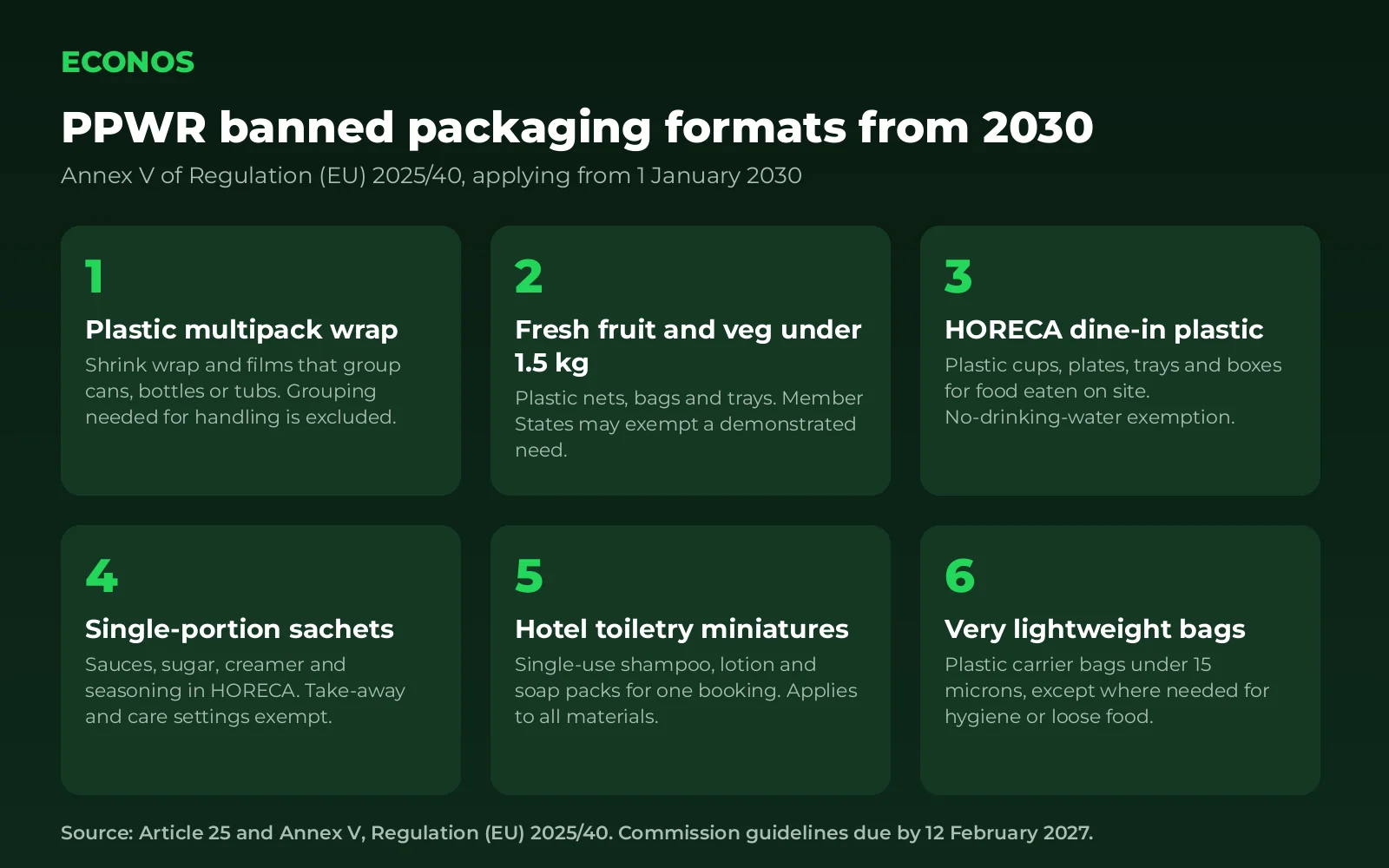
From 1 January 2030, six common packaging formats disappear from the EU market. The PPWR banned packaging formats are listed in Annex V of Regulation (EU) 2025/40: plastic multipack wrap, plastic packs for fresh fruit and vegetables under 1.5 kg, dine-in plastic in restaurants, single-portion sachets, hotel toiletry miniatures and very lightweight plastic bags. This guide explains each ban, the exemptions, and what Romanian food producers, retailers and HORECA operators should decide now.
In short
- Article 25 of the PPWR forbids placing the six formats of Annex V on the EU market from 1 January 2030.
- Each ban has narrow exemptions, for example grouping needed for handling, a demonstrated need for fresh produce, or hygiene reasons for very thin bags.
- The Commission must publish guidelines with examples by 12 February 2027, so 2027 is the year to map your formats and test alternatives.
What Article 25 says about PPWR banned packaging formats
Article 25 is short. From 1 January 2030, economic operators shall not place on the market packaging in the formats and for the uses listed in Annex V. It is a placing on the market rule, so it hits the brand owner, the importer, the private label retailer and the HORECA operator that uses the packaging, not only the converter that makes it.
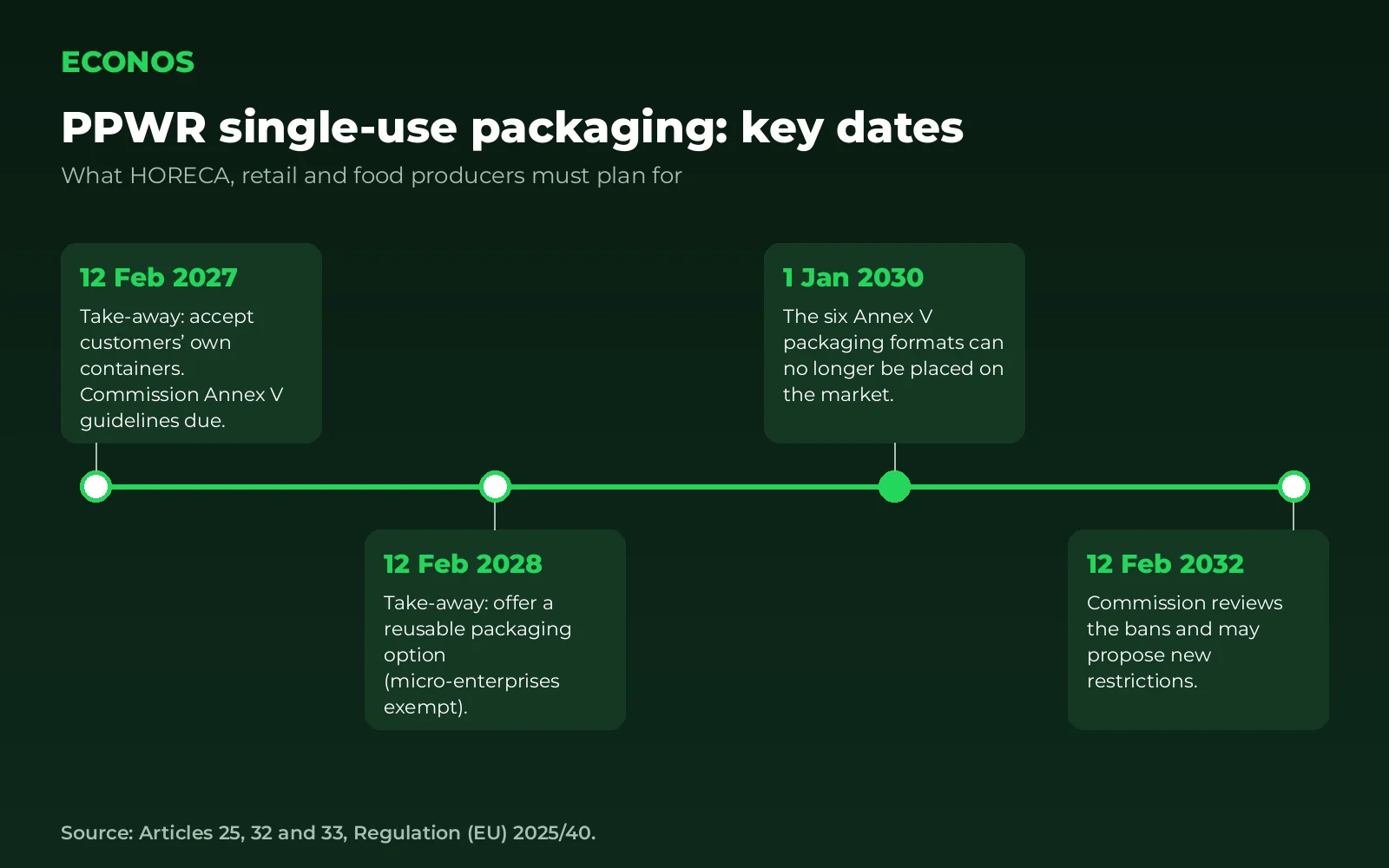
Three details matter. First, Member States may keep national restrictions adopted before 1 January 2025 on Annex V formats made of other materials. Second, they may let micro-enterprises keep dine-in packaging when avoiding it is not technically feasible. Third, by 12 February 2027 the European Commission, with Member States and EFSA, must publish guidelines with examples of formats in scope and a list of fruits and vegetables excluded from the fresh produce ban. If you need a reminder of what already applies today, see our overview of what already applies under the PPWR after 12 August 2026.
The six PPWR banned packaging formats in Annex V
1. Single-use plastic grouped packaging
Shrink wrap and collation films that bundle bottles, cans, tins, pots, tubs and packets to encourage multiple purchases. The ban excludes grouped packaging that is necessary to facilitate handling in distribution.
2. Plastic packaging for fresh fruit and vegetables under 1.5 kg
Nets, bags, trays and containers for pre-packed, unprocessed fresh fruit and vegetables under 1.5 kg. Member States may set exemptions where there is a demonstrated need to avoid water or turgidity loss, microbiological hazards, physical shocks or oxidation, or where there is no other way to separate organic from conventional produce. AGRINFO notes that paper-based packaging with more than 5% plastic is treated as included in the ban, which is worth checking against the final Commission guidelines.
3. Single-use plastic for food and drinks consumed on site
HORECA single-use plastic for food and beverages filled and consumed on the premises, including terraces and shared seating areas: trays, disposable plates and cups, bags, foils and boxes. Establishments without access to drinking water are exempt.
4. Single-portion packaging for condiments and sugar
Plastic sachets, tubs, trays and boxes for individual portions of condiments, preserves, sauces, coffee creamer, sugar and seasoning in HORECA. Two exemptions apply: portions supplied with take-away ready-prepared food, and portions needed for safety and hygiene in hospitals, clinics and care homes.
5. Hotel toiletry miniatures
Single-use packaging for cosmetics, hygiene and toiletry products in the accommodation sector, meant for one booking and thrown away before the next guest: shampoo and lotion bottles, soap sachets. This point is not limited to plastic.
6. Very lightweight plastic carrier bags
Very lightweight plastic carrier bags, below 15 microns, are banned except where required for hygiene reasons or provided as sales packaging for loose food to prevent food waste.
Who is affected in Romania
The bans cut across sectors. Fresh produce packers and supermarkets are hit by point 2, beverage and dairy brands by point 1, and restaurants, cafés, hotels and caterers by points 3 to 5. Because responsibility follows the operator placing the packaging on the market, private label retailers carry the risk for their own brands. Our guide on manufacturer and producer roles under the PPWR helps you decide who acts for each format.
A situation we often see at ECONOS in Romania is a vegetable packer supplying several retail chains. Most of its volume is in small plastic punnets and bags well under 1.5 kg, and each chain has its own specification. Moving to cardboard or loose sale affects the packing line, shelf life and in-store losses, so the decision cannot wait until 2029.
How the bans link to take-away and reuse obligations
HORECA operators face more than Annex V. From 12 February 2027, take-away outlets must let customers bring their own container, and from 12 February 2028 they must offer a reusable packaging option, under Articles 32 and 33. Micro-enterprises are exempt from the reuse offer. These rules come before the 2030 bans, which is why we recommend planning them together. For ideas, see our reusable packaging solutions for businesses.
Replacing plastic with paper is not automatically compliant either. Alternatives still need a good recyclability grade under the PPWR and food contact packaging must respect the PFAS limits, as explained in our article on compliant fast food packaging and PFAS limits.
How to prepare for the PPWR banned packaging formats
- List every packaging item by format and use, and flag those that match one of the six Annex V points.
- For each flagged item, check if an exemption could apply and document the evidence, for example handling tests for multipacks or shelf-life data for fresh produce.
- Test alternatives early: cardboard multipack clips, paper or fibre trays, bulk dispensers for sauces and toiletries, reusable crockery for dine-in.
- Compare the alternatives on cost, recyclability and carbon, for example with a life cycle assessment (LCA).
- Update supplier contracts and stock plans so that no banned format is placed on the market after 31 December 2029.
- Follow the Commission guidelines due by 12 February 2027 and any Romanian exemptions for fresh produce.
Conclusion
The PPWR banned packaging formats are one of the few PPWR rules with a clear, fixed date and a short list. That makes them easy to plan for, if you start in 2027 with the Commission guidelines in hand.
Frequently asked questions
Which packaging formats does the PPWR ban from 2030?
Annex V lists six formats: single-use plastic grouped packaging, plastic packaging for fresh fruit and vegetables under 1.5 kg, single-use plastic for dine-in HORECA, single-portion condiment and sugar packaging, hotel toiletry miniatures and very lightweight plastic carrier bags. The ban applies from 1 January 2030.
Are there exemptions for fresh fruit and vegetables?
Yes. Member States may allow plastic packaging where there is a demonstrated need to prevent water loss, microbiological hazards, physical shocks or oxidation, or to separate organic from conventional produce. The Commission will also publish a list of excluded fruits and vegetables by 12 February 2027.
Can take-away restaurants still use sauce sachets?
Yes. Single-portion packaging supplied together with take-away ready-prepared food intended for immediate consumption is exempt. The ban targets sachets and portions served to customers eating on site.
Does the hotel miniatures ban apply only to plastic?
No. Point 5 of Annex V covers single-use packaging for cosmetics, hygiene and toiletry products in the accommodation sector, whatever the material. Refillable dispensers are the usual alternative.
Can I sell stock of banned packaging after 1 January 2030?
Article 25 targets placing on the market, meaning the first time packaging is made available in the EU. Packaging placed on the market before that date is not covered by the wording, but avoid building large stocks and check the Commission guidelines for the final interpretation.
Sources and recommended reading
- Regulation (EU) 2025/40 on packaging and packaging waste, EUR-Lex
- European Commission, packaging waste policy page
- AGRINFO, single-use plastic packaging for fresh produce
- Latham and Watkins, PPWR summary of provisions and new guidance
- European Commission, PPWR implementation page
Recommended on ECONOS
- PPWR empty space ratio: the 50% rule
- PPWR recycled content targets for plastic packaging
- PPWR labelling requirements 2026
How ECONOS can help
ECONOS helps Romanian and EU companies screen their packaging against Annex V, document exemptions, compare alternatives and plan the switch before 2030. Our EU packaging law compliance service covers PPWR and EPR end to end, and ECONOS Academy trains purchasing, quality and HORECA teams. Contact ECONOS to review your packaging formats.