


More and more Romanian suppliers receive an email from a customer that asks them to complete a carbon questionnaire on the EcoVadis platform. This is the EcoVadis Carbon Rating, a separate assessment of how you manage your greenhouse gas (GHG) emissions. It is not the same as the EcoVadis medal, and it has its own rules. This guide explains how the rating works in 2026, how the score is calculated and what you need to move up a level.
In short
- The EcoVadis Carbon Rating scores your GHG management system from 0 to 100 and places you in one of five levels, from Insufficient to Leader.
- Reporting on results counts for 50 percent of the score, so measured, documented and verified emissions data is the main lever.
- To reach Advanced, you need public, third-party verified GHG reporting. Leader also requires science-aligned targets such as SBTi validation.
What is the EcoVadis Carbon Rating?
According to the EcoVadis Carbon Rating methodology disclosure document, the rating assesses "the level of adequacy and comprehensiveness" of a company's GHG emissions management system. It covers only GHG emissions, not social or governance topics. The current methodology is version 2.0, applicable since January 2026.
Buyers use it to see which suppliers are ready to cut emissions in their value chain, often through the EcoVadis Carbon Action Manager. Many of them have Scope 3 targets, so your emissions are part of their footprint, as we explain in our guide to Scope 3 Category 1 purchased goods and services.
Carbon Rating vs the Sustainability Rating
The full Sustainability Rating covers four themes and can lead to a medal, as described in our article on EcoVadis medal requirements. The Carbon Rating is narrower and gives a carbon scorecard with a maturity level, not a medal. EcoVadis also notes that if you choose the free Carbon Rating, you cannot upgrade it to a Sustainability Rating in the same subscription.
How the EcoVadis Carbon Rating is scored
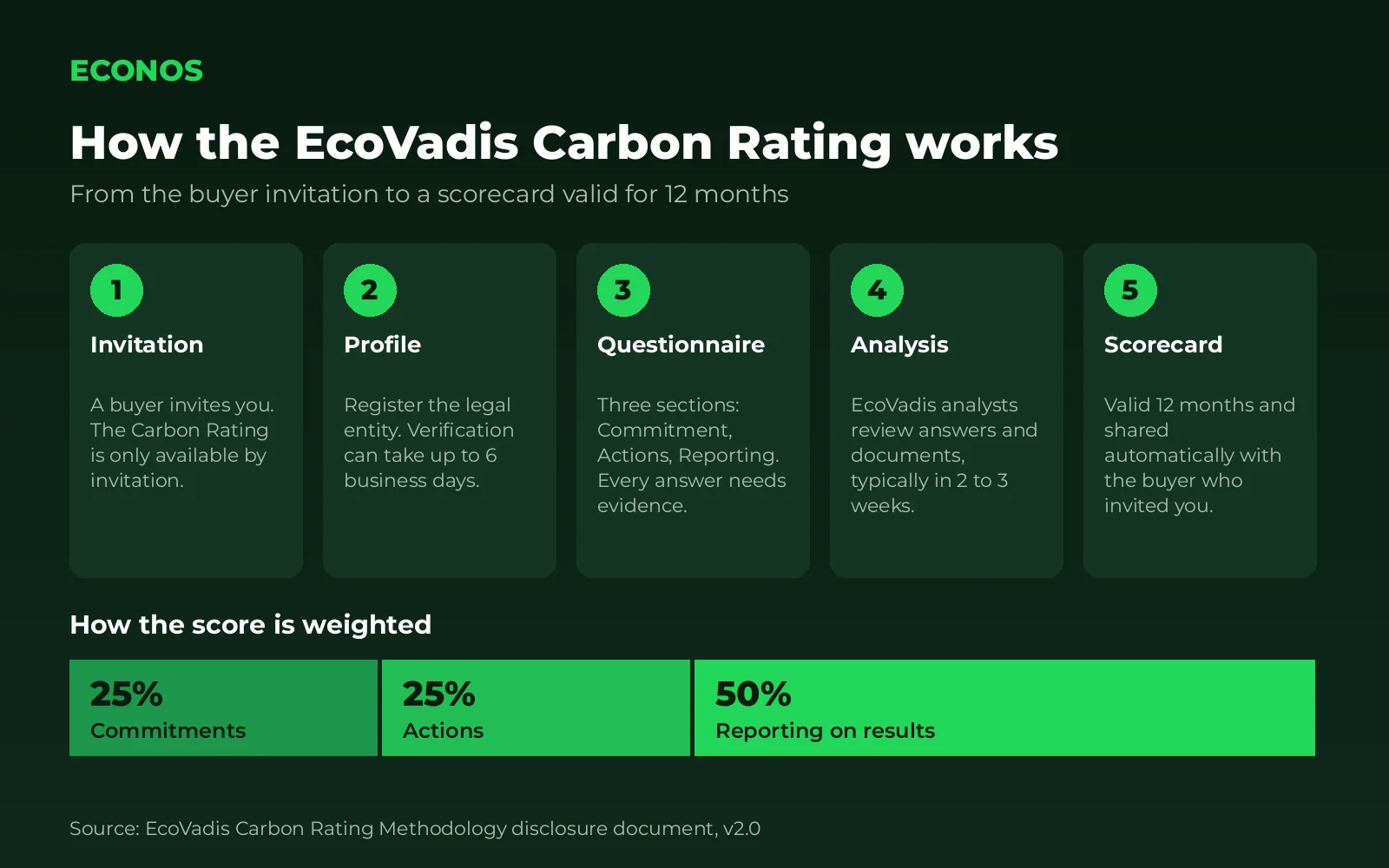
The methodology groups the questions into three layers. Commitments count for 25 percent, actions for 25 percent and reporting on results for 50 percent. Behind them are management indicators such as targets, governance, action plans, Scope 1 and 2 actions, Scope 3 actions, monitoring coverage, supply chain monitoring and reporting practices.
The weighting changes with company size. Small companies (26 to 99 employees) and medium companies (100 to 999) are not scored on governance or supply chain monitoring. Large companies (1,000 employees or more) are assessed on all indicators. A company needs at least 25 employees to be eligible.
The five carbon maturity levels
- Insufficient (0): no information on the GHG management system.
- Beginner (1 to 20): minimal management elements or reporting.
- Intermediate (21 to 50): core GHG management practices in place.
- Advanced (51 to 75): comprehensive system, including public reporting of third-party verified emissions.
- Leader (76 to 100): all Advanced prerequisites, plus absolute Scope 1 and Scope 2 reduction targets and evidence of science-aligned targets, for example SBTi validation.

The EcoVadis and Kearney 2026 Carbon Action Report, based on about 56,000 rated companies, found that the first steps are relatively accessible but many companies stall between Intermediate and Advanced, as EcoVadis explains in its article on the carbon maturity ladder.
The EcoVadis Carbon Rating process, step by step
The EcoVadis Help Center describes a simple process. The Carbon Rating is only available by invitation from a buyer, and it is free for invited companies.
- You accept the invitation and register the legal entity. EcoVadis may take up to 6 business days to verify the profile.
- You answer a questionnaire in three sections: Commitment, Actions and Reporting. Questions depend on your size and industry.
- You upload evidence. Only answers supported by documents are credited.
- Analysts review the file, which typically takes 2 to 3 weeks.
- The scorecard is published, valid for 12 months and shared automatically with the buyer who invited you.
Documents that move your carbon score
Because reporting counts for half of the score, a credible GHG inventory is the starting point. The methodology follows the GHG Protocol Corporate Standard and credits emissions and energy data only when it covers at least 95 percent of the assessed scope. Reporting data stays valid for two annual reporting cycles, and the methodology limits each assessment to 55 files.
- A Scope 1 and 2 inventory with methodology notes, see our guide on how to calculate Scope 1 emissions and on location-based and market-based Scope 2.
- A Scope 3 screening with the most relevant categories, for example upstream transportation in Scope 3 Category 4.
- Formal reduction targets with a base year, and an action plan with owners and dates.
- Evidence of actions: energy audits, renewable electricity contracts, fleet changes, supplier engagement.
- A third-party verification statement and a public report, needed to reach Advanced.
Documents must be dated, complete, clearly linked to your company and machine-readable. Scanned images and files prepared only for the assessment are not accepted. Emission factors also need a clear source, as explained in our article on GHG emission factors.
What we see in Romania
A typical ECONOS case is a Romanian manufacturer that supplies a German automotive or retail group. It receives a carbon invite, has a Scope 1 and 2 spreadsheet for its main plant, but no methodology document, no targets and no verification. The result is usually Beginner or Intermediate. The gap to Advanced is rarely technical: it is coverage of all sites, a documented method, a target and an external verification.
Our advice is to treat the invite as a one-year project, not a questionnaire. A full carbon footprint assessment covers the 95 percent rule, and our decarbonization support turns it into targets and actions. If you also plan a full rating, our guide to the EcoVadis corrective action plan shows how to turn feedback into points.
Conclusion
The EcoVadis Carbon Rating rewards companies that measure, document and verify their emissions. Start with a complete inventory, add targets and an action plan, then plan third-party verification and public reporting. That path moves you from Intermediate to Advanced and prepares you for customer requests in 2027.
Frequently asked questions
What is the EcoVadis Carbon Rating?
It is a separate EcoVadis assessment of how well a company manages its greenhouse gas emissions. It gives a score from 0 to 100 and a maturity level from Insufficient to Leader, based on documented commitments, actions and reporting.
Is the EcoVadis Carbon Rating free?
Yes for invited companies. EcoVadis states that the Carbon Rating is free for companies invited by a trading partner and that it is only available by invitation, so you cannot sign up on your own.
How long does an EcoVadis Carbon Rating take?
After you submit the questionnaire, EcoVadis analysts usually need 2 to 3 weeks to publish the scorecard. Before that, verification of your company profile can take up to 6 business days.
What do I need to reach the Advanced level?
Advanced (51 to 75) requires a comprehensive GHG management system, including public reporting of GHG emissions verified by a third party. Emissions and energy data must also cover at least 95 percent of the assessed scope to be credited.
Does the Carbon Rating give an EcoVadis medal?
No. Medals are linked to the full EcoVadis Sustainability Rating. The Carbon Rating gives a carbon score and a maturity level, and the scorecard is valid for 12 months.
Sources and recommended reading
- EcoVadis, Carbon Rating Methodology disclosure document (v2.0)
- EcoVadis, Carbon Action Manager
- EcoVadis and Kearney, Carbon Action Report 2026
- EcoVadis, The Carbon Maturity Ladder: 5 breakthrough actions
- GHG Protocol, Corporate Standard
- Science Based Targets initiative
Recommended on ECONOS
- EcoVadis medal requirements 2026
- EcoVadis 2026: what changed in the methodology
- Carbon footprint in 2026: who still needs one after Omnibus
- EcoVadis consulting by ECONOS
How ECONOS can help
ECONOS is an EcoVadis partner based in Romania. We prepare your GHG inventory, targets and evidence for the EcoVadis Carbon Rating, review your questionnaire before submission and train your team through the ECONOS Academy. Our AVA carbon accounting assistant keeps your emissions data ready for the next cycle, and our EcoVadis consulting service supports the full Sustainability Rating.
Received a carbon invite from a customer? Contact ECONOS and we will review your carbon scorecard with you.