


Your EcoVadis scorecard is published, and a list of improvement actions now waits in the platform. The EcoVadis corrective action plan (CAP) is where you manage those actions, answer requests from your customers and prepare the evidence for your next assessment. Used well, it turns a disappointing score into a clear work plan. Used badly, it becomes a list of ticks that changes nothing. This guide explains how the CAP works in 2026 and how to use it to win points.
In short
- The EcoVadis corrective action plan lists the actions created from your scorecard, plus any actions your customers request.
- Updating the CAP shows progress to buyers, but it does not change your score. Only a reassessment does.
- The actions that move your score are those backed by evidence (policies, procedures, records) that you link to the questionnaire at reassessment.
What is the EcoVadis corrective action plan?
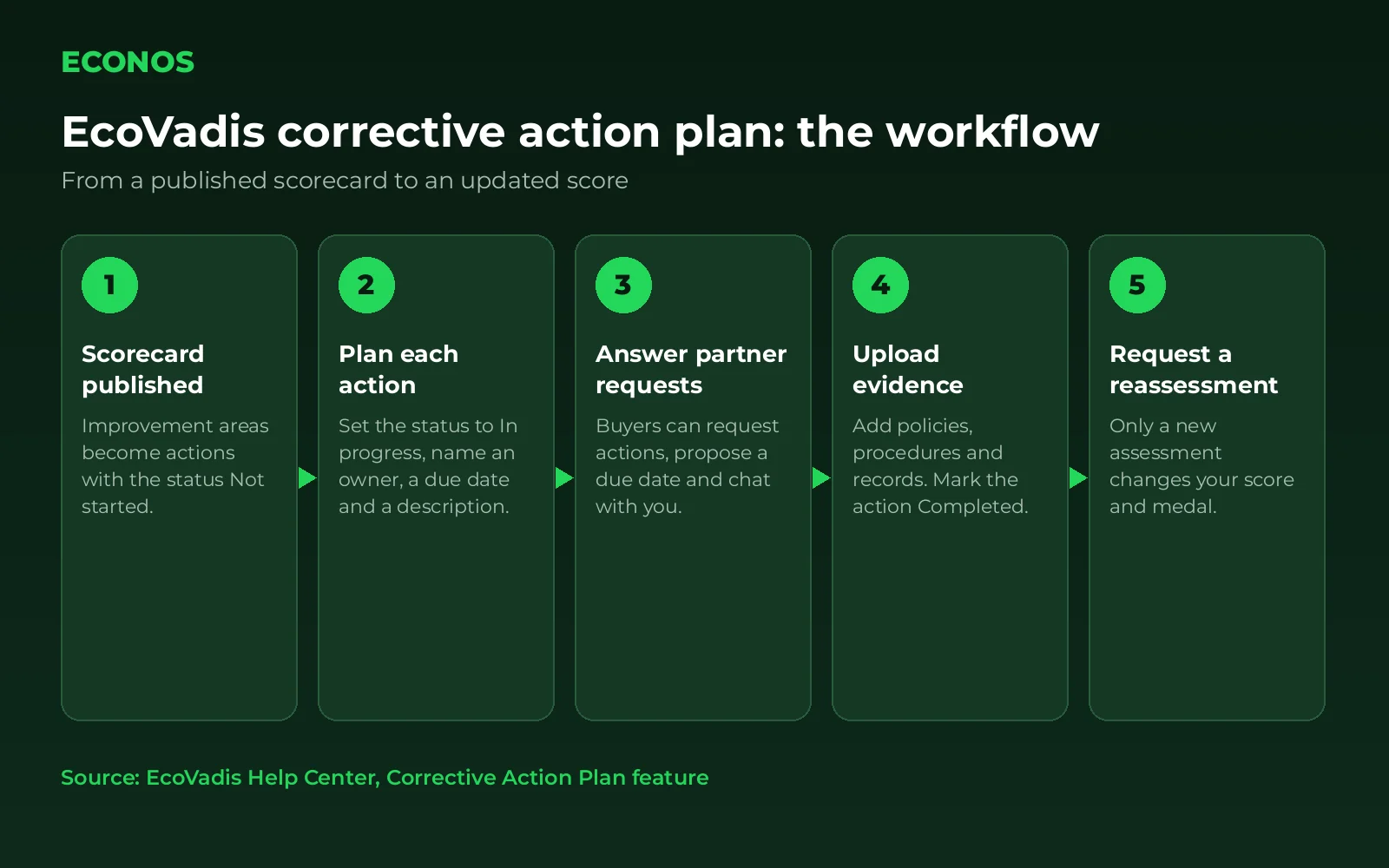
According to the EcoVadis Help Center, the CAP is the dedicated section of the platform where rated companies manage their corrective actions. When your scorecard is published, its improvement areas become scorecard-based actions with the status Not started. Both you and your trading partners can also create general improvement actions. EcoVadis shows the feature step by step in its e-learning video on the Corrective Action Plan.
The CAP is not a separate assessment. It sits on top of your scorecard, so the quality of the actions depends on how well you understand the score itself. If you are not sure why your medal was missed, start with our guide to EcoVadis medal requirements in 2026, then come back to the action list.
How the CAP works: statuses, owners and buyer requests
Each action has one of four statuses: Not started, In progress, Completed or Archived. You can change the status as often as needed. When an action is In progress, you can fill in an action plan with the person or department in charge, a due date and a short description.
Corrective action requests from customers
A buyer that follows your rating can send a corrective action request on a specific action. The request can include a proposed due date and a message, and you can reply through the chat. Each partner sees only its own requests and the progress of your actions. EcoVadis explains in its guide to supplier improvement plans that buyers expect a concrete path with owners and deadlines, not a list of promises.
In practice, buyer requests often target the same weak spots: no supplier code of conduct, no documented supplier checks, or no measured emissions. Our article on supplier assessment for procurement teams shows what buyers look for when they review these answers.
Why the corrective action plan does not change your score
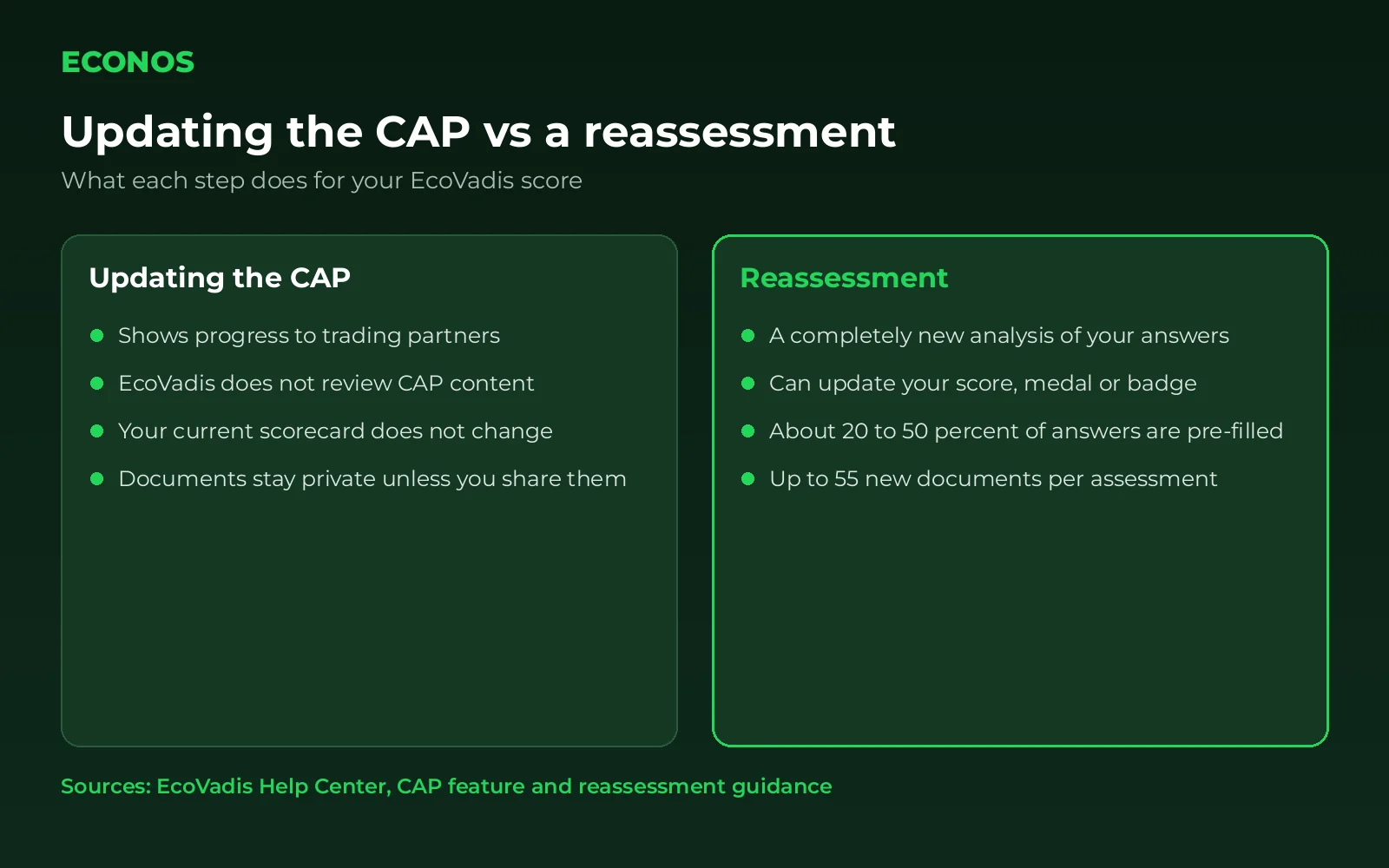
This is the point most suppliers miss. EcoVadis does not review the content of the CAP, and your current scorecard does not change when you mark actions as Completed. Your EcoVadis score changes only after a reassessment, which is a completely new analysis of your questionnaire and documents. EcoVadis describes the process in its reassessment resources.
Two practical rules follow from this. First, documents you upload to the CAP go to your Document library, but on the Basic plan you must link them to the right questionnaire answers yourself at reassessment. Second, a reassessment pre-fills only part of your previous answers (EcoVadis states about 20 to 50 percent), so new evidence must be placed where the analyst will look for it.
Methodology changes also matter. A reassessment that starts after a methodology update is scored under the new rules, as explained in our summary of EcoVadis methodology changes in 2026.
How to build an EcoVadis corrective action plan that wins points
- Read the scorecard theme by theme. Group actions under Environment, Labor and Human Rights, Ethics and Sustainable Procurement, and mark any theme close to the 30/100 minimum.
- Sort by effort. EcoVadis notes that a missing policy can often close in about 30 days, while structural issues may take 6 to 12 months.
- Give each action one owner and one due date, and set it to In progress.
- Collect proof, not promises: signed policies, procedures, training records, KPIs and reports.
- Answer every buyer request in the chat, even with a short update.
- Link the evidence to the questionnaire before you request the reassessment.
Policies are usually the fastest win, but they must include measurable targets and show how they are applied. Our guide on how to draft sustainability policies explains what a strong policy contains.
Environment actions need numbers
For the Environment theme, actions such as "report greenhouse gas emissions" need real data. A carbon footprint assessment with Scope 1 and Scope 2 figures is the typical evidence. Since 2026, EcoVadis asks for Scope 2 location-based and market-based values separately, which we explain in Scope 2 in Romania.
What we see in practice in Romania
A typical ECONOS case is a Romanian manufacturer that supplies a European group. The buyer sends a CAP request for a supplier code of conduct. The team writes the code, uploads it to the CAP, marks the action Completed and waits. One year later the score is the same, because the document was never linked to the Sustainable Procurement answers and there was no proof that suppliers had signed it.
The fix is simple: treat each action as a small project with an owner, an output and a proof. Our EcoVadis consulting service reviews the action list with your team, and teams that want to work in house can learn the method in the ECONOS Academy.
Conclusion
The EcoVadis corrective action plan is a planning and communication tool, not a scoring tool. Use it to show buyers steady progress, but measure success by the evidence you prepare for the reassessment. Prioritise quick policy gaps, plan the structural ones with milestones, and link every document to the right answer before you submit.
Frequently asked questions
What is the EcoVadis corrective action plan?
It is the section of the EcoVadis platform where a rated company tracks the actions that answer its scorecard improvement areas and buyer requests. Each action has a status, and you can add an owner, a due date and supporting documents.
Does completing corrective actions improve my EcoVadis score?
Not directly. EcoVadis does not review the content of the corrective action plan, and your current scorecard stays the same. Your score changes only after a reassessment, which is a completely new analysis.
Can my customer see my corrective action plan?
Trading partners can see the progress of your actions and the requests they sent. Documents stay private by default, so a customer only sees a file if you choose to share it through the Document library.
How long should a corrective action take?
It depends on the gap. EcoVadis suggests that a missing policy can often close in about 30 days, while structural issues may need 6 to 12 months with phased milestones.
When can I request an EcoVadis reassessment?
A scorecard is valid for 12 months. You can start a reassessment earlier, for example when you have new documents or did not reach a customer minimum score, but it uses an assessment credit, so plan it when your evidence is ready.
Sources and recommended reading
- EcoVadis e-learning: How to use the Corrective Action Plan feature
- EcoVadis: Supplier improvement plan, a framework for ESG corrective action
- EcoVadis: Getting started with your reassessment
- EcoVadis: Medals and badges
- EcoVadis Medals Methodology disclosure document
Recommended on ECONOS
- EcoVadis medal requirements 2026
- EcoVadis 2026: what changed in the methodology
- How to calculate Scope 1 emissions
- EcoVadis consulting by ECONOS
How ECONOS can help
ECONOS is an EcoVadis partner based in Romania. We turn your EcoVadis corrective action plan into a prioritised list of tasks, help you write the policies and procedures behind each action, and check that every document is linked to the right answer before reassessment. Our AVA carbon accounting assistant produces the emissions data the Environment theme asks for, and our training model helps your team manage the next cycle with more autonomy.
Received a CAP request from a customer? Contact ECONOS and we will review your scorecard and action list with you.