

Many Romanian companies already use crates, pallets, kegs or bottles that come back to them. Under the EU Packaging and Packaging Waste Regulation, that is not enough to call them reusable. The PPWR reusable packaging requirements in Article 11 of Regulation (EU) 2025/40 set nine design criteria, and Article 27 adds duties on the re-use system behind the packaging. This guide explains both, the key dates, and how to prepare the evidence.
In short
- Packaging is reusable under the PPWR only if it meets all nine criteria of Article 11(1), and you must show this in the technical documentation.
- Companies that use reusable packaging must take part in a re-use system that meets Annex VI and must recondition the packaging before it is used again.
- The Commission must set a minimum number of rotations by 12 February 2027, the reusable label follows from 12 February 2029 at the earliest, and reuse targets start on 1 January 2030.
What the PPWR reusable packaging requirements say
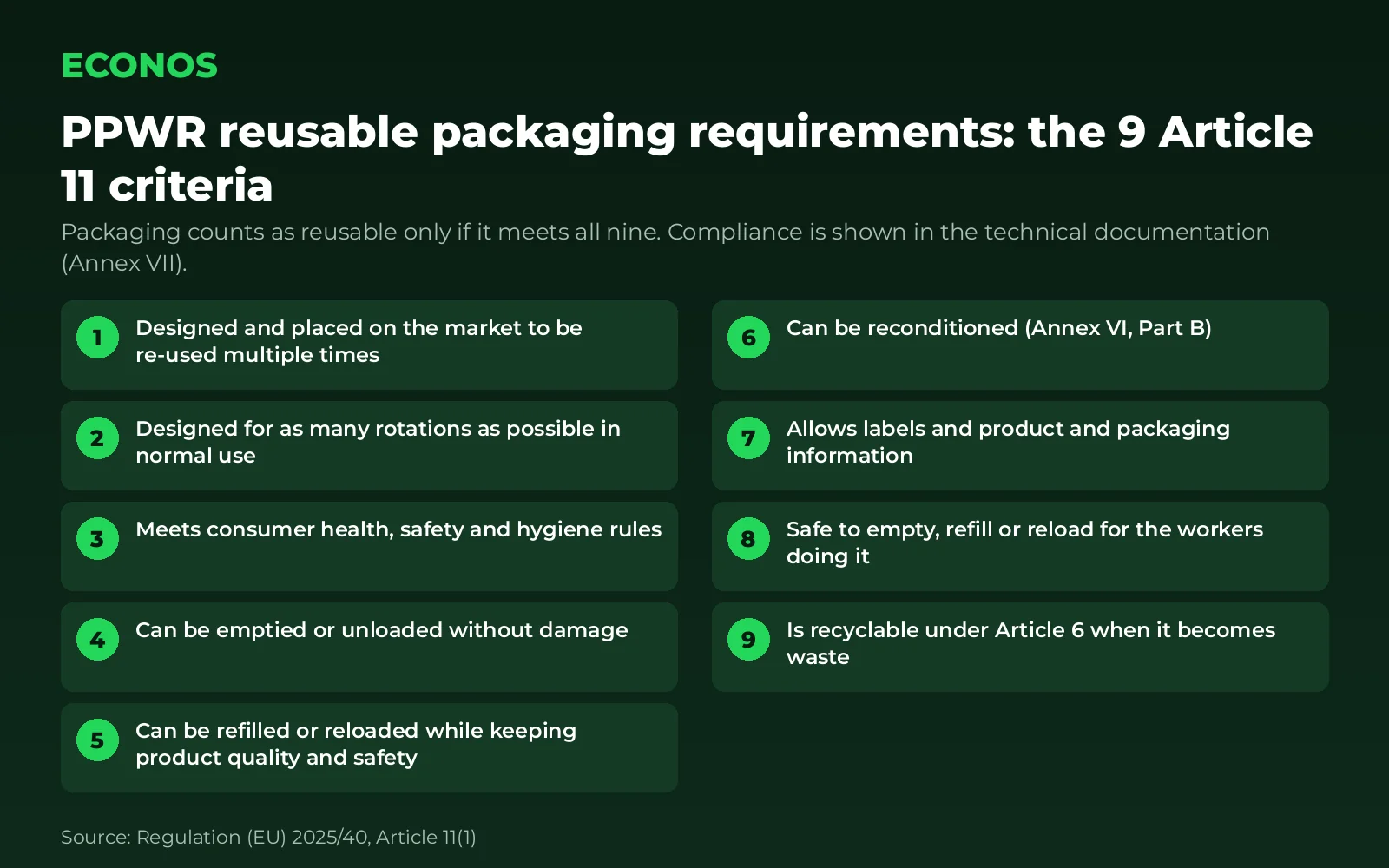
Article 11(1) states that packaging placed on the market from 11 February 2025 is considered reusable only where it fulfils all of the following criteria:
- It is conceived, designed and placed on the market with the objective to be re-used multiple times.
- It is designed to accomplish as many rotations as possible under normally predictable conditions of use.
- It meets applicable consumer health, safety and hygiene requirements.
- It can be emptied or unloaded without damage that would prevent its further use.
- It can be emptied, refilled or reloaded while keeping the quality and safety of the packed product, including food safety.
- It can be reconditioned in line with Part B of Annex VI and still perform its function.
- It allows labels and information on the product and the packaging, including safety and traceability information.
- It can be emptied, refilled or reloaded without risk to the health and safety of the people doing it.
- It meets the recyclability requirements of Article 6, so it can be recycled when it becomes waste.
The last point links reuse to design for recycling. A reusable crate still needs a good recyclability grade, as explained in our guide to PPWR recyclability grades A, B and C.
The minimum number of rotations
Article 11(2) asks the Commission to adopt a delegated act by 12 February 2027 setting a minimum number of rotations for the packaging formats most used in re-use. A rotation is the full cycle from placing the packaging on the market with a product until it is ready to be supplied again with another product. Until then, keep your own rotation and reject data.
Not completely new: the link with EN 13429
The Commission guidance on the PPWR (C/2026/3084) notes that Article 11 is substantially similar to the old Packaging Directive and the harmonised standard EN 13429:2004 on packaging re-use. The guidance also confirms that reusable packaging placed on the market before 11 February 2025 does not need to be brought into compliance retroactively, and that authorities can check compliance only from 12 August 2026.
Re-use system obligations under Article 27
Design alone does not make packaging reusable in practice. Article 27 requires economic operators that use reusable packaging to:
- participate in one or more re-use systems that meet Part A of Annex VI;
- recondition the packaging under Part B of Annex VI before offering it again for use;
- in a closed loop, return the packaging to the collection points approved by the system operator.
They may appoint a third party, for example a pooling provider, to run a mutualised system and meet these obligations on their behalf.
Closed loop and open loop systems
Annex VI defines a closed loop system as one where the packaging circulates without a change of ownership, run by a system operator or a group of participants. In an open loop system, the packaging circulates among an unspecified number of participants and ownership changes along the way, as with exchangeable pallets. Every system needs written rules, incentives to return the packaging and reporting on rotations, rejects and return rates. Reconditioning under Annex VI Part B covers inspection, removal of damaged parts, cleaning, repair and a final fitness check.
Documentation, labelling and key dates
Under Article 11(3), compliance is shown in the technical documentation of Annex VII, the same file that supports your PPWR declaration of conformity and technical file. For reusable packaging, manufacturers keep this documentation for 10 years from placing on the market, instead of 5 years for single-use packaging.
From 12 February 2029, or 30 months after the implementing act on labels, reusable packaging must carry a label saying it is reusable, plus a QR code or similar data carrier with information on the re-use system and collection points. Open loop systems without a system operator are exempt. Our article on PPWR labelling requirements covers the wider label calendar.
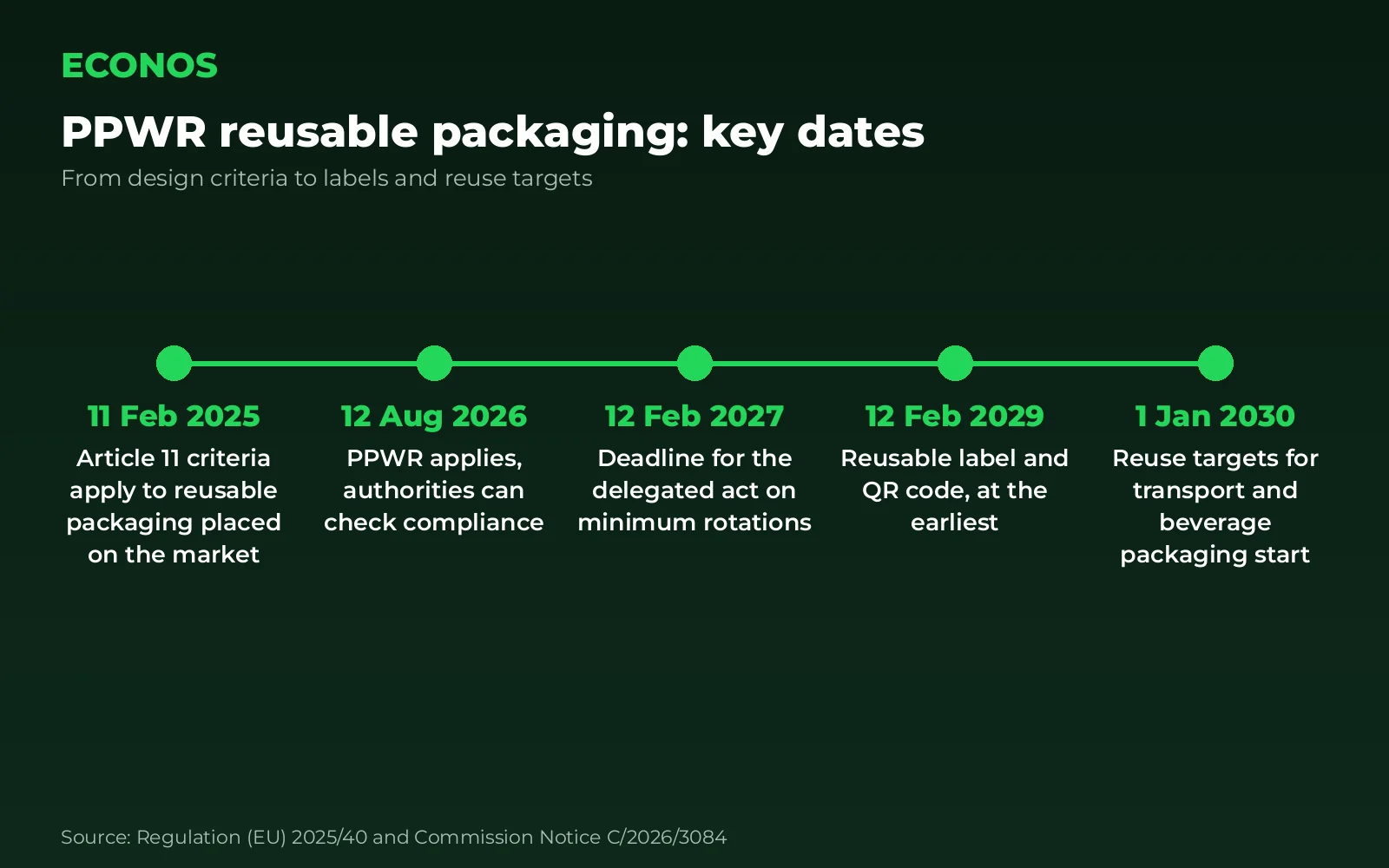
From 1 January 2030, the reuse targets of Article 29 apply, including 40% for transport packaging and 100% for many domestic B2B flows. These targets only count packaging that meets the PPWR reusable packaging requirements and sits in a re-use system. See our guide to PPWR reuse targets for transport packaging, and for cafés and restaurants the PPWR takeaway rules.
What this means for companies in Romania
In Romania, the deposit return system set up by Government Decision 1074/2021 covers non-reusable primary beverage packaging, so reusable packaging needs its own re-use system and its own evidence. Read more in our article on the PPWR deposit return system in Romania, and check national updates on the Ministry of Environment website.
A typical case we see at ECONOS is a Romanian food or auto parts supplier that delivers in plastic crates which customers send back with the next truck. The crates do rotate, but there are no written system rules, no rotation counts and no washing records. Under the PPWR, that set up must become a documented re-use system with a reconditioning procedure and data per crate type. Reusable packaging also changes your EPR reporting, explained in packaging EPR in Romania.
How to meet the PPWR reusable packaging requirements in 5 steps
- List every format you call reusable: crates, pallets, boxes, kegs, bottles, drums.
- Check each format against the nine Article 11 criteria and record the evidence.
- Describe the re-use system: closed or open loop, operator, collection points, rules.
- Write a reconditioning procedure and start counting rotations, rejects and return rates.
- Store everything in the technical file and plan labels for 2029.
Before you switch from single-use to reusable, compare the options with a life cycle assessment (LCA), because a reusable format only pays off after enough rotations. For format ideas, see our examples of reusable packaging solutions.
Conclusion
The PPWR reusable packaging requirements turn "we reuse our crates" into a legal status that must be proven. Check your formats against Article 11, organise the re-use system under Article 27 and Annex VI, and keep rotation and reconditioning data. Companies that start now will be ready for the 2027 rotation rules, the 2029 labels and the 2030 reuse targets.
Frequently asked questions
What are the PPWR reusable packaging requirements?
Article 11 of Regulation (EU) 2025/40 lists nine criteria that packaging must meet to count as reusable, from being designed for many rotations to being recyclable at end of life. Compliance must be shown in the technical documentation of Annex VII.
When do the PPWR reusable packaging requirements apply?
Article 11 applies to packaging placed on the market from 11 February 2025, and authorities can check compliance from 12 August 2026. Reusable packaging placed on the market before 11 February 2025 does not need to be brought into compliance retroactively.
How many rotations must reusable packaging achieve?
There is no fixed number yet. The Commission must adopt a delegated act with minimum rotations for the most common formats by 12 February 2027. Until then, packaging must be designed for as many rotations as possible under normal use.
What is the difference between a closed loop and an open loop re-use system?
In a closed loop system, the packaging circulates without a change of ownership, managed by a system operator or a group of participants. In an open loop system, it circulates among an unspecified number of participants and ownership changes, as with exchangeable pallets.
Do reusable crates need a label under the PPWR?
Yes, reusable packaging placed on the market from 12 February 2029, or 30 months after the implementing act, must carry a reusable label and a QR code or similar data carrier. Open loop systems without a system operator are exempt.
Sources and recommended reading
- Regulation (EU) 2025/40 on packaging and packaging waste, EUR-Lex
- Commission Notice C/2026/3084, guidance document for the PPWR
- European Commission, packaging waste policy page
- ECOS, technical paper on the durability of reusable packaging
- Romanian Ministry of Environment, Waters and Forests
Recommended on ECONOS
How ECONOS can help
ECONOS helps Romanian and EU companies check their formats against the PPWR reusable packaging requirements, document their re-use system and build the technical file. Our EU packaging law compliance service covers PPWR and EPR end to end, and the ECONOS Academy trains logistics, quality and purchasing teams to run the system on their own.