

Every PPWR obligation starts with one question: is this item packaging? The PPWR packaging definition in Article 3(1) of Regulation (EU) 2025/40 decides which items need a declaration of conformity, labels, recyclability grades and EPR reporting. It applies directly in Romania and in every EU country since 12 August 2026. This guide explains the definition, the four packaging categories and the Annex I examples, and shows how to use them in your Romanian reporting.
In short
- Packaging is any item, of any material, used to contain, protect, handle, deliver or present products to another company or to the end user.
- The PPWR adds specific cases: labels, hangers attached to products, items filled at the point of sale, tea and coffee bags, and single-serve capsules.
- An item that is an integral part of the product, and is used, consumed or disposed of together with it, is not packaging.
What the PPWR packaging definition says
Article 3(1) defines packaging as items of any material that an economic operator uses for the containment, protection, handling, delivery or presentation of products, to another economic operator or to an end user. The test is about function, not material. A wooden crate, a glass jar and a plastic film are all packaging when they do one of these jobs. The full text is available in the official PPWR text on EUR-Lex.
The PPWR packaging definition then names formats that are always included:
- components integrated into a packaging item, such as closures, sleeves and labels;
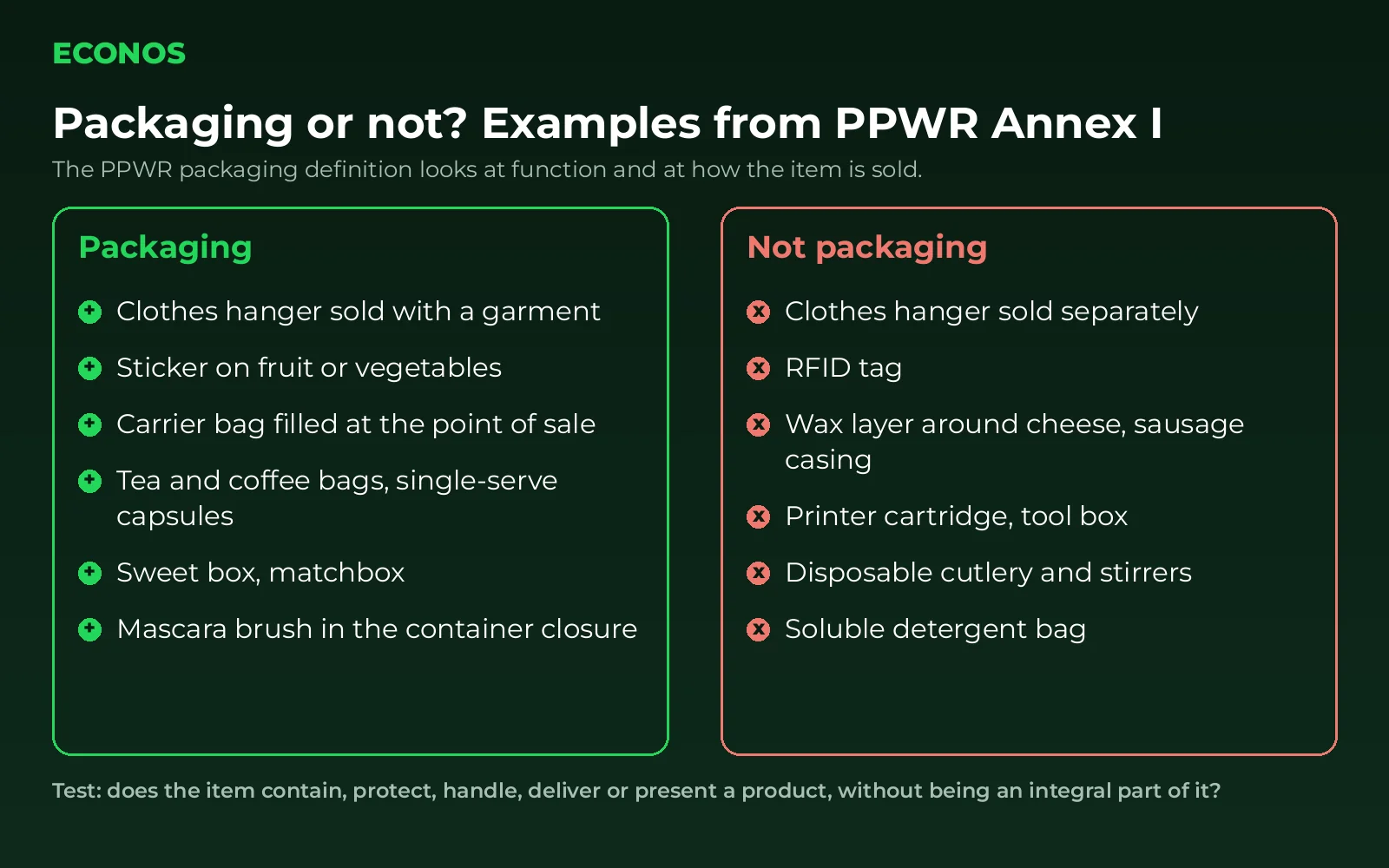
- ancillary elements hung on or attached to a product, such as a hanger sold with a garment or a sticker on fruit;
- service packaging, meaning items designed and intended to be filled at the point of sale, such as carrier bags and takeaway cups;
- disposable items sold filled or designed to be filled at the point of sale;
- tea, coffee and other beverage bags, and single-serve capsules.
If you sell food or drinks in cups and boxes filled on site, read our guide to the PPWR takeaway packaging rules, because service packaging has its own reuse obligations.
When an item is not packaging: the integral part test
The key exclusion in the PPWR packaging definition concerns items that are an integral part of the product. If an item is needed to contain, support or preserve the product for its whole life, and all elements are meant to be used, consumed or disposed of together, it is not packaging. Annex I gives examples: the wax layer around cheese, sausage casings, printer cartridges, tool boxes and soluble detergent bags.
The same item can change status depending on how it is sold. A clothes hanger sold with a garment is packaging, but a hanger sold on its own is a product. A cake doily sold under a cake is packaging, while a pack of doilies sold empty is not. The European Commission confirms this functional, case by case approach in its PPWR guidance document (C/2026/3084). Annex I is an indicative list, so the Article 3(1) test always comes first.
The four PPWR packaging categories
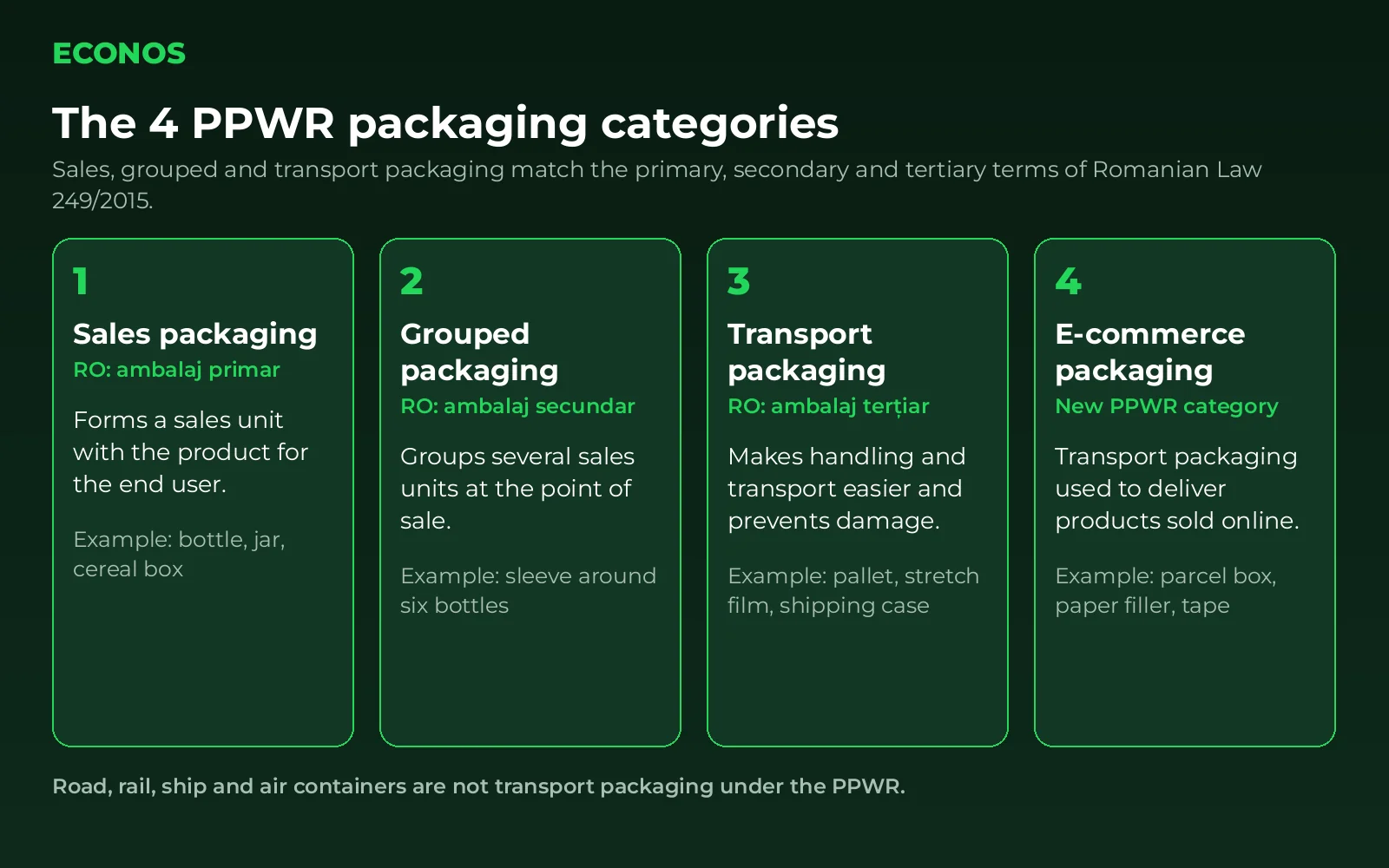
Once the PPWR packaging definition tells you an item is packaging, you need its category, because several obligations depend on it. Article 3(1) defines four main packaging categories:
- Sales packaging: forms a sales unit of product and packaging for the end user at the point of sale, such as a bottle, a jar or a cereal box.
- Grouped packaging: groups a number of sales units at the point of sale and can be removed without changing the product, such as a sleeve around six bottles.
- Transport packaging: makes handling and transport of sales units easier and prevents damage, such as pallets, stretch film and shipping cases. Road, rail, ship and air containers are excluded.
- E-commerce packaging: transport packaging used to deliver products sold online or through other distance sales.
The category matters in practice. The PPWR empty space ratio applies to grouped, transport and e-commerce packaging, the PPWR reuse targets for transport packaging apply to pallets, crates and boxes, and the packaging minimisation rules apply to all of them.
Romanian terms: primary, secondary and tertiary packaging
Romanian companies know these categories under other names. Annex 1 of Law 249/2015 on packaging and packaging waste uses primary packaging (sales packaging), secondary packaging (grouped packaging) and tertiary packaging (transport packaging). The PPWR adds e-commerce packaging and service packaging as named formats. Romanian rules are being aligned with the regulation, so check the latest national text before you update your procedures.
Companies that place packaged products on the Romanian market must register with the Environmental Fund Administration (AFM) and report the packaging they put on the market. The PPWR packaging definition decides which items enter those quantities. Our guide on packaging EPR in Romania and its costs explains how the declarations and fees work.
How to apply the PPWR packaging definition in 4 steps
- List every item that leaves your site with a product: bottles, boxes, labels, tapes, fillers, stretch film, pallets and hangers.
- Apply the function test: does the item contain, protect, handle, deliver or present a product?
- Check the integral part exclusion and compare the item with the Annex I examples.
- Assign a category and confirm your role. Our article manufacturer or producer under the PPWR helps you decide who carries each obligation.
In our PPWR projects in Romania, the most common gap is the items nobody thinks of as packaging. A typical case is a food producer that reported its jars and cartons to AFM but not the labels, stretch film, corner boards and pallets used for deliveries to retailers. Another is an online shop that ignored the paper filler and adhesive tape in its parcels. All of these are packaging under the PPWR and must appear in your inventory, your PPWR labelling plan and your PPWR declaration of conformity and technical file.
Frequently asked questions
What is the PPWR packaging definition?
Article 3(1) of Regulation (EU) 2025/40 defines packaging as items of any material used by an economic operator to contain, protect, handle, deliver or present products to another company or to an end user. It also lists specific cases, such as labels, hangers, service packaging, tea bags and single-serve capsules.
Are labels and stickers packaging under the PPWR?
Yes. Labels attached directly to a product or to another packaging item, including stickers on fruit and vegetables, are packaging. RFID tags and tyre labels under Regulation (EU) 2020/740 are not.
Are coffee capsules and tea bags packaging?
Yes. Single-serve capsules and tea, coffee or other beverage bags are listed in Article 3(1) as packaging. They must therefore follow the PPWR rules that apply to packaging.
What is the difference between transport packaging and e-commerce packaging?
Transport packaging makes handling and transport of sales units easier and prevents damage. E-commerce packaging is transport packaging used to deliver products sold online or through other distance sales.
Is a printer cartridge or a tool box packaging?
No. Annex I lists printer cartridges and tool boxes as items that are not packaging, because they are an integral part of the product or are used together with it for its whole life.
Sources and recommended reading
- Regulation (EU) 2025/40 on packaging and packaging waste, EUR-Lex
- Commission Notice C/2026/3084, guidance document for the PPWR, EUR-Lex
- European Commission, PPWR guidance document page
- Law 249/2015 on packaging and packaging waste management, Rubinian legal database
- Directive 94/62/EC on packaging and packaging waste, EUR-Lex
Recommended on ECONOS
How ECONOS can help
ECONOS helps Romanian and EU companies apply the PPWR packaging definition to their real product range: a complete packaging inventory, a category for each item, the link to AFM and EPR reporting, and a technical file ready for inspection. Our EU packaging law compliance service covers PPWR and EPR end to end, our life cycle assessment (LCA) work compares packaging options, and ECONOS Academy trains your team to keep the inventory up to date on its own.
Contact ECONOS to check which of your items count as packaging.