


Retailers in Romania hand out millions of bags every week, at the checkout, the bakery counter and the fruit section. The new EU Packaging and Packaging Waste Regulation changes the rules for these bags. This guide explains the PPWR plastic carrier bags rules in simple terms: which bags are affected, what is banned from 2030, how the 40 bags per person target works and what Romanian law already requires.
In short
- PPWR plastic carrier bags fall into four classes by wall thickness. Very lightweight bags below 15 microns are banned from 1 January 2030, with two exceptions.
- Member States must keep the use of lightweight bags (below 50 microns) at or below 40 per person per year, from 31 December 2025.
- Romania already bans thin plastic bags with handles and applies an eco-tax on plastic bags. Retailers should map their bags by thickness now.
PPWR plastic carrier bags: what the regulation says
Regulation (EU) 2025/40 applies from 12 August 2026 and replaces the old Packaging Directive, as the European Commission announced. Carrier bags filled at the point of sale are packaging, and Annex I lists paper and plastic carrier bags as examples. If you are not sure where the line sits, our guide on the PPWR packaging definition explains the four categories.
The PPWR plastic carrier bags rules build on Directive (EU) 2015/720, adding a common target and a 2030 ban for the thinnest bags.
Four classes by wall thickness
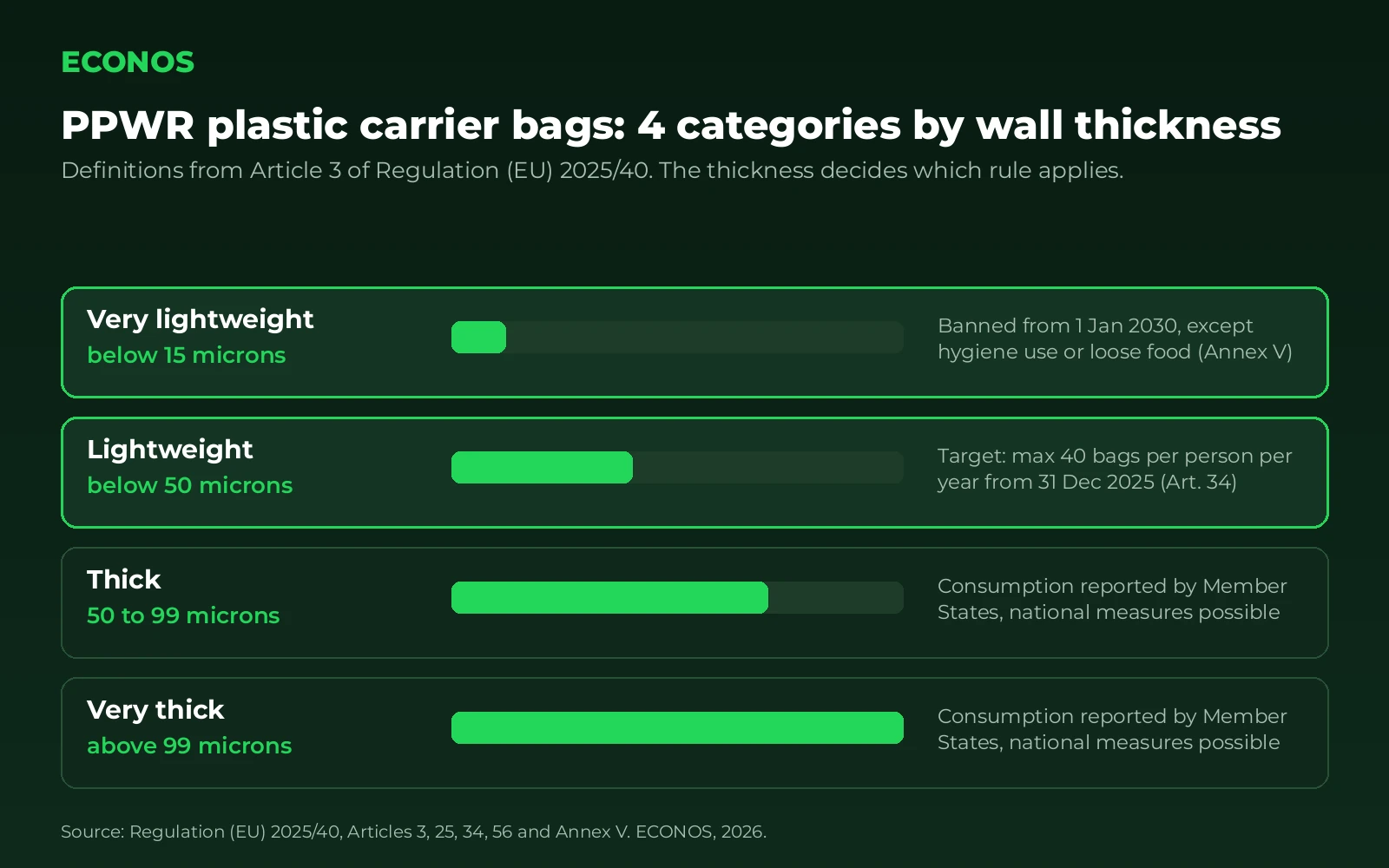
Article 3 of the PPWR text on EUR-Lex defines plastic carrier bags as bags, with or without a handle, made of plastic and supplied to consumers at the point of sale. It then sets four classes:
- Very lightweight plastic carrier bags: wall thickness below 15 microns, typically the roll bags at the fruit counter.
- Lightweight plastic carrier bags: below 50 microns.
- Thick plastic carrier bags: between 50 and 99 microns.
- Very thick plastic carrier bags: above 99 microns, often sold as reusable bags.
The 2030 ban on very lightweight plastic bags
Article 25 and Annex V of the PPWR ban six packaging formats from 1 January 2030. One of them is the very lightweight plastic bag. The ban does not apply when the bag is required for hygiene reasons, or when it is provided as sales packaging for loose food and helps to prevent food waste. The full list of formats is in our article on PPWR banned packaging formats.
In practice, a thin bag for raw meat or fish at a service counter can stay. A thin bag offered by default for items that do not need it is what the ban targets.
Article 9 also allows Member States to require very lightweight and lightweight bags to be compostable, where bio-waste collection can treat them. Read our guide on compostable packaging and PPWR Article 9 before you switch suppliers.
The 40 bags per person target
Article 34 asks each Member State to reach a sustained reduction in the use of lightweight plastic carrier bags. The benchmark is no more than 40 bags per person per year, or the same target in weight, by 31 December 2025 and every year after. Countries can use bans, fees or national targets, and may exclude very thin bags used for hygiene or loose food.
Member States must report yearly use for all four bag classes, so expect more data requests on PPWR plastic carrier bags from your suppliers and EPR organisation.

Plastic bag rules in Romania
Romania acted before the PPWR. Amendments to Law 249/2015 on packaging, prepared to transpose Directive 2015/720, banned thin plastic carrier bags with handles, meaning bags below 50 microns, from the Romanian market from 2018, while reusable bags stayed allowed. Economica.net described the draft and its 50 micron threshold. In 2019, the government also raised the plastic bag eco-tax under Government Emergency Ordinance 196/2005 from 0.10 to 0.15 lei per bag, for bags of any thickness, with an exemption for compostable bags that meet SR EN 13432, as Contabilul.ro reported.
The eco-tax is declared and paid to AFM, the Romanian Environmental Fund Administration, by the producer or importer of the bags. Its value may have changed since 2019, so check the current amount before you plan prices. Bags you hand out also count in your packaging reporting, which we explain in our guide to packaging EPR in Romania and its costs.
Other rules for PPWR plastic carrier bags
Bags that stay on the market must meet the general PPWR rules like any other packaging:
- Recyclability: all packaging must be recyclable by 2030, and grades A to C will decide what stays. See PPWR recyclability grades A, B and C.
- Recycled content: from 2030, plastic packaging that is not contact-sensitive needs at least 35% post-consumer recycled content under Article 7. Our article on PPWR recycled content targets gives the details.
- Labelling: harmonised sorting labels will apply, as described in our guide to PPWR labelling requirements.
What retailers should do now
A situation we often see at ECONOS in Romania is a regional food retailer that buys checkout bags, bakery bags and fruit counter roll bags from three or four suppliers. The technical sheets rarely state the wall thickness in microns, so nobody can say which bags fall under the 2030 ban. Our first step is always a simple bag register.
- List every bag you hand out, by store area and supplier.
- Ask each supplier for thickness in microns, material, recycled content and compostability certificates.
- Classify each bag into the four PPWR classes and flag very lightweight bags that are not used for hygiene or loose food.
- Check the eco-tax and EPR treatment with your supplier and your EPR organisation.
- Plan alternatives, such as thicker reusable bags, paper or no bag, and train store staff.
The ECONOS EU compliance service can run this review with your team, and the ECONOS Academy trains purchasing and store teams on packaging rules.
Frequently asked questions
Are plastic carrier bags banned under the PPWR?
Not all of them. Very lightweight plastic carrier bags below 15 microns are banned from 1 January 2030, except for hygiene uses and loose food. Other plastic bags stay allowed, but Member States must keep the use of lightweight bags at or below 40 per person per year.
What is the difference between lightweight and very lightweight plastic bags?
Under Article 3 of the PPWR, lightweight plastic carrier bags have a wall thickness below 50 microns and very lightweight bags below 15 microns. Thick bags are between 50 and 99 microns, and very thick bags are above 99 microns.
Can shops still offer thin bags for fruit and vegetables after 2030?
Yes, but only where the bag is required for hygiene reasons or is provided as sales packaging for loose food to prevent food waste. Member States may also require these bags to be compostable, so check the Romanian implementing rules.
Do I pay an eco-tax on plastic bags in Romania?
Romania applies an eco-tax per plastic bag under Government Emergency Ordinance 196/2005 on the Environmental Fund. It is declared to AFM by the producer or importer of the bags. The amount has changed over time, so verify the current value with AFM before you budget.
Are paper bags a safe alternative to plastic carrier bags?
Paper carrier bags are also packaging under the PPWR, so recyclability, labelling and EPR rules apply. The regulation also says that cutting plastic bags should not simply shift use to other materials, and the Commission will report on this by 12 February 2032.
Conclusion
The PPWR plastic carrier bags rules are short but they reach every till and counter. Thin bags without a hygiene or food waste reason will go in 2030, national measures will keep lightweight bags under 40 per person, and every bag that stays must meet the recyclability, recycled content and labelling rules. Start with a bag register by thickness and supplier today.
Sources and recommended reading
- Regulation (EU) 2025/40 on packaging and packaging waste, EUR-Lex
- European Commission: new EU rules on packaging enter into application
- European Commission: packaging waste policy page
- Directive (EU) 2015/720 on lightweight plastic carrier bags, EUR-Lex
- Contabilul.ro: Romania raises the eco-tax on plastic bags (2019)
- Economica.net: Romanian draft ban on thin plastic bags with handles
Recommended on ECONOS
- PPWR banned packaging formats: the 6 Annex V bans from 2030
- PPWR packaging definition: what counts as packaging
- Packaging EPR in Romania: how it works and costs
- PPWR recycled content targets for plastic packaging
How ECONOS can help
ECONOS helps Romanian retailers and packaging suppliers map their bags and packaging against the PPWR, prepare supplier requests and plan the switch before 2030. Contact ECONOS to review your plastic carrier bags and packaging compliance plan.