


Most companies that buy and resell packaged goods in Romania think the new EU packaging rules are a problem for manufacturers. They are not only that. Since 12 August 2026, PPWR distributor obligations apply directly to wholesalers, retailers and other resellers under Article 19 of Regulation (EU) 2025/40. This guide explains what a distributor must check before selling, when a distributor becomes a manufacturer, and how to organise the checks in practice.
In short
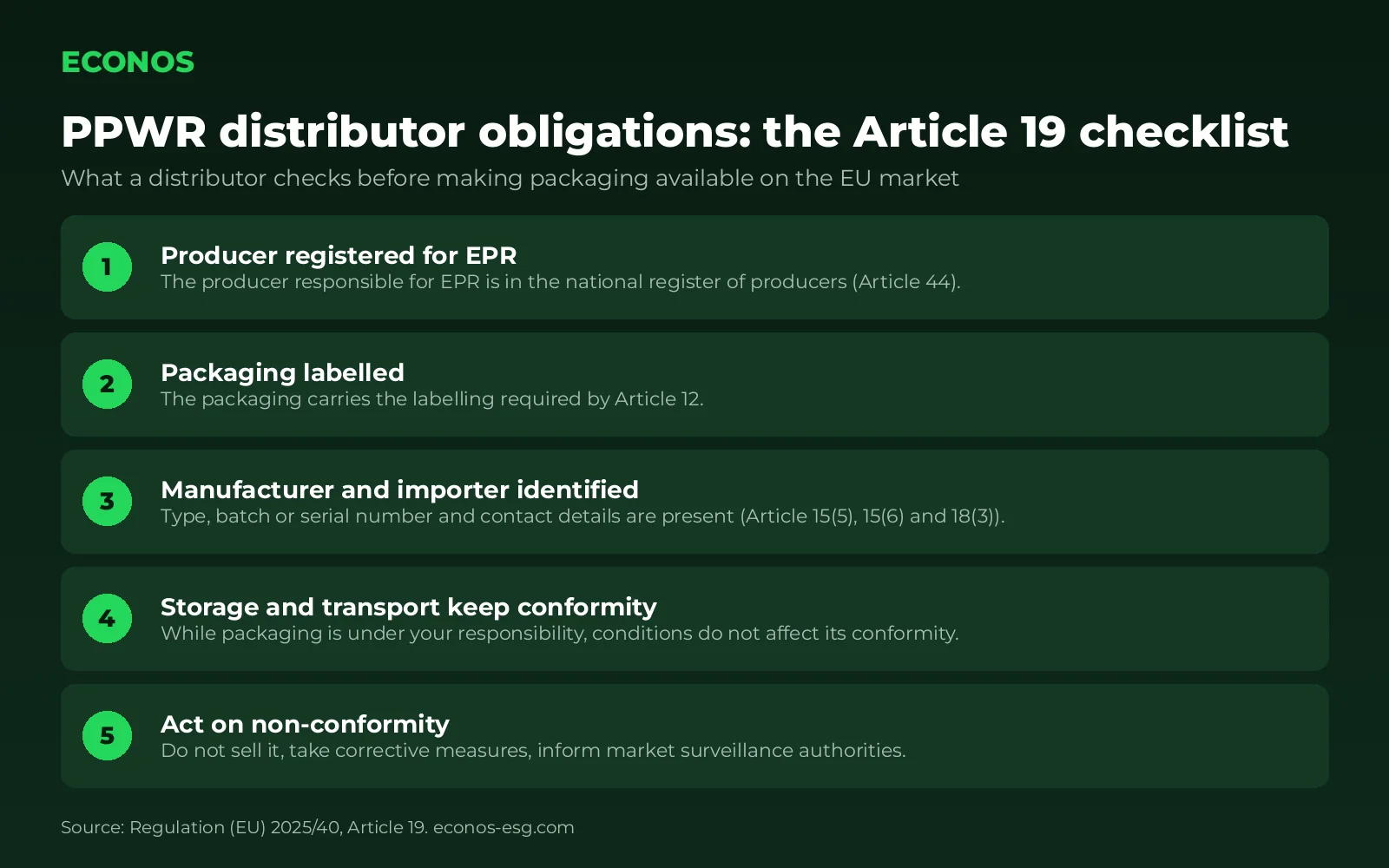
- Before making packaging available, a distributor must verify that the EPR producer is registered, that the packaging is labelled under Article 12, and that the manufacturer and importer identification data are present.
- If you sell packaging under your own name or trademark, or modify it in a way that can affect compliance, you are treated as the manufacturer (Article 21).
- If you suspect non-conformity, you must not sell, you must take corrective measures and inform the market surveillance authorities.
Who is a distributor under the PPWR?
The PPWR defines a distributor as any natural or legal person in the supply chain, other than the manufacturer or importer, that makes packaging available on the market. In practice: wholesalers, supermarket chains, pharmacies, online shops buying from EU suppliers and B2B resellers of packaging materials.
The role is defined per product and per transaction. The same company can be an importer for goods it brings from Turkey, a distributor for goods it buys from a Romanian supplier, and a manufacturer for its private label range. Our article on manufacturer and producer roles under the PPWR explains how these roles fit together.
PPWR distributor obligations under Article 19
Article 19 starts with a general duty: distributors must act with due care in relation to the requirements of the Regulation. It then lists concrete checks to do before the packaging is made available.
The three checks before selling
- Producer registration. The producer that is subject to extended producer responsibility (EPR) for the packaging must be registered in the national register of producers referred to in Article 44. Our guide to PPWR producer registration explains who must register and where.
- Labelling. The packaging must be labelled in accordance with Article 12. The harmonised material label applies from 12 August 2028 or 24 months after the implementing acts, whichever is later, so this check grows over time. See our page on PPWR labelling requirements.
- Identification data. The manufacturer must have put a type, batch or serial number and its contact details on the packaging or in an accompanying document (Article 15(5) and (6)). The importer must have added its own name and postal address (Article 18(3)).
Distributors are not asked to repeat the conformity assessment. That remains the job of the manufacturer, who draws up the technical documentation and the EU declaration of conformity. Still, asking for the declaration is a good way to show due care, and the Commission guidance document on the PPWR is useful to read alongside the legal text. Our guide on how to check the PPWR declaration of conformity your suppliers sent you gives a practical method.
Storage, transport and non-conformity
While the packaging is under your responsibility, storage and transport conditions must not affect its conformity. If you consider or have reason to believe that the packaging does not meet Articles 5 to 12, you must not make it available until it is brought into conformity.
If the packaging is already on the market, you must make sure corrective measures are taken: bring it into conformity, withdraw it or recall it. You must also immediately inform the market surveillance authorities of the Member States where you sold it. On a reasoned request, you must provide all the information and documentation you have access to, in electronic form.
When a distributor becomes a manufacturer
Article 21 is where many retailers and wholesalers are caught. A distributor is treated as the manufacturer, with all the obligations of Article 15, when it:
- places packaging on the market under its own name or trademark, for example a private label range;
- modifies packaging already placed on the market in a way that could affect compliance, for example repacking products into new boxes or trays.
There is one exception. If the distributor is a micro-enterprise and the supplier of the packaging is located in the EU, the supplier is considered the manufacturer for the purposes of Article 15.

What PPWR distributor obligations mean in Romania
In Romania, packaging EPR still runs under national law, mainly Law 249/2015 and the Environmental Fund rules, with registration and declarations at AFM (Administrația Fondului pentru Mediu). National updates are published by the Romanian Ministry of Environment, Waters and Forests. The Article 44 register must be set up by each Member State within 18 months of the first implementing act on the register format, so the final Romanian set up is still to be confirmed. Until then, keep proof of your suppliers' AFM registration on file and verify with AFM how the new register will work. For background, read how packaging EPR works in Romania and what it costs.
A typical situation we see at ECONOS: a Romanian food wholesaler buys products from local importers and also sells a small range under its own brand, packed by a contract packer. For the bought in products it is a distributor and needs supplier evidence. For its own brand it is the manufacturer, and the contract packer cannot take that responsibility from it. Mapping each product line to the right role is usually the first step of our EU compliance support.
How to organise the checks in practice
- Map your roles. List suppliers and product lines and mark each one as distributor, importer or manufacturer.
- Update supplier requirements. Add PPWR clauses to purchase contracts: EPR registration proof, identification data, declaration of conformity on request, and a duty to tell you about non-conformities.
- Check at goods receipt. Train the reception team to check labels, batch numbers and contact details on a sample basis.
- Keep records. Under Article 22, you must be able to identify who supplied you and whom you supplied for 5 years for single use packaging and 10 years for reusable packaging.
- Prepare an escalation process. Decide who stops sales and who contacts suppliers and authorities.
Companies that buy from other EU countries or sell online should also read our articles on cross border PPWR obligations and EPR for marketplaces. If your team needs a structured introduction, the ECONOS Academy offers practical training on packaging compliance.
Frequently asked questions
What are the PPWR distributor obligations?
Under Article 19, distributors must act with due care and, before selling, verify that the EPR producer is registered, that the packaging is labelled under Article 12, and that manufacturer and importer identification data are present. They must also protect conformity during storage and act on suspected non-conformity.
Does a retailer need its own declaration of conformity?
Not as a pure distributor. The declaration of conformity is drawn up by the manufacturer. A retailer selling private label products is treated as the manufacturer under Article 21 and then needs the technical documentation and the declaration.
Since when do PPWR distributor obligations apply?
The PPWR applies from 12 August 2026. Some checks depend on later dates, for example the harmonised label under Article 12, which applies from 12 August 2028 at the earliest.
What should a distributor do with non-compliant packaging?
It must not make the packaging available until it is in conformity. If the packaging is already on the market, the distributor must make sure it is corrected, withdrawn or recalled, and inform the market surveillance authorities immediately.
How long must distributors keep supplier records?
Article 22 requires economic operators to identify their suppliers and customers on request: for 5 years for single use packaging and 10 years for reusable packaging.
Conclusion
PPWR distributor obligations are lighter than those of manufacturers, but they are real and they apply now. A distributor that checks registration, labelling and identification data, documents its checks and reacts quickly to problems is well protected. A distributor that sells private label products must accept that it is the manufacturer.
Sources and recommended reading
- Regulation (EU) 2025/40 on packaging and packaging waste, EUR-Lex
- European Commission guidance document for Regulation (EU) 2025/40 (C/2026/3084)
- European Commission, Packaging waste
- Romanian Ministry of Environment, Waters and Forests
- Mason Hayes & Curran, obligations for importers and distributors
Recommended on ECONOS
- Manufacturer or producer: your role under the PPWR
- PPWR producer registration
- PPWR labelling requirements
- PPWR authorised representative
How ECONOS can help
ECONOS helps Romanian wholesalers, retailers and brand owners map their PPWR role for each product line, set up supplier checks and build the documentation that proves due care. We also train your teams to run the checks themselves. Contact ECONOS to review your distributor obligations under the PPWR.