
.png)
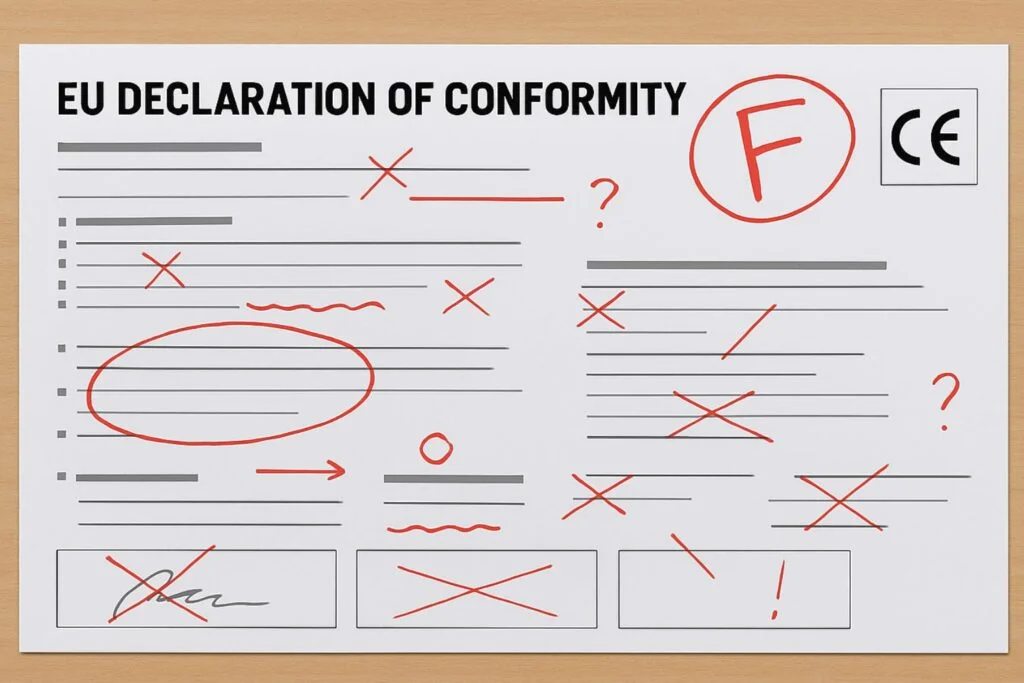
PPWR declaration of conformity: how to check what your suppliers sent you
Since 12 August 2026, any packaging placed on the EU market must be covered by a conformity assessment, technical documentation and an EU Declaration of Conformity. The immediate consequence, visible in every procurement department, is a wave of documents arriving from suppliers.
The problem is that a document received is not compliance demonstrated. In the projects we have run over recent months, a significant share of supplier declarations do not support what they appear to support. Some reference the repealed legislation. Some confuse a technical test with legal proof. Some are correct but cover packaging other than what is actually delivered.
This article is the checklist we use when reading a declaration received from a supplier.
Why it matters who signs
The PPWR distinguishes between the manufacturer and the producer for extended producer responsibility purposes. The manufacturer is the operator placing the packaging on the market under its own name or brand, which in most chains is the company packing the product. The EPR producer is the operator carrying the registration, reporting and waste management financing obligations.
The distinction is decisive for the declaration. If you are the manufacturer under the regulation, the declaration is yours to issue, and documents from your film or board supplier are inputs to your technical file, not substitutes for your declaration.
So the first check is: who signed, and in what capacity. A declaration signed "as importer and or distributor, as the case may be" clarifies nothing. The capacity must be one specific role, determined for that flow.
What a usable declaration contains
A declaration consistent with Annex VIII of the regulation identifies the issuing operator, identifies the packaging unambiguously, states the requirements assessed, and refers to the technical documentation it rests on.
In practice we check eight things.
Identification of the issuer, with name, address and, where relevant, authorised representative. Identification of the packaging, precise enough to allow traceability, ideally with internal code, dimensions and description. Composition by material and component, including adhesives, inks, varnishes, labels and closures, since these routinely enter the recyclability assessment. The list of requirements assessed, article by article, with explicit notes on those not yet applicable at the date of issue. The evidence relied on for each requirement. Reference to the harmonised standards or technical specifications used. Mention of the notified body, where one is involved. Signature, date and place.
If any of the first five is missing, the document is a letter of intent, not a declaration.
The problems we find most often
The declaration references Directive 94/62/EC. Compliance with the repealed directive does not demonstrate compliance with the regulation. Files built under the old regime need rebuilding.
A test report is presented as proof of conformity. This is the subtlest and most common case. A technical recyclability certificate issued under a laboratory protocol, in a conventional recycling stream, shows that the material behaves predictably in that stream. On its own it does not demonstrate that the packaging complies with the recyclability requirements of the regulation. These are two different things, and the difference only becomes visible under inspection.
The declaration covers the material, not the packaging. The film supplier declares the film. Your packaging is the film plus the label plus the adhesive plus the closure. Assessment happens on the packaging in the form it reaches the market.
The declaration does not match what is delivered. This happens after changes in formulation, grammage or secondary supplier, without updating the document.
One document covers the entire portfolio. A generic declaration for "cardboard packaging" allows neither traceability nor assessment. The functional approach is one declaration per homogeneous cluster, where homogeneous means identical composition and identical behaviour against the requirements assessed.
What to do when the supplier cannot or will not
The regulation sets information obligations along the supply chain, but in practice commercial leverage determines the speed. Three things work.
Ask for data, not documents. Many packaging suppliers do not yet have complete declarations, but they do have technical data sheets, material specifications and laboratory reports. That is enough to build your own file.
Put the requirement in the contract. A clause tying acceptance to up to date technical documentation and to notification of any composition change solves more than ten reminder emails.
Prioritise by risk, not alphabetically. Food contact packaging, barrier treated materials, labels permanently bonded to a different substrate, and packaging for export markets go first.
Why we separate verification from drafting
A note on method, because it matters when choosing an advisor. Checking whether a received declaration is complete, coherent and supported by evidence is documentary work. Judging whether the packaging itself meets the technical requirements is technical assessment work, which belongs to laboratories and packaging design.
We do the first and are explicit about the second. An advisor promising both without testing capability is selling you a risk, not a solution.
Frequently asked questions
Who issues the declaration if I only pack products using purchased packaging? Most likely you, if you place the packaging on the market under your own brand. Supplier documents are inputs to your technical file.
How many declarations do I need? As many as you have homogeneous packaging clusters. For most small and mid sized companies, between five and twenty.
Do I have to send the declaration to my customers? Not automatically. You must be able to make it available to authorities on request, and downstream customers increasingly require it contractually.
What if I have the declaration but the technical file is thin? A declaration without supporting technical documentation is the weakest possible position under inspection, because you are asserting something you cannot demonstrate.
If you have received declarations of conformity from suppliers and are not sure they hold up, we run them through our documentary audit and tell you, document by document, what they prove and what they do not.