

Since 12 August 2026, every packaging item placed on the EU market must respect the chemical rules in Article 5 of Regulation (EU) 2025/40. The PPWR substances of concern rules combine a general duty to minimise hazardous chemicals with two hard limits: 100 mg/kg for heavy metals and strict PFAS thresholds for food contact packaging. This guide explains what applies today, which exemptions exist, and what evidence Romanian manufacturers and importers should collect from their suppliers.
In short
- The sum of lead, cadmium, mercury and hexavalent chromium in packaging or any packaging component must not exceed 100 mg/kg.
- Since 12 August 2026, food contact packaging must also respect the PFAS limits of 25 ppb, 250 ppb and 50 ppm.
- Compliance must be shown in the technical documentation, so supplier test reports and declarations are now part of your PPWR file.
What PPWR substances of concern means
The PPWR does not write its own definition. It refers to the definition of substance of concern in Article 2 of the Ecodesign for Sustainable Products Regulation (EU) 2024/1781. In simple terms, it covers substances of very high concern on the REACH candidate list, certain substances classified as hazardous under the CLP Regulation, persistent organic pollutants and substances that make re-use or recycling harder.
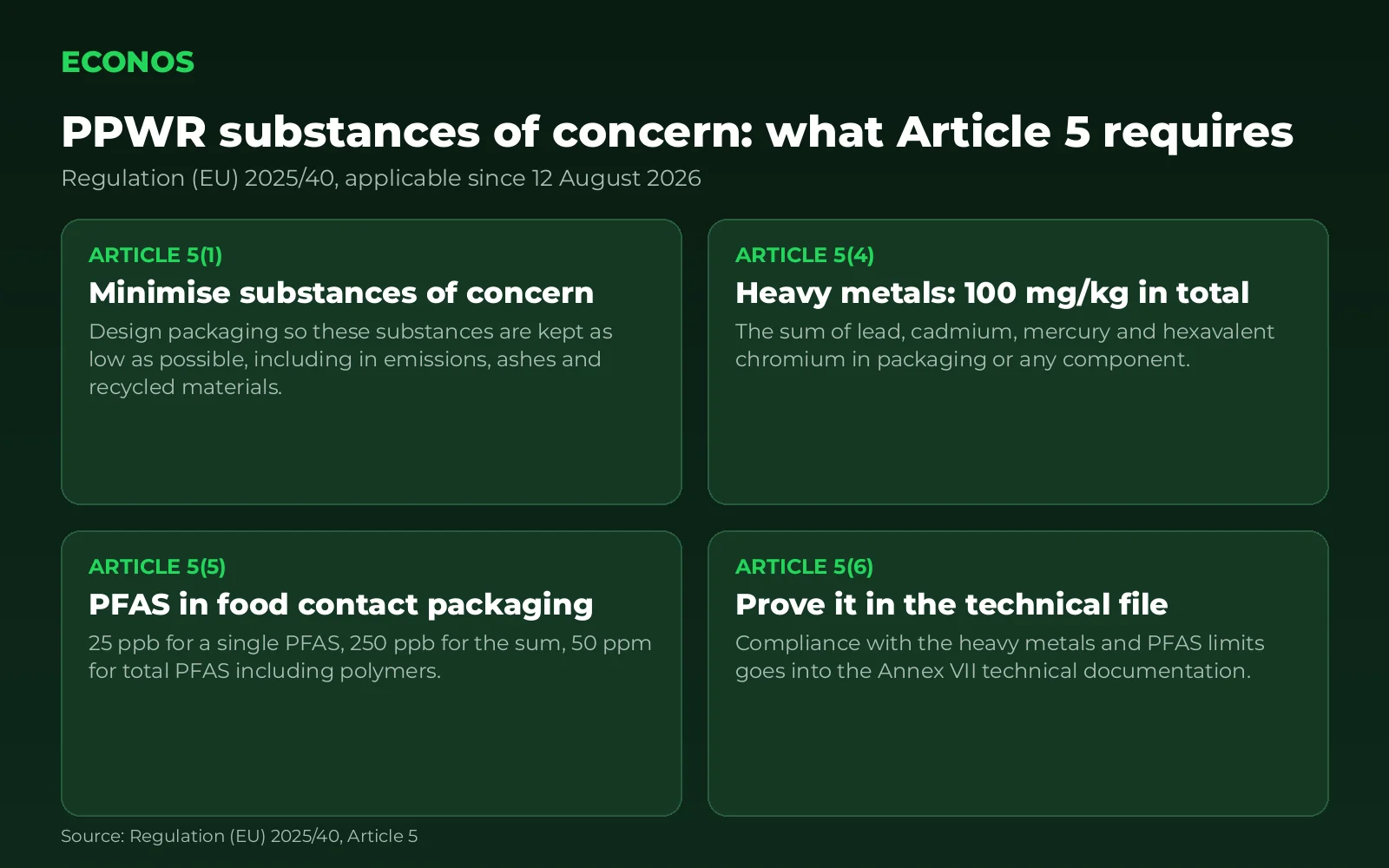
Article 5(1) asks manufacturers to design packaging so that the presence of these substances is minimised, including in emissions, ashes and recycled materials after the packaging becomes waste. It connects with the future PPWR recyclability grades, because substances that disturb recycling can also lower a grade.
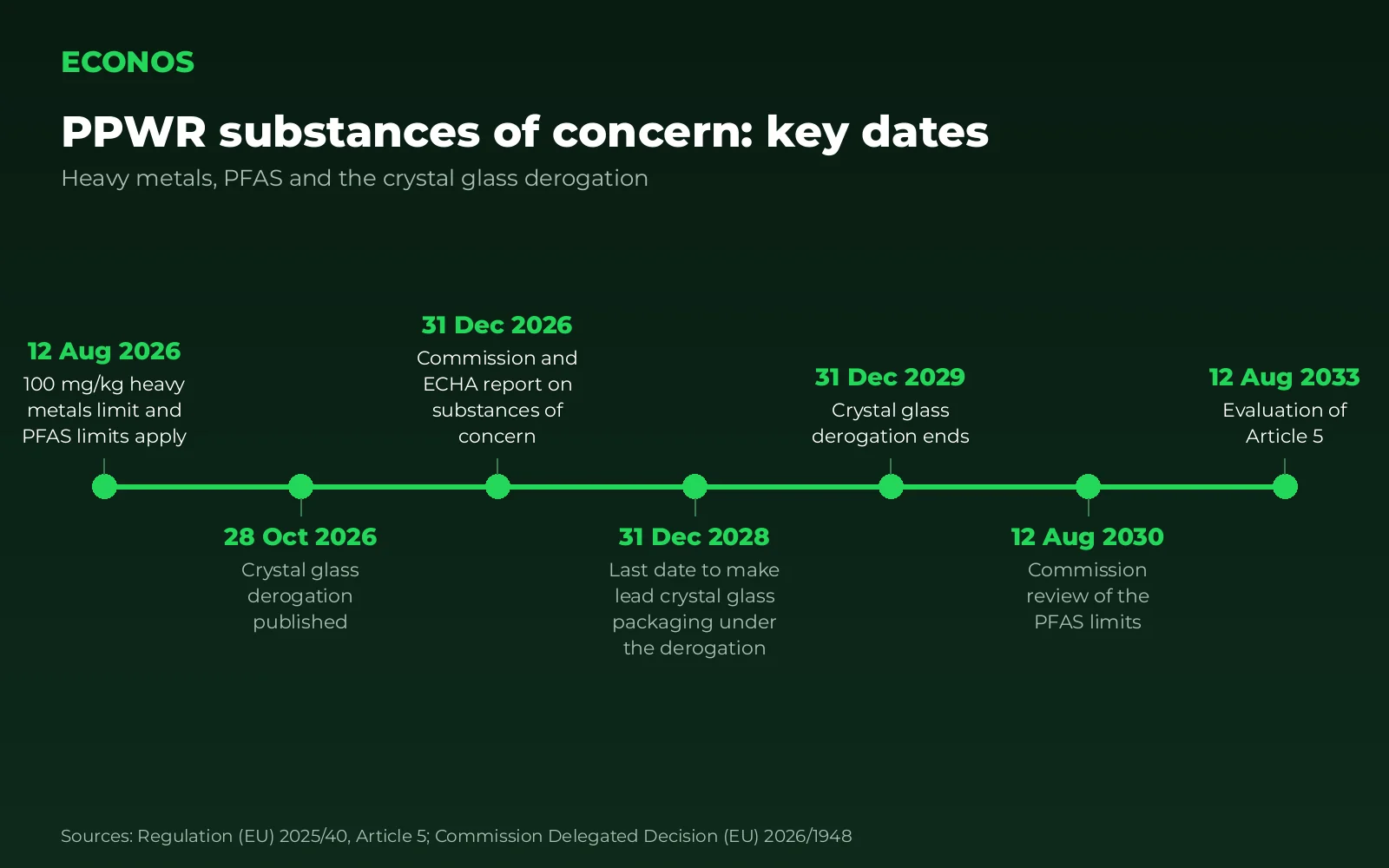
More rules may follow: by 31 December 2026, the Commission and ECHA must report on substances of concern in packaging, which can lead to new REACH restrictions.
The PPWR heavy metals limit: 100 mg/kg in total
Article 5(4) sets the clearest rule. The sum of lead, cadmium, mercury and hexavalent chromium in packaging or packaging components must not exceed 100 mg/kg. It is one combined ceiling, not four separate limits.
The limit is not new. The old Packaging Directive 94/62/EC already used 100 mg/kg, and Romania applied it through its national packaging law. What changes is the legal form: the PPWR applies directly in every Member State, and compliance must now be documented in a structured way. As Packaging Gateway notes, the limit concerns the whole packaging specification, not only the main material.
Where heavy metals can hide in packaging
- Printing inks, pigments and coloured masterbatches, especially older yellow, orange and red formulations.
- Coatings, lacquers and metal parts such as caps, clips and closures.
- Recycled materials that carry legacy contamination from older products.
- Glass, where recycled cullet can contain lead from crystal and other sources.
Exemptions for glass, crates, pallets and crystal glass
Article 5(8) allows the Commission to exempt recycled materials, closed and controlled product loops and some packaging formats, case by case and for a limited time. Existing derogations cover glass packaging in Decision 2001/171/EC and plastic crates and pallets in Decision 2009/292/EC.
A new derogation was added in October 2026. According to SGS, Commission Delegated Decision (EU) 2026/1948 allows crystal glass packaging to exceed the limit until 31 December 2029. Such packaging may only be manufactured until 31 December 2028, must receive a dealkalization treatment or an equivalent barrier, and must carry a permanent marking that identifies the producer.
PFAS in food contact packaging
Article 5(5) bans food contact packaging that contains PFAS at or above three thresholds: 25 ppb for any single PFAS measured by targeted analysis, 250 ppb for the sum of PFAS measured by targeted analysis, and 50 ppm for total PFAS including polymeric PFAS. If total fluorine exceeds 50 mg/kg, the operator must be able to show, on request, how much of it comes from PFAS. We explain the practical side for restaurants in our guide to fast food packaging and PFAS limits.
The Commission will review this paragraph by 12 August 2030 to avoid overlaps with other EU PFAS rules, so follow updates on the European Commission packaging page.
How to prove compliance with PPWR substances of concern
Article 5(6) says that compliance with the heavy metals and PFAS limits must be shown in the technical documentation of Annex VII. This file supports your EU declaration of conformity, as explained in our guide to the PPWR declaration of conformity and technical file. The duty sits with the manufacturer, which is often the brand owner and not the converter, so first check your role under the PPWR.
- List every packaging item and component: substrate, inks, adhesives, labels, closures, coatings.
- Ask each supplier for a recent heavy metals test report or a declaration backed by test data, per material or component.
- For food contact items, ask for PFAS results or a total fluorine screening.
- Check that each document names your exact material, grade and supplier site.
- Store the evidence in the technical file and repeat it when a supplier or recipe changes.
What we see in Romanian companies
A typical case at ECONOS is a Romanian food producer that buys printed metal tins and coloured plastic lids from a supplier outside the EU. The file contains a REACH statement and a food contact declaration, but no figure for lead, cadmium, mercury and chromium VI in the inks or the lid. Under the PPWR, that gap now sits in the technical file of the company that places the packaging on the market.
Recycled content adds a second question. Companies that increase recycled plastic to meet the PPWR recycled content targets should ask recyclers for heavy metals data on each batch or grade, because legacy contamination is the most common reason for a result close to the limit.
Conclusion
The PPWR substances of concern rules are already live. The 100 mg/kg heavy metals limit and the PFAS limits apply since 12 August 2026, and more restrictions may follow the Commission report due by the end of 2026. The practical answer is the same for every company: map your components, collect real test data and keep it in your technical file. For the wider picture, see what already applies under the PPWR since August 2026.
Frequently asked questions
What are PPWR substances of concern?
The PPWR uses the definition of the Ecodesign Regulation (EU) 2024/1781. It covers substances of very high concern on the REACH candidate list, certain substances classified as hazardous under the CLP Regulation, persistent organic pollutants and substances that hamper re-use or recycling.
What is the heavy metals limit for packaging under the PPWR?
Article 5(4) sets a maximum of 100 mg/kg for the sum of lead, cadmium, mercury and hexavalent chromium. The limit applies to the packaging and to each packaging component, such as inks, labels, closures and coatings.
When do the PPWR PFAS limits for food packaging apply?
Since 12 August 2026. Food contact packaging may not exceed 25 ppb for any single PFAS, 250 ppb for the sum of PFAS and 50 ppm for total PFAS including polymeric PFAS. The Commission will review these limits by 12 August 2030.
Is a supplier declaration enough to prove compliance?
A declaration is useful evidence, but the manufacturer must show compliance in the technical documentation. Ask for test reports on the actual materials and components, and check that they match your specification.
Sources and recommended reading
- Regulation (EU) 2025/40 on packaging and packaging waste, EUR-Lex
- Regulation (EU) 2024/1781 on ecodesign for sustainable products, EUR-Lex
- Directive 94/62/EC on packaging and packaging waste, EUR-Lex
- SGS, EU introduces temporary derogation for crystal glass packaging under PPWR
- European Commission, packaging waste policy page
Recommended on ECONOS
- Compliant fast food packaging and PFAS limits
- PPWR declaration of conformity and technical file
- PPWR recycled content targets for plastic packaging
How ECONOS can help
ECONOS helps Romanian and EU companies turn the PPWR substances of concern rules into a clear supplier evidence plan: component mapping, supplier requests for heavy metals and PFAS data, review of test reports and a technical file ready for inspection. Our EU packaging law compliance service covers PPWR and EPR end to end, our life cycle assessment (LCA) work compares material alternatives, and ECONOS Academy trains your quality and purchasing teams to keep the file up to date on their own.
Contact ECONOS to review the chemical evidence in your packaging file.