Scope 4 Emissions Consulting and Calculation: Quantify the Positive Impact of Your Products

Go beyond reporting: demonstrate solutions, not only problems

Today, sustainability reporting mainly focuses on reducing a company’s own emissions Scope 1, 2, and 3. However, if your business offers innovative solutions that help clients and the global market reduce carbon emissions, it is time to quantify this positive impact.

Scope 4 emissions
provide the strategic tool needed to turn your green products and services from a perceived cost into a proven competitive advantage.

At ECONOS, we provide specialized Scope 4 consulting to develop a robust, transparent, and credible methodology that demonstrates the real value of your sustainable innovations.

Contact us today for an initial consultation and discover how we can turn your environmental advantage into measurable financial performance.

SCOPE 4

What are Scope 4 emissions (avoided emissions)

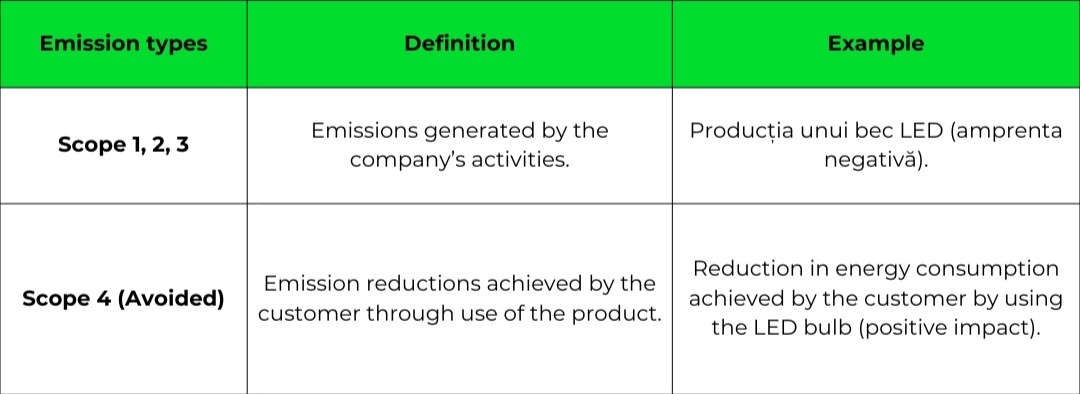
Scope 4 emissions are defined as greenhouse gas emissions avoided through the use of a more energy efficient or climate efficient product or service, compared to a conventional alternative, the baseline scenario.

Unlike Scope 1, 2, and 3 emissions, which represent the direct and indirect carbon footprint of your operations, Scope 4 is not part of the standard GHG Protocol inventory and must not be deducted from your total emissions. Instead, it represents an indicator of positive impact generated outside your value chain.According to the GHG Protocol, Scope 4 is a voluntary framework for estimating and reporting avoided emissions. There is no full standardization, and companies must be transparent about assumptions and methodologies used.
Cele 10 principii de baza CoP - ECONOS

Limitările Scope 4:

Double counting: The same avoided emissions can be claimed by multiple companies, for example the LED manufacturer and the end user.

Uncertain baseline: Selecting the reference scenario, what the customer would have used without your product, is critical and can be challenged.

Credibility: Scope 4 reporting must be conservative and well documented to be accepted by investors and stakeholders.

Integration into ESG reporting

- Scope 4 does not replace Scope 1 to 3 reduction obligations.
- It is a strategic indicator that can be included in ESG reports to highlight the positive contribution of products, but it must be disclosed separately from the official emissions inventory.

SCOPE 4

How does Scope 4 emissions calculation help you?

Quantifying avoided emissions is essential for companies offering green technologies, such as renewable energy, low carbon construction materials, energy efficiency solutions, or carbon capture products.

Key strategic benefits:
Justifying ESG investments:
Provide concrete data to ESG investors seeking companies that actively contribute to global climate goals, supporting investments in green research and development.
Competitive differentiation:
Position your company as a provider of climate solutions, not only as a company reducing its own footprint.
Attracting sustainable finance:
Banks and financial institutions can use Scope 4 data to assess eligibility for green financing or sustainable loans.
Credible communication:
Give boards and marketing teams a solid, data based foundation to communicate the real environmental impact of products.
Support for targets (SBTi/Net Zero):
Although Scope 4 is not included in Science Based Targets Initiative goals, the evidence can strengthen the overall Net Zero transition strategy.
How ECONOS supports you with Scope 4 calculations

Avoided emissions calculations are complex. They require a transparent methodology and a robust baseline scenario that can withstand third party scrutiny.

Our expert team provides support for:

1

Custom methodology development

Designing a calculation framework tailored to your product or service, aligned with international best practices such as WRI WBCSD guidance and relevant ISO standards.

2

Baseline scenario definition

Rigorously determining what the customer would have used without your product. This is the most critical and challenging step.

3

Scope 4 footprint calculation

Calculating avoided emissions while considering the product life cycle and performance differences.

4

Transparency and credibility

Documenting all assumptions and data to ensure a conservative and defensible approach.

5

Strategic reporting

Integrating Scope 4 results into your annual ESG or sustainability report and investor communications.

ECONOS Scope 4 methodology

Our approach ensures accurate and justified avoided emissions calculations.

1

Product and scenario definition

We identify the exact function of your sustainable product and define the baseline scenario, meaning the conventional product or service it replaces. Clear system boundaries are essential.

2

Data collection and life cycle analysis

We collect data to assess emissions across the full life cycle of your product using LCA principles and collect equivalent data for the baseline alternative.

3

Conservative calculation of avoided emissions

We apply calculation formulas to determine the emissions difference between the two scenarios, ensuring no overestimation or double counting.

Avoided Emissions Scope 4 = Emissions baseline minus Emissions your product

4

Validation and communication

We document the entire process. The final report provides solid evidence of your positive contribution to climate action, ready for public communication and stakeholder dialogue.

Frequently Asked Questions (FAQ) - Scope 4 emissions

What are Scope 4 emissions or avoided emissions?

Scope 4 emissions represent greenhouse gas reductions achieved outside the company’s value chain as a direct result of using a more energy or climate efficient product or service instead of a conventional alternative. They reflect the positive impact of sustainable innovation.

How do Scope 4 emissions differ from Scope 1, 2 and 3?

Scope 1, 2, and 3 measure emissions generated by the company that must be reduced. Scope 4 quantifies emissions that do not occur because of your products. It highlights a positive contribution to reducing the global carbon footprint.

Why is reporting Scope 4 important?

Scope 4 reporting demonstrates the positive impact of green technologies, increases transparency for ESG investors and customers, and creates competitive advantage through product differentiation.

How are avoided emissions calculated?

They are calculated by comparing the carbon footprint of your efficient product with a baseline scenario representing the conventional alternative. The difference equals avoided emissions.

What types of products generate avoided emissions?

Any product or innovation that reduces energy use or greenhouse gas emissions at the user level, such as LED lighting, teleconferencing services that avoid travel, low rolling resistance tires, or detergents for low temperature washing.

What does Scope 4 mean in sustainability consulting?

In sustainability consulting, Scope 4 refers to greenhouse gas emissions avoided due to the use of a company’s sustainable products or services compared to conventional solutions. It shows positive climate impact beyond the company’s own value chain.

Is Scope 4 recognized in ESG, CSRD, or GHG Protocol reporting?

Scope 4 is not an official scope under the GHG Protocol or ESRS. It is commonly used as a complementary ESG indicator, reported separately with a clear methodology to highlight climate benefits without replacing Scope 1, 2 and 3.

Can avoided emissions be deducted from a company’s carbon footprint?

No. Scope 4 emissions must not be deducted from Scope 1, 2, and 3 emissions. They are communicated separately to avoid double counting and to maintain ESG best practice compliance.

What concrete benefits does Scope 4 calculation bring?

It helps companies demonstrate the real impact of their products on reducing customer CO₂ emissions, supports B2B sales, strengthens commercial arguments for sustainable solutions, and increases credibility with investors, banks, and ESG partners.

How does Scope 4 provide a competitive advantage?

By quantifying avoided emissions, a company clearly differentiates its offering from competitors by demonstrating measurable climate benefits. Scope 4 becomes a strategic tool for sustainable marketing, tenders, green finance, and relationships with customers pursuing their own decarbonization goals.
English Flag
Romanian Flag
French Flag