
.png)
The Full Cost of PPWR Compliance: What You Actually Pay
Most companies underestimate PPWR costs by 30 to 50 percent. They budget for packaging redesign and forget about five other major cost categories. Here is the complete picture.
1. Packaging Redesign and Tooling
Redesigning packaging is the largest single cost for most companies.
For plastic-heavy packaging (single-use food trays, e-commerce mailers), expect 15,000 to 100,000 EUR per product line to redesign molds, test new materials, and validate production. A food beverage company with 20 SKUs across different package types spends 300,000 to 2,000,000 EUR on tooling alone.
Smaller companies with fewer SKUs pay less on a per-unit basis but still face fixed costs. A startup with three product lines pays 45,000 to 150,000 EUR.
The timeline matters. Tooling lead time is 12 to 16 weeks in Europe. Waiting until July 2026 to start redesign means missing the August deadline and accepting delays or penalties.
Breakdown by industry:
Food and Beverage: 25,000 to 150,000 EUR per line (plastic alternatives, tray redesign, label changes).
E-commerce: 15,000 to 80,000 EUR per mailer design (reusable clamshell tooling, void fill equipment changes).
Cosmetics: 8,000 to 40,000 EUR per packaging format (pump dispenser redesign, cap separation, closure modification).
Electronics: 30,000 to 120,000 EUR per clamshell or protective packaging design (ESD protection validation, material testing).
2. Material Cost Increases
New PPWR-compliant materials cost more than the materials they replace.
Kraft paper alternatives to plastic cost 15 to 30 percent more per unit. A food company switching 10 million units from plastic film to kraft paper adds 150,000 to 300,000 EUR annually in material costs.
Reutilizable packaging costs 40 to 70 percent more upfront. An e-commerce company switching 500,000 annual shipments to reusable clamshells pays 2,000,000 to 3,500,000 EUR per year in material costs alone (vs. 1,200,000 to 2,000,000 EUR for single-use packaging).
Non-plastic void fill (kraft paper crinkle, paper cushioning) costs 0.05 to 0.15 EUR per unit, vs. 0.02 to 0.05 EUR for plastic alternatives. For high-volume shippers, this adds 100,000 to 500,000 EUR annually.
3. Extended Producer Responsibility (EPR) Fees
EPR fees apply to every EU market where you sell and are based on packaging weight placed on market.
Typical annual EPR fees:
Food and Beverage: 5,000 to 20,000 EUR per country (higher volumes = higher fees).
E-commerce: 3,000 to 12,000 EUR per country.
Cosmetics: 1,000 to 5,000 EUR per country.
Electronics: 8,000 to 25,000 EUR per country.
If you sell in five EU countries, multiply by five. A food company selling across UK, Germany, France, Poland, and Romania pays 50,000 to 100,000 EUR annually in EPR fees. These are not one-time costs; they recur every year.
4. Testing and Validation
Packaging must be tested for compliance before market launch.
Recyclability testing: 500 to 2,000 EUR per packaging format (mechanical recyclability assessment, material identification).
Reusability testing: 1,500 to 5,000 EUR per design (10-use-cycle durability testing, wear simulation).
ESD protection testing (electronics): 1,000 to 3,000 EUR per design (electrostatic discharge validation).
Regulatory approval and documentation: 2,000 to 10,000 EUR per country (filing with competent authorities, exemption requests if needed).
For a company with 15 packaging formats across three countries, total testing and validation costs 30,000 to 150,000 EUR.
5. Logistics and Supply Chain Integration
New packaging often requires new logistics setups, especially for reusable packaging.
Reverse logistics for returns: 50,000 to 300,000 EUR to establish take-back systems, partner with logistics providers, or integrate with existing return networks.
Warehouse modifications: 10,000 to 80,000 EUR for storage changes, segregation of reusable vs. single-use packaging, or new handling equipment.
Training and systems updates: 5,000 to 30,000 EUR to retrain warehouse staff, update WMS systems, and track reusable packaging inventory.
6. Compliance Documentation and Registration
EPR registration, product declarations, and sustainability reports cost money.
EPR registration per country: 500 to 3,000 EUR (administrative fees, consultancy).
Digital Product Passport preparation (upcoming requirement): 5,000 to 20,000 EUR for initial setup and systems integration.
Sustainability reporting and third-party verification: 3,000 to 15,000 EUR annually.
7. Penalties and Delays (Cost of Inaction)
If you do not comply, penalties are severe.
Non-compliance fines: 50,000 to 500,000 EUR depending on severity and country.
Product seizures at border: Lost revenue plus seizure fees (5,000 to 50,000 EUR per incident).
Mandatory recalls: 100,000 to 1,000,000 EUR depending on units affected and distribution scope.
Market exclusion from retailers: Retailers enforce PPWR compliance. Non-compliance means Amazon, Zalando, or national retailers delist your products, eliminating sales channels.
One week delay in launching compliant packaging can cost 100,000 to 500,000 EUR in lost revenue.
Total Cost Model: Three Scenarios
Here are realistic cost scenarios for three company types.
Scenario 1: Mid-Size Food Beverage Company (20 SKUs, 5 EU countries)
Redesign and tooling: 600,000 EUR.
Material cost increase (annually): 400,000 EUR.
EPR fees (annually): 75,000 EUR.
Testing and validation: 80,000 EUR.
Logistics and integration: 50,000 EUR.
Compliance and documentation: 15,000 EUR.
Total Year 1 cost: 1,220,000 EUR.
Ongoing annual cost (Years 2+): 475,000 EUR (materials + EPR).
Scenario 2: E-commerce Company (500,000 annual shipments, 3 EU countries)
Redesign and tooling (reusable clamshells): 120,000 EUR.
Material cost increase (annually): 1,800,000 EUR (reusable packaging is expensive).
EPR fees (annually): 18,000 EUR.
Testing and validation: 50,000 EUR.
Logistics and return systems: 200,000 EUR.
Compliance and documentation: 10,000 EUR.
Total Year 1 cost: 2,198,000 EUR.
Ongoing annual cost (Years 2+): 1,818,000 EUR (materials + EPR).
Scenario 3: Small Cosmetics Company (5 SKUs, 2 EU countries)
Redesign and tooling: 100,000 EUR.
Material cost increase (annually): 80,000 EUR.
EPR fees (annually): 8,000 EUR.
Testing and validation: 25,000 EUR.
Logistics and integration: 5,000 EUR.
Compliance and documentation: 5,000 EUR.
Total Year 1 cost: 223,000 EUR.
Ongoing annual cost (Years 2+): 88,000 EUR (materials + EPR).
Financial Impact: Revenue and Margin Effects
Direct costs are only part of the picture. PPWR changes revenue and margins in two ways.
Margin Compression
Material cost increases squeeze gross margins. If your gross margin is 40 percent and material costs rise 15 percent, your margin drops to 37 percent. For a 50,000,000 EUR annual revenue company, this is 1,500,000 EUR in lost profit.
Some companies pass costs to customers. Others absorb them. Most do both, passing some costs while absorbing the rest.
Price Increase Tolerance
Testing price elasticity is critical. A 5 percent price increase to offset material costs may result in 10 to 15 percent volume loss in competitive categories. A 2 percent price increase may be neutral.
Cosmetics and food brands often have higher price tolerance than e-commerce. E-commerce operates on tight margins and low price tolerance.
Upside: Retailer Relationships and Market Access
Compliance unlocks retailer contracts and market access that offset costs.
Retailers like Carrefour, Leclerc, Tesco, and Amazon require PPWR compliance for 2026. Non-compliant suppliers are delisted. Compliant suppliers gain shelf space and volume.
A food company that loses shelf space loses 1,000,000 to 5,000,000 EUR in annual revenue. Compliance protects this revenue.
A cosmetics brand denied access to Sephora or Zalando loses 500,000 to 2,000,000 EUR in potential annual revenue.
These are not small numbers.
Calculating Payback Period and ROI
Payback period is the time it takes for compliance benefits to offset initial costs. Here is how to calculate it for your company.
Step 1: Estimate Total Year 1 Cost
Use one of the three scenarios above, or build your own based on your SKUs, markets, and current packaging.
Step 2: Estimate Annual Recurring Cost
Material increases and EPR fees continue indefinitely. Calculate the annual cost that persists after Year 1.
Step 3: Estimate Compliance Benefits
Avoided penalties: If you do not comply, you face 50,000 to 500,000 EUR in fines. Compliance avoids this. Value: 100,000 to 300,000 EUR annually (cost of penalties avoided).
Retailer access and volume: Compliance unlocks shelf space and volume with major retailers. Estimate the incremental revenue from new retailer relationships and multiply by your gross margin. For many companies, this is 500,000 to 3,000,000 EUR in incremental annual revenue.
Supply chain stability: Compliance reduces risk of border delays, recalls, and customer churn. Value: 50,000 to 500,000 EUR annually (cost of supply chain risk avoided).
Step 4: Calculate Payback Period
Payback period = Year 1 Cost / (Annual Recurring Cost - Annual Compliance Benefits).
If Year 1 cost is 500,000 EUR, annual recurring cost is 150,000 EUR, and annual benefits are 300,000 EUR, payback period is 500,000 / (150,000 - 300,000) = -500,000 / -150,000 = 3.3 years.
Actually, if benefits exceed recurring costs, payback is immediate (benefit realized in Year 1).
Sample ROI Calculation: Mid-Size Food Company
Year 1 cost: 1,220,000 EUR.
Recurring annual cost: 475,000 EUR.
Compliance benefits:
Avoided penalties: 150,000 EUR.
Retailer access and volume: 1,200,000 EUR.
Supply chain stability: 100,000 EUR.
Total benefits: 1,450,000 EUR.
Year 1 result: 1,450,000 EUR benefits minus 1,220,000 EUR cost = 230,000 EUR net benefit.
ROI in Year 1: 19 percent.
In Year 2, benefits of 1,450,000 EUR minus recurring cost of 475,000 EUR = 975,000 EUR net benefit.
ROI in Year 2: 205 percent.
This is a breakeven investment with payback in Year 1 and strong returns in Year 2 and beyond.
Cost Control Strategies
Most companies overspend on PPWR compliance. Here is how to reduce costs without cutting corners.
1. Phase Redesigns by Product Line
Redesign the highest-volume SKUs first. These have the biggest impact and justify the tooling investment. Phase lower-volume SKUs over time or consolidate them into fewer formats.
Cost savings: 200,000 to 500,000 EUR by deferring redesign of low-volume products until Year 2.
2. Negotiate Material Costs Early
Approach material suppliers (plastic alternative providers, kraft paper mills, cardboard manufacturers) with volume commitments. Early commitments lock in lower prices before market demand spikes in 2026.
Cost savings: 100,000 to 300,000 EUR annually through early supplier agreements and volume discounts.
3. Use Qualified Consultants for Testing and Validation
Outsourcing testing and validation to third parties costs 30,000 to 150,000 EUR, but avoids the cost of failed in-house testing and rework. Third parties know which tests pass and which fail before you spend money on tooling.
Cost savings: 50,000 to 200,000 EUR by avoiding failed prototypes and rework.
4. Consolidate EPR Registration and Reporting
Using a single EPR consultant or agency to handle registration across multiple countries costs less than handling each country separately.
Cost savings: 10,000 to 30,000 EUR in administrative fees.
5. Integrate with Existing Logistics Partners
Do not build new reverse logistics from scratch. Integrate with existing return platforms (Orocommerce, Cyclofix, packwise) that already have infrastructure in place.
Cost savings: 50,000 to 150,000 EUR in logistics build-out.
Investment Justification for Your CFO
Frame PPWR compliance as a capital investment, not an expense. Use this narrative.
"PPWR compliance is a 1.2 million EUR capital investment in Year 1 that protects 50 million EUR in annual revenue and unlocks 1.2 million EUR in retailer volume. The investment pays for itself in less than 12 months and delivers 200 percent ROI by Year 2. The alternative is non-compliance, which risks penalties, retailer delisting, and revenue loss of 5 to 10 million EUR."
Boards respond to this language. It is clear, quantified, and shows risk mitigation.
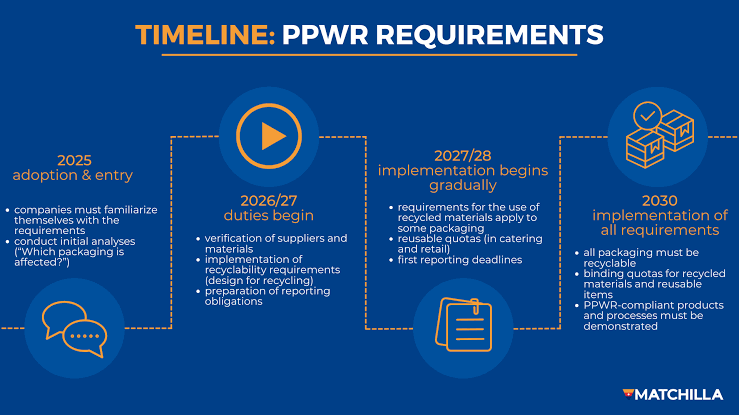
Timeline and Execution
Delay increases costs. Every month you wait erodes your timeline and forces expensive shortcuts.
April 2024 to August 2024: Complete packaging audit, baseline documentation, and supplier evaluation. Cost: 50,000 to 100,000 EUR. This is non-negotiable.
September 2024 to February 2025: Execute redesigns, complete tooling, finish testing and validation. Cost: 500,000 to 1,500,000 EUR. This is where most of Year 1 cost happens.
March 2025 to June 2025: Ramp production on compliant packaging, train teams, register with EPR schemes. Cost: 100,000 to 300,000 EUR.
July 2025 to August 2026: Buffer period for production issues and last-minute adjustments. Any problems found here are expensive to fix.
If you start in April 2024, you have 16 months of execution time. This is tight but achievable.
If you start in September 2024, you have 11 months. This is risky and forces expensive shortcuts.
If you start in January 2025, you have 7 months. This is nearly impossible for large-scale redesigns and forces either delays (missing August 2026) or massive costs (expedited tooling, overtime, penalties for late compliance).