
.png)

TL;DR:
- Most companies mistakenly view EU sustainability compliance as merely emissions accounting, but true compliance requires integrated reporting, environmental claim substantiation, and supply chain due diligence. Building a cross-functional, verified data-driven process aligned with regulations and claims standards is crucial to avoid legal and reputational risks. Tailored support and fostering a compliance culture help organizations effectively navigate complex regional challenges and evolving EU rules.
Most companies enter the EU sustainability compliance process believing it is primarily an emissions accounting exercise. Run the numbers, file the report, done. But that mental model is dangerously incomplete. Achieving genuine compliance in 2026 requires three parallel tracks: robust sustainability reporting under CSRD and ESRS, substantiated environmental claims across all marketing materials, and documented supply chain due diligence that holds up under audit. Companies in Romania, France, and Vietnam are all facing distinct operational pressures within this framework. This guide walks through each track clearly, honestly, and with the practical detail your team actually needs.
Table of Contents
- Understanding the corporate greening process under EU regulations
- Step-by-step: Mapping your greening process for compliance
- Marketing, claims, and the new anti-greenwashing rules
- Greening process challenges: Romania, France, and Vietnam
- Putting it all together: Avoiding common compliance gaps
- Why companies get the greening process wrong: Lessons from real EU compliance failures
- Get tailored support for your greening process
- Frequently asked questions
Key Takeaways
| Point | Details |
|---|---|
| Dual compliance tracks | Companies must address both reporting and buyer/consumer claims to ensure full EU compliance. |
| Evidence-based approach | Audit-ready traceability and data verification are essential for all sustainability actions and statements. |
| Country-specific challenges | Compliance processes must be tailored to local procurement practices and supply chain realities in Romania and Vietnam. |
| Tougher anti-greenwashing rules | Marketing and procurement teams require new controls as environmental claims face stricter laws from 2026. |
| Expert support advantage | Working with specialists streamlines compliance, boosts impact, and helps you adapt to rapid EU regulatory change. |
Understanding the corporate greening process under EU regulations
The greening process is not a single task. It is a structured program that touches legal, finance, operations, procurement, and marketing simultaneously. Many companies confuse “reporting readiness” with “full compliance,” but reporting is only one dimension of what EU regulators now expect.
At its core, corporate greening can be structured around three interconnected phases: scoping the obligations, data collection and verification, and audit-ready documentation aligned to ESRS and double materiality. Double materiality means a company must assess both how sustainability issues affect its financial performance and how its activities impact the environment and society. These are separate lenses, and both must be documented.
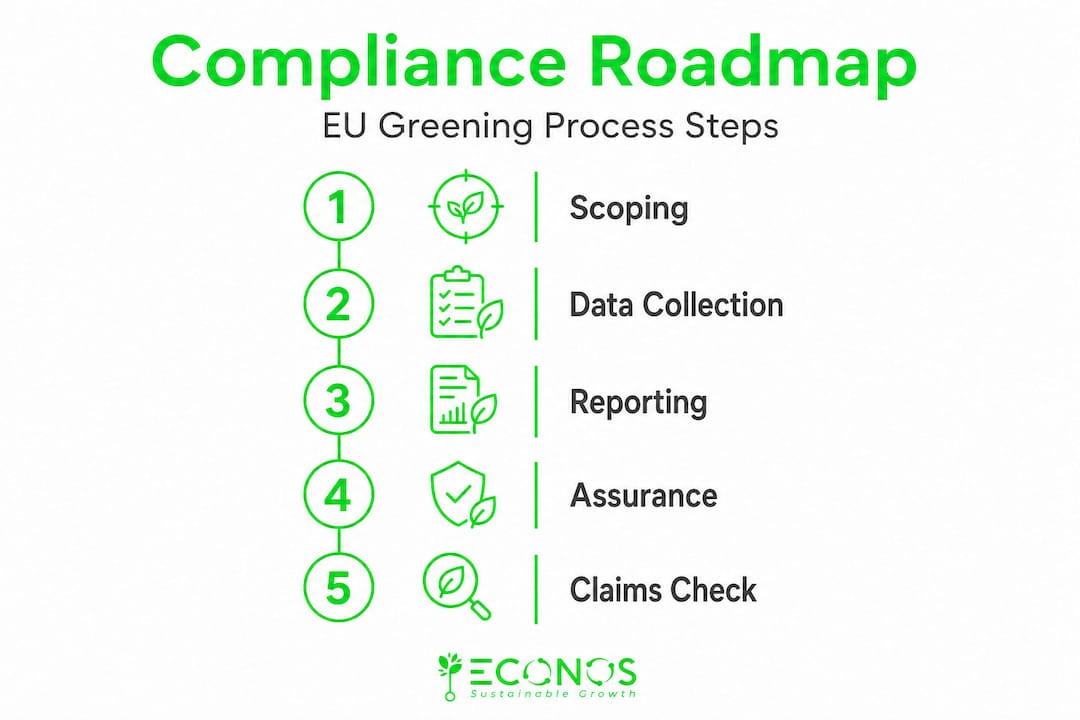
The regulatory framework for 2026 includes several touchpoints companies must track simultaneously:
| Regulation | Scope | Key obligation |
|---|---|---|
| CSRD / ESRS | Large and listed companies | Sustainability reporting with assurance |
| EU Taxonomy | Capital-intensive sectors | Classifying economic activities as “green” |
| Green Claims Directive | All companies making environmental claims | Substantiation and verification |
| CSDDD | Large companies and supply chains | Due diligence on human rights and environment |
| CBAM | Importers of carbon-intensive goods | Carbon price on imports |
A common compliance pitfall for international companies, particularly those operating across multiple jurisdictions, is treating each of these regulations as separate workstreams managed by separate teams. That fragmentation creates gaps. Data collected for CSRD reporting, for example, often overlaps significantly with what you need to substantiate a “carbon-neutral” marketing claim. The EU compliance guide covers how these tracks connect in practice.
Another frequent mistake is underestimating the external assurance requirement. It is not enough to run solid internal calculations. Evidence traceability, meaning your ability to show auditors exactly where each data point came from, is becoming a standard expectation. Companies that build this into their process from day one spend far less time scrambling before audit season.
Step-by-step: Mapping your greening process for compliance
Now that the frameworks are clear, here is a practical step-by-step flow your team can follow.
- Scope your obligations. Identify which regulations apply based on company size, sector, and geography. A Romanian subsidiary of a French multinational may have different obligations than the parent entity.
- Conduct a double materiality assessment. Map sustainability topics that are material from both a financial impact and an environmental/social impact perspective. This assessment is the backbone of your ESRS-aligned report.
- Establish data collection protocols. Define what data is needed, from which operations or suppliers, at what frequency, and with what verification level. Scope 1, 2, and 3 emissions data should be collected systematically, not retroactively.
- Verify and cross-reference. ESRS-aligned sustainability reports require certified assurance, meaning an independent party must confirm the accuracy of your disclosures. Build verification into the workflow, not as a final step but as an ongoing quality check.
- Create audit-ready documentation. Every material claim, data point, or metric in your report needs a clear, traceable source. This same documentation later supports your marketing claims and supplier audits.
- Report, communicate, and iterate. File your sustainability report. Align your marketing claims with verified data. Update supplier contracts to reflect new due diligence requirements. Then review the process annually.
The most critical insight in this sequence is step five. The evidence you gather for reporting is the same evidence that legally protects your environmental marketing claims. If your sustainability and marketing teams operate in silos, you will likely produce correct reports and non-compliant advertisements at the same time. Read the ESG export compliance steps for more detail on how reporting evidence flows into market access requirements.
| Phase | Lead team | Output |
|---|---|---|
| Scoping | Legal + Sustainability | Obligation matrix |
| Materiality assessment | Sustainability + Finance | Double materiality report |
| Data collection | Operations + Procurement | Verified data set |
| Verification | External auditor | Assurance statement |
| Reporting | Sustainability + Legal | ESRS-aligned report |
| Claims alignment | Marketing + Sustainability | Compliant communications |
Pro Tip: Appoint a cross-functional “compliance owner” who sits between sustainability, legal, and marketing. This person does not need to be a technical expert in all three areas. Their job is to ensure that verified data flows between teams and that no claim goes public without a traceable source.
Marketing, claims, and the new anti-greenwashing rules
With your main process mapped, there is a new frontier to master. Environmental claims must now pass much tougher scrutiny.

The Empowering Consumers for the Green Transition Directive fundamentally changes how companies can communicate about their environmental performance. Starting September 2026, EU anti-greenwashing rules will require stronger substantiation and internal alignment whenever ESG information is reused in marketing materials. This applies to website copy, product labels, press releases, and even investor communications if they contain environmental claims.
Here is what changes in practical terms:
- Generic claims like “eco-friendly,” “green,” or “sustainable” without specific, verifiable evidence will be prohibited
- Claims based on carbon offsetting schemes must meet new minimum standards for offset quality and transparency
- Third-party certifications used in marketing must meet EU-recognized criteria
- Any environmental benefit claim tied to a specific product or service must be supported by a life cycle assessment or equivalent methodology
“Companies that have been making broad sustainability claims in their communications without a clear data trail are now facing a compliance problem, not just a reputational one.”
For multinational brands operating across Romania, France, and Vietnam, this creates a particular challenge. Marketing assets are often produced centrally and localized quickly, without systematic review against verified sustainability data. A French brand that claims “reduced emissions packaging” on a product sold in Romania needs the same documented evidence trail as it would for a product sold in Paris.
The checklist your marketing, legal, and sustainability teams need before any environmental claim goes public:
- Is the claim specific and tied to a measurable outcome?
- Is the underlying data verified and traceable to your reporting system?
- Does the claim apply to the specific product, or is it a company-wide statement?
- Has legal reviewed it against the updated Green Claims Directive requirements?
- Is the third-party certification used in the claim EU-recognized?
For packaging specifically, the sustainable packaging compliance process has been updated to reflect these new rules.
Pro Tip: Treat every environmental marketing claim as if it will be audited tomorrow. Build a simple internal registry that links each public claim to its supporting data source, verification date, and approving team member. This takes one afternoon to set up and saves weeks of legal exposure later.
Greening process challenges: Romania, France, and Vietnam
The journey to compliance gets more complex thanks to location-specific challenges. The greening process is not geographically neutral. Where you operate shapes what is feasible and what is required.
| Country | Key challenge | Primary impact area |
|---|---|---|
| Romania | Weak green procurement tradition | Supplier readiness, public contracts |
| France | High regulatory expectation, strong civil society | Reporting quality, claims scrutiny |
| Vietnam | EU CSDDD due diligence via buyer contracts | Supply chain traceability, documentation |
In Romania, green public procurement has moved from policy ambition to legal reality, but the infrastructure to support it remains thin. Suppliers often carry the full burden of proving sustainable credentials to buyers who lack the internal capacity to properly evaluate or guide them. This creates a knowledge asymmetry that mid-size companies, in particular, struggle to navigate. The Romanian procurement guide offers a structured approach for companies dealing with this challenge.
For companies with operations or suppliers in Vietnam, the EU CSDDD adds a direct compliance obligation via the supply chain. Vietnam-based suppliers are now subject to stricter screening, documentation, action clauses, and traceability requirements driven by their EU buyers. This is not a voluntary standard. EU companies contracting with Vietnamese suppliers must include due diligence clauses, conduct periodic risk assessments, and maintain evidence of compliance. Suppliers unprepared for this level of scrutiny risk losing EU contracts entirely. The Vietnamese supplier guide outlines what documentation your supply chain partners need to maintain.
France presents a different kind of challenge. French companies, and French operations of international groups, face a more sophisticated regulatory and civil society environment. The Loi Devoir de Vigilance has been in place since 2017, giving French companies earlier exposure to supply chain due diligence concepts. But as EU-level requirements now align and surpass national rules, even experienced French compliance teams are discovering gaps in how they handle Scope 3 emissions data and third-party claims substantiation.
For companies managing operations across all three contexts, the most practical approach is to build a compliance baseline that satisfies the most demanding jurisdiction, typically France, and adapt it downward for markets where requirements are still maturing. Also, investing in carbon footprint measurement early gives you the data foundation needed across all three markets.
Putting it all together: Avoiding common compliance gaps
To finish, here is how the most successful companies address these challenges holistically.
The most dangerous compliance gap we see consistently is the one between reporting and claims. Omitting either the reporting or procurement/claims track can result in compliance gaps, even when emissions calculations are correct. Companies that invest heavily in producing an accurate ESRS report but fail to align their marketing communications are, by definition, still non-compliant. And the penalties for greenwashing claims are real, ranging from fines to public naming.
Here are the most common practical gaps to watch for:
- Unsubstantiated claims in legacy marketing materials. Website pages, brochures, and packaging from before the Green Claims Directive often contain claims that no longer meet the evidentiary standard. Audit all existing materials, not just new ones.
- Partial Scope 3 data. Many companies calculate Scope 1 and 2 emissions accurately but leave Scope 3, which covers supply chain and downstream emissions, incomplete. For ESRS reporting, this creates a material omission.
- Supplier data gaps. If your ESG report includes supply chain metrics but your suppliers have not actually provided verified data, you are reporting estimates as facts. Document what is estimated and why.
- Siloed governance. When sustainability, legal, and marketing teams do not share a common compliance calendar and data system, contradictory information ends up in public materials.
- No training for internal teams. Compliance is not a document. It is a practice. Teams that understand why these rules exist and how they connect make far fewer costly errors than teams that follow checklists mechanically.
The ESG supply chain compliance guide covers how integrating supply chain governance with your reporting function reduces both workload and risk over time.
Pro Tip: Schedule a quarterly cross-functional compliance review that brings together sustainability, legal, procurement, and marketing. The agenda is simple: What new public claims did we make? What new supplier data did we collect? What gaps remain? An hour every quarter prevents months of remediation work.
Why companies get the greening process wrong: Lessons from real EU compliance failures
Stepping back from the how-to details, it is worth examining why even experienced teams fall short. We have worked across more than 158 projects and 17 industries, and the pattern of failure is surprisingly consistent.
The first reason is what we honestly call “compliance theater.” Companies build beautiful sustainability reports, hire external consultants to write them, and then file them away. The report exists. The underlying practice does not change. When auditors or regulators ask follow-up questions about specific data points or how a claim was substantiated, the internal team has no answer because they were never truly part of the process.
The second reason is tool dependency without understanding. Off-the-shelf carbon accounting software and template ESG reports are useful starting points. But they are insufficient for today’s EU demands, which require judgment calls, contextual evidence, and cross-functional alignment that no tool makes automatically. Companies that rely on software to do their thinking end up with technically complete but strategically hollow reports.
The third reason, and arguably the most fixable, is internal silos. We have sat in rooms where the sustainability manager genuinely did not know what the marketing team was claiming on the company website, and where the procurement team had no awareness that supplier due diligence clauses were now legally required. Each team was working diligently. None of them were working together. The result was partial compliance at best and legal exposure at worst.
What actually works is building a compliance culture rather than a compliance function. This means training your people so they understand what they are doing and why, not just what to fill in on a spreadsheet. It means establishing cross-functional accountability rather than siloing sustainability in one department. And it means treating sustainability consultation as a capacity-building exercise, not an outsourcing decision.
The companies that handle EU compliance smoothly are not always the biggest or the best-resourced. They are the ones where sustainability knowledge lives inside the organization, not just in an external consultant’s deliverable.
Get tailored support for your greening process
For organizations ready to move from planning to action, specialized support can help meet both the letter and the spirit of EU sustainability law.
At ECONOS, we work with mid-size and large companies across Romania, France, and Vietnam to build exactly this kind of internal compliance capacity. Our approach is not to do the work for you and leave you dependent. We help your teams understand and own the process through structured training, hands-on support, and tools like AVA, our AI-powered carbon accounting assistant. Whether you need ESG reporting solutions, a rigorous carbon footprint assessment, or guidance on EU Taxonomy alignment, we are ready to build a program that fits your regulatory context and industry reality.
Frequently asked questions
What are the key EU reporting requirements for the greening process in 2026?
Companies must produce sustainability reports under CSRD using ESRS standards with double materiality and independent assurance, starting from financial year 2024 reporting periods.
How do anti-greenwashing rules impact environmental marketing claims?
From September 2026, all environmental claims must be substantiated and independently verified, with stricter controls required across marketing, legal, and sustainability teams simultaneously.
What is green public procurement, and why is it challenging in Romania?
Green public procurement requires suppliers to demonstrate sustainable credentials to public buyers. In Romania, suppliers bear the burden because buyers often lack the institutional capacity to guide or evaluate sustainability requirements effectively.
How can Vietnamese suppliers prepare for EU sustainability due diligence?
Vietnam suppliers face increased screening and documentation demands under EU CSDDD, so they should ensure full traceability of their supply chain and be ready for contract clauses requiring ongoing compliance evidence.