
.png)

TL;DR:
- Technology impacts the environment through energy, water, land, and electronic waste, not just carbon emissions. Addressing these demands requires comprehensive measurement and policies that include water and land use alongside energy efficiency. Organizations must implement integrated environmental accounting to manage true sustainability risks effectively.
Technology’s environmental impact is defined by four measurable dimensions: energy consumption, water use, land alteration, and electronic waste. These are not abstract concerns. United Nations University (UNU) research published in 2026 shows that global data center electricity consumption is on track to nearly double by 2030, and AI infrastructure alone could consume water equivalent to the annual domestic needs of 1.3 billion people. The impact of technology to the environment is no longer a future problem. It is a present accounting challenge, and the organizations that treat it as one will be better positioned to manage both regulatory risk and operational cost.
How do data centers and AI infrastructure impact energy, water, and land?
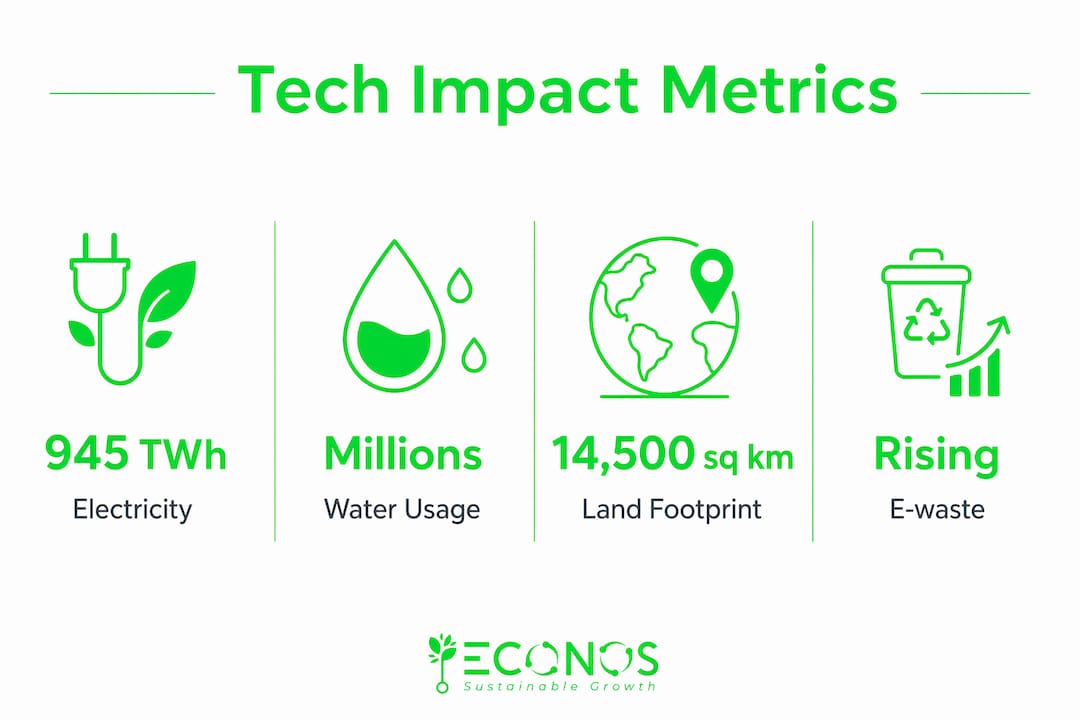
Data centers are the physical backbone of the digital economy, and their resource demands are growing faster than most sustainability frameworks have anticipated. Global data center electricity consumption is projected to rise from 448 TWh in 2025 to 945 TWh by 2030. That figure would rank data centers sixth among the world’s largest electricity consumers if treated as a single country.
Water is the less-discussed cost. Data centers require enormous volumes of water for cooling, and US data center water use is projected to reach 1,006 billion liters annually by 2030. That scale places direct pressure on watersheds already under stress in the American Southwest, parts of Europe, and across South and Southeast Asia. The burden is not evenly distributed. Communities near large facilities often absorb the water and land costs while the economic benefits flow elsewhere.
Land use is the third dimension, and it is the least reported. AI infrastructure land footprint may exceed 14,500 square kilometers by 2030, roughly twice the area of Jakarta’s metro region. Most data centers are built horizontally to reduce upfront construction costs. That design choice fragments ecosystems and consumes agricultural or forested land that cannot easily be restored.

Pro Tip: When evaluating a technology vendor’s sustainability claims, ask specifically about water withdrawal rates and land use, not just carbon emissions. Carbon is the easiest metric to report and the easiest to manipulate.
| Resource | 2030 Projection | Key Risk |
|---|---|---|
| Electricity | 945 TWh globally | Grid strain, fossil fuel dependency |
| Water | 1,006 billion liters (US alone) | Regional water stress |
| Land | 14,500+ sq km globally | Ecosystem fragmentation |
| E-waste | 2.5 million tonnes annually | Toxic burden on lower-income nations |
What are the environmental trade-offs and paradoxes in tech’s impact?
The most dangerous assumption in technology sustainability is that efficiency automatically means less environmental harm. It does not. The Jevons Paradox describes a well-documented pattern: as a technology becomes more efficient, demand for it grows, and aggregate energy consumption rises rather than falls. AI is a textbook example. More efficient models lower the cost per query, which drives more queries, which drives more total energy use.
A 2026 Springer study on AI sustainability dynamics found that AI’s environmental effects are heterogeneous over time. Initial efficiency gains are real, but mid-term rebound effects tend to overshadow them before long-term optimization becomes viable. This means short-term sustainability wins in AI deployment can mask a worsening trajectory.
The carbon-versus-water trade-off is equally counterintuitive. Switching from coal to bioenergy reduces carbon emissions by roughly 70%, but can increase water footprint by more than 30 times and land footprint by more than 100 times. A company that reports a carbon reduction while quietly multiplying its water and land use has not improved its environmental performance. It has shifted the burden.
“AI’s environmental impact is often mismeasured by focusing only on carbon emissions, neglecting water and land footprints which can move inversely to carbon reduction efforts.” — United Nations University, 2026
The practical implication for organizations is clear:
- Carbon metrics alone are insufficient for credible sustainability reporting.
- Water and land footprints must be tracked alongside carbon across Scope 1, 2, and 3 boundaries.
- Rebound effects must be modeled when projecting the environmental benefits of new technology deployments.
- Supplier and vendor environmental data must include all three dimensions, not just carbon disclosures.
How can technology developers and policymakers address these impacts?
Addressing the environmental effects of technology requires structural changes at the design, policy, and procurement levels. Incremental efficiency improvements are not enough when demand is growing exponentially. The following frameworks represent the most credible starting points.
-
Adopt vertical data center design. Horizontal construction is the default because it is cheaper to build. Vertical, multi-story data center design reduces land footprint significantly and limits habitat fragmentation. Policymakers can accelerate this shift through zoning requirements and permitting incentives tied to land efficiency standards.
-
Require integrated environmental disclosures. Carbon reporting is now standard in many jurisdictions, but water and land disclosures remain voluntary in most markets. Regulators in the European Union, through frameworks like the Corporate Sustainability Reporting Directive (CSRD), are moving toward broader environmental metrics. Technology companies operating in the EU should treat this as a compliance floor, not a ceiling.
-
Source renewable energy with full footprint accounting. Renewable energy reduces carbon, but the water and land costs of solar, wind, and bioenergy installations vary enormously by location and technology type. Procurement decisions should account for all three footprints, not just carbon intensity. Organizations can use ESG reporting frameworks to structure this analysis.
-
Prioritize inference optimization over training efficiency. Operational inference accounts for 80–90% of total AI energy consumption. Reducing inference costs through model compression, caching, and query optimization delivers more environmental benefit than reducing training costs. This is where engineering investment has the highest return.
-
Establish water and land budgets for technology procurement. Just as organizations set carbon budgets, they should set water and land budgets for technology infrastructure. This requires supplier data, but the ask is reasonable and increasingly supported by ESG due diligence standards.
Pro Tip: If you are a policymaker reviewing data center permit applications, require applicants to submit water withdrawal projections and land use plans alongside energy efficiency ratings. The data exists. You just have to ask for it.
What practical steps can individuals and organizations take?
The environmental impact of tech is not only a corporate or government problem. Individual behavior and organizational procurement choices aggregate into meaningful demand signals. Here is where to start.
- Shorten AI prompts deliberately. Cutting prompt word count by 30% reduces AI energy consumption by roughly 25%, saving electricity equivalent to what 700,000 people in Africa use annually. This is one of the few individual actions with a quantifiable and immediate impact.
- Extend device lifecycles. Manufacturing a new laptop or smartphone generates more emissions than operating it for several years. Buying refurbished, repairing rather than replacing, and extending refresh cycles all reduce the embodied carbon and e-waste burden.
- Manage e-waste responsibly. AI infrastructure alone is projected to generate up to 2.5 million tonnes of electronic waste annually by 2030, with the heaviest burden falling on lower-income nations. Organizations should establish certified e-waste disposal contracts and track end-of-life device volumes as part of their Scope 3 reporting.
- Choose lower-impact cloud and AI services. Not all cloud providers publish water and land use data, but those that do allow procurement teams to make informed comparisons. Prioritize vendors with public environmental disclosures that go beyond carbon.
- Integrate technology impacts into ESG reporting. Organizations that already report under CSRD, EcoVadis, or similar frameworks should explicitly include IT infrastructure in their environmental materiality assessments. Technology is rarely treated as a high-impact category. In most organizations, it should be.
Key takeaways
Technology’s environmental footprint is defined by energy, water, land, and e-waste, and carbon metrics alone cannot capture or manage it.
| Point | Details |
|---|---|
| Energy demand is accelerating | Data center electricity use will nearly double by 2030, reaching 945 TWh globally. |
| Water and land costs are underreported | AI infrastructure could consume water for 1.3 billion people and occupy 14,500 sq km by 2030. |
| Efficiency gains can backfire | The Jevons Paradox means greater AI efficiency often increases total resource consumption. |
| Integrated metrics are non-negotiable | Carbon-only reporting misses water and land trade-offs that can worsen overall environmental performance. |
| Individual actions have measurable impact | Shortening AI prompts by 30% reduces energy use by 25%, a concrete and immediate lever. |
Technology’s environmental cost: what the data is actually telling us
I have spent years helping companies measure and report their environmental impact, and the pattern I see most often is not denial. It is selective accounting. Organizations report what is easy to measure and call it complete. Carbon is easy. Water withdrawal from a data center two supply chain tiers away is not. So it gets left out.
What the 2026 UNU data is telling us is that selective accounting is no longer defensible. The water and land costs of AI infrastructure are not edge cases. They are central to the story. A company that switches to renewable energy to cut its carbon footprint while its cloud provider draws down an aquifer in a water-stressed region has not solved the problem. It has moved it.
The honest conversation we need to have, across companies, regulators, and technology developers, is about what a complete environmental account actually looks like. It includes carbon, water, land, and e-waste. It covers the full lifecycle from manufacturing to inference to disposal. And it requires supplier transparency that most procurement teams have not yet demanded.
I am genuinely optimistic that this is changing. The CSRD framework in the EU, the growing sophistication of EcoVadis assessments, and the work of researchers like Kaveh Madani at UNU are all pushing in the right direction. But the gap between what is being measured and what is actually happening remains wide. Closing it is the work of this decade.
— Mathieu
How Econos-esg helps you measure and manage technology’s environmental footprint
The environmental costs of technology are real, measurable, and manageable. Econos-esg works with mid-size and large organizations to build the internal capacity to account for these costs accurately, across carbon, water, land, and e-waste dimensions. Our carbon footprint assessment service covers Scope 1, 2, and 3 emissions, including IT infrastructure and cloud services. Our ESG reporting practice helps organizations meet CSRD and EcoVadis requirements with frameworks that go beyond carbon. If your organization is ready to move from selective accounting to a complete environmental picture, Econos-esg is built for exactly that work.
FAQ
What is the biggest environmental impact of data centers?
Energy consumption is the largest single impact. Data centers will consume nearly 3% of projected global electricity by 2030, but water use and land footprint are growing at comparable rates and receive far less regulatory attention.
How does AI affect water resources?
AI infrastructure cooling systems require large volumes of water. By 2030, AI-related water consumption could match the annual domestic water needs of 1.3 billion people in Sub-Saharan Africa, with the heaviest pressure falling on already water-stressed regions.
What is the Jevons Paradox in the context of technology?
The Jevons Paradox describes how efficiency improvements in technology often increase total resource consumption by making the technology cheaper and more widely used. In AI, more efficient models lower the cost per query, which drives higher query volumes and higher aggregate energy use.
How can organizations reduce their technology-related e-waste?
Organizations should extend device lifecycles, establish certified e-waste disposal contracts, and track end-of-life device volumes as part of Scope 3 reporting. AI infrastructure alone is projected to generate 2.5 million tonnes of e-waste annually by 2030, making this a material reporting category.
Why is carbon-only reporting insufficient for technology sustainability?
Carbon metrics miss the water and land trade-offs that often accompany carbon reduction strategies. Switching energy sources can reduce carbon while multiplying water and land footprints, meaning integrated footprint accounting across all three dimensions is required for accurate environmental performance measurement.