
.png)

TL;DR:
- Romanian companies must treat sustainable procurement as a strategic growth opportunity rather than just compliance.
- Building internal ESG systems and data infrastructure early boosts procurement resilience, investor appeal, and ROI.
- Proactive, integrated approaches to ESG criteria and continuous measurement create competitive advantages beyond regulatory requirements.
Romanian companies are facing a moment of reckoning. EU regulatory frameworks like the Corporate Sustainability Reporting Directive (CSRD) and growing investor scrutiny mean that procurement practices are no longer a back-office concern. They are a strategic priority. Yet many mid-size and large companies in Romania are still treating sustainable procurement as a compliance checkbox rather than a growth lever. This guide offers a clear, step-by-step roadmap to help you move from reactive regulatory compliance to proactive, ESG-driven procurement that builds resilience, attracts investors, and creates measurable business value.
Table of Contents
- Understanding sustainable procurement and why it matters
- Key prerequisites: Laying the groundwork for sustainable procurement
- Steps to implement sustainable procurement in your organization
- How to measure, verify, and continuously improve your sustainable procurement performance
- Why real competitive advantage in Romanian procurement goes beyond compliance
- Connect with experts to accelerate your sustainable procurement transformation
- Frequently asked questions
Key Takeaways
| Point | Details |
|---|---|
| Compliance is just the start | Leading Romanian companies gain most by embedding innovation and ESG into procurement, not just meeting legal requirements. |
| Preparation maximizes ROI | Strong internal alignment and clear supplier policies set the stage for measurable sustainable impact. |
| Continuous improvement wins | Audit, measure, and refine procurement practices to maintain ESG momentum and unlock new business advantages. |
| Expert help accelerates progress | Partnering with ESG consultants and leveraging specialized tools can fast-track sustainable procurement success. |
Understanding sustainable procurement and why it matters
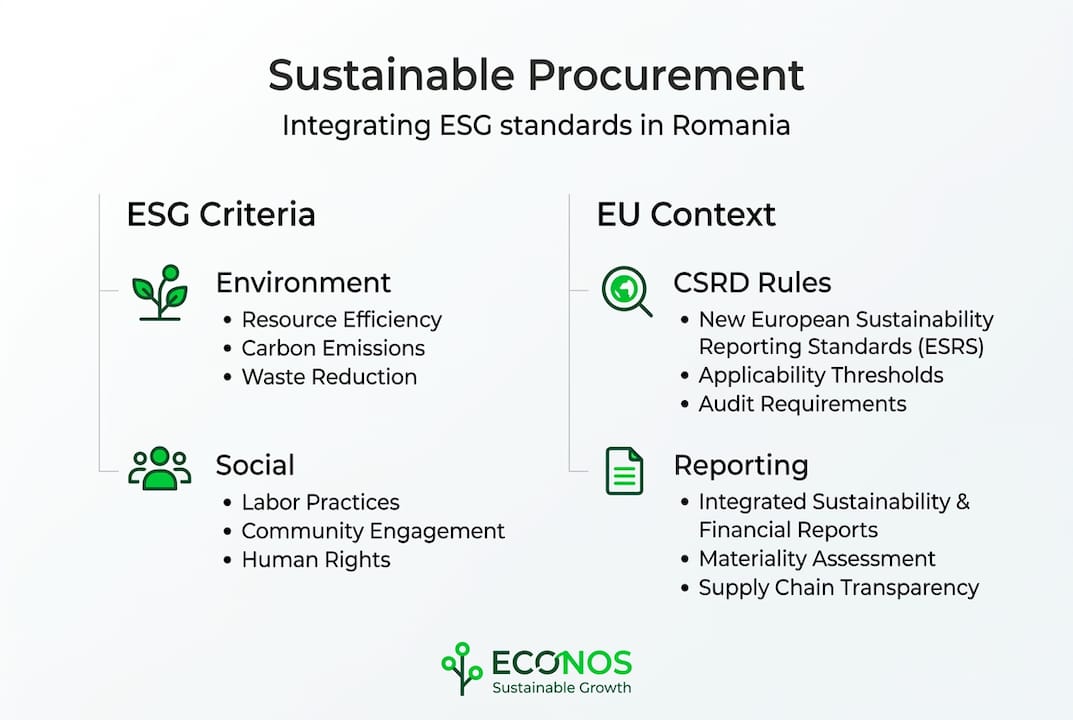
Sustainable procurement means integrating environmental, social, and governance (ESG) criteria into how your company selects suppliers, negotiates contracts, and manages purchasing decisions. It is not just about buying “green” products. It means evaluating your supply chain for carbon emissions, labor standards, ethical sourcing, and long-term resilience.
In the EU context, sustainable procurement connects directly to the CSRD, the European Sustainability Reporting Standards (ESRS), and the EU Taxonomy. These frameworks demand that large and mid-size companies disclose how their operations and supply chains affect climate, people, and communities. Romanian companies subject to CSRD must report on Scope 3 emissions, which include supplier-related carbon impacts, making procurement a core piece of your ESG strategy.
Why does this matter specifically in Romania? As ESG pressures intensify, mid-size and large Romanian companies face data collection challenges, expertise shortages, and growing expectations from international clients and investors. These are real friction points, and we will not pretend otherwise. But they are also opportunities.
Here is what sustainable procurement actually delivers when done well:
- Regulatory compliance under CSRD, ESRS, and Law 162/2017 on statutory audits
- Investor appeal through transparent ESG disclosures and verifiable supply chain data
- Supply chain resilience by identifying high-risk suppliers before problems surface
- Cost efficiency through resource optimization and reduced waste
- Market access as international clients increasingly require ESG-rated suppliers
“Procurement leaders who prioritize innovation in ESG are not just more compliant. They are more profitable.”
The gap between Romania’s public sector (which has made measurable strides in green public procurement) and the private sector is still wide. But private companies that close this gap early gain the advantage. Understanding ESG in supply chains is the first step toward closing it.
Pro Tip: Do not wait for full CSRD applicability to start. Build your supplier data infrastructure now, because retroactive data collection is costly, slow, and often incomplete.
Now that the context is clear, let’s look at the foundational work that must happen before you engage a single supplier on ESG terms.
Key prerequisites: Laying the groundwork for sustainable procurement
Before you launch a supplier sustainability program, your own house needs to be in order. Companies that skip this step often find themselves asking suppliers for data they cannot even interpret internally.
Here are the core documents and processes you need in place:
- Procurement policy that explicitly references ESG criteria and regulatory requirements
- Supplier code of conduct covering environmental impact, labor rights, and anti-corruption standards
- Internal ESG training for procurement, legal, and finance teams
- Data management systems capable of tracking supplier-level environmental and social metrics
- Cross-functional alignment with sustainability, risk, and compliance teams
The CSRD requirements guide for Romanian companies is a useful reference for understanding exactly what data your reporting will demand. The clearer your internal requirements, the better your supplier conversations will be.
Here is a snapshot of how preparation levels affect outcomes:
| Preparation level | Supplier engagement quality | ESG reporting readiness | ROI from innovation |
|---|---|---|---|
| Low (no policy, no training) | Ad hoc, inconsistent | Poor | Below 40% |
| Medium (policy, basic training) | Structured but reactive | Moderate | 54% (average) |
| High (full cross-functional alignment) | Proactive and strategic | Strong | Up to 80% |
Those numbers are striking. Top 10% sustainable procurement leaders see 80% ROI from innovation compared to 54% for others, and resilient firms report 3.6% higher revenue growth. Preparation is not bureaucratic overhead. It is a direct investment in business performance.
Using internal audits for ESG as part of your readiness assessment gives you a defensible baseline and helps you prioritize where to invest first. Your ESG reporting function should be involved from day one, not brought in at the end to compile data that was never designed to be collected.
Pro Tip: Conduct a gap analysis before launching your procurement transformation. Map your current supplier data coverage against CSRD and ESRS requirements to identify the highest-priority gaps. This saves months of reactive firefighting later.
With a solid foundation in place, it is time to move to executing sustainable procurement practices that integrate ESG criteria and genuine innovation.

Steps to implement sustainable procurement in your organization
Implementation is where many Romanian companies stall. They have good intentions but no clear sequence. Here is a practical, ordered approach:
- Draft or update your procurement policy to include mandatory ESG criteria for supplier selection and contract renewal.
- Develop a supplier code of conduct that sets minimum expectations on environmental performance, labor practices, and transparency.
- Segment your supplier base by ESG risk level (emissions, geography, category) to prioritize engagement efforts.
- Launch supplier assessments using structured questionnaires or platforms like EcoVadis to collect verifiable ESG data.
- Set KPIs and targets tied to Scope 3 emissions reductions, supplier diversity, and ethical sourcing milestones.
- Build a continuous improvement loop with quarterly supplier reviews and an escalation path for non-compliance.
A helpful way to understand the shift this requires is to compare traditional and ESG-integrated procurement:
| Dimension | Traditional procurement | ESG-integrated procurement |
|---|---|---|
| Selection criteria | Price, quality, delivery | Price, quality, delivery, ESG score |
| Supplier relationship | Transactional | Collaborative and developmental |
| Data collected | Invoices, delivery records | Carbon data, labor audits, certifications |
| Risk management | Financial and operational | Financial, operational, reputational, regulatory |
| Reporting output | Internal cost reports | CSRD/ESRS disclosures, investor briefings |
A real Romanian example worth noting: IULIUS’s procurement policy integrates a sustainable acquisition policy alongside a formal supplier code of conduct. This is not a theoretical framework. It is a working model that other Romanian private-sector companies can study and adapt.
The gap is real, though. While Romania’s National Program 2025-2030 advances green public procurement, private sector ESG integration still lags due to data and expertise constraints. That gap represents both a risk and an opening. Ensuring your ESRS compliance is grounded in actual procurement data is what separates genuine reporters from those producing beautiful PDFs with little substance behind them.
Pro Tip: Use digital tools and external audits to streamline supplier tracking. Manual spreadsheets collapse under CSRD data volumes. Invest in systems that can scale before the reporting deadlines hit.
After implementing these steps, the critical question becomes: how do you know if it is working?
How to measure, verify, and continuously improve your sustainable procurement performance
Measurement is where ESG commitments either become credible or fall apart. Without clear KPIs and honest reporting, sustainable procurement stays in the realm of aspiration.
Start with these core metrics:
- Supplier ESG coverage rate: percentage of spend covered by assessed suppliers
- Scope 3 emissions intensity: carbon per unit of procurement spend, tracked over time
- Supplier improvement rate: percentage of suppliers who improved ESG scores year over year
- Non-compliance incidents: number of supplier violations and resolution timelines
- Innovation adoption rate: percentage of suppliers engaged in joint sustainability initiatives
“The data collection challenge in Romania is real, but companies that invest in auditable systems now are building a durable competitive advantage.”
For CSRD, Law 162/2017, and EU Taxonomy reporting, you need auditable evidence, not just self-declarations. That means signed supplier attestations, third-party audit reports, carbon calculation methodologies, and traceability documentation for high-risk categories. Your ESG requirements for exports may also impose additional supplier documentation obligations if you sell into international markets.
The continuous improvement loop works like this: measure baseline, engage suppliers, set improvement targets, re-assess annually, report outcomes, and then recalibrate targets. Leading companies do not treat this as an annual audit event. They treat it as an ongoing operating rhythm.
Two common stumbling blocks to address honestly:
- Supplier resistance: Some suppliers, especially smaller ones, view ESG assessments as administrative burdens. Build capacity with them rather than just demanding data. Offer training resources and clear timelines.
- Data gaps: Incomplete Scope 3 data is the norm, not the exception. Use spend-based estimates as a bridge while you build activity-based data coverage.
Firms leading in ESG procurement report up to 3.6% higher revenue growth compared to peers. That is not a coincidence. It reflects the compounding effect of supply chain resilience, better risk management, and stronger investor relationships.
Why real competitive advantage in Romanian procurement goes beyond compliance
Here is something we see consistently: Romanian companies that reach compliance breathe a sigh of relief and stop. That is understandable. Compliance takes real effort. But it is also where the biggest opportunity gets left on the table.
Compliance sets the floor. It does not build the ceiling. Procurement leaders who prioritize circularity, supplier co-innovation, and transparency are not doing so for regulatory reasons alone. They are doing it because it creates structural advantages that are genuinely hard to replicate.
In Romania, the companies that will define the next decade of sustainable business are the ones investing in supplier development today, not just auditing suppliers for minimum standards. That means co-developing roadmaps with key suppliers, sharing carbon tools and training, and treating supply chain compliance as a relationship-building exercise rather than a gatekeeping mechanism.
The competition is moving. What was ESG best-in-class two years ago is quickly becoming the baseline expectation. The window to lead rather than follow is still open, but it is narrowing.
Connect with experts to accelerate your sustainable procurement transformation
Knowing what to do and actually doing it are two different challenges. ECONOS has supported over 158 projects across 17 industries in Romania, helping mid-size and large companies build internal ESG capacity without creating dependency on outside consultants.
Whether you need ESG reporting support, are preparing for EcoVadis certification, or need a credible carbon footprint assessment to underpin your Scope 3 disclosures, we can help you move from intention to execution. Our approach builds your team’s understanding alongside every deliverable, so you are never dependent on us to explain your own data. That is the model we believe in, and it works.
Frequently asked questions
What are the first steps for Romanian companies starting sustainable procurement?
Begin by updating your procurement policy to include ESG criteria, define a supplier code of conduct, and ensure cross-functional alignment between procurement, sustainability, and compliance teams. Regulatory traceability under CSRD should be built into your data systems from the start.
Why is data collection so challenging for sustainable procurement compliance?
Romanian firms often lack the systems and expertise required for detailed supplier-level data tracking, as demanded by CSRD and ESG audits. Building those systems takes time, which is exactly why starting early matters.
What ROI can leaders expect from investing in sustainable procurement innovation?
Top performers see up to 80% ROI from procurement innovation, significantly outpacing the 54% average for other companies. The gap between leaders and followers is widening every year.
Are public and private sector procurement requirements in Romania the same?
No. Public green procurement in Romania is advancing through the National Program 2025-2030, while the private sector still faces meaningful ESG integration gaps alongside additional investor-driven demands that go well beyond what public entities currently face.