
.png)

TL;DR:
- EU Packaging Regulation applies automatically from August 12, 2026, requiring compliance across all packaging types.
- Companies must audit, redesign, and register packaging to meet recyclability, PFAS, and recycled content standards.
- Early proactive compliance offers cost savings, enhances brand trust, and builds supply chain resilience.
August 12, 2026 is not a soft deadline. Regulation (EU) 2025/40, also known as the Packaging and Packaging Waste Regulation (PPWR), applies directly across all EU member states from that date, requiring all packaging placed on the market to meet strict recyclability, material, and reporting standards. For Romanian manufacturing and construction companies, this means real operational changes, not just paperwork. The good news is that a structured workflow can make compliance achievable, and in many cases, profitable. This guide walks you through each phase, from understanding the rules to registering with national authorities, so you can move forward with clarity.
Table of Contents
- Understand EU packaging regulations and requirements
- Audit your packaging portfolio and data gaps
- Implement sustainable redesign and testing
- Register, report, and transition to eco-modulated EPR
- Why compliance is an opportunity, not just a cost
- Partner with experts for sustainable packaging compliance
- Frequently asked questions
Key Takeaways
| Point | Details |
|---|---|
| Know key PPWR deadlines | August 2026 marks the start of strict EU packaging requirements for Romanian firms. |
| Audit packaging now | Early audits reveal gaps and prevent costly non-compliance in materials, recyclability, and data. |
| Redesign and test sustainably | Switching to monomaterials and testing for recyclability ensures legal compliance and savings. |
| Report and optimize EPR fees | Timely registration and reporting, plus eco-modulation, minimize extended producer responsibility costs. |
| Compliance drives advantages | Meeting new rules early wins consumer trust and boosts competitiveness for Romanian manufacturers. |
Understand EU packaging regulations and requirements
Having set the context for why compliance matters, let’s break down what the new EU regulations actually require.
The PPWR is not a directive that Romania must transpose into national law. It is a regulation, meaning it applies automatically and uniformly from August 12, 2026. Every company that manufactures, imports, or places packaged goods on the Romanian market is in scope. There are no small-company exemptions for the core requirements.
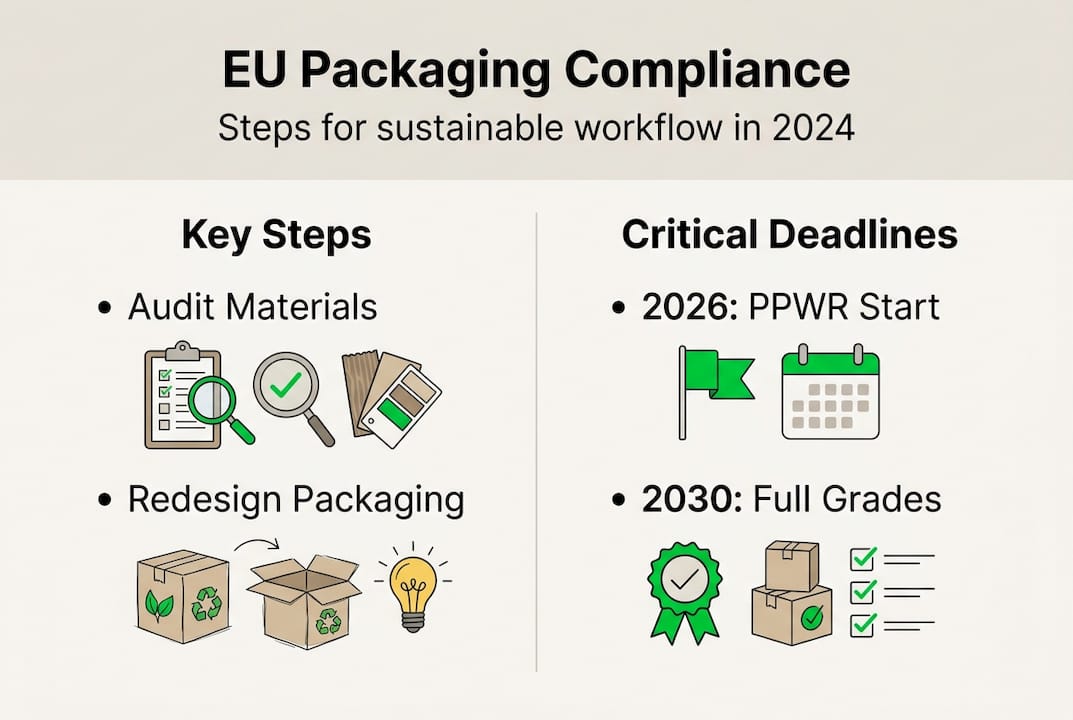
Here is a summary of the key PPWR requirements and timelines:
| Requirement | Deadline | Details |
|---|---|---|
| Recyclability grades A-C | 2030 (prep from 2026) | All packaging must meet DfR/RecyClass grades |
| PFAS ban in food-contact packaging | August 2026 | Per- and polyfluoroalkyl substances fully restricted |
| Recycled content minima | 2030 onwards | Varies by material type and packaging category |
| Eco-modulated EPR fees | From 2026 | Fees adjusted based on recyclability and recycled content |
| Packaging minimization | From 2026 | Unnecessary space, weight, and layers must be reduced |
EU packaging waste generation reached 84 million tonnes across the EU in recent years, and Romania has consistently ranked below the EU average on recycling rates. That gap is exactly why regulators are applying direct pressure through the PPWR.
The core compliance requirements include:
- Recyclability grading: All packaging must achieve grades A, B, or C under Design for Recyclability (DfR) criteria. Grade D packaging will be prohibited by 2030.
- PFAS restrictions: PPWR bans PFAS in food-contact packaging from August 2026, affecting coatings, barriers, and certain laminates.
- Recycled content targets: Minimum percentages of post-consumer recycled (PCR) material will apply by material type.
- Packaging minimization: Void space in transport and consumer packaging must be reduced. This directly affects construction supply chains using oversized corrugated boxes.
- Eco-modulated EPR fees: Extended Producer Responsibility (EPR) fees, which you already know from Romania’s Law 249/2015, will be recalibrated. Compliant packaging pays less. Non-compliant packaging pays significantly more.
For a broader view of how this fits your ESG workflow for manufacturers, it helps to see PPWR compliance as one pillar of a larger sustainability strategy, not a standalone task. Understanding the EPR requirements in Romania is especially important before moving to the next steps.
Audit your packaging portfolio and data gaps
Now that you understand the regulations, kick off compliance by auditing your current packaging portfolio.

Most Romanian manufacturers are surprised by how many packaging types they actually use once they map everything out. Primary, secondary, and tertiary packaging all fall under PPWR scope. A rigorous audit is the foundation of everything that follows.
Here is a step-by-step audit process:
- List all packaging types across product lines, including consumer, industrial, and transport packaging.
- Classify each by material (monomaterial vs. composite, plastic type, paper grade, metal, glass).
- Assess current recyclability using RecyClass or DfR criteria. Assign a provisional grade to each.
- Check for PFAS in food-contact coatings, barrier layers, and adhesives. Request technical data sheets from suppliers.
- Collect supplier documentation, including Declarations of Conformity (DoC) and material composition certificates.
- Benchmark reuse rates for B2B transport packaging, which has specific reuse targets under PPWR.
- Identify data gaps and flag items where supplier documentation is missing or incomplete.
Packaging data gaps affect between 30% and 70% of companies starting their compliance journey. That range is wide, but the pattern is consistent: the more complex your supply chain, the more gaps you will find.
Here is a comparison of common packaging types and their typical audit challenges:
| Packaging type | Main compliance risk | Common data gap |
|---|---|---|
| Multilayer plastic films | Grade D recyclability | Supplier material composition |
| PFAS-coated paper | Banned from August 2026 | Chemical composition certificates |
| Composite beverage cartons | Recycled content tracking | PCR percentage documentation |
| Corrugated transport boxes | Minimization requirements | Void space measurement data |
| Reusable plastic crates | Reuse rate tracking | Trip count and lifecycle data |
Once you have your audit results, use them to prioritize redesign efforts. High-risk items (PFAS presence, Grade D recyclability) need immediate attention. Lower-risk items can follow a phased schedule.
Pro Tip: Digital platforms that centralize supplier data requests and automate recyclability scoring can cut audit time by more than half. If you are managing dozens of packaging SKUs, manual tracking in spreadsheets will create errors. Consider tools that integrate with your existing ERP before the audit begins.
For guidance on what comes next, the packaging redesign guide is a practical resource. You can also use a carbon footprint checklist to capture emissions-related data during the audit, since packaging is often a significant Scope 3 source.
Implement sustainable redesign and testing
After auditing, the next phase is hands-on redesign and testing to meet EU mandates.
Redesigning packaging is where strategy meets engineering. The goal is not just to pass a recyclability test. It is to create packaging that performs operationally, satisfies customers, and costs less to produce and dispose of over time.
The core redesign steps are:
- Switch to monomaterials where possible. Monomaterial PE or PP packaging achieves significantly higher recyclability grades than multilayer composites. This is the single most impactful redesign move for most manufacturers.
- Minimize material use. Reduce wall thickness, layer count, and packaging volume without compromising protection. PPWR requires that packaging weight and volume be kept to the functional minimum.
- Remove problematic additives. PFAS coatings, certain pigments, and non-compatible adhesives must be eliminated. Work with your supplier to find compliant alternatives.
- Submit for recyclability testing. Use RecyClass or an accredited DfR body to obtain an official grade. Grades A-C are compliant. Grade D is not.
- Run runnability checks. Redesigned packaging must still function on existing filling, sealing, and labeling lines. Pilot tests on production equipment catch problems before full rollout.
- Prepare technical documentation. Each packaging type needs a Declaration of Conformity and supporting technical data. This is required for registration and EPR reporting.
Key materials to prioritize in your redesign:
- Polyethylene (PE) and polypropylene (PP): High recyclability, widely accepted in Romanian collection streams.
- Mono-material paper and cardboard: Strong recyclability grades, but check for PFAS coatings and wet-strength additives.
- Glass and aluminum: Already high recyclability grades, but focus on weight minimization.
- Avoid: PVC, multilayer laminates without separation technology, and PFAS-treated materials.
For transport packaging specifically, consider alternatives like biodegradable bubble wrap for construction component shipments where protection requirements allow it.
Pro Tip: Involve your top three or four suppliers in the redesign process from day one. They hold the technical data you need for DoC preparation, and early engagement prevents last-minute delays when testing results come back and adjustments are required.
The step-by-step redesign resource from ECONOS covers material selection matrices and testing protocols in more detail.
Register, report, and transition to eco-modulated EPR
The final step ensures that your new packaging systems are officially compliant and financially optimized.
Completing your audit and redesign is not the finish line. You also need to register, report, and actively manage your EPR obligations. This is where many companies lose momentum, especially those still operating under the older Law 249/2015 framework.
Under PPWR, the key registration and reporting obligations include:
- Annual registration in the national packaging producer registry managed by ANPM (Romania’s National Environmental Protection Agency).
- Annual reporting of packaging quantities placed on the market, broken down by material type and packaging category.
- Collaboration with OTR (Organizatii de Transfer de Responsabilitate, or Responsibility Transfer Organizations) to fulfill collective EPR obligations.
- Transitioning from Law 249/2015 procedures to PPWR-aligned reporting formats, which require more granular material data.
- Monitoring eco-modulation adjustments to your EPR fees, which will reward compliant packaging with lower rates and penalize non-compliant packaging heavily.
PPWR requires direct registration in national producer registries and annual reporting to ANPM, with eco-modulated EPR fees applying from 2026 onward.
The financial stakes are real. EPR eco-modulation savings can be substantial for early movers. One documented case showed savings of €332,000 through proactive packaging redesign and EPR optimization. Companies that delay face both higher fees and potential penalties for non-registration.
Companies that treat EPR as a compliance checkbox miss the financial upside. Early movers who redesign packaging before the deadline pay lower eco-modulated fees from day one, while late movers absorb higher costs and scramble to catch up.
For a full breakdown of how to calculate and manage your EPR exposure, the EPR guide Romania and EPR cost assessment resources are worth reviewing before your next reporting cycle.
Why compliance is an opportunity, not just a cost
Taking a step back, it’s worth being honest about something: most companies approach PPWR as a cost to minimize. That instinct is understandable. But it misses what the data actually shows.
37% of European consumers have switched brands because of packaging concerns. That is not a marginal effect. For B2C-adjacent manufacturers and construction companies supplying retail channels, packaging is now a direct driver of customer retention. Early compliance builds trust that competitors who wait cannot easily replicate.
The operational case is equally strong. Unilever’s use of 38% PCR in packaging materials generated major EPR cost reductions. The logic is simple: less virgin material means lower production costs and lower eco-modulated fees simultaneously.
We admit the transition requires upfront investment. But companies that frame PPWR compliance as a supply chain resilience project, rather than a regulatory burden, tend to move faster and spend less overall. Compliance milestones are also legitimate marketing leverage with procurement teams at large buyers who are themselves under CSRD and ESG rating pressure. You can explore real examples in our success stories from similar industries.
Partner with experts for sustainable packaging compliance
Ready to take the next step? Professional support can accelerate your packaging workflow transformation significantly.
At ECONOS, we work with Romanian manufacturing and construction companies to build internal compliance capacity, not just deliver reports. Whether you need a full carbon footprint assessment that captures packaging-related Scope 3 emissions, structured ESG reporting services aligned with CSRD and PPWR requirements, or support preparing for EcoVadis certification that recognizes your packaging progress, we have done this work across 17 industries.
Our approach is practical. We help you understand what you are doing and why, so your team can manage compliance independently over time. PPWR is not the last regulation you will face. Building the internal muscle now pays dividends across every future requirement.
Frequently asked questions
Which packaging materials are banned or restricted under PPWR from August 2026?
PFAS in food-contact packaging are fully banned from August 2026, and non-recyclable composite packaging will face heavy EPR penalties as eco-modulation takes effect.
How is packaging recyclability graded under the EU PPWR?
Packaging grades A through C are assigned based on DfR and RecyClass testing, and only these grades will be permitted on the EU market by 2030.
Is registration and reporting mandatory for Romanian packaging producers under PPWR?
Yes, annual registration and reporting to national producer registries is required for all Romanian manufacturers placing packaged goods on the market.
What benefits come from early compliance with EU packaging rules?
Early compliance reduces EPR fees, builds supply chain resilience, and improves consumer trust with buyers who are themselves under ESG reporting pressure.
How can companies address data gaps for packaging compliance?
Digital platforms close data gaps that affect 30 to 70% of companies, especially when combined with proactive supplier engagement for material composition documentation.