
.png)
TL;DR:
- Many companies mistake regulatory compliance for genuine sustainability, risking greenwashing and inefficiency.
- Regional differences in enforcement, skills gaps, and delays influence effective ESG strategy and internal capacity building.
- Expert advisory transforms compliance into sustainable value by integrating ESG into core business decisions and operations.
Most companies in Romania, France, and Vietnam assume that ticking the right regulatory boxes means they are genuinely sustainable. That assumption is costing them. ESG reporting and true ecological performance are not the same thing, and the gap between them is wider than most boards realize. Greenwashing risks are climbing, supply chain complexity is intensifying, and regulators are watching more closely. This article maps the regulatory landscape across all three markets, breaks down the core frameworks your teams need to master, and offers practical steps to move from mere compliance to measurable, credible sustainability outcomes.
Table of Contents
- Why sustainable advisory matters: Regulatory reality and business impact
- Key frameworks: ESG, carbon footprint, and supply chain sustainability
- Regional challenges: Skills gaps, greenwashing, and compliance delays
- Best practices for sustainable advisory: Turning compliance into value
- Why compliance alone isn’t enough: What real sustainable advisory looks like
- Enhance your sustainability outcomes with expert advisory solutions
- Frequently asked questions
Key Takeaways
| Point | Details |
|---|---|
| Regulations vary locally | French, Romanian, and Vietnamese ESG requirements differ greatly in scope, enforcement, and timing. |
| Advisory bridges gaps | Sustainable advisory helps translate regulatory frameworks into actionable business strategies for real impact. |
| Skills and data are essential | Training and robust systems are crucial to overcome data gaps and ensure credible carbon and ESG reporting. |
| Compliance doesn’t equal performance | True sustainability comes from innovation, leadership, and metrics—not just meeting reporting deadlines. |
| Expert guidance drives value | Working with experienced advisors unlocks both ecological performance and tangible business outcomes. |
Why sustainable advisory matters: Regulatory reality and business impact
Now that we’ve set the stage, let’s clarify how sustainable advisory aligns with evolving regulations and actual business needs.
Regulations are not uniform. They shift dramatically depending on where your company operates, and misreading that landscape creates real exposure. The three markets we work in most closely illustrate this contrast well.
In France, the regulatory environment is among the most demanding in the world. France requires vigilance plans for large firms with more than 5,000 employees in France or 10,000 globally, covering supply chain risks across human rights and environmental harm. CSRD (the Corporate Sustainability Reporting Directive) is being phased in, the AMF (France’s financial markets authority) provides anti-greenwashing oversight, and boards are directly accountable for ESG strategy. That’s not a soft obligation. It’s board-level liability.
Romania presents a very different picture. Romania’s CSRD reporting is delayed until 2027 or 2028 for most mid-size and large firms, with thresholds set at above RON 50 million in turnover and more than 50 employees. The EU Omnibus package has exempted roughly 95% of Romanian companies, leaving only those with more than 1,000 employees in scope. That sounds like good news. It is not. The delay is creating a false sense of security while the skills gap in data integration and carbon accounting continues to widen. Companies that wait will face a very steep climb.
Vietnam sits at the other extreme. ESG practices in Vietnam are largely voluntary, with only about 25% of reporting companies obtaining even limited independent assurance. Enforcement under Decree 08/2022 is weak, GRI (Global Reporting Initiative) adoption is constrained by cost and skills, and the result is a pattern of recognition over performance. Companies look compliant. Many are not.
“Recognition without performance is the definition of greenwashing. Advisory that doesn’t challenge the gap between claims and evidence is just expensive window dressing.”
For ESG compliance in Romania specifically, the business case for acting early is compelling. Reputation risk, supply chain pressure from European buyers, and lending conditions tied to ESG performance are already reshaping the market, well ahead of formal regulatory deadlines. The regulatory timeline is just the floor. Smart companies use it as the starting point.
Key business impacts across all three markets include:
- Compliance risk: Firms operating in France face immediate legal exposure if vigilance plans are inadequate.
- Reputation risk: ESG ratings, EcoVadis scores, and CSRD disclosures are increasingly visible to clients, investors, and lenders.
- Supply chain risk: European buyers are passing down their own CSRD obligations, meaning suppliers in Romania and Vietnam need to prepare even if they’re not directly regulated yet.
- Financial risk: Weak ESG performance is correlated with higher cost of capital and reduced access to green financing.
Staying current on ESG regulations updates is not optional for any mid-size or large company with European exposure. It’s a basic risk management discipline.
Key frameworks: ESG, carbon footprint, and supply chain sustainability
Understanding the business case and regulatory landscape leads us to the core frameworks that shape advisory strategies.
Three frameworks anchor most sustainable advisory work: ESG reporting, carbon footprint accounting, and supply chain sustainability. Each is distinct, but they overlap in ways that matter for operational decision-making. The ESG impact guide goes deeper on how these connect, but here’s the practical breakdown.
| Framework | Reporting standard | Supply chain scope | Core business benefit |
|---|---|---|---|
| ESG reporting | CSRD/ESRS, GRI | Tier 1 and beyond via Scope 3 | Access to capital, reduced regulatory exposure |
| Carbon footprint | GHG Protocol (Scope 1, 2, 3) | Full value chain emissions | Energy cost reduction, net-zero pathway |
| Supply chain sustainability | Vigilance plans, CSDDD | Tier 1 to Tier N suppliers | Risk management, reputation protection |
In France, supply chain risks are legally embedded in board responsibilities. That means a vigilance plan is not a reporting exercise; it’s a governance instrument. If something goes wrong in your supply chain and you haven’t documented your due diligence, liability falls on you.
Here in Romania, the data tells an important story. Environmental scores correlate positively with financial performance, particularly in high-turnover and more established firms. Eurostat data shows only 12% of Romanian SMEs actively monitor ESG metrics, compared to 60% in Sweden and Denmark. That gap is both a risk and an opportunity.
Implementing these frameworks in sequence makes the work manageable:
- Conduct a materiality assessment. Identify which ESG issues are most relevant to your industry, geography, and stakeholder base.
- Map your carbon footprint. Start with Scope 1 (direct emissions) and Scope 2 (purchased energy), then work toward Scope 3 (value chain emissions), which typically account for 70 to 90% of total impact.
- Assess your supply chain. For each critical supplier, evaluate ESG exposure and request basic disclosures. For companies in France, this maps directly to vigilance plan requirements.
- Integrate ESG into financial tracking. Link sustainability investments to CapEx and OpEx line items so leadership can see the ROI, not just the compliance status.
- Build internal capacity. Train the teams who own the data. External advisors should accelerate your capability, not replace it.
Pro Tip: The single most effective thing you can do to make ESG actionable is to tie it to the same financial tracking your CFO already uses. When sustainability metrics appear alongside CapEx approvals and OpEx budgets, decision-makers take them seriously. Supply chain compliance becomes far easier to justify when the cost of non-compliance is visible in the numbers.
Regional challenges: Skills gaps, greenwashing, and compliance delays
With the frameworks clear, it’s crucial to recognize region-specific challenges that affect advisory and compliance strategies.
Each market we operate in carries its own set of obstacles. Knowing them in advance is half the battle.
| Challenge | Romania | France | Vietnam |
|---|---|---|---|
| Skills gap | Severe (data, carbon accounting) | Moderate (supply chain complexity) | High (GRI, carbon tools) |
| Greenwashing risk | Medium (pre-regulation) | Low (AMF oversight) | High (weak enforcement) |
| Compliance delay | Yes, 2027/2028 for most | No, already in scope | No formal mandate |
| Audit rigor | Low (few companies reporting) | High (vigilance plans, CSRD) | Very low (25% limited assurance) |
Romania’s skills gap in data integration and carbon accounting is not a minor inconvenience. It is a structural vulnerability. Companies that have never built internal processes for collecting Scope 3 data, for example, cannot simply stand up a compliant CSRD report in six months. The gap between where most Romanian firms are today and where CSRD will require them to be is substantial.
Vietnam’s challenge is different but equally serious. With only 25% of companies obtaining limited assurance on their ESG reports, the rest are operating on the honor system. Weak enforcement under Decree 08/2022 means that companies can claim ESG credentials without credible evidence. That works until it doesn’t, and for companies with European clients or investors, the reckoning can come quickly.
Key pitfalls to avoid in each market:
- Rushing compliance: Filing a report full of errors or unverified data is worse than filing late. Weak disclosures invite scrutiny.
- Outsourcing without learning: Advisory that doesn’t build internal capacity creates dependency and leaves companies exposed when consultants leave.
- Treating exemptions as permission to wait: Romania’s Omnibus exemptions mean fewer obligations today, not fewer obligations forever.
- Ignoring supply chain signals: Major European buyers are already requesting ESG data from suppliers in Romania and Vietnam regardless of local regulation.
Use the reporting checklist as a starting point for identifying exactly where your organization stands today.
Pro Tip: If you’re in Romania and currently exempt from CSRD reporting, use this window to fix your data systems, train your people, and run a practice materiality assessment. When the regulation arrives, you will not have time to learn and comply simultaneously. Companies that treat the delay as preparation time will be far ahead of those who treat it as an excuse. Keep an eye on ESG news for any changes to timelines or scope.
Best practices for sustainable advisory: Turning compliance into value
Armed with an understanding of regional challenges, let’s look at best practices that turn advisory from basic compliance to lasting value.
The companies we have worked with across more than 158 projects share a common pattern when they succeed: they treat sustainability as a management tool, not a reporting obligation. That reframe changes everything.
Here are the practices that consistently make the difference:
- Form a multidisciplinary team. ESG data sits across finance, procurement, operations, HR, and legal. No single department can own it alone. Create a cross-functional working group with a clear mandate.
- Upgrade your data infrastructure. Carbon accounting and CSRD reporting require data that most companies simply don’t collect today. Scope 3 categories like purchased goods and business travel need dedicated collection processes. Start building them now.
- Verify your controls. Before you report anything externally, run internal audits. If a claim can’t be verified with evidence, it shouldn’t be in a public disclosure.
- Engage your supply chain early. Suppliers who have never received an ESG questionnaire will need time to respond meaningfully. Give them that time, and consider offering guidance or capacity building.
- Tie leadership incentives to ESG outcomes. Organizations that link executive compensation to sustainability metrics see faster progress. This is one of the clearest findings from the advisory work we do, and it’s backed by broader research.
Romanian firms with strong environmental scores show measurable financial outperformance. That’s not coincidence. It reflects the operational discipline required to actually measure, manage, and improve environmental impact. That same discipline drives efficiency, reduces waste, and lowers risk.
Proactive innovation drives ecological performance more reliably than financial motivation alone. Companies that wait for regulatory pressure to act typically do the minimum required. Companies that act because they see the business logic tend to go further, faster, and with more organizational buy-in.

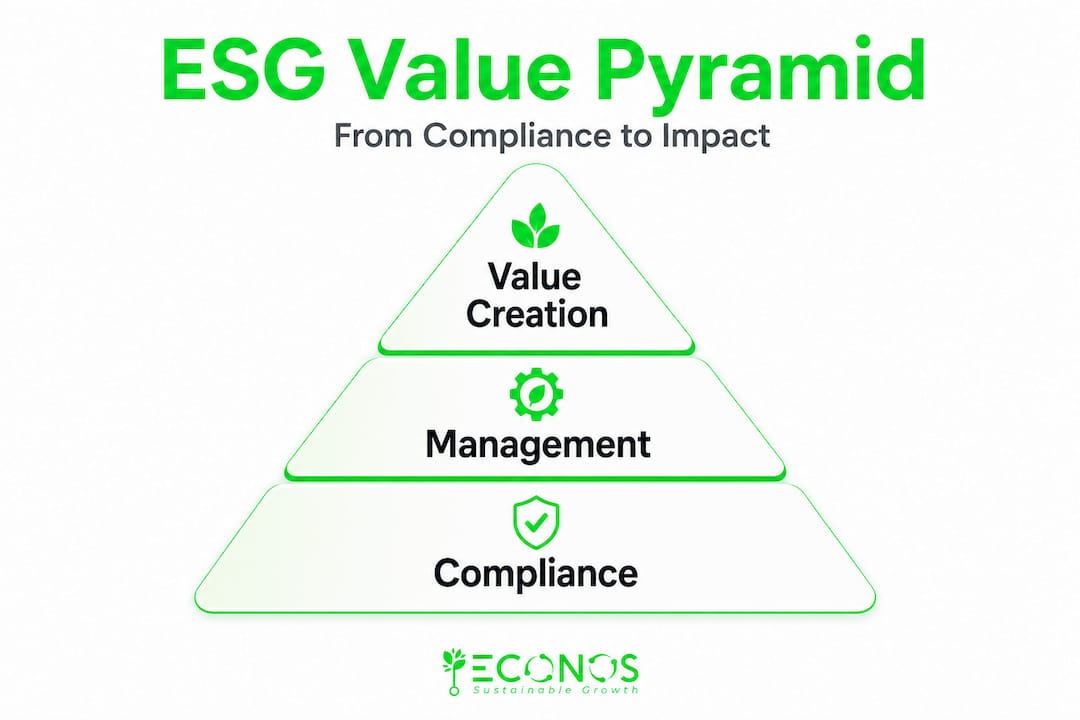
Making ESG genuinely impactful requires moving from reporting to management. Report what you measure. Manage what you report. That loop is the foundation of credible sustainability performance.
Pro Tip: Don’t try to solve everything at once. Pick the two or three ESG issues that are most material to your business, get solid data on them, and manage them actively before expanding scope. Breadth without depth creates the conditions for greenwashing, even when that’s not the intent. Use a sustainability consultation to prioritize effectively.
Why compliance alone isn’t enough: What real sustainable advisory looks like
The best practices set a strong foundation. Here’s a perspective on what most companies and advisors get wrong about sustainable advisory.
Compliance is a floor, not a ceiling. We see this pattern constantly: a company invests significantly in a CSRD report, presents it at board level, and concludes the job is done. Twelve months later, nothing has changed operationally. Emissions are the same. Supply chain risks are unresolved. The report becomes an artifact rather than a management instrument.
The honest truth is that most compliance frameworks are designed for accountability, not transformation. They tell you what to disclose, not how to improve. And because disclosure and performance are different things, a company can produce a technically compliant report while making zero ecological progress. This is the uncomfortable core of the greenwashing problem.
There’s a genuine tension in the market right now. Mandatory versus voluntary ESG reporting is actively debated: mandatory CSRD creates accountability but also bureaucratic burden for smaller firms, while the Omnibus rollback reduces obligations but also removes the pressure that often drives change. Neither extreme gets it right. The real answer is advisory that helps companies understand why they’re doing this, not just what to file.
The expert advisory insights that actually move companies forward share a common trait: they connect sustainability metrics to the decisions that matter, investment decisions, supplier selection, product design, workforce development. When sustainability is integrated into the business logic, it stops being a compliance exercise and starts being a competitive advantage.
We admit that we, like many in this field, have at times delivered reports that were more polished than they were transformative. That is a failure worth naming. The goal of going beyond ESG compliance is to help companies build the internal systems, skills, and leadership commitment that make sustainability self-sustaining, not dependent on annual advisory engagements.
Global supply chain complexity makes expert guidance genuinely necessary, not because companies can’t learn, but because the landscape shifts constantly. New standards, new enforcement actions, new buyer requirements, and new data tools require ongoing navigation. The companies that win are those who build their own capacity while staying connected to advisors who track those shifts in real time.
Enhance your sustainability outcomes with expert advisory solutions
Having explored practical and fresh approaches, here’s how you can access expert guidance and move your company forward.
At ECONOS, we work with mid-size and large companies across Romania, France, and Vietnam to translate the complexity described in this article into clear, manageable steps. Whether your priority is ESG reporting services under CSRD/ESRS, a rigorous carbon footprint assessment covering Scope 1, 2, and 3 emissions, or preparing for EcoVadis certification to strengthen your supply chain position, we focus on building your internal capability rather than creating dependency on us.
Our training-first model, powered by ECONOS Academy and AVA, our AI carbon accounting assistant, means your teams leave every engagement knowing how to continue the work independently. With over 158 completed projects and a Gold EcoVadis rating, we bring both credibility and practical experience. Contact us to discuss where your company stands and what your most urgent next steps should be.
Frequently asked questions
What are the main regulatory differences for ESG reporting in Romania, France, and Vietnam?
Romania delays CSRD reporting until 2027 or 2028 and exempts 95% of firms under the Omnibus package, while France requires vigilance plans and board-level oversight with CSRD already phasing in. Vietnam has weak enforcement and relies largely on voluntary reporting, making assurance quality low across the market.
How does a sustainable advisory service help companies avoid greenwashing?
Good advisory requires documented evidence for every sustainability claim and runs process audits to confirm that controls actually exist and function. Without audit-grade controls and proof, even well-intentioned disclosures become greenwashing by default, especially in markets where enforcement is limited and recognition outpaces performance.
What practical steps can companies take to improve their carbon footprint reporting?
Form a cross-functional team that includes finance, procurement, and operations, then integrate ESG metrics with CapEx and OpEx tracking to make the data actionable for decision-makers. Addressing the skills gap through structured training is essential before attempting to collect or verify Scope 3 data.
Does ESG compliance lead to higher financial performance?
Romanian firms with high environmental scores show a measurable positive correlation with financial performance, particularly in larger and more established companies. That relationship holds, however, only when ESG reflects genuine operational management, not just polished reporting.