
.png)

TL;DR:
- Sustainability statements are formal disclosures of a company’s environmental, social, and governance impacts crucial for business relationships.
- Compliance requirements vary across Romania, France, and Vietnam, with stricter EU regulations and voluntary frameworks influencing reporting standards.
- Moving beyond compliance and integrating sustainability into core business strategies drives real impact and long-term resilience.
Most sustainability leaders in Romania, France, and Vietnam will admit the same uncomfortable truth: writing a sustainability statement feels harder than it should. The rules keep shifting, the frameworks are multiplying, and the pressure from investors, customers, and regulators is intensifying at the same time. What exactly qualifies as a compliant sustainability statement? What separates a credible disclosure from a box-checking exercise? And how do obligations differ if your company operates across Bucharest, Paris, and Ho Chi Minh City? This guide cuts through the noise to give you clear answers, practical benchmarks, and the honest perspective that most compliance guides leave out.
Table of Contents
- Sustainability statements explained: Definitions and value
- How compliance unfolds: CSRD, ESRS, and local rules
- Common challenges and pitfalls in sustainability reporting
- Moving from compliance to real impact: Best practices
- A fresh look: Why most sustainability statements still miss the mark
- Drive impact with expert sustainability reporting support
- Frequently asked questions
Key Takeaways
| Point | Details |
|---|---|
| Know your obligations | Legal requirements for sustainability statements vary by country and company size—check your local threshold early. |
| Pitfalls are common | Data gaps and misunderstanding Scope 3 or voluntary standards can undermine compliance and impact. |
| Good governance matters | Involving the board and assuring data quality sets leaders apart in all jurisdictions. |
| Go beyond ticking boxes | Best-in-class statements drive real value, not just minimal compliance, making them tools for business strategy. |
Sustainability statements explained: Definitions and value
A sustainability statement is a formal disclosure that describes how a company manages its environmental, social, and governance risks and impacts. It is not a marketing brochure, and it is not a general CSR narrative. Under modern regulatory frameworks, a sustainability statement must follow defined standards, cover specific topics, and in many cases receive third-party assurance.
This matters because sustainability statements now sit at the center of business relationships. Banks use them for lending decisions. Large buyers use them for supplier qualification. Investors use them for risk assessment. The shift from voluntary storytelling to mandatory, auditable reporting changes the rules entirely.
Here is what a sustainability statement typically covers:
- Environmental impacts: greenhouse gas emissions (Scope 1, 2, and 3), energy consumption, water use, biodiversity risks
- Social impacts: workforce conditions, human rights in the supply chain, community relationships
- Governance: board oversight of sustainability, anti-corruption policies, transparency mechanisms
- Forward-looking information: transition plans, climate targets, capital allocation intentions
“A sustainability statement is not a summary of good deeds. It is a structured, evidence-based account of material risks and impacts that stakeholders can use to make informed decisions.”
The distinction between a sustainability statement and a classic CSR report is important. Traditional CSR reports were largely voluntary and narrative-driven. Modern sustainability statements, particularly under the EU’s Corporate Sustainability Reporting Directive (CSRD) and European Sustainability Reporting Standards (ESRS), are governed by strict rules on format, content, and verification.
Jurisdictional differences are significant. Romania’s CSRD transposition sets clear reporting thresholds for large companies, making compliance legally enforceable. France follows the same EU directive with its own national thresholds. Vietnam, by contrast, operates under a voluntary framework where disclosure is encouraged but not mandated for most sectors, and sustainability reporting disclosure levels remain low across the country. Understanding which regime applies to your company, and how seriously each is enforced, is the first step toward getting this right. You can read more about the CSRD compliance value for companies navigating this space.
How compliance unfolds: CSRD, ESRS, and local rules
With a basic understanding of sustainability statements, let’s map what the law requires and when companies must act in each country.
Romania and the CSRD
Romania transposed the Corporate Sustainability Reporting Directive through a series of national orders. CSRD deadlines were extended by Order 1421/2025, pushing mandatory reporting to 2027 for large companies and 2028 for mid-size firms, but limited assurance requirements and value chain transparency obligations remain in place. This extension is not a reason to slow down. Companies that wait until 2026 to start building their reporting infrastructure will be unprepared.
France and the CSRD
France applies CSRD with higher thresholds, covering companies with more than 1,000 employees and €450 million in turnover after Omnibus I simplification. Sustainability statements must use ESRS standards and apply a double materiality assessment, which means companies analyze both how sustainability issues affect the business and how the business affects the world. France is further along in implementation than Romania, and the reporting quality gap between early movers and late starters is already visible.
Vietnam’s voluntary framework
In Vietnam, sustainability reporting follows Circular 155/2015/TT-BTC using GRI standards, primarily in manufacturing and energy sectors. Third-party assurance is rare. There are no enforcement penalties for non-disclosure. The result is a landscape where companies report selectively, often prioritizing favorable information over complete transparency.
Here is a quick comparison across the three jurisdictions:
| Dimension | Romania | France | Vietnam |
|---|---|---|---|
| Legal mandate | Yes (CSRD transposed) | Yes (CSRD transposed) | No (voluntary) |
| Standard required | ESRS | ESRS | GRI (predominant) |
| Double materiality | Required | Required | Not required |
| Third-party assurance | Limited assurance required | Limited assurance required | Rare |
| Value chain disclosure | Required | Required | Optional |
| Key deadlines | 2027 to 2028 | Applicable now for large firms | No fixed deadlines |
The core steps for CSRD-regulated companies follow a clear sequence:
- Define scope: Determine which legal entities fall under reporting obligations based on size thresholds.
- Conduct double materiality assessment: Identify which ESG topics are material from both a financial and impact perspective.
- Map data sources: Establish systems to collect Scope 1, 2, and 3 emissions data, social indicators, and governance metrics.
- Prepare the sustainability statement: Structure it according to ESRS requirements, covering all mandatory disclosure points.
- Obtain limited assurance: Engage an accredited third-party verifier to assess the statement’s completeness and accuracy.
- Integrate into annual reporting: The sustainability statement must sit within the annual management report, not as a standalone document.
For a deeper look at what each step requires, the CSRD requirements guide for Romanian companies covers the specifics in detail, and the ESRS compliance guide addresses both the Romanian and French contexts.
Common challenges and pitfalls in sustainability reporting
Even with clear rules, companies run into costly missteps. Here are the main pitfalls and how to navigate around them.
Scope 3 data gaps
This is the most persistent challenge. An AMF study of 20 listed French firms found widespread gaps in Scope 3 emissions data, inconsistencies in transition plan quality, and significant variation in how companies interpret materiality. Scope 3 emissions, those generated by suppliers and customers, often account for 70 to 90 percent of a company’s total carbon footprint in manufacturing and retail. Yet most companies lack direct data from their suppliers and resort to unreliable industry averages.

Superficial disclosures in voluntary markets
In Vietnam, only 25% of reporting companies obtain any form of limited assurance on their sustainability disclosures. The result is that many reports are selective, positive in tone, and low in comparability. This matters for Vietnamese companies with European clients, because those clients are now required to collect supply chain data for their own CSRD statements.
The false security of deadline extensions
Romania’s extended deadlines have created a dangerous comfort zone. Companies assume they have time, so they deprioritize the foundational work: data governance, internal training, cross-functional collaboration. Building a reporting system in the last six months before a deadline is a recipe for errors, omissions, and audit failures.
The most common reporting pitfalls include:
- Failing to conduct a genuine double materiality assessment, instead treating it as a formality
- Treating Scope 3 as optional or approximate when regulators and customers increasingly require precision
- Lacking board-level oversight, which weakens the credibility of reported commitments
- Producing transition plans that are aspirational but not backed by capital allocation or operational targets
- Ignoring value chain reporting requirements, particularly for purchased goods and services
Pro Tip: Prioritize board involvement early. Companies where sustainability oversight sits at board level consistently produce more credible, consistent, and decision-useful disclosures. It is not just about governance optics. It changes the internal culture around data quality and accountability.
“The companies that struggle most with sustainability statements are not the ones that lack ambition. They are the ones that lack systems.”
A solid sustainability reporting checklist can help teams build those systems methodically. And if your company is a supplier to larger European firms, the requirements that flow down through the value chain deserve urgent attention. The CSRD compliance guide for suppliers explains exactly what larger buyers will start requesting.
Moving from compliance to real impact: Best practices
Having covered key challenges, let’s focus on what companies can do to ensure their sustainability statements don’t just tick the box but drive real-world change.
Go beyond the legal minimum
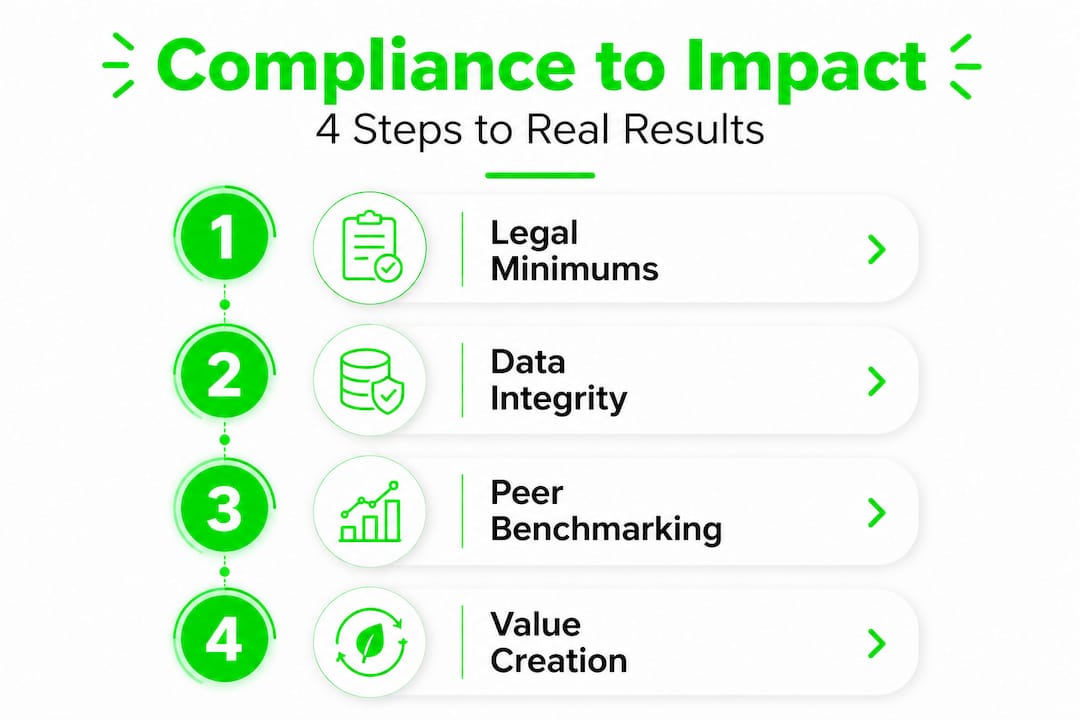
Compliance is the floor, not the ceiling. Companies that treat sustainability statements as risk management tools, rather than reporting obligations, extract the most value. They use the double materiality process to identify where environmental risks intersect with business risk. They use Scope 3 analysis to find inefficiencies and cost reduction opportunities in the supply chain. They use ESG scores to differentiate in procurement processes.
What leading companies are doing right
Leading Romanian companies like Raiffeisen Bank and PORR have moved beyond narrative reporting to integrate quantitative targets, verified emissions data, and supply chain engagement programs into their statements. In France, large industrial firms are investing in supplier sustainability platforms that automate data collection and reduce the manual burden of Scope 3 tracking. In Vietnam, the research is clear: governance structure directly influences reporting quality, with larger, more independent boards producing significantly better disclosures.
Sector benchmarks matter
Understanding how your industry peers perform helps calibrate your own ambitions. Research from Vietnam shows that manufacturing firms outperform energy sector companies on disclosure quality and completeness, which suggests that sector norms and regulatory familiarity shape reporting culture as much as company size does.
| Sector | Disclosure quality | Assurance rate | Scope 3 coverage |
|---|---|---|---|
| Manufacturing | High | Moderate | Improving |
| Energy | Moderate | Low | Inconsistent |
| Financial services | High | High | Partial |
| Retail/distribution | Moderate | Low | Limited |
| Construction | Low to moderate | Low | Early stage |
The steps that consistently separate strong reporters from weak ones are:
- Establish a dedicated sustainability team with cross-functional authority, not a side project for the communications department.
- Invest in data infrastructure before the reporting deadline, not during it.
- Engage suppliers proactively on emissions data, social conditions, and governance practices.
- Tie sustainability targets to executive compensation to create genuine accountability.
- Commission third-party assurance early to identify gaps before regulators or auditors do.
Pro Tip: Use the green reporting guide to structure your sustainability statement in a way that satisfies regulators and speaks to what investors and customers actually want to see. The two goals are more aligned than most companies realize.
A fresh look: Why most sustainability statements still miss the mark
Here is an uncomfortable observation. Many sustainability statements that are technically compliant still fail to drive meaningful progress. They meet the letter of ESRS requirements. They pass limited assurance. They are published on time. And yet they have almost no influence on how the company actually allocates capital, manages supplier relationships, or responds to climate risk.
The gap between compliance and impact is not a reporting problem. It is a culture problem.
The companies that close this gap share a common trait: they treat sustainability as a business intelligence function, not a communications function. They use their carbon footprint data to renegotiate supplier contracts. They use their double materiality assessment to inform long-term investment strategy. They use their ESG scores in customer conversations as competitive differentiators.
The next frontier is value chain transparency. As CSRD requires more granular Scope 3 data, the quality of a company’s sustainability statement increasingly depends on the data quality of its suppliers. SMEs are affected indirectly via supply chain expectations from their larger customers, which means the CSRD ripple effect will reshape entire ecosystems, not just the large companies that file the statements. Our sustainable procurement guidance addresses how to build those upstream relationships in a way that produces reliable data and shared accountability.
The make-or-break factor in 2026 is governance quality. Companies with fragmented ownership of sustainability data, no board-level oversight, and no internal training on ESG methodology will struggle, regardless of how many consultants they hire. Building internal capacity is not optional. It is the difference between a sustainability statement that is filed once and forgotten, and one that becomes a genuine management tool year after year.
We admit that the regulatory environment makes this harder than it should be. Deadlines shift, standards evolve, and the political winds around ESG create uncertainty. But the underlying logic is sound: companies that understand and manage their environmental and social impacts are more resilient, more trusted, and better positioned for the long term.
Drive impact with expert sustainability reporting support
If you’re ready to turn regulatory compliance into real competitive advantage, these solutions can help.
At ECONOS, we have supported companies like Michelin, eMAG, and Raiffeisen Bank in building sustainability statements that are both fully compliant and genuinely decision-useful. What sets our approach apart is that we don’t just produce the report for you. We build the internal capacity your team needs to own the process going forward.
Our ESG reporting support covers CSRD compliance, ESRS structuring, and double materiality assessments tailored to your industry and jurisdiction. If you need to establish your emissions baseline first, our carbon footprint assessment service covers Scope 1, 2, and 3 with the rigor that auditors and customers expect. And if you are working toward a recognized third-party rating, our accredited EcoVadis certification support has helped dozens of companies achieve significant score improvements. Sustainability is a business tool. Let us help you use it well.
Frequently asked questions
Who needs to produce a sustainability statement under Romanian law?
Large and mid-size companies meeting thresholds for assets, turnover, or employees are legally required to comply, with deadlines set to 2027 and 2028 respectively under Order 1421/2025. SMEs are not directly required but face growing indirect pressure through supply chain expectations from larger customers.
What frameworks govern sustainability statements in Vietnam?
Vietnam’s reporting framework is voluntary, primarily guided by Circular 155/2015/TT-BTC and the GRI standard, with no mandatory assurance requirement and historically low average disclosure levels among large companies.
How do French sustainability reporting requirements differ from Romania’s?
France applies CSRD with thresholds of more than 1,000 employees and €450 million in turnover, requires ESRS standards and double materiality assessment, and has a larger cohort of companies already in the reporting cycle compared to Romania, which means French firms face more immediate assurance and Scope 3 data challenges.
What is the business value of sustainability statements beyond legal compliance?
Clear, credible sustainability statements build stakeholder trust, reduce the cost of capital, strengthen supply chain resilience, and give companies a genuine edge in procurement processes where buyers are now required to assess supplier sustainability performance.