
.png)

TL;DR:
- Supply chain assessments identify risks, measure sustainability, and verify compliance across a company’s network. They should be continuously monitored, include third-party data, and link findings to actionable KPIs with clear accountability. Organizations that treat assessments as ongoing processes reduce vulnerabilities and meet evolving regulatory and market expectations.
A supply chain assessment is the systematic evaluation of a business’s entire supply network to uncover risks, measure sustainability performance, and confirm compliance with regulatory and industry standards. For companies facing CSRD, EU Taxonomy, and EcoVadis requirements in 2026, this process has shifted from a periodic audit into a core management discipline. Done well, a supply chain assessment tells you where your vulnerabilities are, which suppliers carry the most risk, and where your sustainability claims can actually be defended. Done poorly, it becomes a document that sits in a folder and expires within months.
What does an effective supply chain assessment cover?
A supply chain assessment covers six to seven core performance domains, and skipping any one of them creates blind spots that regulators and customers will eventually find. Supplier evaluation should measure at least seven criteria: delivery reliability, quality, responsiveness, cost accuracy, capacity, lead-time consistency, and compliance. That list is not arbitrary. Each criterion maps to a specific failure mode that has caused real disruptions for manufacturers and retailers.

Beyond those seven criteria, a thorough supply chain evaluation adds sustainability and ethical performance parameters. This means tracking carbon emissions, labor practices, and environmental certifications alongside the operational metrics. Companies like Michelin and eMAG, both clients of Econos-esg, have learned that sustainability data and operational data belong in the same scorecard, not separate reports.
Supplier risk scoring models weight geographic risk at 40%, concentration risk at 35%, and lead-time volatility at 25%. That weighting matters because it tells you where to focus remediation effort first. A supplier in a politically unstable region with a single-source relationship is a higher priority than a local supplier with minor delivery delays.
The table below shows the most common assessment criteria and their primary risk category:
| Criterion | Risk category | Why it matters |
|---|---|---|
| Delivery reliability | Operational | Directly affects production schedules and customer commitments |
| Compliance status | Regulatory | Triggers legal liability and ESG rating penalties |
| Geographic concentration | Strategic | Single-region dependency amplifies disruption impact |
| Sustainability rating | Reputational | Required for EcoVadis, CSRD, and EU Taxonomy reporting |
| Cost accuracy | Financial | Hidden costs often outweigh purchase price savings |
| Lead-time consistency | Operational | Volatility drives excess inventory and working capital waste |
Pro Tip: Build your supplier scorecard in tiers. Tier 1 suppliers get full seven-criterion reviews. Tier 2 and Tier 3 suppliers get a streamlined version focused on compliance and geographic risk. This keeps the process manageable without creating blind spots.
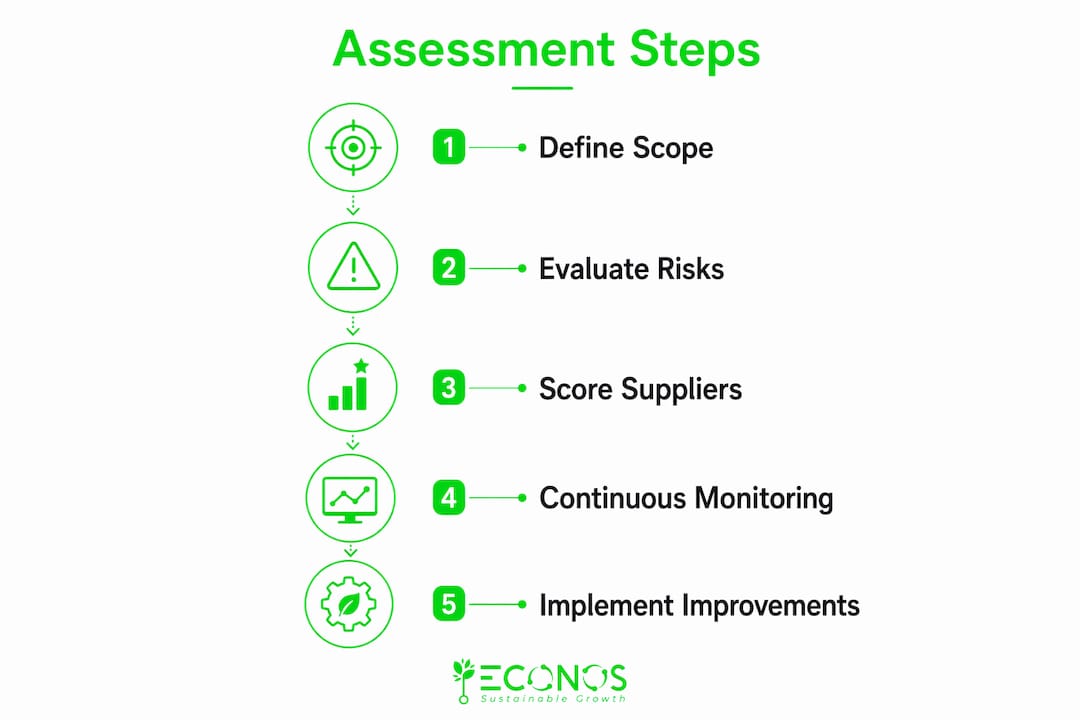
Benchmarking your scores against industry peers gives the data meaning. A delivery reliability score of 87% sounds acceptable until you learn your sector average is 94%. Scorecards without benchmarks produce numbers without context.
How can businesses implement continuous monitoring?
Treating a supply chain audit as a one-time project is the single most common mistake companies make. Assessments treated as static documents become obsolete within months. Regulatory changes, geopolitical shifts, and supplier financial stress can all invalidate a risk picture that was accurate six months ago.
The practical answer is a tiered monitoring schedule. Organizations should conduct comprehensive supply chain risk assessments annually, with quarterly updates for high-risk suppliers. High-risk means any supplier that scores above a defined threshold on geographic concentration, compliance gaps, or sustainability deficiencies.
Automated triggers make quarterly reviews manageable. Set alerts for events like a supplier’s EcoVadis score dropping, a new sanctions listing, or a regulatory change in a key sourcing country. These triggers replace manual calendar reviews with event-driven responses. Tools that integrate external market intelligence, such as news monitoring and regulatory databases, feed those triggers automatically.
“Without corrective action and KPIs, assessments become failed audits rather than strategic risk tools.” — EcoVadis
Third-party verified data is essential for credible supplier risk assessments. Self-assessment questionnaires are easy to complete favorably and difficult to benchmark against peers. Audit reports, EcoVadis ratings, and verified carbon disclosures give procurement teams data they can defend to regulators and investors.
- Set a baseline annual assessment for all suppliers.
- Flag high-risk suppliers for quarterly reviews using defined scoring thresholds.
- Configure automated alerts for regulatory changes, sanctions, and rating drops.
- Require third-party verification for sustainability claims from Tier 1 suppliers.
- Run scenario planning exercises twice a year to test your response to plausible disruptions.
Combining risk assessment with scenario planning moves organizations from reactive crisis management to proactive risk optimization. Marsh’s work with large manufacturers shows that testing disruption scenarios before they happen consistently reduces response time and financial impact when disruptions actually occur.
Pro Tip: Assign a named owner to each high-risk supplier relationship. Monitoring programs without accountability drift. One person responsible for one supplier segment means problems surface faster.
What tools and frameworks are available for supply chain analysis?
Several established tools support supply chain analysis, and they differ significantly in scope, cost, and focus area. Choosing the wrong tool means collecting data that does not answer the questions your regulators or customers are actually asking.
- ASCM tools: The Association for Supply Chain Management offers free assessment frameworks focused on operational performance, process maturity, and supply chain design. These are best suited for companies starting their assessment program and needing a structured baseline.
- EcoVadis: The gold standard for supplier sustainability ratings. EcoVadis assessments cover environment, labor and human rights, ethics, and sustainable procurement. The platform provides benchmarked scores and corrective action recommendations. Econos-esg holds a Gold EcoVadis rating and is an accredited EcoVadis Core partner.
- GAIA Sustainability Tool: Designed for environmental impact tracking across supply chains, with particular strength in carbon accounting and lifecycle data.
The comparison below summarizes how these tools differ in practice:
| Tool | Primary focus | Verification type | Best for |
|---|---|---|---|
| ASCM frameworks | Operational maturity | Self-assessment | Baseline process evaluation |
| EcoVadis | Sustainability and ethics | Third-party verified | Regulatory and customer reporting |
| GAIA | Environmental impact | Data-driven | Carbon and LCA integration |
| Excel-based TCO models | Cost analysis | Internal | Early-stage logistics assessment |
A true logistics assessment captures hidden costs beyond purchase price, including administrative overhead, damage claims, and downtime. Total cost of ownership (TCO) analysis regularly reveals that a cheaper supplier costs more when you account for quality failures and expediting fees. Starting with a simple Excel model before moving to AI-driven analysis is a practical path for most mid-size companies.
Tools that integrate AI and external market intelligence add real value at the monitoring stage. They reduce the manual work of tracking regulatory changes and supplier news, and they surface risk signals that a quarterly manual review would miss. The EcoVadis supplier checklist is a practical starting point for companies preparing for their first formal sustainability-focused evaluation.
How do you turn assessment findings into real improvements?
Assessment data without a corrective action plan is just a report. Linking assessment data to corrective action plans with KPIs, accountability, and improvement timelines is what separates successful programs from failed audits. This connection is where most companies fall short.
- Prioritize findings by risk level. Not every gap requires immediate action. Rank findings by potential impact on compliance, operations, and sustainability commitments. Address critical compliance gaps first.
- Assign KPIs to each corrective action. Vague improvement goals produce no change. A KPI like “reduce Tier 1 supplier carbon intensity by 15% within 12 months” is measurable and defensible.
- Set supplier improvement timelines. Give suppliers a defined window to close gaps, with interim check-ins. Suppliers without deadlines treat improvement requests as optional.
- Measure financial and operational impact. Track whether corrective actions reduce downtime, lower damage claims, or improve on-time delivery. This connects sustainability work to business outcomes that finance teams care about.
- Review and update the assessment after each corrective cycle. Improvements change the risk picture. An assessment that does not reflect completed actions becomes misleading.
Pro Tip: When a supplier consistently fails to meet corrective action timelines, treat that as a concentration risk signal. Begin qualifying alternative suppliers before the relationship becomes a single-source dependency.
Common pitfalls include ignoring indirect costs and failing to follow up. Indirect costs often outweigh initial purchase savings, yet many companies track only invoice price in their supply chain performance review. A supplier with a low unit cost but high damage claim rates and long administrative processing time may be your most expensive relationship. Build indirect cost tracking into your corrective action metrics from the start.
Connecting assessment findings to sustainability risk management practices also strengthens your CSRD and EU Taxonomy reporting. Regulators want to see that your supply chain data feeds into your broader ESG disclosures, not that it sits in a separate procurement database.
Key Takeaways
A supply chain assessment delivers lasting value only when it combines structured criteria, continuous monitoring, third-party verified data, and corrective action plans with defined KPIs and accountability.
| Point | Details |
|---|---|
| Use seven core criteria | Evaluate delivery reliability, quality, responsiveness, cost accuracy, capacity, lead-time consistency, and compliance for every Tier 1 supplier. |
| Monitor continuously | Conduct annual assessments with quarterly updates for high-risk suppliers and automated alerts for regulatory or rating changes. |
| Require third-party verification | Self-assessment questionnaires lack credibility; EcoVadis ratings and audit reports are defensible with regulators and investors. |
| Capture total cost of ownership | Track indirect costs like damage claims and administrative overhead, not just purchase price, to reveal true supplier cost. |
| Connect findings to corrective action | Assign KPIs, timelines, and named owners to every improvement action so assessments drive change rather than document it. |
Why I think most companies are still treating assessment as an event
After working with companies across manufacturing, retail, and financial services, I have seen the same pattern repeat. A company invests in a thorough supply chain evaluation, produces a detailed report, and then files it. Twelve months later, the same risks appear in a different form, and the team is surprised.
The honest truth is that assessment maturity is an organizational capability, not a software purchase. Technology helps, but the discipline of quarterly reviews, named accountability, and corrective action follow-through is a cultural commitment. Companies that get this right treat their supply chain analysis the way a finance team treats a rolling forecast: always current, always connected to decisions.
Regulatory pressure from CSRD and the EU’s supply chain due diligence requirements is forcing this shift faster than most companies expected. The companies I respect most are the ones who admit their current program has gaps and build toward something better, rather than defending a process that stopped being adequate two years ago. That honesty is where real progress starts. You can begin by understanding your supply chain sustainability risks and building from there.
— Mathieu
How Econos-esg supports your supply chain assessment program
Econos-esg works with mid-size and large companies to build supply chain assessment programs that meet regulatory requirements and hold up under scrutiny from customers and investors.
The team at Econos-esg has completed over 158 projects across 17 industries, with clients including Michelin, Romstal, eMAG, Raiffeisen Bank, and PORR. Services cover carbon footprint assessment across Scope 1, 2, and 3 emissions, EcoVadis certification preparation, ESG reporting under CSRD and ESRS, and EU Taxonomy compliance. The training-first model means your team builds the internal capability to run and maintain assessments independently, rather than depending on external consultants indefinitely. Visit Econos-esg to learn more about how these services apply to your supply chain context.
FAQ
What is a supply chain assessment?
A supply chain assessment is a systematic evaluation of a business’s supply network to identify risks, measure sustainability performance, and verify compliance with regulatory and industry standards. It covers supplier performance, geographic risk, cost accuracy, and environmental and ethical criteria.
How often should a supply chain risk assessment be conducted?
Organizations should run a comprehensive supply chain risk assessment annually, with quarterly updates for high-risk suppliers. Automated monitoring between formal reviews catches regulatory changes and supplier rating shifts in real time.
What is the difference between a supply chain audit and a supply chain assessment?
A supply chain audit is typically a point-in-time verification of compliance against a defined standard. A supply chain assessment is broader, covering risk scoring, sustainability performance, cost analysis, and corrective action planning as an ongoing management program.
Which tools are best for supplier sustainability evaluation?
EcoVadis is the most widely recognized tool for third-party verified supplier sustainability ratings, covering environment, labor, ethics, and procurement. ASCM frameworks and GAIA complement EcoVadis for operational maturity and environmental impact analysis respectively.
How do you connect assessment findings to business improvements?
Assign a KPI, a named owner, and a defined timeline to every finding that requires corrective action. Without those three elements, assessment findings remain observations rather than drivers of measurable change.