
.png)

TL;DR:
- Despite a 51% decrease in EU ETS stationary emissions from 2005 to 2024, businesses still face significant reduction challenges ahead of 2030. Building a documented, auditable emissions workflow involving data, people, and systems is essential for compliance and long-term resilience. Effective strategies focus on baseline auditing, prioritized reduction measures, continuous improvement, and internal capacity development to ensure lasting emissions impact.
The EU ETS stationary emissions declined 51% between 2005 and 2024, yet the system’s 62% reduction target by 2030 means businesses still have significant ground to cover in a compressed timeframe. For sustainability managers at mid-size and large Romanian and EU-based companies, the pressure is real: get your emissions strategy documented, auditable, and effective, or face regulatory penalties, financing constraints, and ESG rating risks. This guide gives you a practical, step-by-step workflow from setup to reporting, built around EU ETS, CSRD, and real-world Romanian experience.
Table of Contents
- Understand emissions reduction frameworks and regulatory drivers
- Set up your emissions reduction workflow: What you need
- Execute the step-by-step emissions reduction workflow
- Verification, reporting, and optimizing for continuous improvement
- What most guides miss: The reality of lasting emissions impact
- Get support to accelerate your emissions reduction journey
- Frequently asked questions
Key Takeaways
| Point | Details |
|---|---|
| Follow legal steps | A structured workflow meets EU ETS and CSRD mandates while reducing risk. |
| Leverage quick wins | Efficiency and renewables deliver fast, cost-effective emission cuts. |
| Prioritize data management | Accurate, auditable data is essential for both compliance and ongoing improvements. |
| Integrate for audit readiness | Document every step and benchmark results to prepare for third-party verification. |
| Expert support accelerates impact | Consulting and technology partners bridge gaps in capacity and workflow design. |
Understand emissions reduction frameworks and regulatory drivers
Having established the urgency, you need to know which rules shape your workflow and what is genuinely at stake for your business.
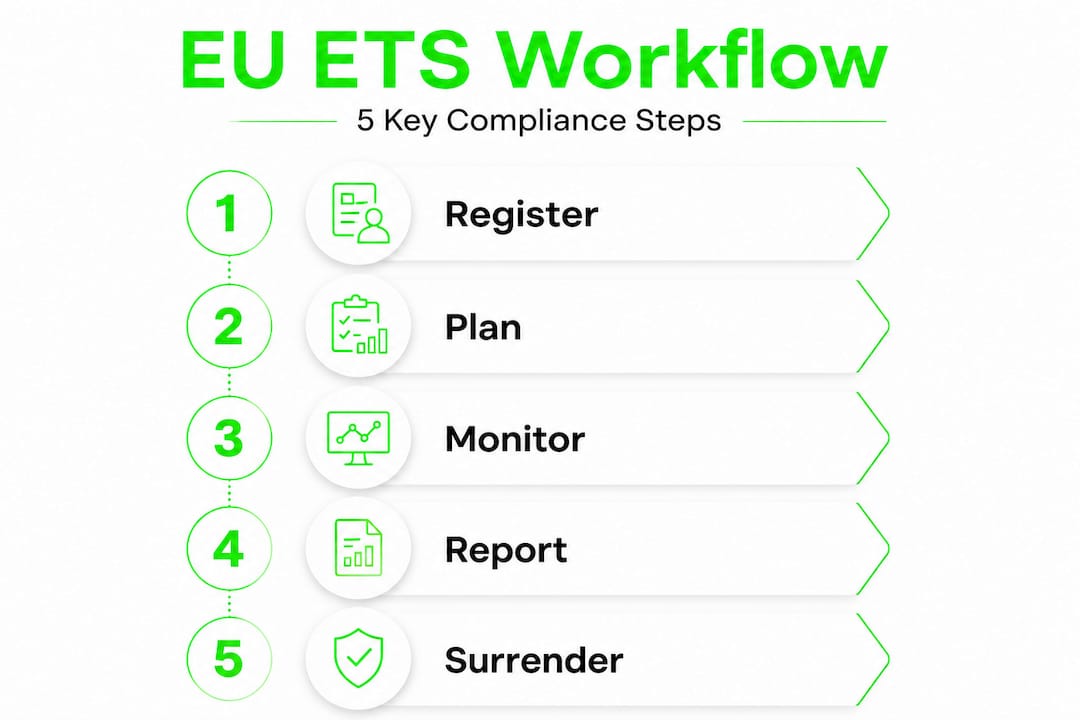
The EU Emissions Trading System is the backbone of large-emitter compliance in Europe. The EU ETS compliance workflow has four core steps: register in the Union Registry, develop and implement an approved monitoring plan, submit your verified annual emissions report, and surrender allowances. Missing the September 30 deadline for surrendering allowances triggers a penalty of €100 per excess ton of CO2e. That is not a hypothetical risk. It is a hard cost.
| Framework | Scope | Key obligation | Penalty for non-compliance |
|---|---|---|---|
| EU ETS | Stationary installations, aviation, maritime | Surrender allowances by Sep 30 | €100/t CO2e over limit |
| CSRD/ESRS | Large and listed companies, phasing to SMEs | Auditable ESG disclosures, double materiality | Potential fines, reputational damage |
| SBTi | Voluntary but investor-driven | 1.5°C-aligned targets, 90%+ absolute cuts | Reputational, financing risk |
Beyond EU ETS, the Corporate Sustainability Reporting Directive (CSRD) pushes companies to publish auditable emissions strategies. It is not enough to reduce emissions; you need to show your methodology, your data trail, and your trajectory. This matters for your supply chain position too. If your major clients are CSRD-reporting entities, they will pull your emissions data into their Scope 3 disclosures and ask hard questions. Understanding both ESG requirements compliance and ESG compliance in Romania is important here because the regulatory calendar for Romanian companies involves specific implementation timelines and local reporting nuances.
“Legal compliance alone is not a resilience strategy. Companies that treat emissions reduction as a minimum-cost checkbox exercise tend to find themselves caught off-guard when thresholds tighten or when a major customer demands verified data.”
Some installations qualify as small emitters under EU ETS and may access simplified procedures, but even these companies face growing CSRD pressure if they sit inside larger supply chains. The practical message: whether you are directly regulated or indirectly pressured, building a structured emissions reduction workflow is no longer optional.
Set up your emissions reduction workflow: What you need
Once you understand the framework and regulatory drivers, the next step is assembling everything required for workflow success before you start reporting or reducing.
Three categories of resources need to be in place before execution: data, people, and systems.
Data foundations
- Scope 1 emissions: direct fuel combustion, on-site industrial processes, refrigerants
- Scope 2 emissions: purchased electricity and heat, using both location-based and market-based methods
- Scope 3 emissions: supply chain, logistics, business travel, employee commuting, product end-of-life
This is more complex than it sounds. Many companies can state their electricity bills but struggle to quantify fleet fuel by activity type or to gather supplier-specific emissions factors for Scope 3 categories. Start by mapping every data source for all three scopes. Be honest about data gaps from the beginning; it saves painful re-work later.

| Resource category | What you need | Common gap |
|---|---|---|
| Data | 12 months of activity data per source | Scope 3 supplier data, refrigerant top-ups |
| People | Cross-functional team: finance, operations, procurement, EHS | Ownership often unclear across departments |
| Systems | Monitoring software, emissions factors database, audit trail | Spreadsheets with no version control |
| External | Verified emissions factor sources, possibly a third-party verifier | Selecting accredited verifier early enough |
Stakeholder involvement is non-negotiable. A cross-functional team, including finance (for capital planning), operations (for process data), procurement (for Scope 3), and sustainability leads (for methodology), is the only way to build a workflow that holds up under CSRD audit. When one department owns the data and another owns the strategy, things fall apart at reporting time.
The PMI Romania factory case illustrates this well. PMI’s emissions reductions through electrification and on-site solar did not happen because of a sustainability team working in isolation. They required capital decisions from finance, process changes from operations, and long-term procurement shifts. That kind of coordination requires the workflow to be institutionalized, not just documented in a single report.
A useful starting point is the carbon footprint reduction checklist to confirm you have covered each data category. For manufacturers specifically, the ESG workflow guide for manufacturers adds operational context that generic frameworks miss.
Pro Tip: Before selecting any software or hiring a verifier, spend two weeks mapping your data sources by scope and location. This single exercise will clarify your actual monitoring needs and prevent costly system mismatches later.
Execute the step-by-step emissions reduction workflow
Now that you have your resources assembled, you can move into the concrete workflow that delivers real-world emission reductions and passes audits.
The order of operations matters. Many companies jump to reduction measures before establishing a credible baseline, which creates problems when targets need to be verified or when a new reporting year shows unexpected increases.
-
Audit your baseline. Collect 12 months of activity data across all three scopes, apply recognized emissions factors (such as those from DEFRA, IPCC, or the EU’s own databases), and calculate a total CO2e figure. Document every assumption. Your baseline year will anchor all future reporting.
-
Set scope boundaries and reduction targets. Define which emissions are in scope for reduction versus reporting only. Align with your most binding framework, typically EU ETS for large installations or SBTi if investors require it. Set short-term targets (2026, 2028) alongside your 2030 horizon.
-
Select reduction measures in priority order. The net-zero strategy guidance is clear on this: prioritize quick wins in energy efficiency and renewables before tackling hard-to-abate processes. For Romanian companies, ETS2 implementation delays create a narrow window to act voluntarily, but on-site solar and vehicle electrification deliver cost savings alongside emissions cuts right now.
-
Integrate monitoring into operations. Monthly data collection beats annual scrambles. Assign data owners per emission source, use consistent emissions factors, and maintain version-controlled records. If you are using a spreadsheet, at minimum add a change-log tab. Ideally, move to purpose-built carbon accounting software.
-
Document every decision for audit-readiness. Each calculation method, each data source used, and each assumption made should be traceable. This is what separates a CSRD-compliant disclosure from a marketing claim.
The PMI Romania factory case offers precise benchmarks: their fleet CO2e dropped from 185g/km in 2020 to 99g/km by 2024, and their on-site solar installation of 3.467 MWp now produces approximately 4,111 MWh per year. Natural gas consumption at the facility stands at 15.9 kilotonnes CO2e as of 2024, reflecting ongoing work on harder-to-decarbonize processes. These are the kinds of data points that make emissions reports credible rather than generic.
“Quick wins in efficiency and renewables are not just environmentally sound; they are financially rational. In most industrial settings, they pay back within three to five years while building the data infrastructure that CSRD requires.”
For practical implementation guidance, the resource on how to implement carbon reduction methods covers specific technical options across sectors. The CSRD compliance benefits resource is worth reviewing alongside this to understand how your emissions workflow feeds into broader disclosure value.
Pro Tip: Document your workflow decisions in writing as you make them, not retrospectively. Auditors and CSRD assurance providers will ask why you chose specific emission factors or boundary definitions. Having those notes from the moment of decision is far more credible than reconstructing rationale months later.
Verification, reporting, and optimizing for continuous improvement
You have executed and documented your emissions reduction steps. Now comes the phase that closes the compliance loop and drives ongoing impact.
Verification steps in practice:
- Internal review: Cross-check calculations independently. Have someone who did not build the model review it for errors in emissions factors, unit conversions, and boundary definitions.
- Third-party verification: For EU ETS installations, this is mandatory. For CSRD, limited assurance is required for the first years, moving toward reasonable assurance. Choose an accredited verifier early; capacity is tight in Romania.
- Submission deadlines: Submit your verified annual emissions report by March 31 and surrender allowances by September 30. Missing these dates is expensive and reputationally damaging.
| Requirement | EU ETS | SBTi Net-Zero |
|---|---|---|
| Reduction ambition | 62% by 2030 vs 2005 | 90%+ absolute cut from base year |
| Offset use | Limited, transitional flexibility | Residual emissions only (post-90% cut) |
| Verification | Mandatory accredited verifier | Third-party validation + monitoring reports |
| Scope coverage | Scope 1 direct for covered installations | Scope 1, 2, and relevant Scope 3 |
| Frequency | Annual | Annual progress disclosure |
The contrast between EU ETS and SBTi matters because many companies face both. SBTi’s net-zero standard demands 90% absolute cuts plus carbon dioxide removals for residual emissions, while EU ETS focuses on verified annual reductions within a declining cap. Relying on offsets to close the gap between your actual reductions and your SBTi commitment is increasingly scrutinized and may not satisfy your largest customers or investors.
Continuous improvement means treating each reporting cycle as a learning loop. After verification, identify which reduction measures outperformed projections and which fell short. Revise your monitoring plan, update your capital investment queue, and set interim targets for the next year based on what the data actually showed.
The carbon reduction checklist is a useful tool to revisit after each annual cycle to confirm you are not missing emerging emission sources or regulatory requirements.
Pro Tip: Use your verified emissions data as an input to your ESG and CSRD disclosures from day one. The same data that satisfies EU ETS requirements can underpin your ESRS E1 disclosures, reducing double handling and improving consistency across reports.
What most guides miss: The reality of lasting emissions impact
Most guides walk you through the technical steps, and then stop. What they rarely address is the organizational and financial reality that determines whether your emissions reduction workflow actually delivers lasting impact.
Here is the uncomfortable truth: the biggest driver of industrial decarbonization is not regulation. It is capital replacement cycles. When a boiler, vehicle fleet, or production line reaches end-of-life, companies face a natural decision point. Capital cycles favor natural asset replacement over costly retrofits, which means that companies that plan their emissions strategy around their capital calendar tend to achieve deeper cuts at lower cost than those who force premature replacements under regulatory pressure.
We see this regularly in our work with Romanian manufacturers. Companies that aligned their decarbonization roadmap with their five-year capex plan achieved faster, more durable reductions than those who tried to retrofit immediately in response to compliance deadlines. Understanding why carbon footprint matters for Romanian companies in this capital-cycle context reframes the entire workflow as a business planning tool, not just a compliance exercise.
The second reality: offsets are a trap for companies that have not done the hard work of reducing actual emissions first. We have seen businesses invest in offset certificates while ignoring energy efficiency measures that would have cost less and reduced real emissions. SBTi’s insistence on 90% actual cuts before any offset use exists for this reason. Offsets do not improve your operational efficiency, they do not satisfy increasingly strict CSRD assurance standards, and they do not build the internal competency that makes your business resilient as regulations tighten.
Third, and most practically: the verification and data management process is what separates companies that own their sustainability narrative from those that outsource it and stay dependent. When your team can collect, calculate, and defend your emissions data independently, you move faster, you cost less to audit, and you build credibility with stakeholders that no purchased certificate can replicate. That is exactly why we built ECONOS Academy and AVA, our AI-powered carbon accounting assistant. Internal capacity is not a nice-to-have. It is your long-term competitive advantage.
Get support to accelerate your emissions reduction journey
If you have read this far, you are serious about building a workflow that works. The challenge is that assembling the right team, data infrastructure, and reporting processes takes time most sustainability managers do not have.
At ECONOS, we have completed over 158 projects across 17 industries, working with companies like Michelin, eMAG, and Raiffeisen Bank to build emissions workflows that are audit-ready, CSRD-aligned, and owned internally by their teams. Whether you are starting with a carbon footprint assessment to establish your baseline or need end-to-end ESG reporting solutions for CSRD compliance, we build capacity rather than dependency. For companies with complex product systems or supply chain emissions, our lifecycle analysis service provides the product-level data that ESRS E1 and EU Taxonomy disclosures increasingly demand. Let’s build something that lasts.
Frequently asked questions
What are the key steps in the EU ETS compliance workflow?
Register in the Union Registry, develop an approved monitoring plan, submit your verified report by March 31, and surrender allowances by September 30. Each step requires documented evidence for audit purposes.
How can Romanian companies get ahead despite ETS2 delays?
Focus on energy efficiency upgrades and on-site renewables now, following the approach of PMI Romania’s solar and electrification program. These deliver cost savings and emissions cuts regardless of ETS2 timeline changes.
What is the penalty for late EU ETS allowance surrender?
Late surrender of allowances incurs a mandatory penalty of €100 per excess ton of CO2e, plus the obligation to still surrender the missing allowances.
Which emission reduction actions have the biggest impact?
Energy efficiency, electrification, and on-site renewables consistently deliver the largest near-term reductions. PMI Romania’s factory data shows fleet emissions dropping from 185g/km to 99g/km through electrification, alongside substantial on-site solar generation.
How do SBTi net-zero targets differ from EU ETS requirements?
SBTi net-zero requires at least 90% absolute emissions cuts plus verified carbon removals for residual emissions, while EU ETS requires annual verified reductions within a declining system cap and allows limited transitional flexibility.