
.png)

TL;DR:
- EU companies must now explain why non-material sustainability topics are assessed and disclosed, reflecting increased scrutiny.
- Consulting focuses on building internal capacity for CSRD/ESRS compliance, double materiality assessments, and integration into business strategy.
Even if your company concludes that a particular sustainability topic is not material to your business, you are still required to explain why, and disclose that you assessed it. That is the level of scrutiny the EU has introduced. For mid-size and large companies in Romania and across the EU, the shift from voluntary corporate social responsibility to mandatory, auditable sustainability compliance is not a future event. It is happening right now, with deadlines already passed for the largest organizations and waves of new requirements hitting mid-size companies through 2026 and beyond. This guide maps out what you actually need, what consulting and training should cover, and how to turn compliance pressure into strategic advantage.
Table of Contents
- CSR and sustainability consulting in today’s EU landscape
- The CSRD and ESRS: What companies must report
- Corporate sustainability due diligence: Beyond reporting
- Practical consulting models: Romania and EU in focus
- Why perfect compliance isn’t the end goal: Consulting lessons from real-world EU cases
- Where to get support: ESG and sustainability consulting for your business
- Frequently asked questions
Key Takeaways
| Point | Details |
|---|---|
| Double materiality disclosure | Companies must disclose their double materiality process and ESRS coverage regardless of materiality outcomes. |
| Integrated consulting approach | Successful CSR consulting involves both reporting design and due diligence system integration. |
| Local relevance matters | Effective consulting adapts EU-wide strategies for Romanian context through targeted training and executive engagement. |
| Due diligence goes beyond reporting | CSDDD expands obligations to include climate plans and value-chain impact assessments. |
| Beyond compliance | Consulting adds most value when it fosters strategic thinking and capacity, not just regulatory box-ticking. |
CSR and sustainability consulting in today’s EU landscape
Not long ago, CSR was essentially voluntary. Companies published glossy reports, highlighted community initiatives, and called it a day. That era is over. The EU has systematically replaced voluntary frameworks with binding obligations, and the consulting market has had to follow.
For EU mid-size and large companies, CSR and sustainability consulting is now tightly coupled to compliance with the Corporate Sustainability Reporting Directive (CSRD) and the European Sustainability Reporting Standards (ESRS). These are not soft guidelines. They are legal reporting obligations with third-party assurance requirements, which means what you report gets checked.
“The question is no longer whether to disclose sustainability performance, but how to do it accurately, credibly, and in a way that reflects genuine business strategy.”
What does consulting and training typically cover in this environment? Here is what companies should expect from a credible engagement:
- Double materiality assessments that evaluate both financial risks from sustainability factors and the company’s impacts on people and the environment
- ESRS disclosure mapping, identifying which of the 12 topical standards apply to your business
- Data collection systems for environmental, social, and governance metrics across Scope 1, 2, and 3 emissions
- Internal capacity building, so your team can own and update the process year after year
- Board and executive training on regulatory obligations, risk exposure, and reporting mechanics
In Romania specifically, the market is growing fast. Providers like the Romanian CSR training provider Sustainability Lens reflect rising demand for structured, regulation-focused sustainability programs. But the gap between awareness and actual compliance readiness remains significant for many organizations.
Having set the fundamental landscape, let’s break down the actual process behind regulatory compliance.
The CSRD and ESRS: What companies must report
The CSRD, which applies in phases based on company size and listing status, is the foundational piece of EU sustainability law for reporting. It replaces the older Non-Financial Reporting Directive (NFRD) and dramatically expands both the scope of required disclosures and the number of companies covered.
Here is a simplified view of the rollout timeline and thresholds:
| Company type | Employees | Financial threshold | Reporting start |
|---|---|---|---|
| Large listed companies (formerly under NFRD) | 500+ | Any | FY 2024 |
| Other large EU companies | 250+ | €40M turnover or €20M assets | FY 2025 |
| Listed SMEs (with opt-out option) | Any | Listed | FY 2026 |
| Non-EU companies (large, with EU activity) | 500+ | €150M EU net turnover | FY 2028 |
The ESRS (European Sustainability Reporting Standards) are the actual reporting templates companies use under CSRD. There are two cross-cutting standards covering general disclosures and strategy, plus 10 topical standards across environment, social, and governance themes.
The EU sustainability consulting must cover the double materiality logic used to determine what topics companies disclose under CSRD/ESRS. This is worth understanding in practical terms. Double materiality asks two questions simultaneously: does this sustainability topic create financial risk or opportunity for your company (financial materiality), and does your company’s activity cause harm or positive impact on people or the environment (impact materiality)? A topic is material if it meets either condition.
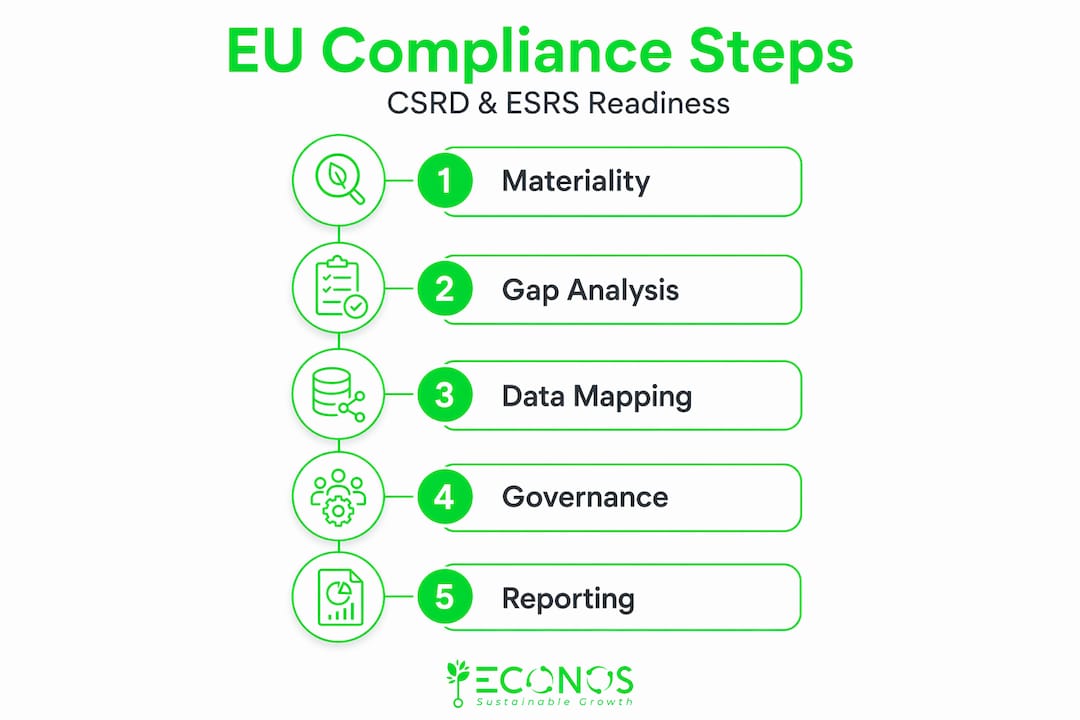
The four-step process typically looks like this:
- Step 1: Identify your business context, value chain, and stakeholder landscape
- Step 2: Screen all ESRS topics for potential relevance based on your sector and activities
- Step 3: Assess and score each topic against both impact and financial materiality criteria
- Step 4: Document conclusions, including the rationale for topics deemed non-material
That last point matters enormously. Companies consistently underestimate the disclosure burden for non-material topics. Under CSRD official rules, you must still disclose the results of your materiality process for every ESRS area you assessed. The absence of a disclosure requires justification, not silence.
Good consulting in this space means CSRD readiness that goes beyond filling out templates. It means building the governance structure, the data pipelines, and the internal know-how to sustain reporting annually. For companies working toward their first sustainability statement, a structured engagement that includes real training, not just deliverables, is the difference between dependency and capability.
Pro Tip: When selecting a consulting partner, ask whether they leave your team more capable at the end of the engagement. If the answer is “we handle it for you,” that is a sign you will need them again next year, and the year after that.
For companies starting to map ESRS compliance, the combination of a strong methodology, practical tooling, and internal training is the most cost-efficient path forward.
With CSRD and ESRS compliance in focus, it is equally important to understand the new due diligence mandates.
Corporate sustainability due diligence: Beyond reporting
Reporting is one thing. Changing how your business actually operates is another. The Corporate Sustainability Due Diligence Directive (CSDDD) addresses the second part. Consulting for large EU companies, in addition to reporting, must prepare for corporate sustainability due diligence obligations under Directive (EU) 2024/1760.
CSDDD applies to very large EU companies (generally 1,000+ employees and €450M+ turnover) and non-EU companies with significant EU revenue. It requires companies to:
- Adopt a corporate policy committing to responsible business conduct aligned with international standards
- Map and prioritize actual and potential adverse impacts across the entire value chain
- Take action to prevent or mitigate identified human rights and environmental harms
- Establish grievance mechanisms accessible to affected workers and communities
- Monitor effectiveness of due diligence measures on an ongoing basis
- Communicate publicly on due diligence performance in line with CSRD requirements
The climate dimension adds another layer. Companies covered by CSDDD must develop and implement a climate transition plan that is compatible with the 1.5°C pathway from the Paris Agreement, including interim targets for 2030, 2035, and 2040 on the way to net-zero by 2050.
Here is a brief comparison of scope between the two main directives:
| Dimension | CSRD | CSDDD |
|---|---|---|
| Primary obligation | Sustainability reporting | Due diligence and action |
| Value chain scope | Reporting only | Active identification and remedy |
| Climate requirement | Disclosure of transition plan | Implementation of transition plan |
| Legal liability | Assurance and audit risk | Civil liability for harm caused |
“CSDDD is not a reporting exercise. It is a governance and operational commitment that touches procurement, HR, legal, and executive leadership simultaneously.”
For companies managing complex supply chains, ESG supply chain strategies are now central to due diligence compliance, not optional add-ons. Consulting engagements for CSDDD readiness typically combine legal analysis, supplier engagement programs, and risk scoring frameworks.
Now, let’s look at how company size, geography, and local training options shape the consulting journey.

Practical consulting models: Romania and EU in focus
In Romania, CSR and sustainability consulting and training providers commonly position offerings around ESG strategy, CSRD/ESRS readiness, double materiality assessments, and training for senior decision-makers. This reflects the maturity of the market: companies are past the “should we care?” stage and are now asking “how do we actually do this correctly?”
What does a practical consulting engagement look like for a Romanian mid-size company entering CSRD scope for FY 2025?
- Gap assessment: Map current data availability against ESRS disclosure requirements. Identify missing metrics and broken data flows.
- Double materiality workshop: Bring together department heads from finance, operations, HR, procurement, and legal to complete a structured materiality assessment.
- Reporting structure design: Define which ESRS topics are material, build the disclosure architecture, and assign internal data owners.
- Training program: Run structured sessions for the sustainability team, finance leads, and board members on their specific obligations and the reasoning behind them.
- First-year reporting support: Guide the team through the actual drafting, with review checkpoints and quality assurance before external assurance.
The key word in that last point is “guide.” The most effective consulting model is not one where the consultant produces the report. It is one where the consultant teaches the client’s team to produce the report, with oversight and feedback. That is the difference between CSRD compliance as value and CSRD compliance as an annual invoice.
Executive and board training deserves specific attention. Many organizations we encounter have operational teams doing excellent work on data collection and reporting, but board members who are unclear on what they are approving or why. Given that CSRD requires board-level governance disclosures, that gap creates real risk. Training for senior leaders does not need to be deep technical; it needs to be strategic, clear, and connected to the company’s actual risk profile.
Pro Tip: A sustainability reporting checklist is a practical starting point, but use it as a diagnostic, not a to-do list. It shows you where you are, not just what you need to do next.
For companies in France, Vietnam, and elsewhere in the EU, the consulting model adapts for local regulatory nuance and language, but the underlying methodology stays consistent. The ESRS are the same standards across all member states. The quality of data, governance, and internal understanding is what differentiates compliant companies from truly prepared ones.
Having seen regional and practical approaches, let’s add perspective from hands-on consulting experience.
Why perfect compliance isn’t the end goal: Consulting lessons from real-world EU cases
Here is something we have learned working with companies across Romania, France, and beyond: the organizations that treat CSRD as purely a compliance exercise almost always struggle more than those that treat it as a business diagnostic.
Conventional thinking holds that compliance is the goal. Tick the boxes, pass the assurance review, publish the report. Done. But that framing misses the actual value embedded in the process. When you conduct a genuine double materiality assessment, you are forcing your leadership team to have conversations about risk, dependencies, and strategy that often have not happened in a structured way. That is not a compliance output. That is organizational intelligence.
We admit this is not how most consulting engagements are framed, especially under time pressure. When a company has twelve months to produce its first CSRD report, the urgency is real and the temptation to just get it done is understandable. But the companies that use the first year to build internal capability, even imperfectly, are dramatically better positioned in year two and year three. The ones that outsource everything find themselves starting from scratch again the next cycle.
The second lesson is about scope. Many clients initially resist including Scope 3 emissions or full supply chain mapping in their real-world ESG consulting engagement because it feels overwhelming. But CSDDD is making value-chain transparency mandatory, not optional. Starting the supply chain mapping process now, even at a high level, is an investment in future compliance capacity. Waiting is not neutral. It just makes the future harder.
The third lesson is humility. Sustainability reporting is a work in progress, always. First-year reports will have data gaps. Some estimates will be rough. That is not failure. That is the honest reality of building new measurement systems inside complex organizations. What matters is that the methodology is sound, the gaps are disclosed, and the trajectory is improvement. Auditors and regulators understand this. What they do not forgive is systematic misrepresentation or the appearance of completeness where none exists.
The companies that get this right are not the ones with the biggest budgets. They are the ones where leadership actually understands what they are committing to, and why.
Where to get support: ESG and sustainability consulting for your business
If you are reading this because your company is facing CSRD obligations, a first EcoVadis assessment, or growing pressure from customers and investors on ESG performance, the next step is not another article. It is a structured conversation about where you actually are and what you need to close the gap.
At ECONOS, we have supported over 158 projects across 17 industries, working with companies like Michelin, eMAG, Raiffeisen Bank, and PORR. What we offer is not a black box consulting service where you hand over data and receive a report. We build your team’s capacity through ECONOS Academy, our AI-powered tool AVA, and structured training programs that make your people genuinely capable. Explore our ESG reporting services for structured reporting support, our carbon footprint analysis for Scope 1, 2, and 3 measurement, and our EU compliance consulting for CSRD, CSDDD, and EU Taxonomy readiness. The regulations are not going away. Let’s make sure your organization is ready.
Frequently asked questions
What are the key differences between CSRD and CSDDD requirements?
CSRD covers sustainability reporting, while CSDDD mandates due diligence on human rights, environment, and climate transition plans for large companies. One governs what you disclose; the other governs what you must actually do in your operations and supply chain.
Do companies need to disclose non-material topics under CSRD?
Yes. The double materiality process and rationale for each ESRS topic must be disclosed, even for topics concluded as non-material. Silence on a topic is not permitted without documented justification.
What should Romanian companies prioritize for ESG and sustainability consulting?
Focus on CSRD/ESRS readiness, double materiality, and board-level training. These three areas build the foundation for both regulatory compliance and genuine strategic integration of sustainability.
How does the consulting process help prepare for CSDDD due diligence?
Consultants guide value-chain mapping and climate plans development, along with policy design and impact assessments that align with 2050 Paris targets and the intermediate milestones required by the directive.