
.png)

TL;DR:
- The EU PPWR mandates all packaging to be recyclable by 2030, influencing design and EPR fees.
- Redesign efforts require cross-functional teams, tools like LCA, and early testing with recycling facilities.
- Recycling alone isn’t sufficient; reduction and reuse strategies should complement recyclability to achieve true sustainability.
The EU Packaging and Packaging Waste Regulation (PPWR) is not a distant policy concern. It is a live compliance deadline that packaging and sustainability managers must act on now. All packaging must be recyclable by 2030, and the grading system that determines your EPR fees and market access is already taking shape. If your current packaging portfolio has not been audited for recyclability, you are already behind. This guide walks you through every stage of a packaging redesign: from understanding the regulatory framework to executing material changes, validating results, and building a continuous improvement loop that keeps you ahead of the curve.
Table of Contents
- Understanding the EU packaging recyclability mandate
- Setting up for a successful redesign: Teams, tools, and frameworks
- Redesigning for recyclability: Step-by-step execution
- Troubleshooting and optimization: Avoiding common pitfalls
- Validating recyclability: Testing, benchmarking, and continuous improvement
- Why recycling alone isn’t enough: The overlooked strategies for lasting improvement
- How ECONOS helps you achieve compliance and beyond
- Frequently asked questions
Key Takeaways
| Point | Details |
|---|---|
| Regulations drive redesign | EU law now requires all packaging to be recyclable by 2030, pushing immediate action. |
| Team and tool readiness | Cross-functional teams and specialized tools like LCA and RecyClass enable effective redesign projects. |
| Execution follows clear steps | Systematic assessment, mono-materials, design simplification, and validation are essential for success. |
| Beyond recycling matters | Combining reduction, reuse, and recycling strategies yields the highest sustainability impact. |
Understanding the EU packaging recyclability mandate
The EU PPWR is the most significant packaging legislation Europe has seen in decades. It replaces the older Packaging and Packaging Waste Directive and introduces binding recyclability performance grades, mandatory recycled content targets, and stricter enforcement timelines. For packaging managers, the practical implications are immediate.
Under the PPWR, all packaging placed on the EU market must be recyclable by 2030, with a grading system that classifies packaging into performance categories A, B, and C. Grade A means packaging is fully recyclable at scale. Grade C means it barely meets the minimum threshold. Your EPR fee structure will reflect which grade your packaging receives, so the financial incentive to aim high is real.
The regulation also sets material-specific recycled content targets. For plastics, the recycling target reaches 55% by 2030, a significant jump from current industry averages. EU packaging waste reached 84.3 million tons in 2021, which tells you the scale of the problem the regulation is trying to solve.
Here is a quick overview of what the PPWR targets mean in practice:
| Packaging type | Recycled content target (2030) | Recyclability requirement |
|---|---|---|
| Plastic contact-sensitive | 10% | Must be recyclable |
| Plastic non-contact | 35% | Must be recyclable |
| Plastic beverage bottles | 30% | Must be recyclable |
| All other packaging | Varies | Grade A, B, or C |
Beyond the grades and targets, the PPWR has supply chain implications that go deeper than material swaps. You need to understand your EPR responsibilities in the EU before you finalize any redesign, because EPR fees are tied directly to recyclability performance. If you export to EU markets, ESG export compliance requirements add another layer of accountability.
Key regulatory facts to anchor your planning:
- All packaging must achieve at least Grade C recyclability by 2030
- Higher grades (A and B) reduce EPR contributions and improve market positioning
- Recycled content minimums apply per material category, not per product line
- CEFLEX guidelines provide design-level detail for flexible packaging compliance
With the regulatory context set, next we will address how to organize your redesign project.
Setting up for a successful redesign: Teams, tools, and frameworks
Redesigning packaging for recyclability is not a solo project. It requires cross-functional ownership from the start. Packaging engineers, procurement leads, sustainability officers, marketing, and supply chain managers all need a seat at the table. Without that alignment, you will redesign a package that performs well in the lab but fails commercially or operationally.
Start by designating a sustainability lead who owns the redesign process end to end. This person coordinates between functions, tracks regulatory updates, and ensures that decisions are documented and defensible. In larger organizations, a steering committee with quarterly reviews works well.
On the tools side, three frameworks matter most:
| Tool/Framework | What it does | Best for |
|---|---|---|
| Life Cycle Assessment (LCA) | Quantifies environmental impact across the full value chain | Strategic material decisions |
| RecyClass | Grades packaging recyclability against EU standards | Compliance validation |
| SPC SMART | Evaluates packaging sustainability across multiple dimensions | Holistic benchmarking |
The CEFLEX Design for Recycling (DfR) guidelines are the most practical starting point for flexible packaging. They prioritize mono-materials, sortability, and compatibility with existing collection infrastructure. Mono-materials are single-polymer structures that sorting facilities can actually process. Multi-material laminates, however clever, often end up in residual waste.
When using LCA tools, focus on comparing your current packaging against redesign scenarios before committing to a new material. LCA’s impact on packaging decisions is well documented: it prevents the common mistake of switching to a “greener” material that actually has a higher carbon footprint over its full life cycle. It also helps you understand EPR cost analysis implications before you finalize specifications.
You also need to audit your supplier base. Ask your packaging suppliers directly: do they have recyclability certifications? Can they supply mono-material alternatives? Are their inks and adhesives compatible with recycling streams? Supplier readiness gaps are one of the most common reasons redesigns stall.
Pro Tip: Do not try to redesign your entire portfolio at once. Start with one pilot SKU, preferably a high-volume product where the learnings will have the most impact. Run the full process, document every decision, and use that experience to build a repeatable internal methodology.
With your team and frameworks ready, you are positioned for practical action. Here are the core redesign steps.
Redesigning for recyclability: Step-by-step execution
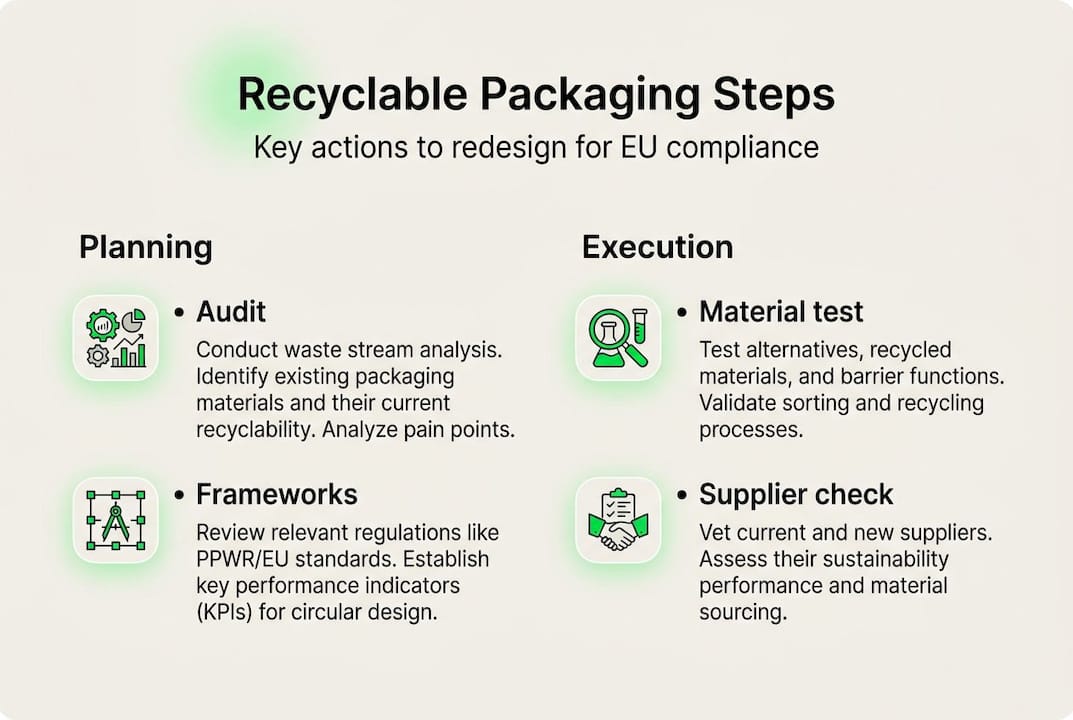
Execution is where most redesigns either succeed or stall. The key is treating it as an iterative process, not a one-time project. Here is a sequence that works:
- Run a holistic life-cycle assessment. Before changing anything, understand your current packaging’s environmental profile. This baseline tells you where the biggest impacts are and guides material decisions.
- Select a recyclable base material. PET, HDPE, and glass are the most compatible with existing EU sorting and recycling infrastructure. They are your safest starting point.
- Simplify the design. Minimize the number of materials, layers, and components. Every additional material type reduces recyclability. Reduce empty space where possible to lower transport emissions as a co-benefit.
- Review inks, adhesives, and labels. These are often overlooked but critical. Certain inks and adhesives contaminate recycling streams. Labels must either be made of the same material as the packaging or be designed to separate cleanly during the recycling process.
- Assess sortability. A package that is technically recyclable but cannot be sorted at a materials recovery facility is still a problem. Test your design against the sorting criteria used in your target markets.
- Validate through third-party testing. Use RecyClass, CPI, or PTS protocols to confirm real-world recyclability before launch.
“Recyclability is only meaningful if the packaging can actually be sorted and processed at scale. Design for the sorting line, not just the lab.”
Common pitfalls at this stage include using multi-material barriers that cannot be separated, choosing adhesives that are incompatible with the recycling stream, and skipping sortability testing because it feels redundant. It is not. Follow a structured ESG workflow for redesigns to keep decisions traceable and auditable. For broader guidance on material and process choices, packaging ESG best practices offer useful reference points.

Pro Tip: Involve your recycling infrastructure partners early. A quick conversation with a sorting facility operator can save months of redesign iteration.
Having outlined execution, we will now address common mistakes and advanced troubleshooting.
Troubleshooting and optimization: Avoiding common pitfalls
Even well-intentioned redesigns hit obstacles. Here are the five most common errors and how to address them.
- Over-complexity. Too many materials, components, or finishes. Simplify ruthlessly. If a design element does not serve a functional purpose, remove it.
- Hard-to-remove components. Caps, sleeves, and closures made from different materials than the primary packaging create sorting problems. Design them to separate easily or use the same material.
- Misaligned materials. Choosing a material that is technically recyclable but incompatible with the collection infrastructure in your target market. Always check local sorting capabilities.
- Ignoring sortability. Sortability is more important than lab recyclability in real-world conditions. A package that cannot be identified and sorted correctly by automated systems will not be recycled, regardless of its material composition.
- Lack of iterative testing. Treating validation as a final step rather than an ongoing process. Test early, test often, and update your design based on results.
Digital watermarks are an emerging tool worth knowing about. They embed invisible machine-readable codes into packaging that sorting systems can detect, improving identification accuracy and routing. Several major European brands are already piloting this technology.
“Mono-materials are essential for flexible packaging recyclability, even when they create barrier performance challenges that require engineering solutions.”
On the broader sustainability picture, it is worth noting that recycling alone is insufficient for true circularity. Material degradation limits the number of times polymers can be recycled, and loop losses mean not all material re-enters the system. Pairing recyclability redesign with material reduction and reuse strategies produces far better environmental outcomes. Your carbon reduction checklist is a useful companion tool here, helping you track the combined impact of redesign decisions.
You can also draw inspiration from real-world eco-friendly packaging examples to see how brands in adjacent sectors are solving similar challenges.
With pitfalls in mind, let us finish by reviewing how to verify recyclability claims and iterate continuously.
Validating recyclability: Testing, benchmarking, and continuous improvement
Validation is not the end of the process. It is the beginning of your continuous improvement cycle. Here is how to approach it systematically.
- Run third-party protocol testing. RecyClass, CPI, and PTS protocols are the recognized standards for EU recyclability validation. Each tests different aspects of real-world recyclability, from material compatibility to sorting performance.
- Benchmark against PPWR grades. Once you have test results, map them to the A, B, C grading system. Know where you stand before regulators assess you.
- Align with national schemes. The Austria Circular Packaging Design Guideline is one example of a national framework that goes beyond EU minimums. If you operate in multiple markets, align with the most stringent applicable standard.
- Reassess with LCA after each major design change. A full LCA review after validation confirms that recyclability improvements did not create unintended trade-offs elsewhere in the life cycle.
- Build a feedback loop. Set annual review cycles. Track EPR fee changes, PPWR grade updates, and new material certifications. Recyclability standards will tighten, and your packaging strategy needs to evolve with them.
| Validation method | What it confirms | Frequency |
|---|---|---|
| RecyClass testing | EU recyclability grade | Per design change |
| CPI/PTS protocols | Real-world processing compatibility | Per design change |
| LCA reassessment | Full environmental trade-off profile | Annually or post-redesign |
| PPWR grade benchmarking | Regulatory compliance status | Annually |
The companies that treat validation as a living process rather than a one-time checkbox are the ones that consistently stay ahead of regulatory changes and maintain their EPR cost advantage.
Having completed the technical process, it is time to reflect on lessons learned and common misconceptions.
Why recycling alone isn’t enough: The overlooked strategies for lasting improvement
Here is something we see often: companies invest significant resources in achieving Grade A recyclability, then declare their packaging sustainable. We understand the logic. The regulation rewards it. Customers notice it. But it is an incomplete picture, and we think it is worth saying plainly.
Reduction and reuse outperform recycling in nearly every LCA comparison. Material degradation means polymers lose quality with each recycling loop, and a meaningful percentage of material never re-enters the system at all. Perfect recyclability on paper does not equal a closed loop in practice.
The most forward-thinking European firms we work with use life cycle impact analysis as a decision tool across all three strategies simultaneously: reduce first, design for reuse where feasible, and then optimize for recyclability. That sequence produces better environmental outcomes and, increasingly, better business outcomes too. Regulatory frameworks will catch up to this logic. The companies building that capability now will not be scrambling later.
How ECONOS helps you achieve compliance and beyond
Packaging redesign for recyclability is a technical, regulatory, and strategic challenge. Getting it right requires more than a checklist.
At ECONOS, we support packaging and sustainability managers through life cycle assessment services that give you a clear, defensible baseline before any redesign begins. We help you interpret PPWR requirements, benchmark your packaging against A-C grades, and build internal capacity so your team owns the process rather than depending on external consultants. Our ESG compliance support connects packaging decisions to your broader reporting obligations under CSRD and ESRS. And our carbon footprint assessment work ensures that material changes translate into measurable emissions reductions you can report with confidence.
Frequently asked questions
What packaging materials are easiest to redesign for EU recyclability?
Mono-materials like PET, HDPE, or glass are the easiest to adapt for recyclability and meet most EU standards because they are compatible with existing sorting and processing infrastructure.
Do I have to achieve Grade A recyclability for legal compliance?
No. EU PPWR accepts grades A, B, and C, but higher grades reduce your EPR fees and strengthen your sustainability reporting metrics.
How do I test whether my new packaging is truly recyclable?
Validate through recognized third-party protocols. RecyClass, CPI, and PTS testing confirm real-world recyclability rather than theoretical material compatibility alone.
Why isn’t recycling alone enough for sustainability leadership?
Reduction and reuse deliver greater impact than recycling in most LCA comparisons, and material degradation means recycling loops are never perfectly closed, so relying on recyclability alone leaves significant environmental value on the table.
Recommended
- Carbon footprint reduction checklist for companies
- Carbon footprint reduction checklist for companies
- How to avoid greenwashing in corporate sustainability: A guide for business leaders
- How to build an effective ESG workflow for manufacturers
- 5 Eco-Friendly Packaging Options for Freeze-Dried Dog Food
- Eco-Friendly & Biodegradable Bubble Wrap Rolls