
.png)

TL;DR:
- Life Cycle Assessment is now a crucial strategic tool for CFOs to meet EU and Romanian sustainability regulations.
- LCA supports regulatory compliance, green financing, risk mitigation, and long-term value creation.
- Early pilot projects, supplier engagement, and internal capacity building are key to successful LCA implementation.
Sustainability reporting used to live in the engineering department. CFOs signed off on the budget and moved on. That model is over. Under CSRD, ESRS, and EU Taxonomy rules now taking hold across Romania and the EU, Life Cycle Assessment (LCA) has moved from a technical footnote to a board-level financial tool. If you are responsible for capital allocation, risk exposure, or financing strategy, LCA is no longer someone else’s problem. This guide explains what LCA actually means for your role, where it sits inside your compliance obligations, and how the smartest finance leaders are already using it to unlock better financing terms and lower risk profiles.
Table of Contents
- What is Life Cycle Assessment (LCA) and why CFOs should care
- LCA and regulatory compliance: CSRD, ESRS, and the EU Taxonomy in Romania and EU
- From compliance to value creation: Using LCA for green financing and strategic decisions
- Common LCA implementation challenges and expert tips for CFOs
- Why most CFOs underestimate LCA and what actually drives success
- How ECONOS helps CFOs master LCA and compliance
- Frequently asked questions
Key Takeaways
| Point | Details |
|---|---|
| LCA is strategic for CFOs | Life Cycle Assessment drives compliance, financing, and competitive advantage for finance leaders in Romania and the EU. |
| Regulatory alignment is urgent | CSRD and ESRS mandate LCA for thousands of Romanian companies, with phased deadlines through 2028. |
| LCA informs better financial decisions | CFOs use LCA data to secure ESG-linked funding and optimize capex investments. |
| Getting Scope 3 data right matters | Addressing value chain impacts is essential for both reporting accuracy and strategic sustainability. |
What is Life Cycle Assessment (LCA) and why CFOs should care
LCA is a structured method for measuring the environmental impacts of a product, process, or service across its entire life. The key term you will hear most often is cradle-to-gate, which covers environmental impact from raw material extraction up to the factory gate. Cradle-to-grave goes further, tracking impacts all the way through use and end-of-life disposal. Both approaches matter for your reporting obligations, but the boundary you choose changes what data you need and how much it costs to collect.
For CFOs, the connection to finance is direct. LCA data supports CSRD compliance, EU Taxonomy eligibility assessments, and Scope 3 emissions quantification, which covers indirect emissions across your value chain. These are not abstract concerns.
“LCA is essential for CSRD/ESRS compliance, EU Taxonomy alignment, Scope 3 accounting, and positioning for green financing.”
Here is what LCA connects to in your financial world:
- Regulatory compliance: CSRD and ESRS require double materiality assessments, meaning you must measure your impact on the environment, not just the environment’s impact on your business. LCA gives you the data to do that.
- EU Taxonomy alignment: To qualify activities as environmentally sustainable, you need evidence. LCA provides it.
- Capital access: Green loans, sustainability-linked bonds, and ESG-rated instruments increasingly require verified environmental impact data. LCA is the methodology behind that verification.
- Risk and net present value (NPV): Carbon pricing, supply chain disruption, and stranded asset risk all tie back to life cycle impact. Modeling these early improves your NPV calculations.
- Romanian specifics: CSRD has been transposed into Romanian law, bringing thousands of local companies into scope faster than many expected.
LCA is not a cost center. Positioned correctly, it is a framework that makes your investment and financing decisions more defensible, more credible, and more competitive.
LCA and regulatory compliance: CSRD, ESRS, and the EU Taxonomy in Romania and EU
With the basics covered, let’s break down exactly where LCA sits inside your compliance roadmap, from CSRD to ESRS and the EU Taxonomy.
Romania transposed CSRD through Order 85/2024 and subsequent updates, affecting approximately 5,300 Romanian companies, with phased deadlines extending to 2028 for smaller entities. That gives many mid-size companies a runway, but not a pass. The companies that start now will be in a far stronger position than those scrambling in 2027.
Here is a simplified overview of which companies face which requirements:
| Company type | Threshold | Reporting deadline |
|---|---|---|
| Large PIEs (public interest entities) | Over 500 employees | 2025 (reporting on 2024) |
| Large non-PIE companies | Over 250 employees or €40M turnover | 2026 (reporting on 2025) |
| Listed SMEs and others | Over 50 employees or RON 50M turnover | Up to 2028 |
Under ESRS standards, the environmental topics most reliant on LCA data include climate change (ESRS E1), resource use and circular economy (ESRS E5), and pollution (ESRS E2). Each of these standards requires value chain data, which LCA is specifically designed to produce.
Here are the practical steps CFOs can start with now:
- Map your material topics. Run a double materiality assessment to identify which environmental impacts are financially significant for your business.
- Define your LCA boundary. Decide whether you need cradle-to-gate or cradle-to-grave depending on which ESRS topics are material.
- Audit your data sources. Identify where your Scope 3 data gaps are, particularly upstream in your supply chain.
- Align LCA outputs with EU Taxonomy criteria. Each activity you want classified as sustainable needs technical screening evidence, and LCA often provides it.
- Start with a pilot. Choose one product line or facility and run a preliminary LCA. Use it to build internal capability before scaling.
Pro Tip: The delay to 2028 for some Romanian companies is not a reason to wait. CSRD requirements are already influencing supplier selection by large EU clients. If your buyers are already CSRD-reporting, they will ask you for LCA data sooner than your own deadline requires.
Also note that LCA for regulatory compliance is not a one-time exercise. Regulations evolve, and your LCA methodology needs to evolve with them.
From compliance to value creation: Using LCA for green financing and strategic decisions
Effective compliance is a foundation, but the real advantage comes when LCA drives both your financial and ESG performance strategies.
Green loans and sustainability-linked bonds now represent a significant share of new debt financing in the EU. Banks and investors price these instruments based on verified environmental credentials. LCA data is one of the most credible inputs you can provide. It shows not just that you are committed to reducing impact, but that you have measured it rigorously and can track progress over time.

Real-world examples show what this looks like in practice. Aurubis published a detailed LCA for tin production, using the data to benchmark environmental performance and support product-level sustainability claims. ELIX Polymers used LCA to demonstrate the carbon advantages of recycled ABS plastic versus virgin material, directly supporting ESG-linked commercial positioning. Eurobitume has applied LCA to bitumen products to support Environmental Product Declarations (EPDs), a tool increasingly required in construction procurement.
For CFOs, the financial logic works like this:
| Decision type | Traditional approach | LCA-driven approach |
|---|---|---|
| Capex approval | ROI and payback period only | ROI plus carbon cost, stranded asset risk, and Taxonomy eligibility |
| Supplier selection | Price and quality | Price, quality, and Scope 3 impact |
| Financing structure | Standard debt or equity | Green or sustainability-linked instruments at favorable rates |
| Risk assessment | Market and credit risk | Market, credit, and transition risk (carbon pricing, regulatory) |
Statistic to note: Life cycle cost analysis integrated with LCA links environmental impacts directly to costs, risks, and NPV, giving CFOs a single framework for both financial and environmental decision-making.
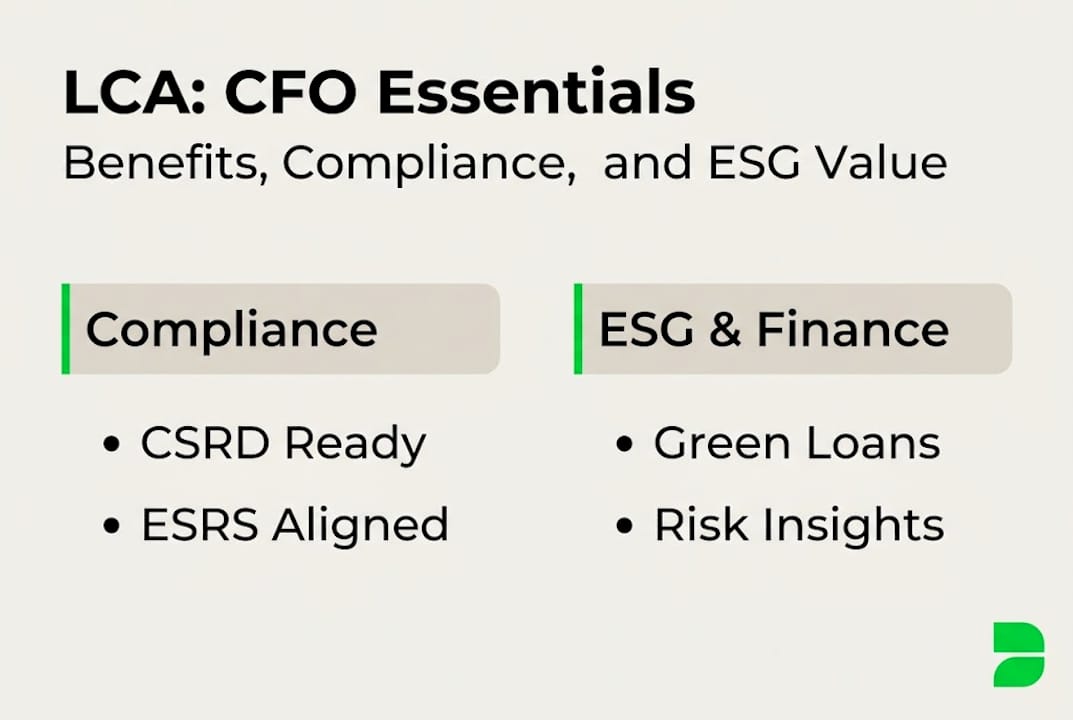
Pro Tip: When presenting LCA findings to your board or to lenders, frame it in NPV terms. A reduction in carbon intensity translates to reduced exposure to future carbon pricing. That is a quantifiable financial benefit, not a soft sustainability claim.
Connecting Scope 3 emissions strategies to your LCA work also helps prioritize which suppliers and processes to address first, directing capex where it creates the most measurable return.
Common LCA implementation challenges and expert tips for CFOs
To translate LCA’s promise into real-world success, CFOs must tackle the practical barriers head-on. Here’s what you need to know.
The single biggest obstacle is upstream data. Scope 3 emissions, which cover purchased goods, logistics, and supplier activities, account for the majority of environmental impact in most value chains. Yet this data is exactly what suppliers are least prepared to provide. Companies preparing for CSRD in Romania consistently identify Scope 3 data gaps as the primary LCA implementation hurdle, reinforcing why prioritizing cradle-to-gate LCAs and using phased deadlines strategically is so important.
Here are the most common challenges CFOs encounter:
- Data gaps from suppliers: Most Romanian SME suppliers do not yet track key environmental indicators like carbon intensity or energy consumption per unit. You will need to use proxy data initially and build toward primary data over time.
- Internal complexity: LCA involves cross-functional input from procurement, operations, logistics, and finance. Without CFO-level sponsorship, data collection stalls.
- Calculation methodology: ISO 14040 and ISO 14044 govern LCA methodology. Getting this wrong creates credibility risk, especially if you are using LCA to support financing claims.
- Supplier engagement: Asking suppliers for environmental data is a relationship management challenge, not just a technical one. Timing, framing, and incentives all matter.
Actionable steps for CFOs:
- Start with a pilot on your highest-impact product or process. A focused cradle-to-gate LCA produces usable data faster than trying to cover everything at once.
- Use the delay to 2028 to build internal capacity. Invest in Scope 3 reporting capability now so that your team owns the process rather than depending entirely on external consultants.
- Engage suppliers early. Frame data requests as partnership rather than compliance pressure. Supplier readiness is a shared challenge across most Romanian and EU value chains right now.
- Work with credible partners who follow ISO standards and can produce LCA results that will hold up to third-party verification.
Pro Tip: Do not let perfect be the enemy of useful. An LCA using secondary or proxy data is still better than no LCA for initial compliance and financing conversations. Upgrade to primary data as supplier relationships mature.
Why most CFOs underestimate LCA and what actually drives success
Here is the honest observation: most CFOs we speak with see LCA as a technical deliverable. Something to commission, receive, file, and report. That framing is understandable, but it is also the reason so many companies get so little value from the exercise.
The CFOs who actually get ahead with LCA are the ones who treat it as a strategic input, not a compliance output. They ask: which environmental impacts are creating financial exposure for us? Where in our value chain are we most vulnerable to carbon pricing or regulatory tightening? Which product lines have the strongest environmental story to tell to lenders?
Building LCA into your sustainability strategy requires CFO-led cross-silo coordination. Engineering, procurement, and finance must be aligned on what data matters and why. When that alignment exists, LCA data becomes a living management tool, not a static report.
The pitfall is treating LCA as a box to tick. The lesson, learned from working across 17 industries, is that material impact, credible benchmarks, and board-level ownership are the three things that separate companies that genuinely benefit from LCA and those that just technically comply.
How ECONOS helps CFOs master LCA and compliance
For finance leaders ready to move from understanding to action, expert partnership makes the difference.
At ECONOS, we work with CFOs and finance directors at mid-size and large companies across Romania and the EU to turn LCA from a compliance obligation into a genuine strategic asset.
Our LCA consulting services are built on ISO-compliant methodology, industry benchmarks, and a training-first model that builds internal capability in your team rather than creating dependency on us. We also support ESG reporting under CSRD and ESRS, and help companies assess and document EU Taxonomy alignment for financing purposes. If you want to understand your starting point and build a realistic roadmap, let’s talk.
Frequently asked questions
What is Life Cycle Assessment (LCA) and why is it critical for CFOs?
LCA measures the environmental impacts of products or processes across their full life cycle, helping CFOs comply with CSRD/ESRS, qualify for EU Taxonomy financing, and manage long-term regulatory and transition risk.
Which companies in Romania must comply with LCA reporting under the CSRD?
Romanian firms above certain size thresholds, including those with over 50 employees or RON 50 million in turnover, must conduct LCA for CSRD, with phased deadlines to 2028 for smaller entities.
How does LCA enable green or ESG-linked financing?
CFOs use LCA to provide credible, ISO-verified impact data that banks and investors require for green loans and sustainability-linked bonds, with LCA linked directly to costs, risks, and NPV in financing discussions.
What are common mistakes in implementing LCA in finance teams?
The most common mistakes include underestimating Scope 3 data gaps, delegating LCA entirely to technical teams, and ignoring material value chain impacts. Prioritizing Scope 3 and using phased deadlines strategically helps avoid these traps.
Recommended
- LCA’s role in building effective sustainability strategies
- How LCA drives regulatory compliance: Key facts
- ESG Reporting
- Unlock sustainable business value with CSRD compliance
- Financial Consulting Services | Tax Strategy & IRS Expertise
- Your guide to sustainable growth: balanced, profitable, responsible – Starfireblast