
.png)

TL;DR:
- HR audits are systematic reviews of a company’s policies to ensure legal compliance and operational efficiency. They involve seven key steps, including scope definition, documentation gathering, checklist creation, review, gap analysis, prioritization, and remediation planning. Regular, documented audits help organizations identify risks, implement timely improvements, and prevent compliance failures.
The HR auditing process is a formal, systematic evaluation of a company’s HR policies, procedures, and documentation to verify legal compliance and operational efficiency. Also called a human resources audit or HR compliance review, it covers functions from recruitment and compensation to health and safety and employee relations. Tools like HR audit checklists from FirstHR and HRBP Online give teams a structured starting point. For small firms with 15–30 employees, the process takes 8–16 hours over 1–2 weeks. Mid-size companies typically need 4–12 weeks, though quick wins are achievable within seven days.
What are the seven essential steps in the HR auditing process?
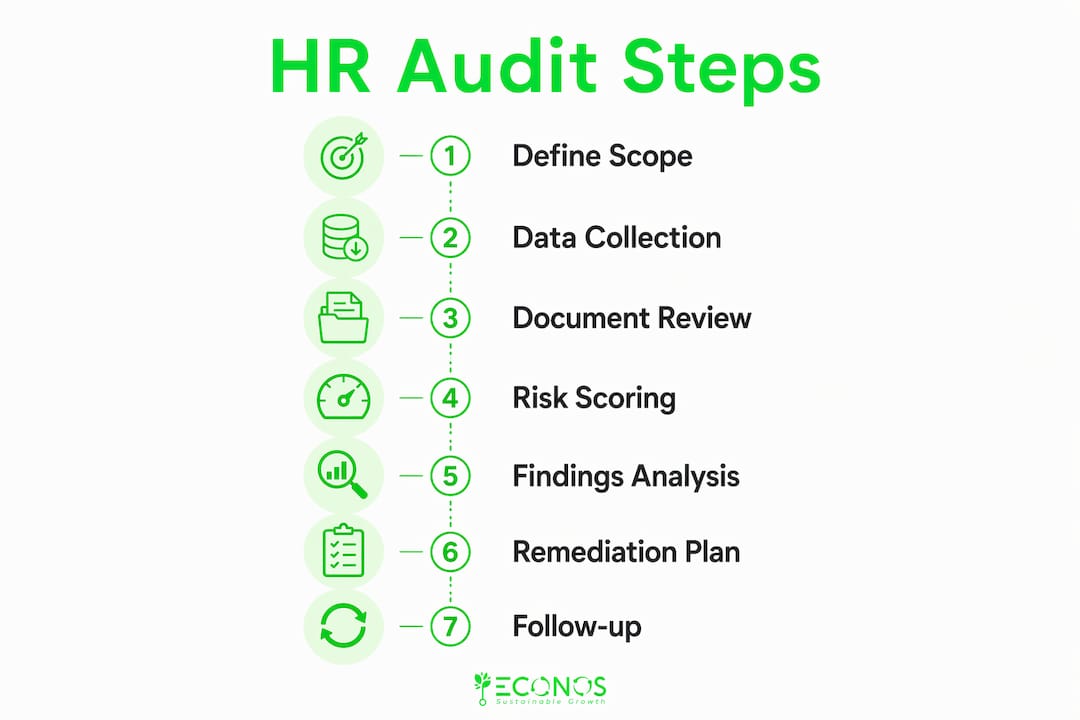
The seven-step HR audit framework defines the gold standard for conducting a thorough compliance review. Each step builds on the last, moving from planning through documentation to remediation. Skipping steps is the most common reason audits fail to produce lasting change.
-
Define scope. Decide which HR functions you are auditing: all of them, or a targeted subset like compensation and I-9 compliance. A focused scope prevents scope creep and keeps timelines realistic.
-
Gather documents. Collect employee files, policy manuals, job descriptions, benefits records, and training logs. Missing documents at this stage are themselves a compliance finding.
-
Build your checklist. Cross-reference current federal, state, and local laws to create an HR audit checklist that reflects your actual legal obligations. Resources like the HRBP Online checklist template and FirstHR’s audit guide are reliable starting points for this step.
-
Review against the checklist. Assign reviewers to each functional area and work through the checklist systematically. Document every finding, including what is compliant, not just what is not.
-
Identify and score gaps. Rate each gap by legal risk and operational impact. A missing I-9 form carries a different risk weight than an outdated performance review template.
-
Prioritize findings by legal impact. Rank gaps from highest to lowest legal exposure. This step determines where your remediation resources go first and prevents teams from spending time on low-risk items while urgent violations sit unaddressed.
-
Create a remediation plan with owners and deadlines. Assign a named owner to every finding. Set a deadline. Without accountability, audit findings become a list that no one acts on.
Pro Tip: Inform managers and staff before data collection begins. Pre-audit communication reduces anxiety, increases cooperation, and improves the quality of the data you receive.
Which core HR areas should a full audit cover?
A complete HR assessment process examines seven functional areas. Each carries distinct legal risks and operational consequences when gaps go unaddressed.
| Functional Area | Documentation Reviewed | Primary Legal Risks | Operational Benefit of Compliance |
|---|---|---|---|
| Staffing and Recruitment | Job postings, interview notes, I-9 forms | EEOC violations, I-9 penalties | Faster, fairer hiring with reduced turnover |
| Compensation and Benefits | Pay scales, benefits enrollment, FLSA records | Pay equity violations, FLSA non-compliance | Reduced wage claims and improved retention |
| Training and Development | Training logs, certifications, completion records | OSHA training gaps, negligent hiring liability | Higher workforce competency and safety |
| Employee Relations | Complaint logs, investigation records, disciplinary files | Wrongful termination, harassment liability | Stronger workplace culture and lower litigation risk |
| Performance Management | Review forms, goal records, PIP documentation | Discrimination claims tied to inconsistent reviews | Clearer accountability and development paths |
| Health and Safety | OSHA logs, incident reports, safety training records | OSHA citations, workers’ compensation exposure | Fewer injuries and lower insurance costs |
| Documentation and Compliance | Policy handbooks, signed acknowledgments, audit trails | Recordkeeping violations across multiple statutes | Audit-ready status and reduced regulatory exposure |
Starting with high-risk, low-complexity items like I-9 forms achieves early quick wins that build internal momentum for more demanding audit phases. This is not just a morale strategy. It is a resource allocation decision. Teams that demonstrate early results earn the organizational support needed to tackle harder areas like compensation equity analysis.
Pro Tip: Use an EHS auditing framework as a structural reference when building your health and safety audit section. The compliance checklist logic transfers directly.
How do you prioritize findings and build a remediation plan?
Effective remediation starts with honest risk categorization. Not every gap carries the same urgency, and treating them equally wastes time and goodwill.
Remediation plans categorize findings by two primary risk thresholds:
- Threshold 1: Immediate corrections required. These are findings involving unlawful conduct, active employee harm, or direct regulatory violations. Examples include missing I-9 forms for current employees, unpaid overtime violations under the FLSA, or undocumented workplace injuries. These items cannot wait for a planning cycle.
- Threshold 2: Scheduled corrections within 30–90 days. These cover recordkeeping gaps, outdated policy language, and non-urgent compliance updates. They matter, but they do not require stopping everything else.
Once findings are categorized, build a remediation playbook. Assign a named owner to each item, set a hard deadline, and schedule a follow-up review date. Ownership without a deadline is just a suggestion.
A 30/60/90-day roadmap keeps remediation on track. At 30 days, all Threshold 1 items should be resolved. At 60 days, Threshold 2 documentation updates should be complete. At 90 days, conduct a follow-up review to confirm no findings have recurred and that policy changes have been communicated to staff.

Pro Tip: Treat the audit as a repeatable project with documented steps, not a one-time event. When the process is written down and assigned, it scales. When it lives only in one person’s head, it disappears when they do.
Tracking progress in a shared document or compliance platform keeps all stakeholders aligned. A simple spreadsheet with columns for finding, owner, deadline, status, and resolution date is enough for most mid-size companies. The goal is visibility, not complexity.
What are the best practices and common pitfalls in HR audits?
The difference between an audit that changes behavior and one that produces a report nobody reads comes down to how the process is designed and communicated.
A hybrid audit model combining internal routine monitoring with periodic external review is the most effective approach for growing companies. Internal teams know the organization. External reviewers bring objectivity and catch blind spots that familiarity creates. Neither alone is sufficient.
Key best practices that separate high-impact audits from compliance theater:
- Communicate before you collect. Stakeholder buy-in starts before the first document request. Explain the audit’s purpose, scope, and timeline to managers and employees in advance. Resistance drops when people understand what is happening and why.
- Time audits strategically. Auditing during seasonal workforce transitions, such as in May before summer hiring ramps up, surfaces bottlenecks before they become expensive problems. Reactive audits after a complaint or inspection are always more costly than proactive ones.
- Document the process, not just the findings. Documenting the audit process itself is what transforms a one-time review into a repeatable compliance program. Future audit teams should be able to replicate your process from your documentation alone.
- Avoid one-off audits. A single audit is a snapshot. Compliance is a moving target as laws change, workforces grow, and business models shift. Build a schedule: annual full audits with quarterly spot checks on high-risk areas.
- Use templates to reduce inconsistency. A standardized compliance reporting checklist reduces the risk of reviewers applying different standards to the same type of finding. Consistency in the audit produces consistency in the results.
The most common pitfall is treating the audit as a destination rather than a discipline. Organizations that audit once after a scare, then wait for the next scare, never build the compliance maturity that protects them from serious exposure.
Why HR audits belong in your organizational strategy, not just your compliance calendar
The most honest thing I can say about HR audits is this: most organizations do them wrong, not because they lack the tools, but because they treat them as a legal obligation rather than a management tool.
I have seen companies invest weeks in a thorough audit, produce a detailed findings report, and then file it. No remediation plan. No owners. No follow-up. The audit becomes evidence of effort rather than a driver of change. That is a failure of organizational will, not process.
What actually works is treating the audit as a continuous improvement cycle. The first audit establishes your baseline. The second one measures progress. By the third, you start seeing patterns: the same gaps recurring in the same departments, which tells you something important about management behavior, not just documentation.
Early quick wins matter more than most HR professionals admit. Resolving I-9 gaps in week one is not just a compliance fix. It signals to leadership that the audit produces results, which builds the political capital you need to tackle harder conversations about pay equity or performance management consistency.
Transparency with employees during the process also changes the outcome. When people understand that the audit protects them as much as the company, cooperation improves and data quality rises. That is not idealism. It is practical audit design.
The data-driven risk scoring approach, where you rank findings by legal exposure and operational impact, is the single most useful tool for focusing limited HR resources. Not every gap is a crisis. Knowing which ones are lets you act with precision rather than panic.
— Mathieu
How Econos-esg supports your compliance and reporting goals
Compliance does not stop at HR. For mid-size and large companies, HR audit findings often connect directly to broader organizational risks: labor practices, supply chain accountability, and ESG reporting obligations under frameworks like CSRD and ESRS.

Econos-esg works with companies like Michelin, eMAG, and Raiffeisen Bank to build internal compliance capacity across sustainability and reporting functions. The same discipline that makes an HR audit effective, clear scope, documented process, assigned ownership, applies directly to ESG reporting and regulatory compliance. If your organization is working through compliance gaps on multiple fronts, Econos-esg’s practical, training-first approach helps your team understand what they are doing and why, not just what to submit.
Key takeaways
A well-executed HR auditing process is a structured, risk-prioritized review that produces a remediation plan with named owners, hard deadlines, and a 30/60/90-day follow-up schedule.
| Point | Details |
|---|---|
| Seven-step framework | Follow the defined scope, gather, checklist, review, score, prioritize, and remediate sequence for every audit. |
| Timeline by company size | Small firms complete audits in 8–16 hours; mid-size companies need 4–12 weeks with quick wins in seven days. |
| Risk threshold categorization | Separate Threshold 1 urgent violations from Threshold 2 policy updates to allocate remediation resources correctly. |
| Hybrid audit model | Combine internal monitoring with periodic external review to eliminate bias and catch compliance blind spots. |
| Repeatable process beats one-off reviews | Document the audit process itself so compliance maturity scales across teams and audit cycles. |
FAQ
What is the HR auditing process?
The HR auditing process is a systematic review of a company’s HR policies, procedures, and documentation to verify legal compliance and operational effectiveness. It covers areas including recruitment, compensation, training, employee relations, performance management, health and safety, and recordkeeping.
How long does an HR compliance audit take?
Small firms with 15–30 employees typically complete an HR audit in 8–16 hours over 1–2 weeks. Mid-size companies generally need 4–12 weeks, with initial quick wins achievable within seven days.
What should an HR audit checklist include?
An HR audit checklist should cover all seven functional areas: staffing and recruitment, compensation and benefits, training and development, employee relations, performance management, health and safety, and documentation compliance. Each section should reference the specific federal, state, and local laws that apply to your organization.
How do you prioritize HR audit findings?
Categorize findings by risk threshold: Threshold 1 covers immediate legal violations requiring urgent correction, while Threshold 2 covers recordkeeping gaps and policy updates that can be scheduled within 30–90 days.
How often should a company conduct an HR audit?
Most HR experts recommend annual full audits combined with quarterly spot checks on high-risk areas. Treating audits as repeatable, documented projects rather than one-time events is what builds sustainable compliance maturity over time.