
.png)

TL;DR:
- Building internal ESG capacity through targeted upskilling ensures compliance and embeds sustainability into daily operations. Conducting regular assessments, designing modular training, and establishing cross-functional governance structures foster ongoing maturity and competitive advantage. Practical integration and continuous improvement are essential for long-term success in environmental and social reporting.
Many sustainability managers at mid-sized and large companies face a familiar frustration: they have compliance deadlines closing in, a small team stretched thin, and a growing stack of regulatory requirements from CSRD/ESRS, EcoVadis, EU Taxonomy, and more. Hiring more specialists sounds like the answer, but it rarely solves the underlying problem. What actually works is building real internal capacity, where your existing team understands the material, owns the process, and can operate without constant external hand-holding. This guide walks you through a practical, step-by-step path to making that happen.
Table of Contents
- Assessing current capacity and compliance requirements
- Designing a modular and practical training curriculum
- Integrating sustainability training into existing business processes
- Establishing governance and building cross-functional ESG teams
- Verifying training effectiveness and driving continuous improvement
- Beyond compliance: Why sustainability training is your competitive edge
- How ECONOS helps accelerate ESG team transformation
- Frequently asked questions
Key Takeaways
| Point | Details |
|---|---|
| Start with a skills audit | Audit your current ESG capacity and compliance gaps before building a training program. |
| Use modular training | Modular, exercise-driven training delivers better internal skills and regulatory readiness. |
| Integrate training with business processes | Embed sustainability skills into daily workflows for lasting cultural and operational change. |
| Governance and cross-functional teams matter | Hub-and-spoke structures and collaboration across functions ensure audit-ready reporting and compliance. |
| Commit to ongoing updates | Frequent review and adaptation keep your ESG training current and effective. |
Assessing current capacity and compliance requirements
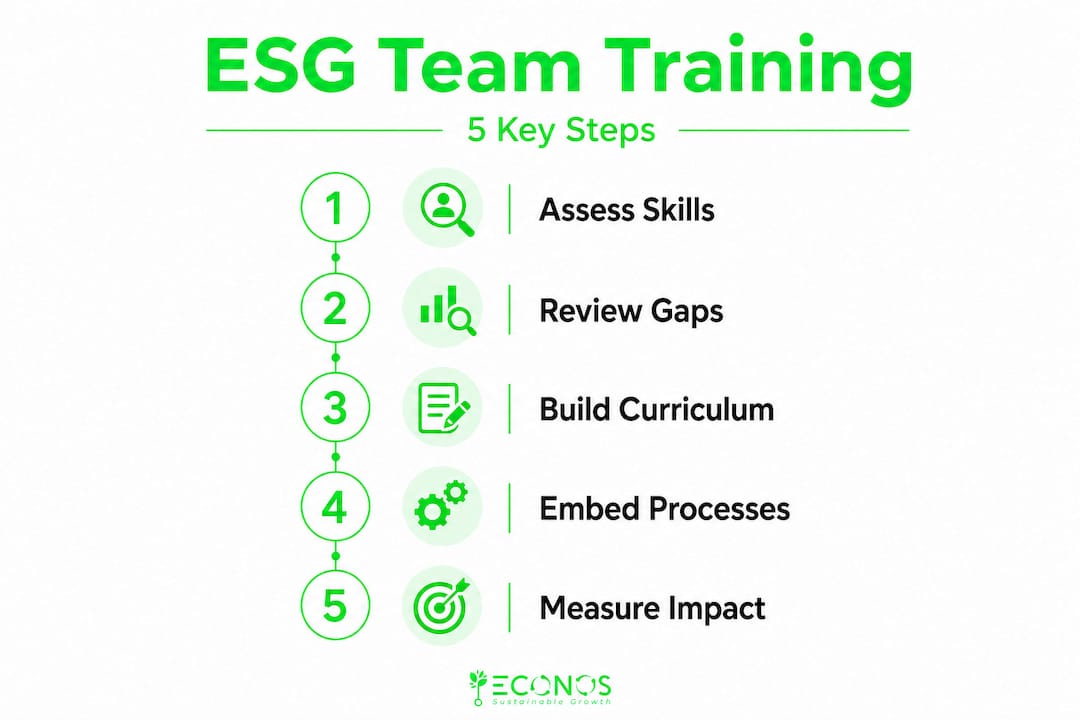
Understanding what you have is the first step to any effective upskilling process. Before designing a single training module, you need an honest picture of your team’s current knowledge, the regulatory obligations driving your work, and where the gaps actually are.
A skills audit and legal gap review come first for a reason. Many teams have pockets of strong knowledge sitting in one department while critical gaps exist in another. Finance might understand disclosure obligations but lack carbon accounting skills. Operations might track energy data but have no idea what double materiality means. Without mapping these gaps explicitly, training efforts scatter.
The regulatory landscape for companies in Romania and France is increasingly specific. CSRD and ESRS set the reporting architecture for both markets. French companies face the AFEP-MEDEF Code’s governance expectations and DPEF obligations. Romanian companies are increasingly engaging with EcoVadis ratings and local upskilling programs like the CES ESG Institute. Understanding your exact compliance drivers allows you to prioritize what your team needs to learn first.
Here is a summary of core competency areas, common compliance drivers, and typical gaps seen in Romanian and French mid-sized companies:
| Competency area | Compliance driver | Common gap |
|---|---|---|
| Carbon accounting (Scope 1, 2, 3) | CSRD/ESRS, EcoVadis | Scope 3 data collection |
| Double materiality assessment | ESRS 1, CSRD | Methodology and stakeholder mapping |
| ESG data governance | CSRD, EU Taxonomy | Audit trails and data quality |
| Supplier engagement | EcoVadis, ESRS G1 | Capacity to assess supply chain |
| Board-level reporting | AFEP-MEDEF Code, CSRD | Framing ESG for non-specialists |
| Sustainability development essentials | General ESG literacy | Terminology and strategic framing |
Corporate sustainability teams benefit most from embedding skills through upskilling rather than just hiring, because knowledge that lives inside the organization is far more durable than expertise rented from outside.
Pro Tip: Engage each functional head (finance, procurement, operations, HR, IT) in the skills audit. They will surface knowledge gaps you would never find by talking only to the sustainability team.
Designing a modular and practical training curriculum
Once you know your gaps, building the right curriculum is your next move. A modular design is not just a nice feature. It is a practical necessity. Different roles need different depth on different topics, and a one-size-fits-all program will lose most of your audience quickly.
Teams need flexible, exercise-driven modular training to genuinely master ESRS and CSRD skills. That means the curriculum should be built around real tasks your team already performs, not abstract theory.
Here are the five core modules every corporate ESG curriculum should include:
- Governance clarity. Who owns what, who approves what, and how decisions flow. This eliminates the constant confusion over accountability that slows most ESG programs down.
- Double materiality methodology. How to identify material ESG topics from both a financial risk and an impact perspective, using the ESRS framework as a guide.
- Compliance data practices. How to collect, validate, and store ESG data in a way that holds up to external audit. This includes understanding data lineage and documentation requirements.
- Process integration. How ESG responsibilities connect to existing business workflows, procurement cycles, and reporting calendars.
- Value chain and supplier training. How to extend ESG expectations into the supply chain, including practical tools for supplier assessment and capacity building.
For curriculum development, follow this process:
- Set learning objectives tied to specific compliance outcomes, not vague awareness goals.
- Design each module around a real task or scenario your team will face in practice.
- Decide which content can come from internal subject matter experts and what requires external program input.
- Include practical exercises: live data exercises, case studies, peer review sessions.
- Run a pilot with a small cross-functional group before full rollout.
When choosing between off-the-shelf programs and custom modular content, consider this comparison:
| Feature | Off-the-shelf programs | Custom modular content |
|---|---|---|
| Cost | Lower upfront | Higher upfront, lower long-term |
| Relevance to your context | Generic | Directly mapped to your gaps |
| Engagement | Variable | High with local case studies |
| Update frequency | Provider-dependent | Controlled by your team |
| Regulatory specificity | General | Can be CSRD/ESRS specific |
CES ESG Institute in Romania delivers applied, local case-based ESG training that bridges the gap between generic frameworks and the practical realities Romanian companies face. For corporate ESG upskilling, combining a structured external framework with locally customized content tends to produce the best results.
Pro Tip: Use local case studies from your own industry whenever possible. A packaging company in Bucharest will retain far more from a case involving a Romanian manufacturer than from a generic European example. Check your ESRS compliance approach for Romania and France to identify the most relevant local examples.
Integrating sustainability training into existing business processes
With a curriculum in place, teams must now weave these new skills into their daily operations for long-term impact. Training that lives only in a classroom or an online module rarely survives contact with the real work environment. The goal is to make ESG knowledge part of how your team already thinks and acts.

Embedding sustainability skills into business processes consistently outperforms reliance on new hires because it distributes ownership and makes compliance a team capability, not a single person’s responsibility.
Here are practical strategies to embed training into day-to-day operations:
- Onboarding integration. Add ESG fundamentals to the onboarding process for any role that touches data, procurement, finance, or operations. New employees learn the expectations before forming bad habits.
- Shadowing and mentoring. Pair less experienced team members with internal ESG leads for live projects. Watching how someone navigates a Scope 3 data collection challenge is worth more than ten hours of theory.
- Real data tasks. Use actual company data in training exercises. Ask the procurement team to calculate the carbon footprint of a real supplier category. The stakes make the learning stick.
- Feedback loops. After each reporting cycle, run a debrief session. What worked, what broke, what the team still does not understand. This converts reporting into a learning event.
- Performance review integration. Include ESG competency development as part of annual reviews for relevant roles. It signals that this is not a side project.
- Process update checkpoints. When a business process changes, such as a new procurement system or ERP upgrade, explicitly review what effective ESG workflows need to be maintained or redesigned.
Credible ESG strategy and reporting depend on robust data management, solid business modeling, and active change management. Without these foundations embedded in everyday processes, no training program can produce lasting results.
LCA methodology and ESG strategy integration offer a good example of this principle in action. Companies that train their product teams to understand life cycle thinking tend to make better procurement decisions naturally, without needing a consultant to review every choice.
Pro Tip: Pair every upskilling initiative with a process review. Ask the team to identify one existing workflow they can improve using their new knowledge within 30 days of training completion. This turns learning into doing immediately.
Establishing governance and building cross-functional ESG teams
Internalizing knowledge is only effective if governance and structure reinforce it. Without clear roles, decision rights, and cross-departmental ownership, ESG knowledge gets siloed back into the sustainability team and nothing really changes.
The hub-and-spoke model is widely used and genuinely effective. The central hub (usually the sustainability or ESG team) sets standards, manages frameworks, and ensures regulatory alignment. The spokes are designated ESG representatives in each business unit who own data collection, local reporting, and frontline decision-making within those standards.
Cross-functional hub-and-spoke models and board-level training are consistently identified as key success factors in CSRD implementation. The governance structure gives the training somewhere to land.
Here are the steps to set up a cross-functional ESG team structure:
- Establish the central hub. Define the core sustainability team’s mandate, reporting line, and accountability. Make it clear who has final sign-off on ESG disclosures.
- Appoint business unit spokes. Identify one ESG contact in each major function: procurement, finance, operations, HR, IT, and legal. These people do not need to be experts yet. They need to be willing to learn and to own their data.
- Set shared standards. Document a data dictionary, reporting calendar, and escalation process that every spoke uses. Consistency matters more than perfection at first.
- Build an internal audit process. Before external verification, run internal data quality checks that the spokes conduct and the hub reviews. This builds muscle memory for audit readiness.
| Team structure | Role | Key responsibilities |
|---|---|---|
| Central sustainability hub | Standards and strategy | Framework management, regulatory tracking, external reporting |
| Business unit spokes | Data ownership | Data collection, local compliance, supplier liaison |
| IT team | Data infrastructure | System integration, data quality tools, reporting platforms |
| Board/senior leadership | Governance and oversight | Approval of ESG strategy, public commitments, risk review |
AFEP-MEDEF Code governance expectations in France reinforce that sustainability governance is a board-level responsibility, not just a management function. French companies need to be especially deliberate about training directors and officers, not just operational teams. You can use your practical sustainability assessment process to identify where governance training is most needed at each level.
Pro Tip: Review governance training for all new board members and senior appointments. Build a short ESG orientation into your board onboarding process. This is also worth including in your broader ESG governance navigation roadmap.
Verifying training effectiveness and driving continuous improvement
Once structures are in place, ongoing measurement and improvement ensure lasting ESG maturity. Training that is not measured quickly becomes irrelevant. Verification is not about testing people. It is about knowing whether your investment is actually changing how your team performs.
A sustainable training program involves regular review, feedback, and adaptation, not just one-time execution. The companies that treat ESG training as a living program consistently outperform those that complete a training cycle and move on.
Practical verification methods include:
- Pre- and post-training surveys. Measure knowledge levels before and after each module. This gives you a clear signal of what landed and what missed.
- Compliance test scenarios. Run simulated CSRD audit scenarios or mock EcoVadis questionnaire reviews. See how the team performs under pressure before the real assessment arrives.
- Audit-readiness checks. Quarterly internal reviews of data completeness, documentation quality, and process adherence. These catch problems early and build team confidence.
- Supplier and vendor feedback. Ask key suppliers how they experience your ESG engagement. If they find your requests confusing or inconsistent, that is a signal your supply chain training needs work.
- Performance against ESG consultation feedback. Review recommendations from any external ESG review against actual team behavior. Are people applying what they learned?
Common pitfalls to avoid: neglecting curriculum updates when regulations change, over-relying on self-assessment rather than observable behavior, and measuring only training completion rates instead of actual outcomes. Completion rates tell you people sat through a module. They tell you nothing about whether the team can now handle a Scope 3 emissions calculation without help.
Pro Tip: Set quarterly review checkpoints with all team spokes. Treat these as short operational reviews, not performance evaluations. Ask what tools or knowledge they are still missing and update the curriculum accordingly.
Beyond compliance: Why sustainability training is your competitive edge
Now that you have the core how-to, it is worth considering the bigger picture. The companies we see struggling most with ESG are not the ones lacking policies. They are the ones with polished sustainability reports but teams that cannot explain or defend the numbers behind them.
There is a common assumption that once you have the right framework, the right disclosure software, and the right consultant on retainer, you are covered. We would push back on that directly. True ESG capability is not built in annual workshops or by outsourcing materiality assessments to a third party. It is forged in ongoing, cross-functional upskilling that connects real people to real decisions.
The companies that genuinely benefit from their ESG investment are the ones where a procurement manager in Cluj can explain why a supplier’s carbon intensity matters for their own CSRD disclosure. Where a finance director in Lyon understands how to read a double materiality matrix without needing a translator. That kind of capability does not come from compliance checklists. It comes from training embedded in the fabric of how the organization works.
There is also a competitive angle worth taking seriously. As ESG data quality becomes a factor in supply chain selection, financing conditions, and customer trust, the companies with internally owned, audit-ready ESG programs will consistently outperform those dependent on external consultants for every update. Internal maturity builds trust faster than any external rating alone. You can review how effective ESG workflow examples translate into concrete operational advantage.
The honest admission is that building this takes time and commitment. It is a work in progress for every organization. But the direction is clear: invest in your people, not just your reports.
How ECONOS helps accelerate ESG team transformation
If this guide has mapped out the journey, you may be wondering where to start without getting overwhelmed. ECONOS was built specifically for this challenge: helping sustainability teams at mid-sized and large companies in Romania and France move from reactive compliance to genuine internal capability.
Our training-first model means we are not trying to keep you dependent on us. Through ECONOS Academy, we deliver modular sustainability training designed around real regulatory requirements, local context, and practical exercises your team can apply immediately. And for the reporting and disclosure side, our ESG reporting consulting services are built to transfer knowledge, not just produce documents. Whether you need to close a skills gap before an EcoVadis assessment, prepare for CSRD reporting, or build a cross-functional ESG team structure, we can help you move forward with clarity and confidence.
Frequently asked questions
What are the essentials for ESG training in France and Romania?
Essentials include governance clarity, audit-ready data processes, regulatory context, and local case study integration. A robust curriculum for Romanian and French companies should also cover double materiality, supplier capacity, and ESRS-specific disclosure skills.
How often should sustainability training be updated?
Review and update your curriculum at least annually or with every major regulatory change to stay compliant. A sustainable training program requires regular feedback loops and adaptation, not just periodic delivery.
What is the most common mistake in training sustainability teams?
Focusing solely on compliance checklists instead of building cross-functional, embedded ESG skills leads to short-term results. Embedding sustainability skills into everyday processes is consistently more effective than relying on a single hired specialist.
Are there local training providers for ESG in Romania?
Yes, CES ESG Institute delivers applied ESG programs with local case studies and practical modules tailored to Romanian corporate contexts.
Is board-level sustainability training required in France?
Yes, the AFEP-MEDEF Code and French ESG governance authorities recommend that directors and officers receive sustainability training as part of their governance responsibilities.