
.png)

TL;DR:
- Romanian companies paid over €10 million in penalties in 2024 for missed EPR targets.
- Effective EPR management requires accurate data collection, strong PRO partnerships, and integration into ERP systems.
- Proactive optimization and real-time monitoring can significantly reduce compliance costs and legal risks.
Romanian firms paid over €10M in penalties in 2024 alone for missed Extended Producer Responsibility targets. That number is not a warning sign. It is a wake-up call. EPR compliance is no longer a back-office checkbox for mid-size and large companies in Romania and the EU. It is a direct financial risk with measurable consequences. This guide walks you through a practical, step-by-step process for assessing your EPR costs accurately, avoiding penalties, and building a compliance strategy that actually holds up under regulatory scrutiny. Whether you are just starting or trying to fix a broken process, this is where you begin.
Table of Contents
- Understand EPR obligations and cost-drivers
- Collect and structure your EPR-related data
- Calculate your EPR liabilities and compare compliance routes
- Optimize EPR cost management and limit risks
- Our perspective: Why real-time data and PRO partnerships are game-changers
- Take the next step with expert EPR assessment
- Frequently asked questions
Key Takeaways
| Point | Details |
|---|---|
| Know your obligations | Understanding applicable EPR regulations is critical to accurate cost assessment and compliance. |
| Structure and automate data | Accurate, automated data reporting minimizes errors and penalties in EPR accounting. |
| Calculate and compare strategies | Benchmarking methods and using PROs can significantly reduce EPR expenses. |
| Integrate for real-time control | Integrating EPR costs into wider ESG and ERP systems enables ongoing management and risk reduction. |
Understand EPR obligations and cost-drivers
Extended Producer Responsibility, or EPR, is a policy framework that makes producers, importers, and retailers financially responsible for the end-of-life management of the products and packaging they place on the market. The goal is to shift waste management costs from governments and municipalities to the companies that generate the packaging in the first place.
In Romania, EPR for packaging is governed by Law 249/2015, which requires companies to report packaging volumes, join a Producer Responsibility Organization (PRO), and pay fees based on recycling target gaps at a rate of 2 RON per kilogram of unmet targets. That gap between what you were supposed to recycle and what actually got recycled is where costs accumulate fast.
The main cost-drivers you need to track include:
- Material type: Plastics carry higher fees than glass or paper in most schemes.
- Packaging volume: The more you place on the market, the larger your baseline obligation.
- Recycling target gaps: Missing annual targets triggers penalty payments.
- DRS involvement: Romania’s Deposit Return System (DRS) affects how collection volumes are counted toward your targets.
- Reporting accuracy: Late or incomplete reports can trigger additional fines independent of your recycling performance.
At the EU level, EPR harmonization efforts push for full cost reflection, anti-free-riding rules, and consistent fee structures across member states. In practice, though, national schemes still vary significantly. Romania’s system is more volatile than, say, Belgium’s or Germany’s, which means Romanian companies face a wider range of cost outcomes depending on their compliance posture.
| Cost driver | Low impact | High impact |
|---|---|---|
| Material type | Paper, glass | Plastics, composites |
| Volume on market | Under 10 tons/year | Over 100 tons/year |
| Target gap | Less than 5% | Over 20% |
| DRS participation | Active | Non-participant |
| Reporting timeliness | On time | Late or incomplete |
Pro Tip: Review your EPR obligations in Romania and the EU before you build your cost model. Knowing the regulatory baseline prevents expensive surprises later.
“EPR schemes should reflect the full costs of waste management, prevent free-riding, and be harmonized across borders to level the playing field.” — EU Circular Economy Platform
Collect and structure your EPR-related data
Once you know what influences your EPR charges, the next crucial step is gathering the right data and structuring it for accuracy and transparency.

Accurate EPR cost assessment starts with clean, complete data. Most compliance failures we see at ECONOS do not come from bad intentions. They come from fragmented records, inconsistent material categorization, and reporting timelines that do not align with regulatory deadlines.
Here is what you need to collect:
- Total packaging weight by material category (plastic, paper, glass, metal, wood, composites) placed on the Romanian and EU markets.
- PRO contracts and contribution records for the current and previous reporting periods.
- Historical compliance gaps, meaning the difference between your recycling targets and actual verified collection.
- DRS-related volumes if your products are covered by the Deposit Return System.
- Import and distribution records to confirm which volumes trigger EPR obligations in each country.
Aligning your data structure with AFM (Administratia Fondului pentru Mediu) requirements in Romania and equivalent authorities in other EU markets is not optional. Regulators expect consistent categorization, and discrepancies between what you report and what your PRO reports create audit risk.
Integrating EPR into your ERP system for real-time cost calculation is one of the most effective moves a mid-size or large company can make. Instead of a manual, annual scramble, you get continuous visibility into your obligation as volumes flow through your supply chain.
| Data approach | Manual collection | ERP-integrated |
|---|---|---|
| Update frequency | Quarterly or annual | Real-time |
| Error risk | High | Low |
| Audit readiness | Reactive | Proactive |
| Cost forecasting | Difficult | Automated |
Common mistakes to avoid:
- Under-reporting volumes to reduce fees, which creates significant legal exposure.
- Double-counting DRS volumes that have already been credited through the return system.
- Missing subsidiary data when a group operates multiple legal entities across markets.
Pro Tip: Use your EPR tracking solutions to set up automated alerts when packaging volumes approach thresholds that trigger higher fee tiers. Prevention is always cheaper than correction.
A detailed EPR compliance guide can help you map data requirements to specific national regulations, especially if you operate in multiple EU markets simultaneously.
Calculate your EPR liabilities and compare compliance routes
With structured data in hand, you are ready to run the numbers. Let’s see how the costs actually add up depending on the compliance strategy you choose.
The core formula for EPR liability in Romania is straightforward: multiply your reported packaging volume (in kg) by the applicable fee rate, then subtract the value of recycling targets you have already met through your PRO. What remains is your financial exposure.
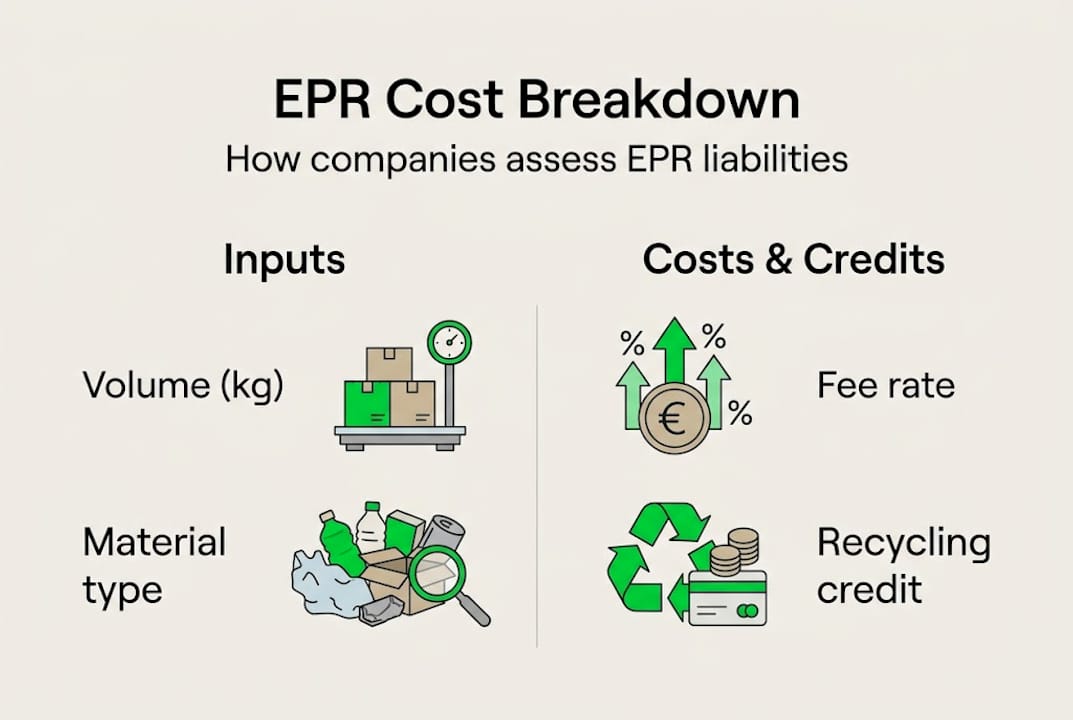
Basic formula: EPR liability = (Total volume placed on market × target rate) minus (verified recycled volume × credit rate)
If you miss targets, the penalty rate in Romania is 2 RON per kg of shortfall. For a company placing 500 tons of plastic packaging on the market annually with a 15% target gap, that is 75,000 kg × 2 RON = 150,000 RON in penalties. That is before any late-filing fines.
Here is how three compliance strategies compare:
| Compliance strategy | Estimated cost (500 tons plastic) | Risk level |
|---|---|---|
| Full PRO membership, targets met | 40,000 to 60,000 RON | Low |
| PRO membership, partial gap | 80,000 to 120,000 RON | Medium |
| No PRO, penalties only | 180,000 to 250,000 RON | High |
Benchmarking against other EU markets is useful here. PRO-Europe’s 2025 cost overview shows that efficient schemes like Belgium maintain low and predictable costs, while Romania’s cost volatility is notably higher due to infrastructure gaps and shifting collection rates.
Romania’s PROs achieved 79% collection via DRS in 2025, which is a significant improvement. Companies that aligned with strong PROs captured this benefit directly in their compliance accounts.
- Map your volumes to each material category.
- Apply the current target rates per category.
- Calculate your gap using verified PRO collection data.
- Model three scenarios: full compliance, partial gap, and non-compliance.
- Compare the cost of PRO fees against the penalty exposure in each scenario.
Pro Tip: Check EPR benchmarks in Romania annually. Fee structures and collection rates shift, and a benchmark from two years ago may lead you to underestimate your current liability. Also consider how your EPR exposure connects to broader ESG supply chain requirements under CSRD.
Optimize EPR cost management and limit risks
After running your calculations, the smartest companies focus not just on compliance but cost control and risk reduction. Here is how you can actively optimize your EPR program.
The gap between companies that manage EPR well and those that struggle is rarely about intent. It is about process maturity. Romanian firms that paid €10M+ in 2024 penalties were not all negligent. Many simply lacked the systems and partnerships to stay ahead of their obligations.
Here are the most effective optimization levers:
- Partner with reputable PROs to cap your liabilities and benefit from collective collection infrastructure. PROs that achieved 79% DRS collection in 2025 gave their members a direct cost advantage over companies going it alone.
- Redesign packaging where feasible. Switching from composite materials to mono-materials reduces your fee rate and simplifies reporting.
- Integrate EPR into your ESG and sustainability reporting. When EPR data flows into your broader carbon footprint reporting for Romanian firms, you get a holistic view of environmental liabilities and can prioritize investments more effectively.
- Run annual scenario analyses. Model what happens to your EPR costs if volumes grow 20%, if target rates increase, or if a new material category gets added to the scheme.
- Avoid free-riding. Regulators are increasingly sophisticated. Companies that under-report or delay filings face not just fines but reputational damage with procurement teams and ESG raters.
“Collective compliance through PROs is not just a cost optimization tool. It is a risk management strategy. Going it alone in Romania’s current EPR environment is a bet most companies cannot afford to lose.”
Pro Tip: Schedule a mid-year EPR review, not just an annual one. Packaging volumes shift with product launches and seasonal demand. Catching a growing gap in July is far cheaper than discovering it in December.
Our perspective: Why real-time data and PRO partnerships are game-changers
Most companies we work with admit the same thing: they treated EPR as an annual administrative task until a penalty arrived. That mindset is expensive.
The companies that manage EPR costs well share two traits. First, they integrate EPR into ERP systems so that cost assessment is continuous, not a once-a-year scramble. Second, they invest in strong PRO relationships early, before gaps accumulate. PRO partnerships in Romania can cap costs at less than three times lower than penalty rates, which is a meaningful difference at scale.
We have seen Romanian companies reduce their EPR penalty exposure by over 60% within a single reporting cycle simply by cleaning up their data and switching to a more active PRO. The technology exists. The regulatory framework is clear. What is missing, in most cases, is the internal capacity to act on the data in real time.
That is exactly the gap that deep EPR guidance and integrated compliance systems are designed to close. EPR is not going away. The targets will tighten, the penalties will grow, and the companies that build real-time visibility now will be the ones that compete on cost rather than scramble for compliance.
Take the next step with expert EPR assessment
If you are ready to move from compliance anxiety to cost-efficient confidence, working with the right experts can make all the difference.
At ECONOS, we help mid-size and large companies in Romania and Europe turn EPR from a financial risk into a managed, optimized line item. From professional carbon footprint assessment to full ESG reporting services, our team builds the internal capacity your organization needs to stay ahead of regulatory change. We do not just hand you a report. We help you understand it, own it, and act on it. Visit our sustainability consulting experts page to start a conversation about your EPR assessment, reporting setup, and long-term compliance strategy.
Frequently asked questions
What are the main drivers of EPR costs for Romanian companies?
The main drivers are packaging volume by material type, recycling target gaps under Law 249/2015, and penalties for missed targets at 2 RON per kg of shortfall. Late or incomplete reporting adds further financial exposure.
How can companies reduce their EPR costs most effectively?
Partnering with PROs, optimizing material use, and integrating EPR into ERP systems for real-time assessment reduce both costs and compliance risk significantly. PRO partnerships in Romania can cap costs at less than three times the penalty rate.
What happens if you miss EPR targets or deadlines in Romania?
Companies face significant fines and back-payments, with €10M+ in Romanian penalties paid in 2024 alone. Repeated non-compliance can also trigger regulatory audits and reputational damage with ESG-focused partners.
How do EPR costs in Romania compare to other EU countries?
Romania’s EPR costs are more volatile and generally higher than efficient schemes like Belgium’s, largely due to infrastructure gaps. PRO-Europe’s 2025 benchmarks confirm that benchmarking against peer markets helps companies identify where they are overpaying and where to optimize.
Recommended
- What is EPR compliance? A clear guide for global companies
- ESG requirements for European exports: A practical compliance guide
- ESG requirements for European exports: A practical compliance guide
- Carbon footprint reduction checklist for companies
- Strategie efficaci per ridurre i costi energetici in azienda