
.png)

TL;DR:
- Effective greens communication in 2026 requires organizations to provide transparent, scientifically accurate claims backed by verifiable data. It emphasizes replacing vague terminology with precise disclosures aligned with frameworks like CSRD, EU Taxonomy, and GHG Protocol to mitigate greenwashing risks. Adopting sustainable digital habits and integrating data governance with communication strategies enhances credibility, stakeholder trust, and compliance.
Greens communication is defined as the purposeful, transparent exchange of environmental and sustainability information between organizations and their stakeholders, governed by scientific accuracy and regulatory compliance. The term is widely used in practice, though the recognized industry standard is environmental communication, a field that the Mistra Environmental Communication program has advanced as a science of change-oriented, constructive sustainability dialogue. For professionals managing ESG reporting, carbon disclosures, or sustainability marketing, mastering this discipline is no longer optional. Regulatory pressure from frameworks like CSRD and the EU Taxonomy, combined with rising stakeholder expectations, makes credible greens communication a core business competency in 2026.
What constitutes effective greens communication in 2026?
Effective greens communication rests on one non-negotiable principle: specificity over sentiment. Vague claims like “eco-friendly” or “green” no longer satisfy regulators, investors, or informed consumers. The Roman Declaration of Green Communication Responsibility requires organizations to replace those terms with transparency, accountability, and scientific accuracy. The Global Alliance for Public Relations and Communications Management, representing over 320,000 members, officially endorsed this standard as of April 2026. That endorsement signals a profession-wide shift: communicators are now accountable for the accuracy of environmental claims, not just their persuasiveness.
The practical implications are significant. Organizations must back every environmental claim with verifiable data, third-party validation, or recognized methodologies such as GHG Protocol accounting or ISO 14064. Saying “we reduced our carbon footprint” without specifying the baseline year, scope, and percentage is no longer acceptable under this standard.
“Environmental communication shapes how stakeholders interpret and respond to environmental crises. Identifying harmful communication patterns is essential for constructive sustainability dialogue.” — Mistra Environmental Communication
Three principles define credible green communication strategies in 2026:
- Transparency: Disclose what you measured, how you measured it, and what the results mean. Include limitations and uncertainties.
- Scientific accuracy: Ground all claims in recognized frameworks. Reference Scope 1, 2, and 3 emissions, lifecycle assessments, or EPD data where relevant.
- Stakeholder relevance: Tailor the depth and format of disclosures to the audience. Investors need quantitative data; employees need context and narrative.
Pro Tip: Before publishing any environmental claim, run it through a simple test: Can you cite the data source, the measurement methodology, and the reporting period? If any of those three are missing, the claim is not ready to publish.
How can organizations adopt sustainable digital communication habits?
Most organizations focus their sustainability efforts on energy, logistics, and procurement. Digital communication habits rarely appear on the agenda. Yet digital carbon debt from excessive CC’ing, large email attachments, and unnecessary HD video calls accumulates silently across every department. Imperial College London’s annual printing usage exceeds 5.1 million pages, consuming over 600 trees. That figure illustrates how deeply embedded unsustainable communication habits are, even in institutions that publicly champion sustainability.
Changing those habits requires a structured approach. The following steps move from the easiest wins to the more systemic changes:
- Stop reflexive CC’ing. Every unnecessary email recipient triggers server processing, storage, and energy use. Audit your team’s CC habits for one week. Most organizations find that 30 to 40 percent of CC’d recipients never open the message.
- Replace attachments with shared links. Sending a 10 MB PDF to 50 people creates 500 MB of redundant storage. A single shared link in Google Drive or SharePoint eliminates that duplication entirely.
- Default to text for routine updates. Video calls consume significantly more bandwidth and server energy than text-based communication. Reserve video for complex discussions, relationship-building, and collaborative problem-solving.
- Apply greener virtual meeting practices. Turning off video when not needed, avoiding unnecessary recordings, and choosing low-impact platforms reduce meeting-related energy consumption without sacrificing collaboration quality.
- Set digital-free hours. Cloud-based sharing and digital-free periods reduce thermal stress on IT infrastructure. Scheduled downtime for non-critical systems is one of the simplest and most overlooked carbon reduction levers available to operations teams.
- Print only when legally or operationally required. Default all internal documents to digital. When printing is unavoidable, use duplex printing and recycled paper stock.
These changes do not require new technology or capital investment. They require policy, training, and accountability. A communication policy that codifies these habits, reviewed annually and tied to the organization’s carbon accounting, transforms individual behavior into measurable Scope 3 reduction.
Pro Tip: Assign a “digital sustainability lead” within your communications or IT team. Give them a quarterly mandate to audit email volume, attachment size averages, and video call frequency. Tracking these metrics makes the invisible visible and creates a feedback loop for continuous improvement.

What are the strategic benefits and challenges of greens communication?
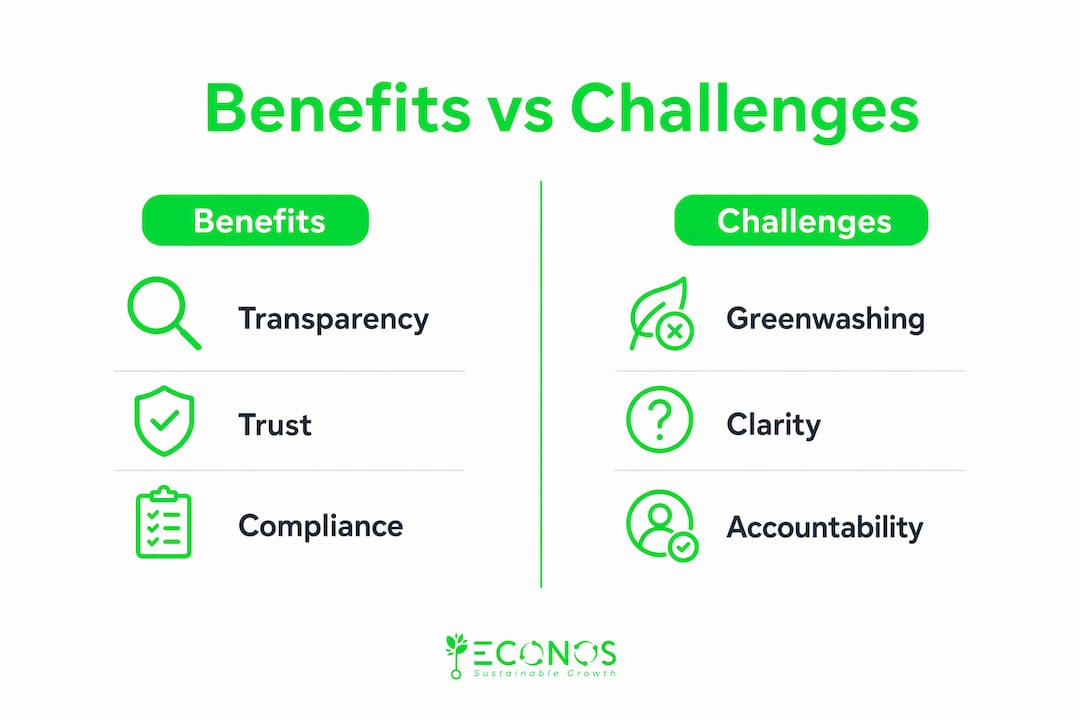
Effective green communication enhances corporate reputation and builds competitive advantage by aligning transparency with stakeholder expectations. That is not a soft benefit. Investors increasingly screen for disclosure quality as a proxy for management quality. A company that communicates its environmental performance clearly signals that it measures, manages, and takes responsibility for its impact.
The strategic benefits break down across four dimensions:
- Cost reduction: Sustainable digital communication habits lower IT infrastructure costs, reduce printing expenses, and decrease energy consumption across office operations.
- Reputation management: Transparent, accurate environmental disclosures protect against greenwashing accusations, which carry regulatory fines and reputational damage that can take years to recover from.
- Stakeholder engagement: Clear, data-backed communication builds trust with investors, customers, employees, and regulators simultaneously. Multi-stakeholder engagement is a documented driver of ESG performance improvement.
- Regulatory compliance: Organizations that communicate sustainability data clearly are better positioned to meet CSRD, EU Taxonomy, and EcoVadis disclosure requirements without last-minute scrambles.
The challenges are equally real and deserve honest acknowledgment.
| Challenge | What it means in practice |
|---|---|
| Greenwashing risk | Vague claims invite regulatory scrutiny and erode stakeholder trust faster than silence would |
| Digital carbon debt | Poor communication habits create hidden emissions that undermine publicly stated carbon targets |
| Data quality gaps | Inaccurate or incomplete data in disclosures exposes organizations to legal and reputational liability |
| Audience fragmentation | Different stakeholders require different formats, depths, and tones, making consistency difficult |
The greenwashing risk deserves particular attention. Regulators in the EU have moved from guidance to enforcement. The strategies to avoid greenwashing that matter most are not communications strategies. They are data governance strategies: ensuring that what you say is grounded in what you actually measured.
How does greens communication integrate with sustainability reporting and compliance?
Digital communication is a strategic enabler connecting sustainability and digital transformation objectives, not merely a support function. Academic research published in early 2026 identifies five pillars linking digital communication and sustainable corporate practices: transparency, stakeholder engagement, alignment with business objectives, AI-enabled communication, and reputation management. Each pillar maps directly onto the requirements of major reporting frameworks.
Aligning your green communication strategies with ESG reporting under CSRD and ESRS requires more than writing clear sustainability reports. It requires building the data infrastructure that makes accurate disclosure possible. The communication layer sits on top of that infrastructure. If the data is wrong, the communication is wrong, regardless of how well it is written.
Practical steps for compliance-driven environmental communication in 2026:
- Map your disclosures to specific ESRS standards. Each environmental topic, from climate to biodiversity, has a corresponding standard with defined disclosure requirements. Your communication must match those requirements precisely.
- Use AI tools with caution and transparency. AI-based sustainability reporting solutions must prioritize data privacy, transparency, and compliance, avoiding data leakage and excessive energy consumption. Tools like GreenPT offer private AI chatbot functionality running on renewable energy within secure EU-hosted infrastructure, which addresses both the disclosure and the footprint concern simultaneously.
- Build a disclosure calendar. Sustainability communication is not a once-a-year exercise. Quarterly updates to investors, annual reports, EcoVadis submissions, and ad hoc regulatory filings each have different timelines and audience requirements.
- Validate before you publish. Third-party assurance of sustainability data is becoming a regulatory expectation under CSRD. Build assurance into your communication workflow, not as a final check but as an ongoing process.
| Reporting framework | Communication requirement | Key risk if mishandled |
|---|---|---|
| CSRD / ESRS | Double materiality disclosures with quantitative data | Regulatory fines and restatement obligations |
| EU Taxonomy | Alignment percentages with technical screening criteria | Investor misrepresentation claims |
| EcoVadis | Evidence-backed responses across four themes | Score reduction and supply chain exclusion |
| GHG Protocol | Scope 1, 2, and 3 data with boundary definitions | Greenwashing accusations from NGOs or media |
The green reporting guide from Econos-esg provides a practical framework for meeting 2026 clarity and accuracy standards across these frameworks. The common thread across all of them is the same: say what you measured, how you measured it, and what you are doing about it.
Key takeaways
Credible greens communication requires verified data, framework alignment, and sustainable digital habits working together, not as separate initiatives.
| Point | Details |
|---|---|
| Replace vague claims with data | The Roman Declaration requires scientific accuracy; “eco-friendly” without evidence is a liability, not a differentiator. |
| Audit digital communication habits | Excessive CC’ing, large attachments, and unnecessary video calls create measurable digital carbon debt. |
| Align disclosures to frameworks | Map every environmental claim to CSRD, EU Taxonomy, or GHG Protocol requirements before publishing. |
| Use AI tools responsibly | AI-enabled reporting must run on compliant, low-energy infrastructure to avoid undermining your own sustainability claims. |
| Treat communication as risk management | Transparent, accurate disclosures protect against greenwashing accusations and regulatory enforcement actions. |
What I’ve learned from watching organizations get this wrong
I have worked with enough companies across Romania, France, and Vietnam to say this plainly: most organizations treat sustainability communication as a marketing problem when it is actually a data governance problem. The beautifully designed sustainability report that arrives in October is only as credible as the spreadsheets that fed it in January. When those spreadsheets contain estimated figures, missing Scope 3 categories, or boundary definitions that shift year to year, no amount of careful writing fixes the underlying weakness.
The second thing I have observed is that digital sustainability habits are almost universally ignored in sustainability strategies. I have sat in meetings where a company proudly presents its net-zero roadmap while the meeting itself is being recorded in 4K, distributed to 200 people who will never watch it, and stored on servers running on coal-powered grids. The irony is not lost on anyone in the room, but it rarely makes it into the action plan.
What gives me genuine optimism is the growing number of professionals who are connecting these dots. The Roman Declaration is a meaningful signal that the communications profession is accepting accountability, not just influence. AI tools built on renewable energy and designed for data sovereignty, like GreenPT, show that the technology sector is beginning to take its own footprint seriously. And frameworks like CSRD are forcing organizations to measure before they communicate, which is exactly the right sequence.
The work is imperfect. Progress is uneven. But the direction is right, and the professionals who build internal capacity now, rather than outsourcing the thinking, will be the ones who lead their industries in five years.
— Mathieu
How Econos-esg can support your sustainability communication
Econos-esg works with mid-size and large companies to build the data infrastructure and internal capacity that credible sustainability communication requires. From carbon footprint assessments covering Scope 1, 2, and 3 emissions to full ESG reporting under CSRD and ESRS, Econos-esg’s approach is practical: measure accurately, report transparently, and build the skills inside your team to sustain it. Clients like Michelin, eMAG, and Raiffeisen Bank have used this model to meet regulatory requirements and strengthen stakeholder trust simultaneously. If your organization is ready to move from vague environmental claims to verified, compliant disclosures, Econos-esg is the partner that builds your capacity rather than your dependency.
FAQ
What is greens communication?
Greens communication, more formally called environmental communication, is the strategic practice of transparently conveying environmental and sustainability information to stakeholders using verified data and recognized reporting frameworks. It covers everything from sustainability reports and carbon disclosures to internal digital habits that reduce an organization’s carbon footprint.
What is the Roman Declaration of Green Communication Responsibility?
The Roman Declaration of Green Communication Responsibility is a professional standard requiring organizations to replace vague environmental terms like “green” or “eco-friendly” with transparency, accountability, and scientific accuracy. The Global Alliance for Public Relations and Communications Management, representing over 320,000 members, endorsed it in April 2026.
How does greens communication relate to ESG reporting?
Greens communication is the external and internal expression of ESG data. Effective communication requires accurate underlying data aligned with frameworks like CSRD, EU Taxonomy, and GHG Protocol. Without that data foundation, even well-written disclosures create greenwashing risk.
What is digital carbon debt in the context of sustainable communication?
Digital carbon debt refers to the cumulative energy cost of poor communication habits such as excessive email CC’ing, large attachments, and unnecessary HD video calls. Imperial College London’s research identifies these habits as key contributors to organizational carbon footprints that are rarely measured or managed.
How can organizations avoid greenwashing in their sustainability communications?
Organizations avoid greenwashing by grounding every environmental claim in verifiable data, specifying the measurement methodology and reporting period, and aligning disclosures with recognized frameworks like GHG Protocol or ESRS. Third-party assurance of sustainability data adds an additional layer of credibility and regulatory protection.