
.png)

TL;DR:
- Green positioning involves substantiating environmental claims with verified, product-level evidence to meet new EU and UK regulations in 2026. It is now a compliance requirement that also enhances brand trust, investor access, and competitive differentiation through evidence-backed sustainability practices. Building cross-functional governance and internal capacity to document and update claims is essential for durable, credible green positioning beyond mere marketing.
Green positioning is the strategic practice of differentiating a brand by aligning it with credible, verifiable environmental credentials that satisfy legal requirements and build lasting consumer trust. With the EU’s Empowering Consumers for the Green Transition (ECGT) directive taking effect in September 2026 and the UK Green Claims Code already in force, the rules governing what companies can say about their environmental performance have fundamentally changed. Generic claims like “eco-friendly” or “climate neutral” are no longer defensible without documented, product-level evidence. For business leaders and sustainability professionals, green positioning is no longer a marketing choice. It is a compliance obligation and a competitive differentiator.
What is green positioning and why does it matter in 2026?
Green positioning, known in marketing strategy as environmental positioning, is the deliberate alignment of a brand’s identity with specific, substantiated environmental attributes. It goes beyond general sustainability marketing by requiring that every public claim connect directly to verifiable performance data, certifications, or lifecycle assessments.

The stakes in 2026 are higher than they have ever been. The EU ECGT directive bans generic or unsubstantiated terms and requires that environmental claims reflect actual, measurable product characteristics. This is not a soft guideline. It is a regulatory step change that exposes brands to enforcement action, fines, and reputational damage if their marketing language outpaces their operational reality.
The business case for getting this right is equally compelling. Authentic environmental positioning builds brand trust, attracts sustainability-conscious investors, and opens access to green financing instruments. The EPA notes that sustainable manufacturing improves brand recognition, competitive advantage, and access to financing, moving green positioning well beyond defensive compliance into genuine strategic territory.
“Green claims compliance centers on consumer protection, requiring claims to be clear, honest, and accurate with supply chain collaboration.” — GOV.UK Green Claims Code
The risks of getting it wrong are not abstract. Regulators across the EU and UK are actively scrutinizing brand communications. Companies that built their market identity on broad environmental language now face the uncomfortable task of either substantiating those claims or retracting them entirely.
- Generic claims like “green,” “sustainable,” or “eco-friendly” attract regulatory scrutiny and may be prohibited under ECGT.
- Carbon offset-only claims labeled “climate neutral” are banned unless emissions reductions occur inside the product’s own value chain.
- Unsubstantiated claims expose brands to enforcement action under both EU and UK frameworks.
- Authentic green positioning, backed by evidence, delivers measurable brand and financial advantages.
How do 2026 regulations shape green positioning strategies?
The regulatory environment governing environmental claims has shifted from voluntary best practice to mandatory compliance. Understanding the specific requirements of each framework is the foundation of any defensible green positioning strategy.
EU Empowering Consumers for the Green Transition (ECGT) takes effect in September 2026 and introduces the most prescriptive rules on environmental marketing claims in EU history. Under ECGT, generic claims face prohibition unless supported by recognized EU-level environmental performance labels or verified product-level data. The directive also requires that comparative claims, such as “lower emissions than our previous model,” be based on equivalent methodology and independently verified.
The UK Green Claims Code operates in parallel for brands selling into British markets. The GOV.UK framework mandates evidence-backed claims that are robust, credible, and current, with explicit cooperation required among brands, retailers, and manufacturers across the supply chain. This means a retailer cannot simply rely on a supplier’s assurance. They must verify it.
The following claim types carry the highest regulatory risk under both frameworks:
- Generic environmental descriptors (“green,” “sustainable,” “eco-friendly”) without product-specific substantiation.
- Carbon offset-only neutrality claims where emissions are not reduced within the value chain.
- Comparative claims without equivalent methodology or independent verification.
- Future-oriented claims (“we will be net-zero by 2030”) without a credible, published transition plan.
- Partial claims that highlight one environmental benefit while ignoring significant trade-offs elsewhere in the lifecycle.
| Claim type | Regulatory risk | Substantiation required |
|---|---|---|
| “Eco-friendly product” | High (likely banned) | Full lifecycle assessment |
| “30% lower carbon vs. 2020” | Medium | Verified comparative data |
| “Climate neutral” via offsets | High (banned under ECGT) | Value chain reductions only |
| “Made with recycled materials” | Low to medium | Supplier declarations, certifications |
| “Certified by [recognized label]” | Low | Valid, current certification |
Pro Tip: Start your ECGT readiness audit now by listing every environmental claim currently in use across your website, packaging, and sales materials. Map each claim to its existing evidence. Any claim without a direct evidence link is a liability.
The cross-border implications are significant. A company operating in Romania, France, and Vietnam, as Econos-esg clients often do, must manage claim consistency across jurisdictions with different enforcement timelines and legal standards. Building a single, evidence-first claim governance system is far more efficient than managing country-specific workarounds.
What common challenges and credibility gaps arise in green positioning?
The most dangerous gap in green positioning is not ignorance. It is overconfidence. A UN Global Compact and Kantar benchmark study found that 69% of marketers rated themselves as advanced in sustainability integration, while overall organizational performance sat at just 52%. That 17-point gap represents exactly the kind of credibility exposure that regulators and consumers are now equipped to exploit.
“There is often a disconnect between marketing progress and sustainability operational execution; organizations should prepare for credibility gaps if claims outpace actual performance.” — UN Global Compact / Kantar
The structural causes of this gap are predictable. Marketing and brand strategy teams tend to move faster than procurement, operations, and legal. A campaign promising “fully sustainable packaging by 2025” may have been approved before anyone confirmed that the supply chain could actually deliver it. This is not bad faith. It is a governance failure, and it is common.
- Supply chain blind spots: Most companies lack full visibility into Scope 3 emissions and supplier environmental performance, making supply-chain-level claims particularly risky.
- Claim drift: Claims approved two years ago may no longer reflect current product formulations, supplier relationships, or manufacturing processes.
- Offset dependency: Many brands built their “climate neutral” positioning on carbon credit purchases. Under ECGT, offset-only neutrality claims are prohibited, leaving those brands exposed.
- Legal-marketing misalignment: Legal teams often review claims reactively rather than being embedded in the claim development process from the start.
Pro Tip: Treat every environmental claim as a regulated disclosure. Before publishing, ask: “Can I produce the evidence for this claim within 48 hours if a regulator asks?” If the answer is no, the claim is not ready.
The avoid greenwashing guide from Econos-esg offers a practical framework for auditing existing claims and identifying the highest-risk language in your current communications. The work of closing credibility gaps is unglamorous, but it is the foundation on which durable green positioning is built.
How can businesses implement effective green positioning practices?
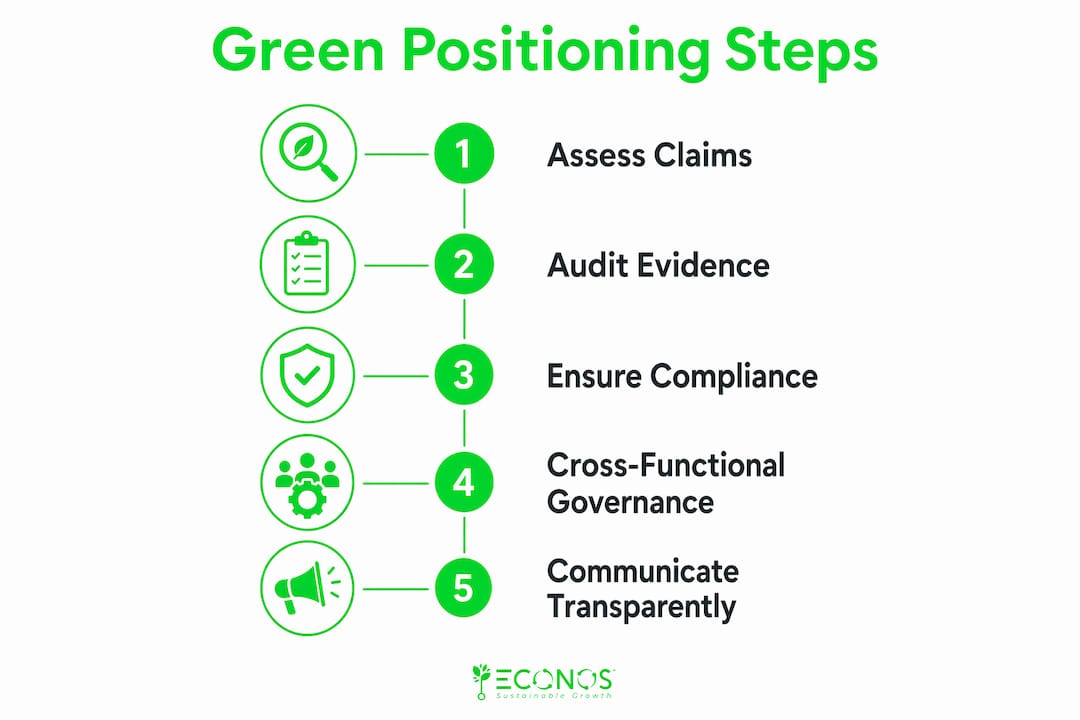
Implementing green positioning that holds up under regulatory scrutiny requires treating environmental claims with the same rigor applied to financial disclosures. The following process reflects what Econos-esg recommends to clients preparing for ECGT compliance and beyond.
-
Build a claim register. Document every public-facing environmental claim across all channels: website, packaging, sales decks, social media, and press releases. Each claim needs a unique identifier, the channel where it appears, and a link to its supporting evidence. This is the foundation of a defensible claim governance system.
-
Assemble substantiation dossiers. For each claim, build a file containing the specific evidence that supports it. This may include third-party certifications (EcoVadis, ISO 14001), lifecycle assessments (LCAs), Environmental Product Declarations (EPDs), supplier declarations, and internal measurement data. Evidence must be current, not from a study conducted five years ago.
-
Integrate cross-functional governance. ECGT requires consistent criteria and internal alignment for the development and approval of environmental claims. In practice, this means marketing, legal, procurement, and sustainability teams must review claims together before publication, not sequentially after the fact.
-
Update claims proactively. When a product formulation changes, a supplier is replaced, or a certification lapses, the corresponding claims must be reviewed and updated immediately. Claim drift is one of the most common sources of inadvertent greenwashing.
-
Align marketing language with measured performance. If your carbon footprint assessment shows a 22% reduction in Scope 1 emissions since 2020, say exactly that. Specific, quantified claims are both more credible and more defensible than broad descriptors.
| Approach | Weak version | Strong version |
|---|---|---|
| Emissions claim | “We’re reducing our carbon footprint” | “Scope 1 emissions reduced 22% since 2020, verified by third-party audit” |
| Material claim | “Made with sustainable materials” | “67% recycled PET, certified by [recognized label]” |
| Neutrality claim | “Climate neutral product” | “Emissions reduced 40% in-value chain; residual offset via Gold Standard credits” |
| Supplier claim | “Sustainable supply chain” | “83% of tier-1 suppliers hold ISO 14001 certification” |
Pro Tip: Use your ESG reporting workflow as the data backbone for your claim register. If a metric already appears in your CSRD or ESRS report, it is already substantiated and ready to use in marketing communications.
What benefits does authentic green positioning deliver to businesses?
Authentic environmental positioning delivers returns that extend well beyond regulatory compliance. When claims are grounded in evidence and communicated with precision, the business outcomes are measurable and durable.
The EPA’s guidance on sustainable manufacturing confirms that sustainability efforts improve operational efficiency and market competitiveness in ways that go beyond cost-cutting. Companies that embed environmental performance into their product development and supply chain management gain a structural advantage that is difficult for competitors to replicate quickly.
The specific benefits break down across four dimensions:
- Brand trust and reputation: Consumers and B2B buyers increasingly distinguish between brands that make vague environmental claims and those that publish specific, verified data. Specificity signals credibility.
- Investor and financing access: ESG-aligned investors and green bond frameworks require documented environmental performance. Brands with mature green positioning systems are better positioned to access favorable financing terms.
- Customer engagement: Sustainable purchasing decisions are growing across both consumer and industrial markets. Brands that communicate environmental performance clearly capture a disproportionate share of this demand.
- Competitive differentiation: In sectors where products are functionally similar, verified environmental credentials become a meaningful differentiator. This is particularly true in procurement processes where EcoVadis scores or ISO certifications influence supplier selection.
The operational benefits are equally real. Building the internal systems required for claim substantiation, including lifecycle assessments, supplier data collection, and carbon accounting, generates insights that improve manufacturing efficiency, reduce waste, and identify supply chain risks before they become crises. Green positioning, done properly, makes the business smarter about itself.
Key takeaways
Green positioning requires documented, product-level evidence for every public claim, with cross-functional governance connecting marketing, legal, procurement, and sustainability teams to prevent credibility gaps and regulatory exposure.
| Point | Details |
|---|---|
| Define claims precisely | Replace generic terms like “eco-friendly” with specific, quantified, evidence-backed statements. |
| Build a claim register | Map every public environmental claim to its supporting evidence and update it when conditions change. |
| Prepare for ECGT enforcement | September 2026 bans offset-only neutrality claims and generic descriptors without product-level substantiation. |
| Close the credibility gap | Marketing integration must match operational execution; a 17-point gap between perceived and actual performance is a regulatory liability. |
| Treat sustainability as strategy | Authentic green positioning improves financing access, brand trust, and competitive differentiation beyond compliance. |
Why green positioning must be built from the inside out
I have worked with enough companies to recognize a pattern that repeats itself across industries and geographies. The marketing team is enthusiastic, the sustainability report is polished, and the claims on the packaging sound confident. Then someone asks for the evidence file, and the room goes quiet.
The honest truth is that most organizations built their environmental communications during a period when regulators were not looking closely and consumers were not asking hard questions. That period is over. ECGT is not a distant threat. It is a deadline, and September 2026 arrives whether your substantiation dossiers are ready or not.
What I find most instructive about the UN Global Compact and Kantar findings is not the 17-point gap itself. It is what the gap reveals about organizational structure. Marketing moves fast because it is designed to. Sustainability operations move slowly because building real evidence takes time, supplier cooperation, and investment. The companies that close this gap are not the ones that slow down marketing. They are the ones that speed up governance.
The practical implication is this: green positioning cannot be a marketing project with sustainability input. It must be a cross-functional discipline with marketing as one voice among several. Legal needs to be in the room when claims are drafted, not reviewing them after the campaign launches. Procurement needs to confirm that supplier data actually supports what the packaging says. Sustainability needs to own the evidence files, not just the narrative.
I am also candid about the limits of external certification alone. EcoVadis scores and ISO 14001 certificates are valuable, but they are not a substitute for claim-level substantiation. A Gold EcoVadis rating, which Econos-esg holds, reflects organizational maturity. It does not automatically validate every individual product claim. Companies that conflate the two are taking a risk they may not recognize until enforcement arrives.
The companies that will lead on environmental positioning in the next five years are the ones building internal capacity now, not the ones outsourcing the problem and hoping the paperwork holds up. That is a harder path. It is also the only one worth taking.
— Mathieu
How Econos-esg supports your green positioning strategy
Econos-esg works with mid-size and large companies to build the internal systems that make green positioning defensible and durable. That means developing substantiation dossiers, conducting carbon footprint assessments that generate the product-level data your claims require, and preparing ESG reporting under CSRD and ESRS frameworks that double as your evidentiary backbone. With ECGT enforcement arriving in September 2026, the window for preparation is narrowing. Econos-esg’s training-first model means your team builds the capability to manage claims independently, not just for this regulatory cycle but for every one that follows. If you are ready to align your environmental communications with your actual performance, the conversation starts at econos-esg.com.
FAQ
What is green positioning in marketing?
Green positioning is the practice of differentiating a brand by aligning it with specific, verifiable environmental credentials. Under frameworks like the EU ECGT and UK Green Claims Code, those credentials must be substantiated with product-level evidence, not generic descriptors.
What claims are banned under the EU ECGT in 2026?
The ECGT prohibits generic terms like “eco-friendly” and “sustainable” without product-specific substantiation, and bans carbon offset-only neutrality claims where emissions are not reduced within the product’s own value chain.
How do I avoid greenwashing in my brand communications?
Build a claim register that maps every public environmental statement to specific supporting evidence, including certifications, lifecycle assessments, and supplier declarations. Update the register whenever product formulations, suppliers, or certifications change.
What is the difference between green positioning and general sustainability marketing?
General sustainability marketing may include broad organizational commitments and values. Green positioning specifically requires that individual product or service claims connect to verifiable, current environmental performance data that can withstand regulatory scrutiny.
How does cross-functional governance reduce green claim risk?
Cross-functional alignment between legal, marketing, procurement, and sustainability teams prevents claims from being published before their evidence is confirmed. This structure is explicitly required under ECGT and reduces the risk of inadvertent greenwashing as products and supply chains evolve.