
.png)

TL;DR:
- Green controlling integrates environmental metrics into core management systems for strategic decision-making. It ensures verified ESG data, regulatory compliance, and operational improvements. Implementation requires clear KPIs, data integration, internal controls, and leadership commitment.
Most sustainability managers can explain Scope 1, 2, and 3 emissions without hesitation. Yet ask them to define green controlling, and you’ll often get a pause, a rough guess, or a description that sounds more like carbon accounting than actual management control. This confusion is understandable but costly. Without a functioning green controlling system, your sustainability data remains fragmented, your ESG reports stay unverified, and your organization keeps flying blind through an increasingly demanding EU regulatory environment. This guide cuts through the noise and gives you a clear, practical picture of what green controlling is, what it does, and how to make it work for your business.
Table of Contents
- What is green controlling and why does it matter?
- The core functions and benefits of green controlling
- Implementing green controlling: challenges and practical steps
- Green controlling for regulatory compliance and ESG reporting
- What most companies miss about green controlling
- Practical next steps with ECONOS
- Frequently asked questions
Key Takeaways
| Point | Details |
|---|---|
| Green controlling essentials | Success requires blending environmental metrics into core business operations and not treating sustainability as a silo. |
| EU reporting made easier | Robust green controlling delivers audit-ready data for ESG and EU Taxonomy compliance. |
| Cultural buy-in matters | True progress comes when leadership commits to education and cross-functional teamwork. |
| Few benchmarks but proven wins | Empirical benchmarks are limited, but leaders like BASF show that major emissions reductions are achievable with the right approach. |
What is green controlling and why does it matter?
Green controlling is not a rebranding of carbon accounting. It is the systematic integration of environmental and sustainability metrics, targets, and controls into a company’s core management system. Think of it as what happens when your environmental ambitions finally get the same rigorous measurement, budget allocation, and decision-support infrastructure that your financial goals have always had.
This distinction matters enormously. Many companies measure their emissions. Far fewer have built internal control systems that turn those measurements into decisions, accountability structures, and verified outcomes. Green controlling closes that gap.
“In France, management controllers in environmental management control (EMC) act as carbon auditors, business partners, euro-carbon translators (monetizing environmental impacts), and agents of change.”
This framing from French research is instructive. It tells us that green controlling is not a back-office function. It is a strategic role that sits at the intersection of sustainability, finance, and operations. The green controller must speak the language of carbon and euros simultaneously, translating ecological performance into business terms that executives and board members can act on.
Why does this matter for companies in Romania and France right now? Several forces are converging. The Corporate Sustainability Reporting Directive (CSRD) requires large companies to report verified, audit-ready sustainability data. The EU Taxonomy demands that companies classify economic activities as sustainable or not, using precise environmental thresholds. CBAM (Carbon Border Adjustment Mechanism) is creating direct financial exposure based on embedded carbon in supply chains. Reputation risk from greenwashing allegations adds another layer of urgency.
Understanding carbon footprint basics is the starting point, but green controlling turns that knowledge into an institutional capability. Without it, companies face several serious risks:
- Regulatory non-compliance, including fines and disqualification from EU public procurement.
- Investor pressure, as ESG-focused funds increasingly require demonstrated management systems, not just reported numbers.
- Operational inefficiency, because uncontrolled emissions usually correlate with uncontrolled energy and resource costs.
- Reputational damage, since unverified or inconsistent sustainability claims invite scrutiny and accusations of greenwashing.
Green controlling transforms sustainability from a reporting obligation into a management tool. That shift is not optional anymore. It is a competitive and legal necessity.
The core functions and benefits of green controlling
With green controlling’s rising relevance clarified, let’s break down its core functions and responsibilities.
Green controlling encompasses a broad set of tasks, but they cluster around four main activities: monitoring environmental performance, integrating ecological KPIs into management reporting, monetizing environmental impacts, and supporting certification and external reporting.
The ICV Green Controlling Award recognizes innovative green controlling solutions integrating ecological strategies into management, demonstrating profitability, using KPIs essential for sustainability implementation. What makes award-winning implementations stand out is not just the sophistication of their data systems. It is the way they align ecological performance with financial strategy, making sustainability a driver of business value rather than a cost center.
What a mature green controlling program looks like in practice:
- KPI integration: Environmental metrics such as CO2 intensity per product unit, water consumption, and waste ratios sit alongside financial KPIs in management dashboards. Leaders see both simultaneously and make decisions accordingly.
- Budget linkage: Sustainability investments are tracked with the same rigor as capital expenditure. ROI is calculated, and trade-offs between ecological and financial outcomes are made explicitly.
- Internal audit readiness: Data collection, verification, and documentation processes are designed from the start to satisfy external auditors, reducing last-minute scrambling before CSRD or ISO audits.
- Cross-functional reporting: Green controllers collaborate with procurement, logistics, finance, and production to capture accurate Scope 3 data and identify reduction opportunities across the value chain.
| Function | Traditional controlling | Green controlling |
|---|---|---|
| Primary KPIs | Revenue, cost, margin | Emissions, resource efficiency, ecological KPIs |
| Reporting audience | CFO, board | CFO, CSO, board, regulators |
| Data sources | Financial systems | Financial + operational + environmental systems |
| Time horizon | Quarterly, annual | Quarterly, annual + long-term net-zero targets |
| Regulatory driver | Financial law | CSRD, EU Taxonomy, CBAM |
Exploring carbon assessment strategies gives you the measurement foundation, but green controlling gives those measurements a home inside your management structure. A well-run green controlling function also opens doors to less obvious insights. For example, tracking scope 4 emissions insights (avoided emissions) allows companies to demonstrate positive environmental contributions, not just report what they have reduced.
Pro Tip: Start your green controlling rollout with two or three ecological KPIs that directly connect to cost drivers in your business. Energy consumption per production unit and logistics emissions per revenue euro are good starting points. They create immediate buy-in from the CFO’s office because they speak money and environment at the same time.
The tangible benefits compound over time. Companies with established green controlling systems tend to report cleaner, faster, and more defensible ESG data. They also make better capital allocation decisions because environmental risk is priced into their analysis from the start.
Implementing green controlling: challenges and practical steps
Understanding green controlling’s purpose, let’s see how these principles play out in real company operations.

One honest admission upfront: quantifiable benchmarks for green controlling in Romanian and French mid-to-large firms are sparse. BASF’s public data offers a rare and useful reference point, showing Scope 1 and 2 emissions dropping from 21.877 Mt CO2e in 2018 to 16.081 Mt in 2025, a 26% reduction driven in part by systematic environmental management controls. Most mid-sized companies in Romania and France have not published comparable figures, which creates both a gap and an opportunity for early movers.
Practical implementation steps:
- Define your ecological KPIs. Start with emissions intensity, energy use, and waste generation. Tie each KPI to an existing business process so it has a natural data owner.
- Integrate data systems. Connect your ERP, energy monitoring tools, and logistics data into a unified reporting environment. This is where most companies struggle, because data lives in silos.
- Establish internal controls. Define who collects data, who verifies it, and who signs off. This chain of custody is what makes your ESG data audit-ready.
- Train your team. Green controlling fails when it is treated as a one-person job. Finance, operations, and procurement teams all need enough literacy to contribute accurate, timely data.
- Review and iterate. Run quarterly internal reviews of your KPIs, identify data quality issues, and update your methodology as regulatory guidance evolves.
| Implementation stage | Key action | Common pitfall |
|---|---|---|
| Assessment | Map current data sources | Assuming IT can handle it without sustainability input |
| KPI design | Link ecological and financial metrics | Choosing KPIs that cannot be measured reliably |
| Data integration | Unify reporting systems | Underestimating the time and cost of integration |
| Internal control | Assign data owners and verifiers | No clear accountability structure |
| Reporting | Generate audit-ready outputs | Waiting until audit season to check data quality |
Follow your carbon footprint reduction checklist to prioritize where green controlling efforts will have the most immediate impact. The effective reduction methods available to manufacturing and service companies vary widely, so KPI selection should reflect your actual emission profile. Do not underestimate scope 3 emissions, which often represent 70% or more of a company’s total footprint and require the most sophisticated data collection processes.
Pro Tip: Before investing in new software, map your existing data flows on paper. In our experience working with companies across Romania and France, most already possess 60 to 80 percent of the data they need. The problem is access and accountability, not data volume.
Common obstacles worth naming honestly include inconsistent definitions across departments (what counts as “waste” in production versus logistics?), lack of standardized frameworks for Scope 3, and reluctance from business unit leaders who see green controlling as additional reporting burden rather than a management tool.
Green controlling for regulatory compliance and ESG reporting
Having covered core functions and practical implementation, let’s translate this into specific compliance and reporting obligations.
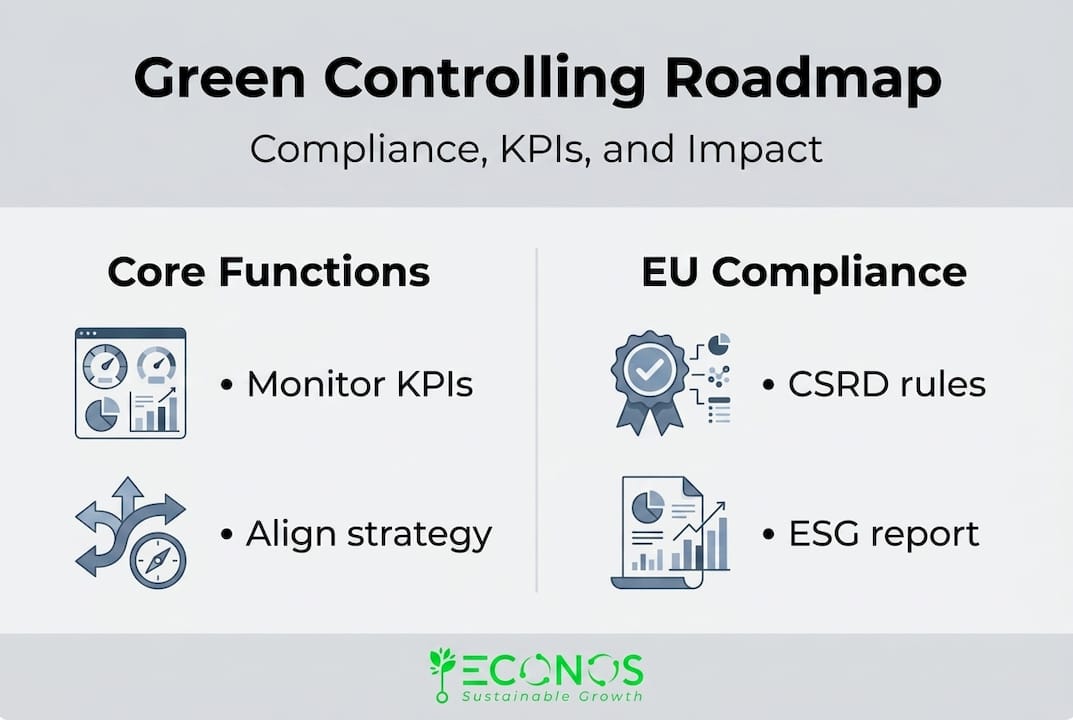
The EU regulatory landscape is not waiting for companies to catch up. The CSRD applies to large companies from 2025 reporting cycles onward, with mid-sized companies following. EU Taxonomy alignment requires companies to demonstrate that economic activities meet environmental performance thresholds. CBAM creates direct financial exposure for companies importing carbon-intensive goods. In each case, green controlling is the mechanism that makes compliance manageable rather than reactive.
Country-specific data for Romania on green controlling practices is limited, with most academic and industry research focusing on green building certifications rather than management control systems. France has a more developed tradition, including pioneering work on controller roles in environmental management, but even there, recent political resistance to EU green regulations creates friction between regulatory ambition and practical implementation.
A step-by-step green controlling approach for compliance:
- Assess: Conduct a gap analysis comparing your current data infrastructure against CSRD double materiality requirements and EU Taxonomy technical screening criteria.
- Measure: Implement systematic data collection for all material environmental topics, using standardized methodologies (GHG Protocol for emissions, for example).
- Document: Build a documentation trail that a third-party auditor can follow, from raw data to final reported figures.
- Report: Publish sustainability information in the format required by ESRS (European Sustainability Reporting Standards), ensuring consistency between financial and sustainability reports.
Your ESG reporting process should flow directly from your green controlling system, not be assembled manually at year-end. The difference between a company that struggles with ESG reporting and one that handles it smoothly usually comes down to whether sustainability data is collected continuously or scrambled together in Q4.
“France has pioneering controller roles in EMC but recent political resistance to EU green regulations creates gaps between regulatory ambition and actual firm-level implementation.”
Understanding EU Taxonomy rules in depth is essential for finance teams who must classify investments and revenues under the Taxonomy’s six environmental objectives. Green controllers play a critical bridging role here, ensuring that the technical criteria are translated into operational data collection requirements. For companies ready to move from measuring to actually reducing, carbon reduction actions offer a practical path forward.
The green controller, in this compliance context, is not just a data manager. They are the organizational bridge between the sustainability team’s environmental goals, the finance team’s reporting obligations, and the operations team’s day-to-day decisions. Without that bridge, regulatory compliance becomes fragmented, inconsistent, and expensive to correct.
What most companies miss about green controlling
Here is what we observe repeatedly, working with companies across Romania and France: organizations invest heavily in data collection tools and reporting software, then wonder why their green controlling program feels hollow. The data is there. The dashboards are populated. But nothing changes.
The missing ingredient is almost always leadership commitment and cultural integration, not technical sophistication. Award-winning implementations consistently combine technical mastery with internal education programs and cross-functional teams that share ownership of ecological outcomes. The companies that make real progress are the ones where a production manager feels responsible for emissions intensity, not just output volume.
There is also a transparency problem in our market. We at ECONOS see robust benchmarks lacking across Romania and France for mid-sized firms, which means companies cannot easily learn from peers. That is a call for more open data sharing and industry dialogue, not just better internal systems. The companies willing to publish their green controlling methodologies and results will shape best practices for the entire region. Sustainability, at its most honest, is a collective project.
Practical next steps with ECONOS
Green controlling is one of the most impactful steps your organization can take toward genuine EU compliance and measurable environmental progress.
At ECONOS, we help mid-sized and large companies build green controlling systems that are practical, audit-ready, and internally owned. We start with a structured carbon footprint assessment to establish your baseline, then design KPI frameworks and data workflows tailored to your industry and regulatory obligations. Our ESG reporting tools ensure your sustainability data flows seamlessly from collection to publication. If you are also working toward supplier or buyer rating requirements, our EcoVadis certification support ensures you are positioned to achieve the rating your business relationships require.
Frequently asked questions
What is the difference between green controlling and traditional controlling?
Green controlling integrates environmental and sustainability metrics into core management systems, while traditional controlling focuses solely on financial KPIs. In practice, French EMC research shows green controllers take on roles like carbon auditor and euro-carbon translator that have no equivalent in traditional finance control.
How does green controlling support EU ESG reporting requirements?
Green controlling ensures that sustainability actions are measured, documented, and aligned with EU reporting obligations, streamlining ESG and CSRD compliance. The ICV Green Controlling Award highlights that integrating ecological KPIs into management is essential for effective sustainability implementation, not just nice-to-have reporting.
Are there reliable benchmarks for implementing green controlling in Romania or France?
Benchmark data is limited, but companies can reference best practices like ICV award winners and BASF’s public CO2 reduction targets showing a 26% Scope 1 and 2 reduction between 2018 and 2025.
What are the most common challenges when introducing green controlling?
The biggest challenges include data quality issues, lack of standard frameworks, and securing cross-departmental engagement. Empirical gaps in regional data reinforce the need for companies to build their own internal benchmarks early and document their methodology rigorously.