
.png)
TL;DR:
- Green consultation involves a comprehensive, ongoing process that transforms regulatory complexity into strategic operational improvements. It encompasses ESG reporting, compliance, risk mitigation, and capacity building to enhance reputation, operational efficiency, and access to capital. Successful integration requires organizational commitment, cross-departmental collaboration, and a focus on embedding sustainability into core decisions beyond mere compliance.
Most companies assume green consultation means getting a few recycling tips and a pat on the back for sorting their waste. The reality is far more demanding, and far more valuable. Across the EU and Romania, companies are navigating a rapidly evolving web of reporting obligations, supply chain scrutiny, and investor expectations that touch every department, not just the sustainability team. Green consultation, done right, is a structured professional service that translates regulatory complexity into operational strategy, measurable performance, and genuine business resilience.
Table of Contents
- What is green consultation and why does it matter?
- The green consultation process: Key stages and deliverables
- ESG, CSRD, and compliance: How green consultation futureproofs your business
- Integrating green consultation for measurable business impact
- What most companies miss about green consultation
- Take the next step with expert green consultation
- Frequently asked questions
Key Takeaways
| Point | Details |
|---|---|
| Beyond simple eco advice | Green consultation includes ESG, compliance, training, and strategic transformation for real business impact. |
| Structured process matters | A professional consultation includes assessment, reporting, planning, and training tailored to company needs. |
| Compliance creates opportunity | Aligning with CSRD and ESG requirements positions your business for resilience and stakeholder trust. |
| Measurable results with KPIs | Action plans with clear KPIs turn sustainability aspirations into quantifiable progress. |
| Start now for an advantage | Early adoption empowers adaptation to regulations and sets the foundation for long-term competitive edge. |
What is green consultation and why does it matter?
Green consultation is an advisory service that guides organizations through environmental compliance, ESG (Environmental, Social, and Governance) integration, sustainability reporting, and capacity building. It is not a one-time audit or a glossy brochure about company values. It is a sustained, methodical engagement that reshapes how organizations measure their impact, manage their risks, and communicate their progress.
The scope of what falls under “green consultation” is often wider than executives expect. In Romania and the EU, ESG assessment, compliance, and sustainability training are all standard components of a professional consultation package. This means a single engagement can span carbon footprint measurement across Scope 1, 2, and 3 emissions, materiality analysis, stakeholder mapping, policy gap assessment, and hands-on team training.
Why does it matter beyond regulatory obligation? A few critical reasons:
- Risk reduction: Identifying environmental and social liabilities before regulators or investors do is far less costly than reacting after the fact.
- Reputation and ratings: EcoVadis scores, EU Taxonomy alignment, and CSRD-compliant reports directly influence how customers, banks, and partners evaluate your company.
- Operational efficiency: Tracking energy, waste, and water through a sustainability lens often uncovers cost savings that traditional audits miss.
- Access to capital: ESG-linked financing is growing fast. Companies that cannot report credibly are increasingly locked out of favorable loan terms.
“Sustainability is a risk management and business tool, not an ideological exercise. The companies that treat it as such are the ones that come out ahead.”
With this foundation, let’s break down the standard process of green consultation and what companies can expect when they engage a professional partner.
The green consultation process: Key stages and deliverables
Professional ESG reporting does not happen in one meeting. Consultancies package ESG workstreams starting with structured assessments and ending with training and implementation support. Understanding these stages helps your team prepare and get more value from the engagement.
Here is a typical stage-by-stage breakdown:
- Initial ESG assessment: A baseline review of the company’s current environmental and social performance, existing policies, regulatory exposure, and data availability. This establishes where you actually stand, not where you think you stand.
- Materiality analysis: Identifying which ESG topics are most significant for your industry, your stakeholders, and your operations. This filters the noise and focuses effort where it matters most.
- Gap analysis and compliance review: Comparing current practice against applicable standards, including CSRD, EU Taxonomy, EcoVadis criteria, or sector-specific regulations.
- ESG strategy and action plan development: Building a roadmap with specific initiatives, owners, deadlines, and KPIs (Key Performance Indicators). This is where green consultation moves from diagnosis to direction.
- Sustainability report preparation: Drafting and structuring the report in line with CSRD/ESRS (European Sustainability Reporting Standards) or other required frameworks.
- Training and internal capacity building: Equipping your team to maintain, update, and improve sustainability performance independently after the engagement ends.
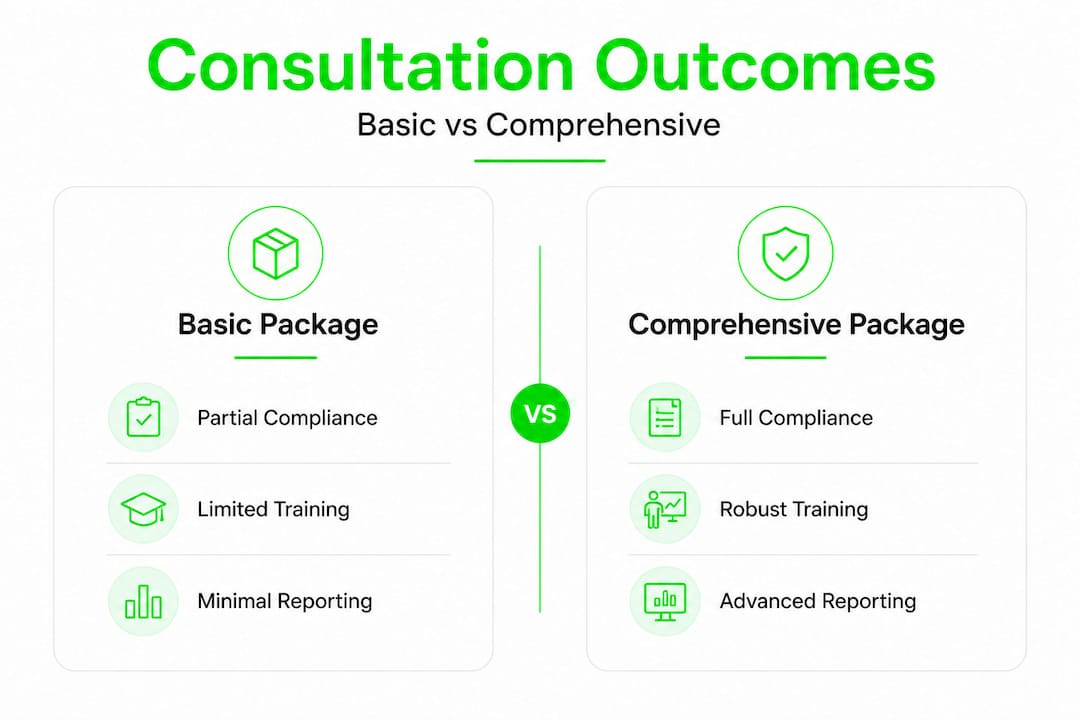
To illustrate the difference between service levels, here is a comparison of what a basic versus comprehensive package typically includes:
| Feature | Basic package | Comprehensive package |
|---|---|---|
| ESG baseline assessment | Yes | Yes |
| Materiality analysis | Limited | Full stakeholder-based |
| Gap analysis (CSRD/EU Taxonomy) | Partial | Complete |
| ESG strategy with KPIs | No | Yes |
| Sustainability report drafting | No | Yes |
| Staff training | No | Yes, multi-session |
| Carbon footprint (Scope 1, 2, 3) | Scope 1 only | All scopes |
| EcoVadis preparation | No | Yes |
The difference in outcomes is substantial. Basic packages often leave companies partially compliant and poorly equipped for the next reporting cycle. Comprehensive packages build lasting capability.
Pro Tip: Engage internal stakeholders, including finance, operations, procurement, and HR, from the very first stage. Green consultation succeeds or fails based on data access and cross-department cooperation. Starting those conversations early prevents delays and surface-level outputs.
Now that the core process is clear, let’s focus on how green consultation targets compliance with major regulations such as the CSRD in the EU, and why it matters to your business.
ESG, CSRD, and compliance: How green consultation futureproofs your business
The Corporate Sustainability Reporting Directive (CSRD) is reshaping ESG obligations for thousands of companies across the EU. Preparation of sustainability reports in line with CSRD and the development of ESG strategy are now core deliverables for professional consultants, not optional add-ons. Understanding your company’s specific obligations under this framework is the starting point for any serious green consultation engagement.
Here is a snapshot of key EU reporting requirements and timelines relevant to Romanian and international companies:
| Obligation | Who is affected | Deadline |
|---|---|---|
| CSRD reporting (large companies) | 500+ employees, listed | From FY2024 (reports in 2025) |
| CSRD reporting (mid-size listed) | 250+ employees or €40M+ turnover | From FY2025 (reports in 2026) |
| EU Taxonomy disclosure | Companies subject to CSRD | Concurrent with CSRD |
| CBAM (Carbon Border Adjustment Mechanism) | Importers of carbon-intensive goods | Phased from 2024 to 2026 |
| EcoVadis assessment | Supply chain requirement, buyer-driven | Ongoing |
The scale of this shift is significant. Approximately 50,000 companies across the EU will eventually fall under CSRD reporting requirements, up from roughly 11,700 under the previous NFRD (Non-Financial Reporting Directive). Romanian companies that supply to large EU buyers are also indirectly affected through supply chain due diligence obligations, even if they do not yet meet direct CSRD thresholds.
Green consultation translates this regulatory landscape into a manageable, prioritized action plan. Rather than reacting to every new directive, companies that invest in consultation build a compliance architecture that absorbs future changes without starting from scratch.
Pro Tip: Connect your compliance efforts directly to value creation by linking ESG KPIs to your financial planning process. When sustainability targets appear in the same dashboard as revenue and cost metrics, leadership attention follows naturally, and so does budget.
Equipped with an understanding of compliance, let’s explore practical ways your company can integrate green consultation to drive measurable business outcomes.

Integrating green consultation for measurable business impact
Knowing that green consultation matters and actually building it into your company’s strategy are two very different things. Development of action plans, deadlines, and KPIs are standard consultation outcomes, but only when companies show up to the process with intention and structure.
Here is a practical checklist for integrating green consultation into your company strategy:
- Assign internal ownership: Designate a sustainability lead or working group before the consultation begins. Consultants bring expertise; your team provides context, data, and continuity.
- Audit your data readiness: Collect existing energy bills, waste records, procurement data, and HR metrics before the first session. Poor data is the single biggest delay in most ESG engagements.
- Set a clear scope for the engagement: Are you targeting CSRD compliance, an EcoVadis rating improvement, a carbon footprint baseline, or all three? Defined scope produces focused outputs.
- Establish baseline metrics: You cannot manage what you do not measure. Work with your consultant to agree on KPIs for carbon emissions, energy intensity, waste diversion, and supplier sustainability performance.
- Plan for iteration, not perfection: Your first sustainability report will not be perfect. That is fine. The goal is a credible, defensible baseline you can improve year over year.
- Build the training component in from the start: External consultants should transfer knowledge, not create permanent dependency. Ensure the engagement includes training sessions, documentation, and tools your team can use autonomously.
Common pitfalls to avoid include treating green consultation as a one-department project, underestimating the time required for data collection, and publishing sustainability commitments without the internal systems to back them up. The last one is particularly risky. Greenwashing, which means making environmental claims that are not supported by evidence, is increasingly scrutinized by both regulators and the public. A practical sustainability assessment done honestly and thoroughly is your best protection against that exposure.
Pro Tip: Identify two or three quick wins in the first 90 days of your green consultation engagement. Reducing energy waste in a specific facility, achieving a higher EcoVadis score on one category, or publishing a first carbon footprint calculation. Small wins build organizational momentum and signal to leadership that sustainability investments deliver tangible results.
With practical steps in hand, let’s step back and consider what most businesses get wrong, and what really drives green consultation success.
What most companies miss about green consultation
Here is an uncomfortable truth: most companies that engage professional green consultation services do not fail because they chose the wrong framework or missed a reporting deadline. They fail because they treat the entire process as a compliance exercise rather than a strategic one.
We have seen this pattern repeatedly. A company hires a consultant, produces a CSRD-aligned report, submits it, and then shelves the whole effort until next year. The data collection was painful, the process was opaque to most of the organization, and nothing actually changed in how the company operates. That is not green consultation. That is box-ticking with expensive help.
True value from green consultation emerges when sustainability is embedded into how the company makes decisions, not just how it reports. This means procurement teams considering carbon intensity when evaluating suppliers. It means finance teams understanding how EU Taxonomy alignment affects access to green bonds. It means operations managers tracking energy efficiency the same way they track production output. A deep-dive sustainability assessment is only the beginning; the real work is organizational.
The other piece that companies consistently underestimate is culture change. Templates, checklists, and frameworks are tools. They are useful tools. But no tool generates sustained progress without sustained leadership attention. When the CEO treats sustainability as a communications function and delegates it entirely to one junior manager, the results reflect that. When leadership visibly connects sustainability performance to business strategy, the whole organization moves differently.
This is why we built ECONOS around a training-first model. Building internal capacity, through ECONOS Academy and tools like our AI-powered carbon accounting assistant AVA, is how you make green consultation stick. The goal is never permanent reliance on external consultants. The goal is a company that understands what it is doing and why, can answer hard questions from investors and customers, and keeps improving even when no consultant is in the room.
The companies that get this right treat green consultation not as a cost of compliance but as an investment in organizational intelligence. That shift in mindset is worth more than any single report.
Take the next step with expert green consultation
If this article has clarified anything, it is that green consultation is too consequential to improvise. Whether your company is navigating its first CSRD reporting cycle, preparing for an EcoVadis assessment, or trying to understand Scope 3 emissions across a complex supply chain, having an experienced partner makes the process faster, more accurate, and far less stressful.
At ECONOS, we combine hands-on expertise in ESG reporting, life cycle assessment services, and EcoVadis certification with a genuine commitment to building your team’s capacity, not your dependency on us. We have supported companies like Michelin, eMAG, Romstal, and Raiffeisen Bank across 158 projects in 17 industries. We hold a Gold EcoVadis rating ourselves, because we practice what we help others achieve. If you are ready to move from confusion to clarity on your sustainability journey, we are ready to help.
Frequently asked questions
What deliverables should I expect from a professional green consultation?
Typical deliverables include an ESG assessment, materiality analysis, CSRD-aligned sustainability report, ESG strategy with KPIs, and targeted training for compliance and reporting. The specific scope depends on your company’s size, industry, and regulatory exposure.
Is green consultation only relevant for multinationals?
No. Even mid-size companies in Romania and the EU face growing regulatory and reporting obligations that green consultation directly addresses, particularly through CSRD applicability thresholds and supply chain due diligence requirements from larger customers.
How soon should my company start a green consultation process?
Early engagement enables better adaptation to CSRD and ESG trends, giving your company a strategic edge rather than a reactive scramble. Starting 12 to 18 months before your first reporting deadline is ideal.
Can green consultation help define and track ESG KPIs?
Yes. Professional consultants create measurable action plans with KPIs to ensure sustainability efforts produce real business impact, not just well-formatted reports. These KPIs are then integrated into your management systems for ongoing tracking.