
.png)

TL;DR:
- Most companies believe their supply chains are fully traceable, but many still unknowingly use prohibited labor or materials. EU regulations like CSRD and CSDDD require Romanian companies to actively manage and verify ethical supply chain practices beyond mere documentation. Effective compliance demands strategic policies, risk-based supplier segmentation, digital verification tools, and leadership commitment to genuinely uphold human rights and environmental standards.
Most companies believe they know their supply chains. They have supplier lists, audit reports, and traceability certificates. Yet 90% of major brands showed traces of prohibited cotton linked to forced labor despite claiming near-complete traceability. For Romanian mid-sized and large companies operating under tightening EU rules, the gap between claimed compliance and verified ethical supply chain reality is not just a reputational risk. It is a legal and financial liability. This guide explains what that gap looks like, what regulators now expect, and what you can actually do about it.
Table of Contents
- Understanding ethical supply chains and regulatory landscape in Romania
- The verification gap: why supply chain visibility isn’t enough
- Key components of an effective ethical supply chain program
- Navigating compliance: EU directives and enforcement impact on Romanian companies
- Applying ethical supply chain best practices: strategies for Romanian mid-sized and large companies
- Why many ethical supply chain efforts fail and what Romanian firms can do differently
- How ECONOS supports Romanian companies in ethical supply chain compliance
- Frequently asked questions
Key Takeaways
| Point | Details |
|---|---|
| Verification gap impact | Many companies face major risks because claimed supply chain visibility often misses forced labor and unethical sources. |
| Regulatory scope | Romanian companies with over 1,000 employees and €450 million turnover must comply with evolving EU ESG reporting laws by 2029. |
| Program essentials | Effective ethical supply chains require comprehensive risk assessments, grievance mechanisms, public reporting, and sufficient budgets. |
| Compliance timelines | CSRD and CSDDD introduce phased obligations and penalties, mandating due diligence beyond direct suppliers. |
| Practical approach | Romanian firms should prioritize high-risk sectors, use digital tools, reform purchasing practices, and ensure leadership commitment. |
Understanding ethical supply chains and regulatory landscape in Romania
An ethical supply chain ensures that every product and service your company buys respects human rights, labor standards, and environmental rules throughout the entire value chain, not just at your direct suppliers. It covers living wages, safe working conditions, no forced or child labor, and responsible use of natural resources. In Europe, that definition is no longer aspirational. It is written into law.
Two EU directives are reshaping what Romanian companies must do. The first is the Corporate Sustainability Reporting Directive (CSRD), which requires detailed ESG (environmental, social, and governance) disclosures including supply chain information. Romania fully transposed CSRD via Ministry of Finance Order No. 85/2024 and Financial Supervisory Authority Rule No. 4/2024, meaning national enforcement mechanisms are already active. The second is the Corporate Sustainability Due Diligence Directive (CSDDD), which goes further by requiring companies to actively identify, prevent, and mitigate human rights and environmental risks across their full value chains.
Key applicability facts to know right now:
- CSRD applies to companies with over 1,000 employees and €450 million in turnover, with a compliance deadline of July 2029
- CSDDD targets even larger companies (over 5,000 employees and €1.5 billion turnover) with penalties reaching 3% of global turnover
- Romanian supervisory authorities are actively enforcing these requirements, with scope expected to expand over coming years
- Companies near the thresholds must reassess applicability annually, as M&A activity or organic growth can trigger obligations unexpectedly
Working with a partner experienced in Romanian ESG compliance consulting matters here, especially because the local transposition includes nuances that generic EU-level guidance tends to miss. You can also track the latest changes in ESG regulations in Romania as the regulatory picture continues to evolve.
The verification gap: why supply chain visibility isn’t enough
With the regulatory framework clear, it is vital to understand why traditional traceability methods frequently fall short in ensuring ethical compliance. Most companies believe that having a supplier database and conducting annual audits means they have visibility. They do not.
“72% of companies claiming full supply chain visibility traced only to Tier 1 suppliers, leaving deeper tiers entirely opaque, which is precisely where most labor and environmental risks concentrate.”
The problem is structural. Tier 1 suppliers are your direct vendors, but the factories making the raw materials, the farms growing the cotton, the smelters processing the metals, those sit at Tier 2, 3, or even deeper. Most audit programs never touch them. And most supplier “transparency” declarations are based on self-reporting rather than independent physical or forensic verification.
The consequences are measurable and harsh:
- 90% of brands had prohibited cotton despite 87% to 94% claiming traceability, exposing the failure of audit-only approaches
- 80% of companies experienced border delays and financial penalties directly tied to verification gaps
- Consumer trust is eroding fast; buyers, investors, and procurement officers are increasingly skeptical of self-declared compliance
The financial harm from verification gaps compounds quickly. Customs holds, product seizures under the EU Forced Labor Regulation, reputational damage, and contract losses from ESG-conscious buyers all carry real costs. It is no longer enough to have paperwork. Regulators and border authorities increasingly expect scientific, forensic, or geo-verified evidence, not just signed declarations.
Looking at sustainable supply chain practices examples from companies that have already closed this gap gives you a clearer sense of what verified compliance actually looks like in practice. For companies ready to build structured internal processes, starting with an ESG workflow creates the data foundation that verification requires.
Key components of an effective ethical supply chain program
Understanding the verification challenges, here is how companies can effectively build ethical supply programs that meet evolving demands. There is no single template, but there are non-negotiable building blocks.
- Policy foundation. A publicly available human rights and environmental policy statement, signed by leadership, sets the tone for the whole program. This is not a box-ticking exercise; suppliers, auditors, and regulators read these documents.
- Risk-based supplier segmentation. Not every supplier carries equal risk. Classify your supply base by geography, commodity type, and sector. Concentrate initial Human Rights Due Diligence (HRDD) resources where risks are highest.
- Supplier code of conduct. A clear, contractually binding code that cascades to Tier 1 and, wherever possible, Tier 2 suppliers. Adopting HRDD in a minimum viable way for mid-sized firms costs roughly $100,000 to $300,000 in year one, covering the policy statement, risk assessment, grievance mechanism, and public reporting.
- Audit and verification program. Audits are necessary but not sufficient (more on that in the perspective section). Third-party audits cost between $3,000 and $8,000 per site. Annual HRDD program costs for companies managing 500 to 2,000 suppliers range from $1.5M to $5M, including training ($500 to $2,000 per site).
- Grievance mechanism. Workers and communities must have a safe, accessible way to report concerns. This is a CSDDD requirement, and it is one of the most under-resourced elements of most programs.
- Transparent reporting. Annual public disclosure aligned with ESRS (European Sustainability Reporting Standards) formats, covering material risks, actions taken, and outcomes, not just intentions.
Pro Tip: Digital traceability platforms and real-time supplier monitoring tools reduce the manual burden significantly and create audit-ready evidence trails. If your team is building or refreshing an ethical supply chain program, reviewing supply chain best practices from comparable companies saves months of internal debate. And if you want to understand how ESG compliance creates value rather than just cost, the framing matters.

Navigating compliance: EU directives and enforcement impact on Romanian companies
Knowing program elements helps, but understanding legal obligations and enforcement risks completes the compliance picture. CSRD and CSDDD are related but distinct instruments with different scopes and timelines.
| Directive | Size threshold | Core obligation | Deadline | Penalty |
|---|---|---|---|---|
| CSRD | >1,000 employees, >€450M turnover | Sustainability reporting including supply chain disclosures | July 2029 | National supervisory enforcement |
| CSDDD | >5,000 employees, >€1.5B turnover | Full value chain due diligence and risk management | Phased from 2027 | Up to 3% of global turnover |
A few things worth spelling out clearly:
- Romania has fully transposed CSRD, meaning national reporting rules are already in effect, not pending
- CSDDD imposes active risk management obligations, not just disclosure; companies must identify, address, and report on adverse impacts
- Firms hovering near size thresholds need annual reassessment, not a one-time determination
- The overlap between CSRD and CSDDD creates reporting efficiency opportunities if programs are designed together from the start
Understanding what these laws require for your specific exports is critical. Guidance on ESG compliance for European exports walks through the interaction between these directives and trade obligations. Companies earlier in the journey can benefit from a structured view of the EU sustainability compliance process before diving into individual directive requirements.
Applying ethical supply chain best practices: strategies for Romanian mid-sized and large companies
With legal and program insights in place, here is how Romanian companies can practically implement ethical supply chain management to meet EU demands. The good news is that you do not need to do everything at once.
Start here:
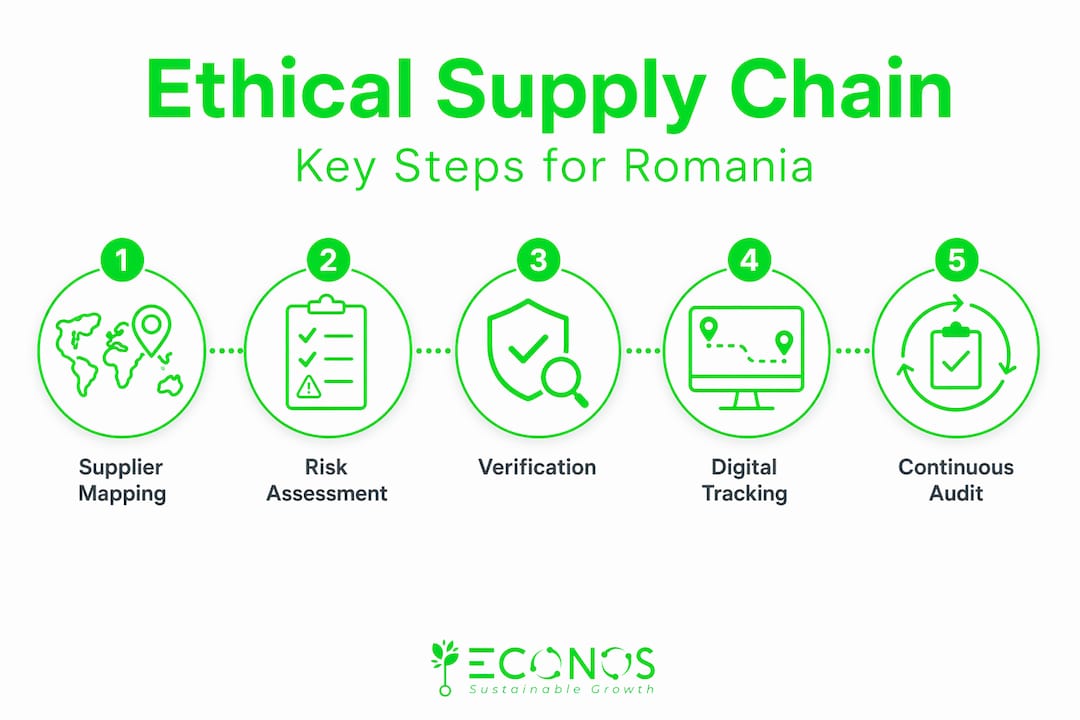
- Map your supply chain. Even a partial map that captures your top 20 suppliers by spend and categorizes them by risk is better than nothing. For Romanian companies in sectors like agriculture, textiles, or construction materials, a risk-based approach prioritizing high-risk commodities and geographies is viable before launching full audit programs.
- Adopt a supplier code of conduct now. Even a one-page code with clear expectations on labor rights, environment, and anti-corruption creates contractual accountability that makes later enforcement far easier.
- Build internal cross-functional ownership. Procurement, legal, compliance, and sustainability teams must all be involved. Supply chain ethics cannot live in a single department.
- Invest in digital traceability. Digital traceability platforms cost $50,000 to $150,000 per year and integrate with ERP systems to provide geo-verified evidence that directly supports compliance documentation.
- Run continuous monitoring, not just periodic audits. Worker feedback mechanisms, satellite monitoring for environmental risk, and real-time supplier performance dashboards are now available at accessible price points.
Pro Tip: When choosing a digital traceability tool, confirm it can generate evidence in formats that satisfy ESRS S2 (workers in the value chain) reporting requirements. Many platforms produce dashboards but not structured data exports. That distinction matters when your auditor or regulator asks for documentation. For companies tracking how compliance investments pay off over time, reviewing ESG compliance efficiency gains alongside a practical EU export compliance guide provides the full picture.
Why many ethical supply chain efforts fail and what Romanian firms can do differently
Here is an uncomfortable truth that most compliance guides avoid: the majority of ethical supply chain programs fail not because companies lack policies, but because the root causes of supply chain abuses often sit inside the buying company itself.
Short lead times, last-minute order changes, relentless price pressure, these are buying behaviors that push suppliers into corners where labor violations become inevitable. Social audits show no consistent long-term impact on reducing violations, and buyers’ purchasing behaviors are frequently identified as direct contributors to human rights abuses, even when compliance programs are formally in place. You can audit your way into a filing cabinet full of green checkmarks while the workers at your Tier 2 factory are still doing forced overtime to meet your rush order.
This is where we see Romanian companies have a genuine opportunity to differentiate. Many are still early enough in their ESG journey that they can build ethical supply chain governance and procurement reform together, rather than retrofitting compliance onto broken purchasing practices. Leadership commitment across the entire supply chain is not a nice-to-have. It is the single biggest predictor of whether an ethical supply chain program actually changes behavior or just generates paperwork.
The companies that get this right treat supply chain ethics as a risk management discipline, not a PR effort. They measure it, they budget for it, and they hold procurement managers accountable for it the same way they are held accountable for cost and delivery. For Romanian companies ready to take that step, consulting for Romanian ESG compliance that integrates both governance design and procurement practice reform is the most effective starting point.
How ECONOS supports Romanian companies in ethical supply chain compliance
Romanian companies navigating CSRD, CSDDD, and growing buyer requirements do not have to figure this out alone.
ECONOS is a sustainability consultancy founded in Romania in 2020, and we have completed over 158 projects across 17 industries with clients including Michelin, eMAG, Romstal, Raiffeisen Bank, and PORR. We hold a Gold EcoVadis rating and accredited EcoVadis Core partner status. Our approach is practical: we build internal capacity in your team rather than creating dependency on external consultants. Through ESG reporting services, our digital ESG compliance platform, and EcoVadis certification support, we help you get compliant, get rated, and understand exactly what you are doing and why.
Frequently asked questions
What is the main difference between supply chain visibility and ethical verification?
Supply chain visibility means knowing your suppliers, usually at Tier 1, while ethical verification scientifically confirms the origin and compliance of materials across multiple tiers. 90% of major brands showed prohibited cotton despite claiming traceability, which illustrates exactly why visibility without verification leaves companies exposed.
Which Romanian companies must comply with the EU Corporate Sustainability Reporting Directive?
CSRD applies to companies with over 1,000 employees and €450 million in turnover, including ESG reporting and supply chain disclosures, with enforcement beginning by July 2029. Romania has already transposed the directive into national law, so supervisory mechanisms are active now.
How can mid-sized Romanian companies start improving ethical supply chain compliance?
Start with risk-based supplier mapping focused on high-risk sectors, adopt a clear supplier code of conduct, and begin with high-risk sectors before launching full audit programs. Digital traceability tools can be added incrementally as your program matures.
What are common pitfalls in ethical supply chain management to avoid?
Relying solely on periodic social audits without reforming internal purchasing practices is the most common failure mode. Purchasing practices are major contributors to human rights violations even when compliance programs formally exist, so leadership engagement and procurement reform must go hand in hand with any audit program.