
.png)

TL;DR:
- Manufacturers must develop comprehensive, automated ESG workflows to meet upcoming CSRD reporting deadlines.
- Technology tools like ERP integration and AI validation are essential for scalable, accurate ESG data management.
- Building internal skills and early supplier engagement are critical for effective ESG compliance and audit readiness.
Regulatory pressure on manufacturers in Romania and across Europe is real, and it is accelerating. Mid-size and large companies are now preparing for CSRD reporting postponed to 2028 for fiscal year 2027, which sounds like breathing room until you realize how much internal work is required. Building an ESG workflow from scratch, one that handles emissions data, social metrics, supply chain audits, and regulatory checkpoints, is not a weekend project. This guide walks you through every stage: from understanding what your workflow needs to include, to designing it, automating it, and verifying that it actually holds up under scrutiny.
Table of Contents
- Understanding ESG workflow requirements for manufacturers
- Step-by-step guide: Designing your ESG workflow
- Tech tools and automation for ESG workflows
- Troubleshooting, auditing, and verifying ESG workflow performance
- Our perspective: ESG workflow lessons for Romanian manufacturers
- Upgrade your ESG workflow capabilities
- Frequently asked questions
Key Takeaways
| Point | Details |
|---|---|
| CSRD deadline clarity | Romanian manufacturers report ESG from 2028—planning ahead is essential. |
| Workflow essentials | A robust ESG workflow requires process modeling, supply chain audits, and tailored KPIs. |
| Automation benefits | Tech solutions can automate up to 80% of ESG tasks, freeing resources for strategic improvement. |
| Audit readiness | Regular audits and intelligent data management help overcome supply chain and compliance challenges. |
Understanding ESG workflow requirements for manufacturers
Before you design anything, you need to know what you are building toward. The CSRD criteria and reporting deadlines apply to mid-size and large firms in Romania, with first reports due for FY2027. That timeline is firm. Waiting until 2027 to start building your workflow is not a strategy; it is a liability.
An ESG workflow is not just a reporting checklist. It is a structured set of processes that connects people, technology, and data across your entire operation. Think of it as the backbone of how your company collects, validates, and communicates sustainability information. The ESG regulatory changes landscape is shifting fast, and companies that treat ESG as a bolt-on compliance task tend to struggle most when audits arrive.
Here is what a functional ESG workflow actually requires:
- People: Designated owners for each data stream, from energy consumption to supplier ethics
- Technology: Software that integrates with your existing ERP and automates data collection
- Process: Clear steps for data gathering, validation, escalation, and reporting
- Governance: Defined approval chains and audit trails that satisfy external verifiers
The concept of sustainable BPM (business process management) is useful here. Sustainable BPM integrates ESG considerations directly into workflow design, using specific modeling patterns and KPIs like carbon intensity, waste ratios, and social compliance metrics. It moves ESG out of the sustainability team’s inbox and into the operational core of the business.
The contrast between traditional and integrated ESG approaches is stark:
| Approach | Data collection | Reporting frequency | Audit readiness |
|---|---|---|---|
| Traditional (siloed) | Manual, fragmented | Annual | Low |
| Integrated ESG workflow | Automated, centralized | Continuous | High |
One risk worth naming: companies that rely on fragmented processes face real SFDR greenwashing risks when their reported data does not match operational reality. The best ESG workflow practices are built to prevent exactly that.
Step-by-step guide: Designing your ESG workflow
Now that the requirements are clear, let’s walk through designing an actual ESG workflow for your manufacturing operations. The goal is a workflow that is specific enough to be useful and flexible enough to evolve.
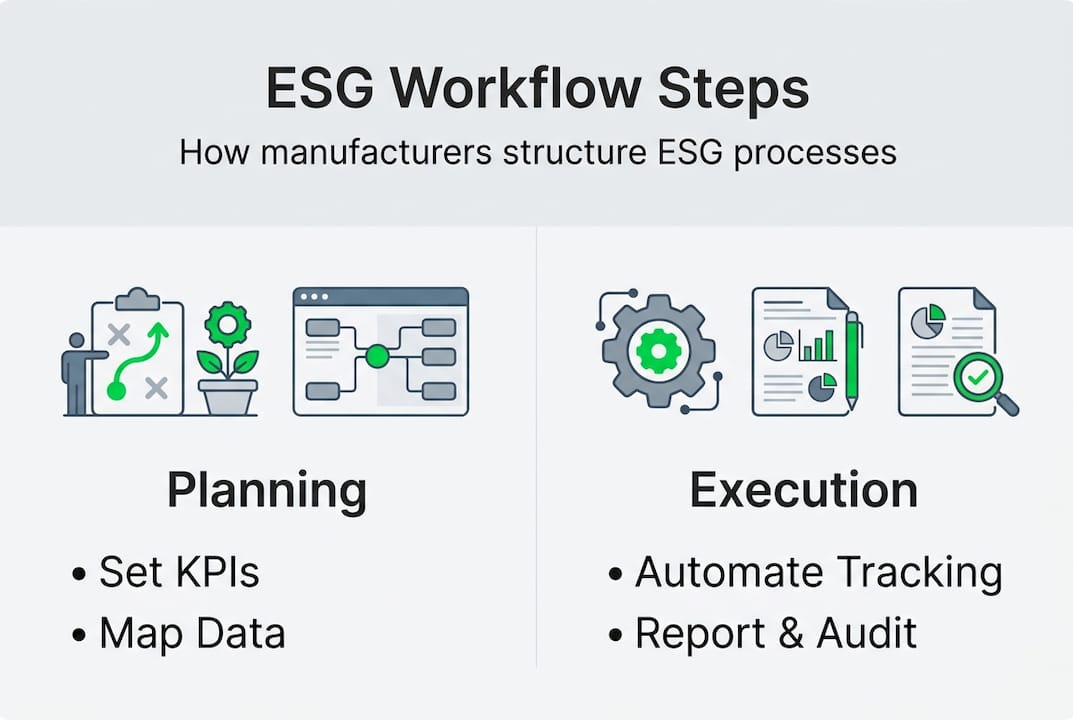
- Map your emission sources. Start with Scope 1 (direct emissions from your facilities), Scope 2 (purchased energy), and Scope 3 (supply chain and product use). Each scope needs a designated data owner and a collection method.
- Define your social KPIs. Diversity metrics, labor practices, and ethics compliance are not optional under CSRD. Assign ownership and set baseline measurements now.
- Build compliance checkpoints. Each stage of your workflow should include a verification step where data is reviewed against ESRS (European Sustainability Reporting Standards) requirements before moving forward.
- Model your workflow using ESG process modeling patterns. Sustainable BPM integrates ESG workflow steps with KPIs such as carbon intensity and waste reduction targets, making your process auditable by design.
- Assign escalation paths. When data is missing or out of range, who gets notified? Clear escalation prevents bottlenecks during reporting periods.
- Test with a pilot scope. Run one facility or one product line through the full workflow before scaling. This surfaces gaps without exposing your entire operation.
Here is a practical KPI reference for manufacturers:
| ESG dimension | Example KPI | Measurement unit |
|---|---|---|
| Environmental | Carbon intensity | tCO2e per unit produced |
| Environmental | Waste diversion rate | % of waste recycled or reused |
| Social | Gender pay ratio | % difference |
| Governance | Ethics training completion | % of employees |
Manufacturers that leverage intelligent manufacturing for green innovation consistently achieve better ESG outcomes because their data collection is already embedded in production systems. That is a significant advantage. Check the latest ESG workflow trends and ESG case studies to see how peer companies are structuring their approaches.

Pro Tip: Start with energy and waste tracking. These two data streams are usually the easiest to automate and deliver the fastest visible wins, which builds internal momentum for the harder work ahead.
Tech tools and automation for ESG workflows
With your workflow design mapped, let’s explore how tech tools can transform the way you build and monitor ESG processes. The honest truth is that manual ESG data collection does not scale. It creates errors, delays, and audit vulnerabilities.
ESG software can automate up to 80% of manual tasks for manufacturers. Tools like Tanso, IBM Envizi, and PwC’s ESG platforms handle data ingestion, emissions calculations, supply chain audits, and regulatory report generation. That is not a small efficiency gain. It is the difference between a two-person team drowning in spreadsheets and a lean operation that produces audit-ready reports on demand.
Key capabilities to look for in ESG workflow software:
- ERP integration: Your ESG tool should pull data directly from SAP, Oracle, or whatever system your production team already uses
- AI-driven data validation: Automated checks that flag anomalies before they become audit findings
- Supply chain audit modules: Tools that send data requests to suppliers and track response rates
- Regulatory mapping: Built-in alignment with CSRD, ESRS, and EU Taxonomy requirements
- Dashboard and reporting: Real-time visibility into your ESG KPIs, not just year-end snapshots
For manufacturers exploring industrial energy automation, integrating energy storage and monitoring systems with your ESG software creates a continuous data feed that eliminates manual meter reading entirely.
Pro Tip: Before purchasing new software, audit what your existing ERP already captures. Energy consumption, waste output, and headcount data are often already there. A good ESG tool connects to these existing streams rather than duplicating them. This approach reduces implementation time and avoids the data reconciliation headaches that come from running parallel systems.
If you are exploring reporting automation options, prioritize tools that offer ESRS-aligned templates out of the box. Custom-built templates take time and often miss regulatory nuances. Review automation tips from companies that have already gone through implementation.
Troubleshooting, auditing, and verifying ESG workflow performance
Once your workflow is running, you will need ways to verify performance, troubleshoot issues, and handle audits efficiently. This is where many manufacturers hit a wall.
The most common ESG workflow problems we see:
- Data silos: Different departments using incompatible formats for the same data type
- Scope 3 gaps: Supply chain emissions are notoriously hard to collect because your suppliers may not have their own ESG systems
- Skills shortage: Skilled ESG auditors are scarce, and internal teams often lack the technical knowledge to validate complex emissions calculations
- Inconsistent baselines: Without a clearly defined baseline year, year-over-year comparisons become meaningless
“Internal audit is evolving from a compliance function into a strategic ESG tool. Companies that invest in audit capability now are building a competitive advantage, not just managing a regulatory obligation.”
For Scope 3 data integration and supply chain verification, AI-powered validation tools can flag missing or implausible data points before they reach your external auditor. This dramatically reduces the cost and stress of third-party assurance.
When it comes to audits, the distinction between internal and external matters. Internal audits are your rehearsal. They should happen at least twice a year and focus on data completeness and process adherence. External audits, required under CSRD for limited assurance, need a clean audit trail and documented methodology. Review audit case studies to understand what auditors actually look for.
The ESG audit best practices that work in practice involve treating every audit finding as a workflow improvement opportunity, not a failure. The companies that improve fastest are the ones that document what went wrong and fix the process, not just the number.
Our perspective: ESG workflow lessons for Romanian manufacturers
We have worked with manufacturers across Romania and Europe long enough to see patterns in what breaks and what holds. The honest observation is that most ESG workflows in Romania do not fail because of bad intentions. They fail because of skills gaps and a cultural reluctance to admit when data is incomplete.
The hidden cost of ESG is not software or consulting fees. It is the internal time required to build genuine data literacy across departments. When a production manager does not understand why they are collecting energy data, the data quality suffers. Training is not optional; it is the foundation.
Research on ESG impacts shows that ESG boosts competitiveness and resilience, but upfront costs are real. Smaller manufacturers actually gain more from green transformation than larger ones, because the efficiency improvements are proportionally larger. That is a counterintuitive finding worth sitting with.
The practical shortcuts that actually work: start with supplier engagement early, use your first internal audit as a training exercise rather than a performance review, and pick two or three KPIs where you can show measurable improvement within six months. Quick wins matter. They build the internal credibility that sustains the longer work. Explore lessons from case studies and our broader consulting perspectives for more on this approach.
Upgrade your ESG workflow capabilities
Building an ESG workflow that actually holds up under CSRD scrutiny takes more than good intentions. It takes structured processes, the right tools, and people who understand what they are doing and why.
At ECONOS, we help mid-size and large manufacturers in Romania and Europe do exactly that. Whether you need a carbon footprint assessment to establish your baseline or end-to-end ESG workflow consulting to get your reporting process audit-ready, our team builds internal capacity rather than dependency. We have completed over 158 projects across 17 industries. We know what works in practice, not just in theory. Let’s build something that lasts.
Frequently asked questions
What is the CSRD deadline for Romanian manufacturers to start ESG reporting?
Medium and large manufacturers must report sustainability under CSRD from 2028 for FY2027, following a two-year postponement introduced in Romania. This does not mean preparation can wait.
Which manufacturing ESG workflow KPIs are most critical for compliance?
Key ESG KPIs include Scope 1, 2, and 3 emissions, carbon intensity, waste metrics, workforce diversity ratios, and ethics compliance rates. These cover the environmental, social, and governance dimensions required under ESRS.
What technology can automate ESG workflows for manufacturers?
Software solutions such as Tanso, IBM Envizi, and PwC platforms automate up to 80% of manual ESG data collection, reporting, and supply chain management tasks for manufacturers.
How can manufacturers overcome supply chain data and audit challenges for ESG?
Audits and AI software can validate supply chain data and resolve format inconsistencies, but building internal audit skills remains essential because qualified ESG auditors are still scarce in the Romanian market.