
.png)

TL;DR:
- An ESG materiality assessment, known as the Double Materiality Assessment under CSRD, identifies sustainability topics that impact business and society, requiring independent impact and financial evaluations. This process must be thoroughly documented and involve structured stakeholder engagement to ensure compliance and assurance readiness by considering impact scope, risk, opportunity, and suitable ESRS standards. Embedding early planning, clear governance, and regular reassessment are essential for producing a credible, audit-ready sustainability report.
An ESG materiality assessment is the structured process by which a company identifies, evaluates, and prioritizes the environmental, social, and governance topics that matter most to its business performance and its impact on people and the planet. Under the Corporate Sustainability Reporting Directive (CSRD) and the European Sustainability Reporting Standards (ESRS), this process is no longer optional for in-scope companies. It is the foundation of every disclosure obligation you carry, and getting it wrong means your entire sustainability report is built on sand.
What is an ESG materiality assessment and why does it matter in 2026?
The term “ESG materiality assessment” is widely used in practice, but the recognized industry term under CSRD is the Double Materiality Assessment (DMA). Both refer to the same structured process of determining which sustainability topics trigger disclosure requirements. The distinction matters because the DMA framework demands two separate evaluations, not one.

Double materiality means a sustainability topic is material if it is significant either for its impact on people and the environment, or for its effects on the company’s finances. Either lens crossing the threshold triggers ESRS disclosure obligations. This is a critical point many teams misread: you do not need both lenses to confirm materiality. One is enough.
This dual structure sets CSRD/ESRS apart from the International Sustainability Standards Board (ISSB), which focuses exclusively on financial materiality, and from the Global Reporting Initiative (GRI), which centers on impact materiality. If your company reports under multiple frameworks, you need to understand which lens each standard requires. Conflating them produces gaps that auditors will find.
For compliance officers at mid-size and large companies entering their first CSRD reporting cycle, the DMA is the single most consequential piece of work you will do. Every ESRS topic standard you apply or omit traces back to this assessment.
What is double materiality and why does it matter for ESG assessments?
Double materiality operates through two distinct lenses that must be assessed independently before being combined into a final determination.
Impact materiality asks whether the company causes, contributes to, or is directly linked to significant impacts on people or the environment across its value chain. Severity, scale, and the company’s ability to influence the impact all factor into the score.
Financial materiality asks whether a sustainability topic creates risks or opportunities that could reasonably affect the company’s cash flows, access to capital, or cost structure over short, medium, or long time horizons.
The practical implications of this split are significant:
- A company’s water consumption in a water-stressed region may be material from an impact perspective even if it carries no near-term financial risk.
- A supplier’s labor practices may be financially material due to reputational and supply chain disruption risk, even if the company’s direct impact is limited.
- Climate physical risks may be financially material over a 10-year horizon but not yet reflected in current financial statements.
- Biodiversity loss may be impact-material for a food company operating near protected areas, regardless of whether it affects quarterly earnings.
ESRS 2 requires disclosure of the entire process used to identify and assess material impacts, risks, and opportunities (IROs), including methodology, stakeholder engagement, and the rationale for topics excluded as non-material. This means the process narrative is as important as the output matrix. Assurance providers will scrutinize both.
How to conduct a step-by-step ESG materiality assessment
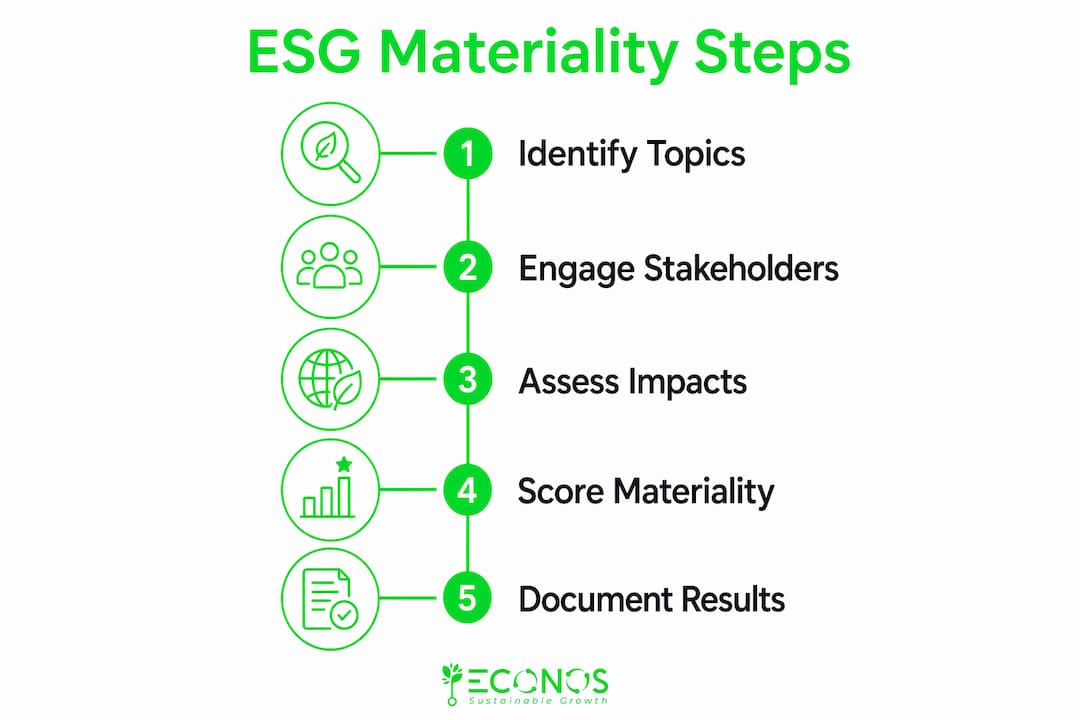
A defensible DMA workflow typically runs through ten stages, from project team assembly to final disclosure mapping. Here is how to structure yours.
-
Assemble a cross-functional project team. Sustainability, finance, legal, procurement, HR, and operations all need representation. The DMA touches every function, and siloed ownership produces blind spots.
-
Build a long list of sustainability topics. Anchor your topic list to the ESRS 1 Application Requirements taxonomy to avoid missing critical issue categories. Supplement with GRI Standards, SASB industry standards, and peer company reports to capture sector-specific issues.
-
Map your value chain. Document upstream suppliers, own operations, and downstream customers. Impact materiality assessment requires you to evaluate IROs across this full scope, not just within your direct operations.
-
Conduct stakeholder engagement. Identify affected stakeholders (employees, communities, customers, investors, NGOs) and users of sustainability information (analysts, lenders, regulators). Design structured surveys and interviews before scoring begins.
-
Score impact materiality. Evaluate each topic on severity (scale, scope, irremediability) and likelihood. Use a consistent numerical scale, such as 1 to 5 or 1 to 10, and document the rationale for every score.
-
Score financial materiality. Assess each topic as a risk or opportunity across short (0 to 1 year), medium (1 to 5 years), and long (5 to 10 or more years) time horizons. Time horizons must be scored independently; averaging them distorts the assessment and can cause genuine risks to fall below the threshold.
-
Apply materiality thresholds. Set quantitative cut-off scores for each lens. Topics above the threshold on either lens are material. Topics below on both lenses are non-material, but you must document why.
-
Validate with leadership. Present results to the executive team and board. Leadership sign-off is not a formality. It creates accountability and ensures the assessment reflects strategic reality.
-
Map material topics to ESRS standards. Each material topic maps to one or more ESRS topic standards (E1 through S4 and G1). This mapping determines your disclosure obligations for the sustainability report.
-
Plan for reassessment. Materiality is not static. Build a review cycle into your ESG calendar, triggered at minimum by significant business changes, new regulations, or major shifts in stakeholder expectations.
Pro Tip: When building your long list, do not start from a blank page. Use the ESRS 1 Application Requirements list of sustainability matters as your baseline, then add sector-specific topics from SASB. This approach is faster, more defensible, and less likely to produce gaps during assurance.
Best practices for documentation, scoring, and assurance readiness
The DMA is only as strong as its documentation. Most assurance failures stem from documentation gaps: absent rationale for non-material topics and incomplete mapping of IROs to ESRS disclosures. Assurance providers are not just checking your materiality matrix. They are checking whether your process was rigorous and traceable.
Your documentation package should include:
- A value chain map showing the scope of your impact and financial assessments
- A comprehensive IRO register listing every topic considered, with scores and the rationale for both material and non-material conclusions
- Records of stakeholder engagement: who was consulted, how, and how their input influenced scoring
- Scoring methodology documentation, including the scale used, threshold levels, and any adjustments made during validation
- A mapping table linking each material topic to the relevant ESRS disclosure requirements (IRO-1 and IRO-2 under ESRS 2)
“The DMA must focus on a defensible documented process narrative to satisfy assurance, not just on the materiality matrix or list of topics.” — ESRS Double Materiality Methodology
Scoring rigor matters as much as documentation. For impact materiality, assess magnitude (scale and scope of the impact), severity (how hard it is to remediate), and likelihood separately before combining them into a composite score. For financial materiality, assess the probability of occurrence and the potential magnitude of financial effect across each time horizon independently. Collapsing time horizons into a single score is a common error that distorts materiality conclusions and undermines the credibility of your report.
One area teams consistently underestimate is the documentation of non-material topics. Auditors will ask why climate adaptation was excluded, or why human rights in the supply chain did not cross the threshold. If you cannot show a scored rationale, the exclusion looks arbitrary. Every topic on your long list needs a documented outcome, whether material or not.
How to engage stakeholders and integrate their input effectively
Stakeholder engagement is not a checkbox in the DMA process. It is a primary data source for impact materiality scoring, and regulators expect it to be structured and traceable.
Start by identifying two distinct groups. Affected stakeholders are those whose interests are impacted by your company’s activities: workers, local communities, customers, and supply chain partners. Users of sustainability information are those who rely on your disclosures to make decisions: investors, lenders, analysts, and regulators. Both groups need to be consulted, but through different methods and with different questions.
Structured surveys that ask stakeholders to rank ESG issues on dimensions such as business impact and management effectiveness, using a 1 to 10 scale, produce data that feeds directly into your scoring model. Qualitative interviews with senior stakeholders add context that surveys cannot capture. The combination of both methods produces a more defensible and nuanced result.
After engagement, translate stakeholder input into quantitative scores using a magnitude-probability framework. Do not simply average stakeholder rankings and call it a materiality score. Use their input to calibrate your internal assessments, then apply your scoring methodology consistently. Combining stakeholder ranking with post-survey scoring builds an actionable materiality matrix that evolves with changing business and regulatory contexts.
Pro Tip: Run a pre-engagement workshop with your project team to align on which stakeholder inputs will influence which scoring dimensions. This prevents the common problem of collecting rich stakeholder data and then not knowing how to use it in the scoring model.
Transparency in your engagement process also protects you during assurance. Document the number of stakeholders consulted, the methods used, the response rates, and how disagreements between internal and external perspectives were resolved. This level of detail signals process integrity to auditors and builds credibility with the readers of your sustainability report.
Key takeaways
A defensible ESG materiality assessment requires independent scoring of impact and financial materiality, structured stakeholder engagement, and a complete documentation package that covers both material and non-material conclusions.
| Point | Details |
|---|---|
| Double materiality is the standard | Under CSRD/ESRS, either impact or financial materiality alone is sufficient to trigger disclosure obligations. |
| Documentation is the audit target | Assurance providers review the process narrative and IRO rationale, not just the final materiality matrix. |
| Time horizons must stay separate | Scoring short, medium, and long-term horizons independently prevents distorted materiality conclusions. |
| Stakeholder input feeds scoring | Structured surveys and interviews should calibrate quantitative scores, not replace them. |
| Reassessment is mandatory | Materiality changes as your business and regulatory context evolve; build a formal review cycle. |
Why the DMA is harder than it looks, and what actually helps
I have worked through enough DMA processes with companies across Romania and France to say this plainly: the double materiality concept is not complicated in theory, but it is genuinely difficult to execute well under time pressure with a cross-functional team that has never done it before.
The most common failure I see is not in the scoring model. It is in governance. Teams start the DMA without clear ownership of each step, and by the time they reach stakeholder engagement, the sustainability manager is doing everything alone while finance and procurement have mentally checked out. The result is a materiality matrix that reflects one person’s judgment dressed up as a cross-functional process. That does not survive assurance.
The second failure is treating the materiality matrix as the deliverable. I have seen companies produce a beautiful two-by-two matrix and then realize, three months before their report deadline, that they have no documentation trail. No scoring rationale. No record of who was consulted or why certain topics were excluded. At that point, you are rebuilding the process from memory, which is both stressful and unreliable.
What actually helps is starting earlier than you think you need to, assigning clear roles before the first workshop, and treating the documentation package as a live working document from day one. The ESG workflow for manufacturers principle applies broadly: build the process infrastructure first, then run the assessment through it. Companies that do this produce reports that hold up under scrutiny. Companies that skip it spend the following year fixing gaps.
The DMA is also not a one-time project. Embedding it into your annual ESG calendar, with a formal trigger for mid-cycle reassessment, is what separates companies that are genuinely managing sustainability risk from those that are just producing reports.
— Mathieu
How Econos-esg can support your materiality assessment and CSRD compliance
If you are preparing for your first CSRD reporting cycle or need to strengthen an existing DMA process, Econos-esg offers hands-on support built around your team’s capacity, not around creating dependency on external consultants.
Econos-esg works with mid-size and large companies across Romania and France on ESG reporting under CSRD/ESRS, including full DMA facilitation, stakeholder engagement design, scoring methodology, and assurance-ready documentation. The team has completed over 158 projects across 17 industries and holds a Gold EcoVadis rating. For companies that also need to quantify their environmental impact as part of the assessment, Econos-esg’s carbon footprint assessment service covers Scope 1, 2, and 3 emissions with the rigor ESRS E1 requires. Reach out to discuss where your process stands and what it needs.
FAQ
What is the difference between single and double materiality?
Single materiality, used by ISSB, focuses only on how sustainability issues affect a company’s finances. Double materiality, required under CSRD/ESRS, adds a second lens: how the company’s activities impact people and the environment, regardless of financial effect.
How often should an ESG materiality assessment be updated?
ESRS requires reassessment whenever significant changes occur in your business, value chain, or regulatory context. Most companies conduct a full review annually and build in a mid-cycle check triggered by major events such as acquisitions or new legislation.
Which stakeholders must be included in a CSRD materiality assessment?
ESRS requires engagement with both affected stakeholders (workers, communities, supply chain partners) and users of sustainability information (investors, lenders, analysts). Both groups must be consulted through structured, documented methods.
What happens if a topic is assessed as non-material?
Non-material topics must still be documented with a scored rationale explaining why they did not cross the threshold on either the impact or financial lens. Absent documentation for excluded topics is one of the most common causes of assurance failure.
Can a company use GRI materiality results for CSRD compliance?
GRI materiality focuses on impact materiality only, which covers one of the two lenses required under CSRD/ESRS. A GRI-based assessment can serve as a useful input, but it must be supplemented with a full financial materiality assessment and updated documentation to meet ESRS 2 requirements.