
.png)

TL;DR:
- ESG due diligence has shifted from a one-time audit to a continuous governance cycle encompassing environmental, social, and governance risks across entire supply chains. Regulatory pressures by 2026 demand integration of ESG into procurement, with cross-document reasoning and traceability as essential tools to prevent greenwashing. Embedding ESG practices into everyday processes enhances risk management, financial valuation, and regulatory compliance, giving organizations a competitive advantage.
Most compliance and sustainability managers treat ESG due diligence as a one-time audit. You get a report, check a few boxes, file it away. That framing is now both outdated and risky. ESG due diligence has evolved into a continuous governance cycle covering environmental risk assessment, social impact, and governance accountability across your entire value chain. Regulatory pressure in 2026 has made this shift non-negotiable. 73% of asset owners incorporate sustainability factors in investment decisions, yet a third cite greenwashing as a significant barrier. This article addresses what rigorous, defensible ESG due diligence actually looks like in practice.
Table of Contents
- Key Takeaways
- What ESG due diligence really covers in 2026
- Best practices for rigorous, greenwashing-proof ESG assessments
- Embedding ESG into procurement and contract workflows
- Translating ESG findings into financial risk and value
- My honest take on where most programs still fall short
- How Econos-esg supports your ESG due diligence program
- FAQ
Key Takeaways
| Point | Details |
|---|---|
| Beyond the checklist | ESG due diligence is a continuous governance cycle, not a one-time corporate social responsibility audit. |
| Regulatory thresholds matter | The EU Omnibus directive confirms obligations for organizations with more than 5,000 employees and €1.5 billion turnover. |
| Greenwashing requires evidence triangulation | Cross-document reasoning comparing utility invoices with emissions claims is the most reliable detection method. |
| Embed ESG into procurement | Integrating ESG criteria into supplier onboarding and contract management reduces downstream compliance risk. |
| Quantify to act | Translating qualitative ESG findings into risk materiality scores enables financial modeling and deal-level decisions. |
What ESG due diligence really covers in 2026
Understanding what is ESG due diligence requires dismantling a popular misconception: it is not simply an audit or an ESG compliance checklist you hand off to a consultant once a year. It is a structured, repeatable process for identifying, assessing, acting on, and monitoring ESG risks and impacts across your organization and supply chain. The OECD six-step framework treats it as a cycle of identification, assessment, action, monitoring, and remedy, not a point-in-time snapshot.
The three pillars remain environmental, social, and governance, but what falls under each has expanded considerably.
- Environmental: Carbon footprint (Scopes 1, 2, and 3), water consumption, biodiversity impact, waste management, and physical climate risk exposure.
- Social: Labor conditions, living wages, freedom of association, human rights along the supply chain, and community impact.
- Governance: Anti-corruption policies, board diversity, executive accountability, tax transparency, and whistleblower protections.
The regulatory context in 2026 adds real urgency. The EU Corporate Sustainability Due Diligence Directive (CS3D or CSDDD) now requires large companies to identify and address adverse human rights and environmental impacts throughout their operations and supply chains. The Corporate Sustainability Reporting Directive (CSRD) mandates detailed disclosure under European Sustainability Reporting Standards (ESRS). The Sustainable Finance Disclosure Regulation (SFDR) governs how financial products are labeled and reported. Importantly, the EU Omnibus directive defers expanded ESG obligations to 2029 for some firms, but confirms active duty for organizations with more than 5,000 employees and €1.5 billion net turnover.
One critical distinction to keep straight: ESG due diligence is about identifying and managing risks, while ESG reporting is about disclosing performance. The first informs the second. Confusing the two leads to disclosure that lacks a credible governance foundation behind it.
Pro Tip: If your organization falls below current CSDDD thresholds, do not treat this as a reason to defer action. Customers, banks, and large clients who are already in scope will push requirements down the supply chain well before 2029.
Best practices for rigorous, greenwashing-proof ESG assessments
The most important shift in how leading organizations approach ESG due diligence is moving from a one-off audit model to a continuous governance model. Here is what that looks like in practice.
-
Build a multidisciplinary team. Effective ESG due diligence cannot rely on a single expert or a single function. It requires environmental specialists, employment law advisors, technical engineers, and legal counsel working together. Each discipline catches what the others miss.
-
Use cross-document reasoning to detect greenwashing. This means comparing claims in sustainability reports against financial statements, utility invoices, procurement records, and operational data. A supplier claiming a 30% reduction in carbon intensity should be able to show it in their energy bills and production output data. Cross-document comparison is the most reliable method for finding discrepancies between narrative and reality.
-
Create a defensible audit trail for every metric. Each data point in your social impact due diligence or environmental risk assessment should link back to a primary source. If you cannot trace a number to an invoice, a meter reading, or a verified third-party audit, it will not hold up under regulatory scrutiny or investor review.
-
Document your risk escalation workflows before incidents happen. Modern ESG due diligence requires documented workflows showing how risks are escalated and mitigated. This is not just good governance. It is increasingly what regulators expect to see during inspections and what banks require for green financing.
-
Avoid over-reliance on management presentations and self-reported supplier data. These are starting points, not endpoints. On-site verification, satellite data for environmental risk assessment, and third-party certifications should all feed into your final assessment.
Pro Tip: When reviewing a supplier’s sustainability claims, always request the underlying raw data alongside the report. The gap between what a company says and what the numbers show is where greenwashing lives. A helpful starting point for identifying those gaps is this guide on avoiding greenwashing in corporate sustainability programs.
Embedding ESG into procurement and contract workflows
A rigorous ESG due diligence process that lives only in a compliance department report will not protect your organization. The real risk reduction happens when ESG criteria are embedded into day-to-day procurement, supplier onboarding, and contract management.

Following ISO 20400, the international standard for sustainable procurement, provides a practical structure for this. It pushes organizations to align procurement policy with their overall sustainability strategy, define ESG requirements at the sourcing stage, and hold suppliers accountable through contractual mechanisms. This is not theoretical. Companies that operationalize ESG procurement requirements consistently report better data quality and stronger enforcement outcomes than those that rely on periodic audits alone.
Here is a comparison of two approaches organizations commonly take:
| Approach | Trigger | Evidence | Enforcement | Limitation |
|---|---|---|---|---|
| Periodic audit model | Annual review cycle | Supplier self-assessment | Report filed, no binding follow-up | Gaps emerge between audit cycles |
| Continuous governance model | Risk-based triggers and event monitoring | Live data, site visits, and third-party verification | Contractual corrective action obligations | Higher resource investment upfront |
The continuous model wins on risk detection and regulatory defensibility. Getting there requires a few concrete steps:
- Risk mapping at onboarding. Use geographic, sector, and spend data to assign every new supplier a risk tier before the first purchase order goes out. High-risk tiers require deeper social impact due diligence and environmental risk assessment before contract execution.
- ESG clauses in every contract. These should specify minimum performance standards, audit rights for your team or a nominated third party, timelines for corrective actions, and exit provisions for material breaches.
- Tracking corrective action closure. Opening a finding is easy. What separates mature programs is systematic tracking of whether corrective actions are actually implemented and verified.
Technology platforms are making this more manageable. Supplier self-assessment portals, risk scoring engines, and integration with ESG reporting workflows mean your procurement team can flag risks in the same system where your compliance team is building regulatory disclosures.
Translating ESG findings into financial risk and value
For ESG due diligence to earn a permanent place in corporate decision-making, it must speak the language of financial risk. Qualitative findings about labor practices or carbon intensity only move deal teams and boards when they are translated into numbers.
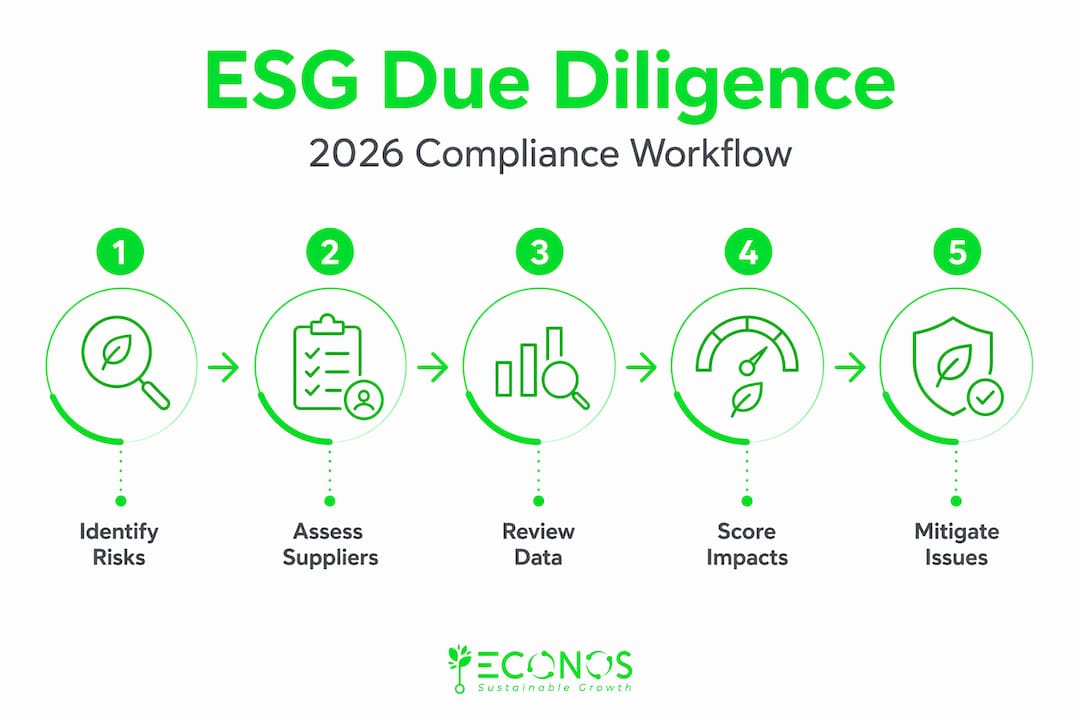
Risk scoring links qualitative ESG findings to financial impacts, supporting pricing adjustments and exit valuations in M&A transactions. A facility with unresolved environmental contamination liability or documented wage theft claims is not just an ethical concern. It is a valuation risk that may require purchase price adjustment or escrow provisions.
A few ways organizations are turning ESG due diligence findings into financial inputs:
- Materiality scores by workstream. Assign a risk rating (high, medium, low) to each ESG finding, then map those ratings to estimated financial exposure ranges. A high-rated labor rights violation in a tier-one supplier carries quantifiable supply chain disruption cost.
- Green financing access. Companies that demonstrate credible ESG governance through audit-ready documentation are increasingly able to access sustainability-linked loans at lower interest rates. This is a direct financial benefit of rigorous due diligence.
- Exit multiple support in M&A. SDG-aligned indices exceed 16% returns in 2026. Buyers are willing to pay a premium for assets with clean ESG records and defensible reporting. Conversely, undisclosed ESG liabilities discovered post-close are among the most common sources of deal disputes.
- 100-day integration plans. Post-acquisition ESG integration planning should begin during due diligence, not after closing. Identifying the highest-priority corrective actions in advance accelerates value realization. Advanced due diligence platforms now enable simultaneous multi-workstream analysis with full source traceability, reducing weeks of manual review to days.
For investors conducting sustainable investment analysis, the connection between due diligence quality and portfolio performance is increasingly direct. For corporate deal teams, it is a risk mitigation and value creation tool in the same transaction. Building smarter, more resilient portfolios starts with the quality of data collected during the due diligence phase.
My honest take on where most programs still fall short
I have worked with enough companies across enough industries to say this plainly: the biggest failure in ESG due diligence programs is not malice. It is complacency disguised as process.
Organizations build a checklist, get through an audit cycle, produce a report, and call it governance. Then a labor rights issue surfaces in a tier-two supplier, or a regulatory inspection finds emissions data that cannot be traced back to actual meter readings, and suddenly the “process” turns out to have been documentation without substance.
What I have learned from both failures and successes is that the discipline of traceability is what separates real programs from performative ones. Every claim needs a source. Every finding needs a corrective action with an owner and a deadline. And every corrective action needs someone verifying closure, not just ticking a box.
The greenwashing challenge is real, and I admit it is getting harder to detect as sustainability communications become more sophisticated. That is precisely why cross-document reasoning and multidisciplinary teams are not optional extras. They are the only reliable method for connecting narrative to reality.
The future of ESG due diligence is not a more complicated checklist. It is integration into procurement governance, financial modeling, and enterprise risk management as a standard operating procedure. Companies that get there early will have a structural advantage. The ones that wait for a regulatory enforcement action to force the issue will spend far more to catch up than they would have spent building it right the first time. That is not pessimism. It is an honest read of where things are heading.
— Mathieu
How Econos-esg supports your ESG due diligence program
If reading this article surfaced gaps in how your organization currently manages ESG risk, you are not alone. Most mid-size and large companies have pieces of the process in place but lack the integration, traceability, and evidence quality that 2026 regulations and investors now expect.
Econos-esg supports organizations across all stages of ESG due diligence, from carbon footprint measurement under Scopes 1, 2, and 3 to full ESG reporting under CSRD/ESRS frameworks. Our EU Taxonomy compliance work helps companies map their economic activities to regulatory eligibility criteria with the audit-ready documentation that regulators and banks require. For supply chain assessments, our EcoVadis certification support gives procurement teams a structured, credible framework for supplier evaluation. What sets Econos-esg apart is that we build internal capacity in our clients rather than creating consultant dependency. You understand what you are doing and why, which is exactly what defensible ESG governance requires.
FAQ
What is ESG due diligence?
ESG due diligence is a structured process for identifying, assessing, and managing environmental, social, and governance risks across an organization’s operations and supply chain. Unlike a one-time audit, it is designed as a continuous cycle of assessment and corrective action.
How is ESG due diligence different from ESG reporting?
ESG due diligence identifies and addresses risks before they become material issues, while ESG reporting discloses performance data to external stakeholders. Rigorous due diligence is what makes your ESG disclosures credible and defensible.
Who is required to conduct ESG due diligence under EU regulations?
Under the EU CS3D directive and the 2026 Omnibus update, organizations with more than 5,000 employees and €1.5 billion in net turnover currently face active obligations, with expanded thresholds coming into force by 2029.
How do you detect greenwashing during ESG due diligence?
The most reliable method is cross-document reasoning: comparing sustainability claims in reports against financial records, utility invoices, and operational data to identify discrepancies between what a company says and what the underlying data shows.
What does a good ESG compliance checklist include?
A credible ESG compliance checklist covers environmental risk assessment, social impact due diligence, governance policy review, supplier risk mapping, contractual ESG clauses, corrective action tracking, and audit trail documentation for every metric.