
.png)

TL;DR:
- Effective ESG benchmarking relies on focusing on material KPIs with high data coverage to ensure reliable comparisons. Regulatory standards like the EU PAB and ESRS set strict performance floors that influence corporate reporting and investor evaluations. Different benchmark types serve separate organizational and external purposes, requiring a unified data architecture for compliance and operational improvement.
An ESG benchmark is a structured set of industry-specific key performance indicators (KPIs) that companies use to measure and compare their environmental, social, and governance (ESG) performance against peers and regulatory standards. Frameworks like ISSB, SASB, GRI, and the EU’s Corporate Sustainability Reporting Directive (CSRD) all depend on reliable benchmarking to give performance data meaning. Without a credible esg benchmark, your sustainability reports are just numbers without context. This guide explains what makes a benchmark work, how regulatory requirements are reshaping the field, and how to select the right tools for your organization in 2026.
What makes an ESG benchmark effective?
An effective ESG benchmark is built on materiality, not comprehensiveness. Industry leaders track 8–12 sector-specific material KPIs with data coverage thresholds above 85%. That threshold matters because benchmarks with lower coverage produce unreliable comparisons that mislead rather than inform.

Materiality is the deciding factor between a useful benchmark and a compliance checkbox. Companies focusing on material ESG factors outperform those concentrating on immaterial ones by approximately 6% annually. That gap reflects the difference between tracking what actually drives risk and value in your sector versus tracking what looks good on a disclosure form.
The table below shows how sector-specific KPIs translate into concrete benchmark ranges across three performance tiers.
| Sector | KPI Example | Laggard | Median | Leader |
|---|---|---|---|---|
| Manufacturing | GHG emissions intensity (tCO₂e/revenue) | >150 | 80–150 | <80 |
| Financial Services | Board ESG oversight (% meetings) | <30% | 30–60% | >60% |
| Retail / Consumer | Waste diversion rate | <40% | 40–70% | >70% |
| Energy | Renewable energy share | <20% | 20–50% | >50% |
One distinction that sustainability professionals often overlook: reporting metrics and management KPIs are not the same thing. Confusing regulatory reporting metrics with internal management KPIs leads companies to build data sets that are compliant but operationally useless. A Scope 1 emissions total satisfies a disclosure requirement. An emissions intensity ratio per unit of production tells you whether your operations are actually improving.
Pro Tip: When building your KPI list, ask whether each metric would change a management decision. If the answer is no, it belongs in your disclosure appendix, not your performance dashboard.
How do EU regulatory benchmarks shape ESG measurement?
Regulatory benchmarks set the floor for ESG performance, and that floor is rising. The EU Paris-aligned Benchmarks (PABs) are the clearest example. PAB indices require 50% lower GHG emissions than broad market indices and a minimum 7% year-on-year reduction in emissions for inclusion. That is not a voluntary aspiration. It is a hard eligibility criterion that shapes how institutional capital flows toward or away from your company.
CSRD extends this logic into corporate reporting. Under the European Sustainability Reporting Standards (ESRS), companies must disclose against defined indicators that align with the same materiality logic underpinning PABs. The result is a regulatory architecture where your ESG reporting and your benchmark performance are increasingly the same conversation.
The major reporting frameworks are converging, not competing:
- ESRS (EU): Mandatory for CSRD-scope companies; double materiality required
- ISSB / IFRS S1 and S2: Global baseline for climate and sustainability disclosures
- GRI: Stakeholder-focused; widely used for voluntary and supplementary reporting
- SASB: Sector-specific financial materiality; strong alignment with investor-grade KPIs
The practical implication of this convergence is that a single, well-designed data architecture can satisfy multiple frameworks simultaneously. Building separate data silos for each standard is a waste of resources and a source of inconsistency.
For CSRD-scope companies, the regulatory benchmark is no longer optional context. It is the performance standard against which auditors, investors, and supply chain partners will evaluate you. Understanding where you sit relative to PAB thresholds and ESRS indicators is the starting point for any credible ESG transition plan.
What types of ESG benchmarks and rating systems exist?
Not all ESG benchmarks serve the same purpose. Mixing them up is one of the most common and costly mistakes sustainability teams make. The three main categories are third-party ESG ratings, sustainability-oriented equity indices, and sector-specific performance benchmarks.
Third-party ESG ratings from providers like MSCI, Sustainalytics, and EcoVadis aggregate large volumes of disclosed data into a single score. They are useful for investor screening and supply chain qualification. They are not designed to tell you which operational levers to pull. Transitioning from generic ESG scores to industry-specific benchmark ranges gives companies a far clearer picture of their competitive ESG positioning.
Sustainability-oriented equity indices, such as the MSCI ESG Leaders or FTSE4Good series, track financial performance alongside ESG criteria. The performance data is real. Indian ESG-linked indices outperformed the Nifty 100 benchmark with cumulative returns of 272–274% versus 240% over 2011–2023. That result shows ESG-oriented indices can deliver competitive financial returns. However, sustainability-oriented equity indices also show higher volatility and market sensitivity than conventional benchmarks. Higher returns come with higher beta, which matters for risk evaluation.
| Benchmark Type | Primary Use | Strength | Limitation |
|---|---|---|---|
| Third-party ESG ratings | Investor screening, procurement | Broad coverage, recognized | Generic; not operationally specific |
| Sustainability equity indices | Portfolio construction, financial comparison | Financial performance data | Higher volatility; limited operational insight |
| Sector-specific KPI benchmarks | Internal performance management | Actionable, material, comparable | Requires strong internal data infrastructure |
| Regulatory benchmarks (PAB/CTB) | Compliance, capital access | Legally grounded | Narrow focus on GHG and exclusions |
Pro Tip: Use third-party ratings to understand how external stakeholders perceive your ESG performance. Use sector-specific KPI benchmarks to understand what you actually need to fix. They answer different questions.
How to select and apply ESG benchmarks for compliance and performance
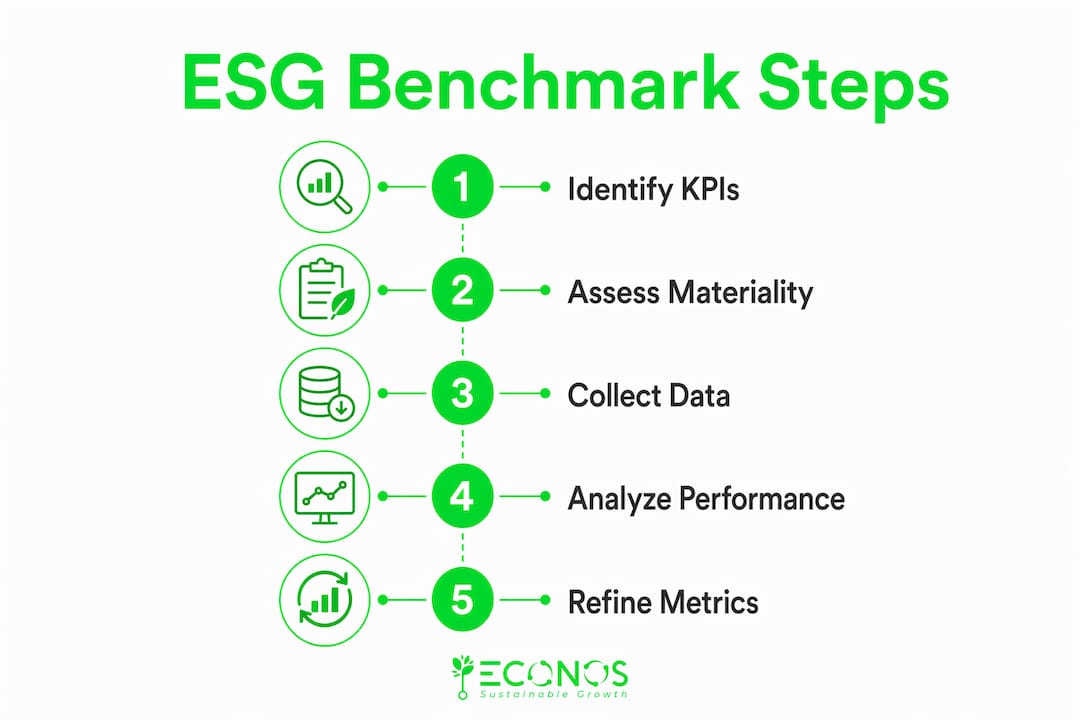
Selecting the right ESG benchmark starts with mapping your material ESG factors. ISSB and SASB both provide sector-specific materiality maps that identify which environmental, social, and governance issues are most likely to affect financial performance in your industry. Start there. A step-by-step materiality assessment will tell you which KPIs belong in your benchmark set and which are noise.
Once you have your KPI list, apply the following steps to build a benchmark that is both compliant and operationally useful:
- Set data coverage minimums. Commit to above 85% data coverage for each material KPI before treating any benchmark comparison as valid. Incomplete data produces misleading results.
- Establish quarterly refresh cycles. Leading companies implement quarterly ESG data refresh cycles rather than relying on annual reporting alone. Quarterly updates let you catch performance drift before it becomes a compliance problem.
- Build one data architecture for multiple frameworks. A single data architecture that satisfies ESRS, ISSB, GRI, and SASB simultaneously reduces duplication and eliminates the risk of inconsistent disclosures across frameworks.
- Separate your disclosure data from your management data. Your CSRD disclosure and your internal performance dashboard should draw from the same source but serve different audiences. Design both from the start.
- Link benchmarks to your ESG transition plan. A benchmark without a target is just a measurement. Connect each KPI to a time-bound improvement target and assign ownership. That is how ESG compliance becomes real value rather than a reporting exercise.
Investing in material ESG management KPIs rather than just meeting disclosure requirements drives better operational performance and deeper sustainability integration. The companies that treat benchmarking as a management tool, not a reporting obligation, are the ones that close the 6% performance gap described earlier.
Pro Tip: Map your KPI architecture to ESRS first if you are CSRD-scope. ESRS has the broadest mandatory reach in Europe. Then check alignment with ISSB and SASB to cover investor-grade disclosure in parallel.
Key takeaways
Effective ESG benchmarking requires material KPIs, reliable data, and a single architecture that serves both compliance and performance management simultaneously.
| Point | Details |
|---|---|
| Materiality drives performance | Companies tracking material ESG KPIs outperform peers by approximately 6% annually. |
| Regulatory benchmarks set the floor | EU Paris-aligned Benchmarks require 50% lower GHG emissions and 7% annual reduction from included companies. |
| Benchmark types serve different purposes | Use sector-specific KPI benchmarks for operations and third-party ratings for external stakeholder communication. |
| Data quality is non-negotiable | Maintain above 85% data coverage per KPI and refresh data quarterly to keep benchmarks actionable. |
| One architecture, multiple frameworks | A unified data structure covering ESRS, ISSB, GRI, and SASB reduces duplication and ensures consistent disclosures. |
Where most companies get ESG benchmarking wrong
I have seen this pattern repeat across industries: a company invests months building an ESG report, discloses against every required indicator, and then cannot answer a basic question from their procurement team about whether their emissions intensity improved year over year. The report exists. The benchmark does not.
The mistake is treating ESG benchmarking as a disclosure task rather than a management discipline. Generic ESG scores from third-party raters feel like performance data, but they are not. They reflect how well you disclosed, not necessarily how well you performed. The companies I have watched make real progress are the ones that build sector-specific KPI sets, track them quarterly, and hold operations teams accountable to the numbers.
The regulatory pressure from CSRD and the EU’s broader sustainable finance agenda is actually helpful here. It forces companies to get specific. Double materiality, ESRS indicators, and PAB thresholds all push in the same direction: toward data that is precise, sector-relevant, and tied to real outcomes. That is the direction every sustainability team should be moving, regardless of whether a regulator is watching.
The honest admission is that most organizations are still in transition. The data infrastructure is incomplete, the KPI sets are too broad, and the link between benchmark performance and management decisions is weak. Acknowledging that gap is the first step toward closing it. The tools and frameworks exist. What is missing, in most cases, is the discipline to apply them consistently.
— Mathieu
How Econos-esg supports your ESG benchmarking work

Econos-esg works with mid-size and large companies to build the data infrastructure and KPI frameworks that make ESG benchmarking real rather than theoretical. From carbon footprint assessment covering Scope 1, 2, and 3 emissions to full ESG reporting under CSRD and ESRS, Econos-esg helps you move from disclosure compliance to performance management. The team also supports EU Taxonomy alignment and EcoVadis preparation, so your benchmark work connects directly to the regulatory and commercial requirements your stakeholders care about most. If you are ready to build a benchmark framework that actually informs decisions, Econos-esg can help you get there.
FAQ
What is an ESG benchmark?
An ESG benchmark is a systematic framework of KPIs used to compare a company’s environmental, social, and governance performance against industry peers and regulatory standards. It gives raw ESG data meaningful context by showing where a company stands relative to sector norms.
How many kpis should an ESG benchmark include?
Industry leaders track 8–12 sector-specific material KPIs per benchmark set, with data coverage above 85% for each. Tracking fewer, more material indicators produces more reliable and actionable results than tracking dozens of loosely relevant metrics.
What is the difference between ESG ratings and ESG benchmarks?
ESG ratings aggregate disclosed data into a single score for investor screening and supply chain qualification. ESG benchmarks compare specific operational KPIs against sector ranges, making them more useful for internal performance management and identifying where to improve.
How do EU paris-aligned benchmarks affect corporate ESG reporting?
EU Paris-aligned Benchmarks require companies included in PAB indices to maintain GHG emissions at least 50% below broad market levels and reduce emissions by a minimum of 7% each year. These thresholds directly influence how institutional investors evaluate corporate ESG performance and capital allocation decisions.
How often should ESG benchmark data be refreshed?
Leading companies refresh their ESG benchmark data quarterly rather than relying solely on annual reporting cycles. Quarterly updates allow sustainability teams to identify performance drift early and make corrections before issues compound into compliance gaps.