

An environmental agreement functions as a sustainability identity card for a project. It is the official document that confirms that an investment, a new factory, a wind farm, or a residential complex has been analyzed and approved from the perspective of its environmental impact. In short, it is the green light certifying that the project is viable and environmentally responsible.
What the environmental agreement means for your business
Far from being a simple formality, the environmental agreement has become a strategic tool. Obtaining it is not only a legal obligation, but also a pillar for risk management, strengthening partner trust, and ensuring long term competitiveness.
In a business context shaped by the green transition, this document becomes an essential condition for:
- Access to financing: Banks and investors increasingly require proof of environmental compliance to grant green loans or finance large scale projects.
- Integration into European value chains: Business partners, especially within the European Union, require suppliers to demonstrate environmental responsibility, and the environmental agreement is a first solid proof.
- Building trust: It demonstrates commitment to local communities and to a sustainable business model, an increasingly important factor for clients and employees.
From obligation to strategic advantage
The permitting process requires a rigorous analysis of all potential impacts, from greenhouse gas emissions and waste management to biodiversity protection. This assessment forces companies to think proactively and integrate sustainable solutions from the design phase, turning a legal requirement into an opportunity to optimize operations.
Moreover, the agreement becomes the foundation for ESG reporting (Environmental, Social, Governance) required by regulations such as the CSRD Directive (Corporate Sustainability Reporting Directive).
A well grounded environmental agreement not only unlocks the building permit, but also validates the business model in the eyes of investors, authorities, and the market. It certifies that environmental risks have been identified, assessed, and are properly managed.
The legal framework and its scope in Romania
The procedure is directly linked to the implementation of European legislation. In Romania, the transposition of the EU Environmental Impact Assessment (EIA) Directive has generated significant regulatory activity.
Official data show that between 2015 and 2023, the National Environmental Protection Agency (ANPM) issued over 45,000 environmental agreements for various projects. Of these, 68 percent included specific carbon emission reduction measures, reflecting alignment with national and European climate objectives. You can find more details on evaluated projects in this report.
Obtaining this document is not optional, but mandatory for projects that may have a significant environmental impact. Neglecting this step leads not only to sanctions, but also to the risk of completely blocking an investment. A correct understanding of this mechanism is a key element of any operational risk management strategy.
What the legal framework looks like today
Navigating environmental legislation may seem complex, but it comes down to a few clear principles. Their purpose is to align economic development with European environmental protection standards.
Current rules are not mere formalities. Understanding them is essential to plan a project strategically and avoid costly blockages that can arise unexpectedly.
The central piece is Law no. 292/2018, which concerns the environmental impact assessment of certain projects. It transposes the European EIA Directive into national law and establishes the procedure through which projects with significant potential impact are analyzed before receiving approval.
Key actors and their roles
To interact effectively with the system, it is vital to know who does what. The process of obtaining an environmental agreement mainly involves two institutions:
- The Environmental Protection Agency (APM): Operating at county level, it is usually the first point of contact. The APM handles the screening stage, deciding whether a project requires a full environmental impact assessment, and issues agreements for projects of local or regional importance.
- The National Environmental Protection Agency (ANPM): The central authority coordinating APM activities. ANPM handles more complex cases, including nationally significant, cross border, or highly technical projects.
Transparent collaboration with these authorities and a complete file are key to a predictable process.
Alignment with European rules
Romanian legislation is not isolated, but directly connected to EU regulations. Beyond the EIA Directive, other concepts are becoming increasingly important in environmental assessment.
Projects evaluated today are no longer judged only by their immediate local impact. Authorities increasingly assess how well a project aligns with EU strategic objectives such as decarbonization, biodiversity protection, and circular economy principles.
What does this mean in practice? The evaluation may include questions such as:
- Contribution to climate objectives: Does the project help reduce greenhouse gas emissions? Does it integrate renewable energy solutions?
- Resource management: Does it promote material reuse or waste minimization? How does it fit into circular economy value chains?
- Impact on biodiversity: Are there clear measures to protect local ecosystems? Are solutions proposed to offset any negative impacts?
New trends in environmental assessment
With the entry into force of regulations such as the CSRD Directive and the EU Taxonomy, transparency standards have increased. Although these rules mainly target corporate reporting, their principles already influence how individual projects are assessed.
A strong environmental agreement file should show that you understand these new directions. For example, justifying a project by aligning it with sustainable economic activity criteria under the EU Taxonomy can become a significant advantage before authorities.
If you want to better understand how these directives connect, you can read more about the changes introduced by the Omnibus Package for CSRD and the EU Taxonomy.
In conclusion, the current legal framework requires a proactive approach. Simply ticking minimum requirements is no longer enough. Success depends on the ability to integrate sustainability into the project’s DNA, demonstrating not only economic viability but also environmental responsibility.
Step by step process to obtain the agreement
Obtaining an environmental agreement may seem like a bureaucratic marathon, but approached strategically, it becomes a predictable process. The key lies in three elements: a clear understanding of the stages, proper documentation preparation, and proactive communication with authorities. It is a process that requires time and anticipation, but secures the long term viability of the project.
This guide breaks down the procedure into simple, actionable steps, from the initial notification to the final decision. Knowing the details of each step helps avoid costly delays.
The diagram below shows how the legislative mechanism works, from a European directive to Romanian law and the authorities that enforce it.
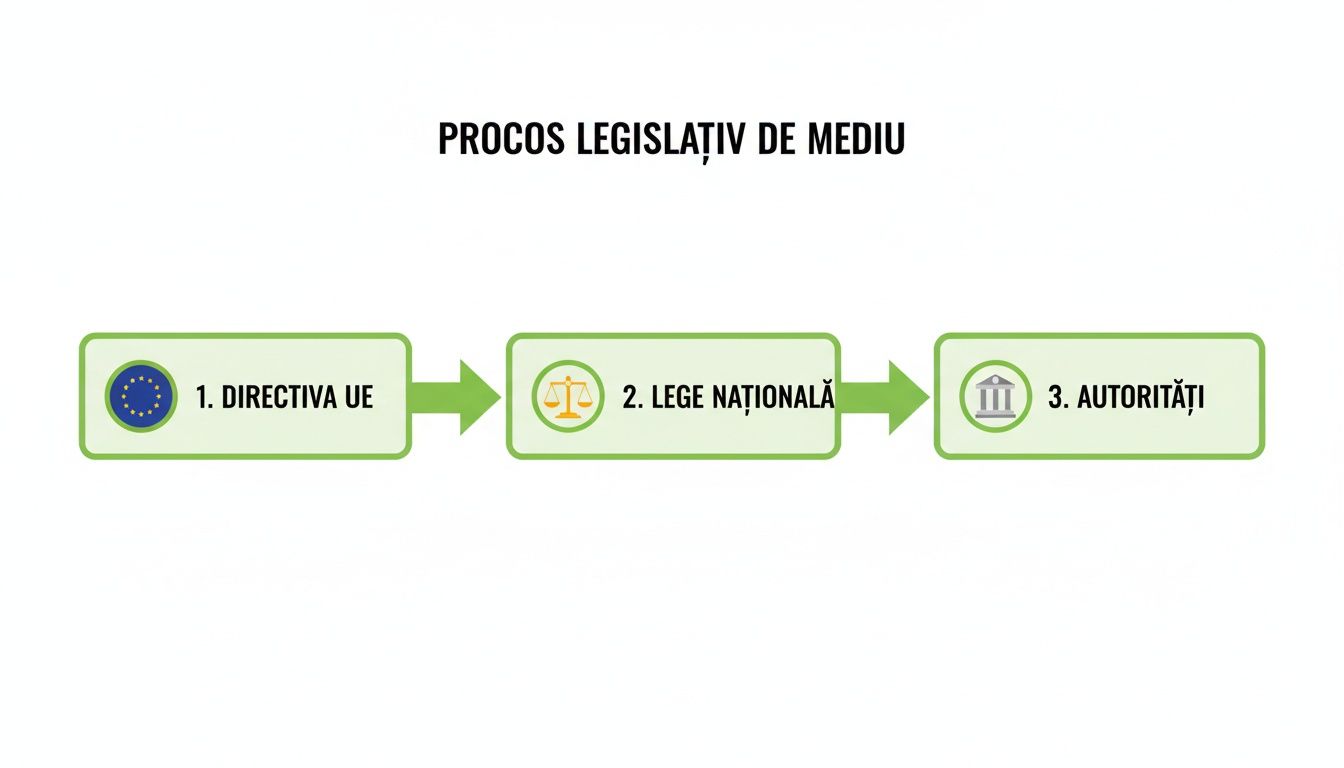
The link between strategic decisions in Brussels and the concrete requirements faced by developers highlights the importance of alignment with European standards.
Stage 1: Notification and project screening
The first step is submitting a notification to the Environmental Protection Agency (APM) in the county where the project will be located. The notification includes basic information: location, project description, and investment size. This officially informs the authority of the intent.
Based on this information, the APM begins the screening stage, a critical moment. The authority decides whether the project requires a full environmental impact assessment or qualifies for a simplified evaluation.
The decision depends on clear criteria:
- Project scale: Area occupied, production capacity, or built volume.
- Location: Proximity to protected natural areas, residential zones, or water sources.
- Nature of impact: Types of emissions, waste generated, or natural resources consumed.
Stage 2: Impact studies
If a full assessment is required, the next step is preparing the Environmental Impact Report (EIR). This is a detailed technical document prepared by certified experts, analyzing all possible effects of the project.
The EIR is not just a list of risks, but a management plan. It must identify, describe, and assess direct and indirect impacts on water, air, soil, biodiversity, and human health. It must also propose concrete measures to prevent, reduce, or compensate negative effects.
A well prepared report is more than a legal obligation. It is a business tool that demonstrates responsibility and supports operational optimization.
Stage 3: Public consultation and transparency
An essential component is public consultation. Once completed, the Environmental Impact Report becomes public. Stakeholders, from citizens and NGOs to other authorities, are invited to submit comments, often including a public debate.
Managing this stage requires transparency and open communication. It is an opportunity to present project benefits and address community concerns constructively. A proactive approach can turn potential conflict into productive dialogue.
Stage 4: Authority analysis and final decision
After public consultation, the complete file is reviewed by the Technical Analysis Committee within the APM. This committee assesses legal compliance and supports the final decision.
Based on its recommendation, the authority issues the decision: granting the environmental agreement, possibly with conditions, rejecting the application, or requesting additional information.
Historical data in Romania show continuous adaptation to European requirements. Over 120,000 agreements were issued between 2010 and 2025, with acceleration after 2019 under the Green Deal. In 2024, verified emissions in regulated sectors fell by 9 percent to 32 million tonnes of CO2, helping around 200 large companies align with standards such as TCFD and IFRS S1 and S2. You can explore more statistics on environmental regulation trends.
Integrating the environmental agreement into ESG strategy

Many companies still view the environmental agreement as a bureaucratic obligation. This view is costly.
In reality, the data and analyses prepared for this file are the foundation of a strong and credible ESG strategy. The agreement should be seen not as a formality, but as a core component of sustainability performance.
From compliance to active strategy
Impact studies, emissions assessments, and waste management plans are not mere annexes. They provide a detailed snapshot of a project’s footprint.
When interpreted correctly, this data becomes a strategic asset, highlighting risks, optimizing processes, and setting clear, measurable sustainability targets well before operations begin.
At ECONOS, we combine permitting with dedicated training so client teams become autonomous in managing sustainability over the long term.
Direct link to European regulations
A well documented agreement not only unlocks the project, but also simplifies alignment with EU regulations.
Examples include:
- CSRD reporting: Emissions, water use, and biodiversity data collected for environmental assessment directly support ESRS reporting, simplifying audits.
- EU Taxonomy alignment: Demonstrating substantial contribution and DNSH is supported by the impact study.
- CBAM risk management: For sectors like cement, steel, or aluminum, carbon assessments prepared for the agreement are the first step in estimating CBAM obligations and planning decarbonization investments.
Consider a construction materials manufacturer.
The classic scenario: The company obtains the environmental permit, archives it, and starts production. Emissions are managed strictly to remain within legal limits.
The strategic scenario: The company uses data from the impact assessment study to set clear emission reduction targets. It identifies energy efficiency opportunities and, using the environmental permit as evidence, accesses a green financing line. Later, it uses the same data to prepare a sustainability report aligned with CSRD.
This shift in perspective transforms a compliance cost into an investment in resilience. The environmental permit plays a central role in ESG reporting, an area in which Romania has seen a 150% increase in requests for environmental approvals between 2020 and 2025, from 3,200 to 8,000 annually.
This surge reflects CBAM pressure on importers and producers, with 25% of Romanian industrial emissions linked to exposed sectors (steel, cement), estimating additional costs of 500 million euros from 2026 if decarbonization does not occur.
Therefore, integrating data from the permitting process into the sustainability strategy is no longer an option. It has become a necessity for any company that wants to thrive in the green economy.
Frequent mistakes to avoid in the permitting process
Obtaining an environmental permit is a rigorous process where details make the difference. From our team’s experience, we often see companies stumble over the same pitfalls, turning a predictable procedure into a source of stress and unexpected costs.
Avoiding these mistakes is a strategic necessity to keep a project on schedule and within budget. Let us look at the most common errors and how to prevent them.
Underestimating the required timeframe
The biggest trap is believing that obtaining an environmental permit is a simple formality. In reality, the process can take between 6 and 12 months, sometimes even longer for complex projects that require an Environmental Impact Assessment Report (EIA).
Practical solution: Start the process at least 9 to 12 months before the date when you need the building permit. Realistic planning provides a safety margin for any additional information requested by authorities.
Incomplete or superficial documentation
A file with missing documents, unclear data, or superficially prepared impact studies is a guaranteed recipe for delays. Environmental authorities will return the file for completion, and each review cycle adds weeks or months to the final timeline.
An initial investment in specialized consultancy to prepare a complete file can prevent much higher costs generated by delays, fines, or, in the worst case, project blockage.
Ignoring the public consultation stage
Many companies treat public consultation as a simple box-ticking exercise, without preparing for real dialogue. Poor communication can generate opposition, objections, and can complicate the approval process.
Practical solution: Approach this stage proactively.
Transparency: Publish clear, easy-to-understand information about the project.
Dialogue: Organize meetings with local community representatives and NGOs to listen to their concerns and provide answers.
Constructive approach: Use the feedback received to improve the project. An open approach can turn critics into supporters.
Unrealistic budgeting of costs
The costs of an environmental permit are not limited to administrative fees. They include expert fees, laboratory analysis costs, and potentially expenses for implementing required environmental measures. Underestimating them puts pressure on the project budget.
How much does six months of delay cost for a major project due to an incomplete file? Beyond direct costs, opportunity losses and the cost of tied-up capital can far exceed the initial investment in proper preparation.
Misunderstanding long-term responsibility
Obtaining the permit is not the finish line. The document includes conditions and obligations that must be respected throughout the entire life of the project. Ignoring them can lead to inspections, sanctions, or even suspension of activity.
Practical solution: Monitoring plan: Create an internal plan to track and document compliance with imposed conditions.
Responsibility: Appoint a person or team responsible for monitoring environmental compliance.
Reporting: Ensure that periodic reporting to authorities is carried out correctly and on time.
By anticipating these mistakes, the permitting process becomes a risk management exercise, not an obstacle. A structured approach ensures not only legal compliance, but also the foundation of a sustainable project.
The future of environmental regulations and how to prepare
Obtaining an environmental permit is the starting point, not the finish line. The world of environmental regulation is changing rapidly, and the direction is clear: sustainability will be integrated more deeply into every business decision. Remaining relevant no longer means reacting to change, but anticipating it.
Tomorrow’s compliance framework will assess the entire life cycle of a product, from raw material to end of use.
Key trends shaping the future
The business world is moving toward greater transparency, and this will be reflected in how projects are evaluated. To be prepared, we must track several major trends emerging at European level.
These are not abstract concepts, but realities that will dictate costs, operations, and access to financing.
Three main directions are emerging:
The circular economy becomes the new normal: The focus will shift to projects that minimize waste and encourage material reuse. Environmental assessments will increasingly penalize linear models of extract-produce-dispose.
Biodiversity moves to the center of attention: Beyond traditional impacts, protecting and restoring biodiversity becomes essential criteria. Projects will need to demonstrate a net positive or neutral impact on ecosystems.
Whole value chain analysis: Evaluation will no longer stop at the factory gate. Authorities will want to understand upstream (suppliers) and downstream (distribution, use) impacts. This is a consequence of the principles behind regulations such as CSRD or CSDDD (Corporate Sustainability Due Diligence Directive).
Future environmental assessments will operate on the principle of double materiality, a concept from sustainability reporting (CSRD). It will matter not only how the project impacts the environment (impact materiality), but also how climate change affects the financial viability of the project (financial materiality).
Practical steps to stay ahead
Waiting for new rules to become law is a risky strategy. Companies that will thrive are those that act proactively. Adaptation does not have to be overwhelming if approached strategically.
The question every company leader should ask is: “Do we have the systems needed to measure and manage what will be required tomorrow?”
Here are three concrete actions that can start today:
Invest in data collection systems: Build solid infrastructure to collect granular data on resource consumption, emissions (including Scope 3), and waste management. These data are vital for future permitting files and ESG reporting.
Develop internal capabilities: Regulations are becoming increasingly complex. Invest in specialized training for environmental, legal, and operations teams. Building internal autonomy reduces reliance on consultants and ensures more agile management.
Build strategic partnerships: Start collaborating with suppliers to obtain data on their carbon footprint. Engage in partnerships with circular economy or biodiversity experts. The complexity of future requirements will make collaboration indispensable.
Ultimately, adapting to new regulations is not just an obligation. It is an opportunity to innovate, optimize costs, and build a more robust business model.
Frequently asked questions about the environmental permit
To clarify the most common uncertainties, we have gathered here direct answers to questions we frequently hear in discussions with our partners. We cover practical aspects, from validity to consequences and the need for specialized consultancy.
How long is an environmental permit valid?
An environmental permit is valid for the entire period during which the project is carried out, until completion of works.
There is one essential condition: if investment works do not begin within 5 years from the issuance date, the permit loses its validity. After project completion, there is an obligation to notify the competent environmental authority within 60 days.
What are the consequences if I carry out a project without an environmental permit?
Carrying out a project without an environmental permit, when required by law, is a serious offense with significant consequences.
This includes substantial fines, between 30,000 and 60,000 lei for legal entities. More importantly, authorities may order the immediate cessation of works and even demolition of illegally built structures. This means massive financial losses and reputational risks.
Is specialized consultancy necessary to obtain it?
In theory, the process can be managed internally. In practice, specialized consultancy is almost always a wise decision.
Legislation is complex, and technical documentation, especially an Environmental Impact Assessment Report, requires in-depth expertise. An experienced consultant knows how to navigate the process efficiently, reduce the risk of delays or rejections, and transform an environmental obligation into a strategic component of the sustainability plan.
A consultant does not just complete a file; they transform a compliance obligation into a strategic process, ensuring the project is not only authorized, but also aligned with ESG requirements and future-ready.
Managing environmental compliance and integrating it into ESG strategy requires expertise and a structured approach. ECONOS offers comprehensive services, from permitting to reporting and decarbonization, to ensure your projects are resilient and competitive. Find out how we can support you.